
 Worksheets
HONORS Unit 5 Solutions
Total questions: 160
Worksheet time: 4hrs 47mins
Solid or liquid that is being dissolved? (a)
solute
solvent
solution
solubility
When no more solute will dissolve in solution and has reached maximum. The rest settles to the bottom of container?
Solubility
Super Saturated
Saturated
Unsaturated
Molarity is defined as ______ per _____.
grams solvent, mols solute
liters solution, mols solute
mols of solvent, liters solute
mols solute, liters solvent
A solution not in equilibrium with a given dissolved substance in which more solute can be added.
saturated
unsaturated
super saturated
solvent
A student is preparing solutions for a laboratory experiment by dissolving solid solutes in liquid solvents. Which action will increase the rate of solubility?
lowering the temperature of the solvent
stirring the solute in the solution
increasing the pressure on the solution
increasing the particle size of the solute
Which of the following types of solutions has more room to dissolve solute?
supersaturated
saturated
unsaturated
True or False? The higher the concentration of a solution the less solutes it has in it.
True
False
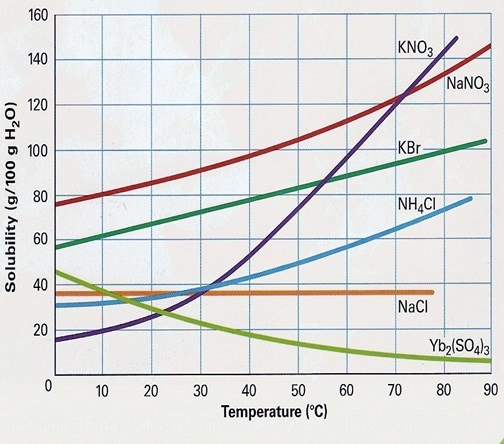
Identify how many grams of KNO3 is required to make a saturated solution at 40'C.
50 g
45 g
55 g
33 g

Which solute does not increase in solubility as temperature rises?
NH3
NaNO3
KNO3
NaCl

When 40 grams of NaCl is dissolved in 100 grams of water at 90 ºC, the solution can be correctly described as:
supersaturated
saturated
unsaturated

How many grams are soluble in 100 g of water at 100 ºC?
300 grams
250 grams
100 grams
50 grams
What does it mean to dilute a solution?
lower the concentration of solute per solvent
increase the concentration of solute per solvent

Which gas is the most soluble at 20 oC?
Helium
Nitrogen
Carbon dioxide
oxygen
methane
In the expression “like dissolves like,” the word “like” refers to similarity in what?
size
polarity
energy
mass
As temperature increases, solubility of a solid in a liquid
increases
decreases
stays the same
can increase or decrease
As temperature increases, solubility of a gas in a liquid
increases
decreases
stays the same
can increase or decrease
Which gas is the least soluble at 20 oC?
Helium
Nitrogen
Carbon dioxide
oxygen
methane
The van't Hoff factor represents
how much degrees C the temperature will be lowered from freezing
how much degrees C the temperature will be raised from boiling
how many atoms a compound has
the amount of particles which dissociate in an ideal conditions
When CaBr2 is dissolved in water, how many particles will be in solution?
1
2
3
4
5
When CH3OH is dissolved in water, how many particles are in solution?
1
3
4
5
6
Colligative properties depend on the _____ of solute particles in solution.
type
number
pH
nature
The freezing point of a solution is ____ the freezing point of the pure solvent.
the same as
lower than
higher than
no relation to
The boiling point of a solution is ______ the boiling point of the pure solvent.
higher than
the same as
lower than
higher or lower than
The vapor pressure of a pure solvent is ___________ that of a solution
more than
less than
equal to
Which of the following solutions will have the lowest freezing point? (Hint: who makes the most particles when dissolved?)
1.0 M C12H22O11
1.0 M LiCl
1.0 M Na3P
1.0 M MgF2

Which one of the following diagrams has the lowest vapor pressure?
1
2
3
4
5
Compared to the freezing point of 1.0 M KCl(aq) at standard pressure, the freezing point of 1.0 M CaCl2(aq) at standard pressure is
lower
higher
the same

The table above gives information about four aqueous solutions at standard pressure.
Which list of solutions is arranged in order from highest boiling point to lowest boiling point?
A, B, D, C
A, C, B, D
C, D, B, A
D, B, C, A
Colligative properties depend on the _________ of the solute but not the __________ of the solute.
concentration; identity
identity; concentration
reactivity; nature
nature; reactivity
____________ is the process whereby particles of a solvent completely surround the particles of a solute, disperse them throughout the solvent particles, and hold them in solution.
solvation
immisciblation
dissolution
saturation
Which of these is NOT a factor that affects solvation?
agitation/stirring
increasing temperature
increasing surface area
adding dye
a solution that holds more dissolved solute than is required to reach equilibrium at a given temperature
supersaturated solution
saturated solution
unsaturated solution
suspension
dissolution
solution that contains a mixture of a solute and solvent
cohesion
due to the strong bonds of water molecules
adhesion
surfaces of objects are attracted to water
polar
opposite charged ends of a molecule
saturation
amount of solute that can be dissolved in solution
Which would NOT increase the rate at which a sugar cube dissolves?
Reducing the amount of solvent
Crushing the sugar cube
Stirring the solution
Heating the solvent

Three 10 g samples of sugar are represented below.
Sample A dissolves in water more slowly than sample B.
Sample B dissolves more slowly than sample C.
Which of the following best explains why sample A dissolves more slowly than the other two?
It has the most volume.
It has the smallest surface area.
It has the largest number of sugar molecules.
It has the fewest bonds between sugar modules.
A technican prepared a solution by heating 100 mL of distilled water while adding KCl crystals until no more KCl would dissolve. She then capped the clear solution and set it aside on the lab counter. After several hours she noticed the solution had become cloudly and some solid had settled to the bottom of the flask. Which statement best describes what happened?
As the solution cooled, evaporation of water increased the KCl concentration beyond its solubility.
Water molecules, trapped with the KCl crystals, were released after heating.
At lower temperatures the solubility of KCl decreased and recrystallization occurred.
At increased temperatures the solubility of KCl increased and remained too high after cooling.
Which would cause the vapor pressure of a solvent to decrease?
heating
Adding a more volatile solute
Adding a less volatile solute
reducing the volume of the solvent
How do we define a solute?
Usually a liquid, in which other materials dissolve to form a solution
A substance that is dissolved in a solution
A substance with sulfur in it
When a solution contains a mixture of two substances
amount of solute in a given amount of solvent
concentration
saturated
solution
suspension
As you put in more solute in the solution, the concentration of the solution will...
increase
decrease
stay the same
____________ is the process where particles of a solvent completely surround the particles of a solute.
solvation
immisciblation
dissolution
saturation
Which of these is NOT a factor that affects solvation?
agitation/stirring
increasing temperature
increasing surface area
adding dye
A 'dilute' solution is a solution with a _____ concentration
high or strong
normal
low or weak
Solvation will happen if the attractive forces between the solute and solvent particles are stronger than the individual forces inside the solute and solvent themselves.
True
False
Which of these would be most likely to decrease the rate of solvation?
stirring or shaking
breaking the solute into smaller pieces
lowering the temperature
increasing the temperature
The overall energy change that occurs during the solution formation process is called the
Endothermic change
Exothermic change
Heat of solution
Attractive energy change
What is the most common liquid solvent in Chemistry?
Oil
Water
Hydrochloric Acid
Sodium Chloride
Chloroform (CHCl3) and water
Soluble (miscible)
Insoluble (immiscible)
Partially soluble
Octane (C8H18) and water
Soluble (miscible)
Insoluble (immiscible)
Partially soluble
Ethanol (CH3CH2OH) and water
Soluble (miscible)
Insoluble (immiscible)
Partially soluble
Butanol (C4H9OH) in methanol (CH3OH)
Soluble (miscible)
Insoluble (immiscible)
Partially soluble
Diethyl ether (CH3OCH3) in water
Soluble (miscible)
Insoluble (immiscible)
Partially soluble
Methanol (CH3COH) in pentane (C5H12)
Soluble (miscible)
Insoluble (immiscible)
Partially soluble
Sodium chloride in water
Soluble (miscible)
Insoluble (immiscible)
Partially soluble
Sodium chloride in ethanol (CH3CH2OH)
Soluble (miscible)
Insoluble (immiscible)
Partially soluble
Sodium chloride in acetone (CH3COCH3)
Soluble (miscible)
Insoluble (immiscible)
Partially soluble
Sodium chloride in hexane (C6H14)
Soluble (miscible)
Insoluble (immiscible)
Partially soluble
Toluene (C6H5CH3) in chloroform (CHCl3)
Soluble (miscible)
Insoluble (immiscible)
Partially soluble
Toluene (C6H5CH3) in water
Soluble (miscible)
Insoluble (immiscible)
Partially soluble
Toluene (C6H5CH3) in hexane (C6H14)
Soluble (miscible)
Insoluble (immiscible)
Partially soluble
Hydrogen peroxide (H2O2) in ethanol (CH3CH2OH)
Soluble (miscible)
Insoluble (immiscible)
Partially soluble
Hydrogen peroxide (H2O2) in water
Soluble (miscible)
Insoluble (immiscible)
Partially soluble
Hydrogen peroxide (H2O2) in hexane (C6H14)
Soluble (miscible)
Insoluble (immiscible)
Partially soluble
Napthalene (C10H8) in water
Soluble (miscible)
Insoluble (immiscible)
Partially soluble
Sodium hydroxide (NaOH) in water
Soluble (miscible)
Insoluble (immiscible)
Partially soluble
Sodium hydroxide (NaOH) in chloroform (CHCl3)
Soluble (miscible)
Insoluble (immiscible)
Partially soluble
Sodium hydroxide (NaOH) in methanol (CH3OH)
Soluble (miscible)
Insoluble (immiscible)
Partially soluble
Which of the following types of solutions has more room to dissolve solute?
supersaturated
saturated
unsaturated
When calculating molality, Kg of the following are included in the calculation?
solvent
solute
none of these
solvent & solute
Which solution has the highest boiling point at standard pressure?
0.10 M KCl(aq)
0.10 M K2SO4(aq)
0.10 M K3PO4(aq)
0.10 M KNO3(aq)
How do the boiling point and freezing point of a solution of water and calcium chloride at standard pressure compare to the boiling point and freezing point of water at standard pressure?
Both the freezing point and boiling point of the solution are higher.
Both the freezing point and boiling point of the solution are lower.
The freezing point of the solution is higher and the boiling point of the solution is lower.
The freezing point of the solution is lower and the boiling point of the solution is higher.
Compared to a 2.0 M aqueous solution of NaCl at 1 atmosphere, a 3.0 M aqueous solution of NaCl at 1 atmosphere has a
lower boiling point and a higher freezing point
lower boiling point and a lower freezing point
higher boiling point and a higher freezing point
higher boiling point and a lower freezing point
At standard pressure when NaCl is added to water, the solution will have a
higher freezing point and a lower boiling point than water
higher freezing point and a higher boiling point than water
lower freezing point and a higher boiling point than water
lower freezing point and a lower boiling point than water
Which solution will freeze at the lowest temperature?
1 mole of sugar in 500 g of water
1 mole of sugar in 1,000 g of water
2 moles of sugar in 500 g of water
2 moles of sugar in 1,000 g of water
Colligative properties depend on the (a) of the solute but not the (b) of the solute.
Which of the following compounds will be most effective in melting the ice on the roads when the air temperature is below zero?
sodium iodide (NaI)
magnesium sulfate (MgSO4)
potassium bromide (KBr)
all will be equally effective
Solute
The part of the solution that is being dissolved
Solvent
The part of the solution that is dissolving
Dilute
Contains more solvent than solute
Concentrate
Contains more solute than solvent
What was one surprising experimental result of the photoelectric effect?
The number of ejected electrons is independent of light intensity.
The kinetic energy of ejected electrons is independent of light frequency.
The photoelectric effect occurs only with visible light.
The kinetic energy of ejected electrons is independent of light intensity.
Which property of light affects the kinetic energy of ejected electrons in the photoelectric effect?
Intensity
Wavelength
Frequency
Amplitude
How quickly does the photoelectric effect occur when light is shone on a metal?
Delayed by seconds
Delayed by minutes
Instantaneous
Delayed by hours
What happens when the frequency of light is increased in the photoelectric effect?
The number of ejected electrons increases.
The intensity of light increases.
The wavelength of light increases.
The kinetic energy of ejected electrons increases.
What was the classical theory of light before the discovery of the photoelectric effect?
Light is a stream of particles.
Light is a sound wave.
Light is a gravitational wave.
Light is an electromagnetic wave.
What concept did the photoelectric effect help to establish?
Classical wave theory
Newtonian mechanics
Quantum nature of light
General relativity
What happens if the frequency of light is below the threshold frequency in the photoelectric effect?
No photoelectric effect occurs below the threshold intensity.
No photoelectric effect occurs below the threshold frequency.
The photoelectric effect occurs with reduced intensity.
The photoelectric effect occurs with increased intensity.
What is a historical fact about the discovery of the photoelectric effect?
The photoelectric effect was discovered before electrons were discovered.
The photoelectric effect was discovered after electrons were discovered.
The photoelectric effect was discovered at the same time as electrons.
The photoelectric effect was discovered by the same person who discovered electrons.
A particle of light is called a...
Photoelectron
Photon
Proton
Electron
The only way to increase the number of photoelectrons emitted is by increasing the _________ of the light
Intensity
Wavelength
Frequency
Energy
What color of light has the greatest energy per photon?
Red
Green
Blue
Violet


The energy in joules of a photon of wavelength 355 nm is
5.596 x 10¹⁹ J
5.596 x 1028 J
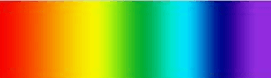
A beam of light has a wavelength of 600 nm in air. What is the frequency of the light (c = 3x10⁸ m/s)?
5 x 10¹⁴ Hz
2 x 10¹⁴ Hz
3 x 10¹⁴ Hz
6 x 10¹⁴ Hz
C = λν
If an AM radio station broadcasts at
9.95 x 10⁵ Hz, what is the wavelength of this radiation?
Which of the following is the relationship between Absorbance and the Transmission of light?
A= antilog of - %T
A= - log T
A= log 100/ T
A= -log 1/ T

A student finds the percent transmittance and the absorbance of the 0.10 M solution at different wavelengths. She creates the two graphs below. What is the optimum wavelength for analysis?
600 nm
400 nm
510 nm
440 nm
What is the unit of absorbance which can be derived from Beer Lambert’s law?
L mol-1 cm-1
L gm-1 cm-1
Cm
No unit
How do we make a dilution?
Add more solute
Remove solute
Remove solvent
Add more solvent

Which of the following statements is correct??
Spectrophotometry allows for a correlation to be made between samples
Spectrophotometry allows for a correlation to be made between patient absorbance
Spectrophotometry allows for a correlation to be made between absorbance and concentration
Spectrophotometry allows for a correlation to be made between the concentration of each sample

What passes through your sample to give you an absorbance reading?
Water
Blank solution
Biuret
Light
A spectrophotometer uses _______________ of a certain wavelength to determine the ________________ of a solution.
water, color
air, width
compounds, density
light, concentration
The equation for Beer's law is ......
M1V1 = M2V2
A = bcd
E = mc2
A = Ebc
The relationship between concentration and absorbance in Beer's law is .......
direct
inverse
exponential
unknown
Which of the following is not in the Beer's Law equation?
molar absorptivity
cell path length
light wavelength
concentration
What would happen if we use the wrong wavelength?
there will be little to no absorbance
there will be little to medium absorbance
there will be medium to high absorbance
None of the Above

A
B
A&B
None of the above

Which of the options represent complementary colors?
Blue and Orange
Yellow and Green
Purple and Orange
Yellow and Red
A an outlier is found below the straight line graph of absorbance vs. concentration data. What could have caused this outlier?
a fingerprint on cuvette
drops water not removed from cuvette before adding new solution
excess of compounds is used to solution
Why is it generally preferable to use absorbance as a measure of absorption rather than % Transmittance?
Because %T cannot be measured as accurately as absorbance
Because %T is dependant on the power of the incident radiation
Because absorbance is proportional to the concentration of the analyte, whereas %T is not.
If light passes through water, what will be the %T?
50%
20%
100%
0%
The higher the % Transmittance (%T) the lower the Absorbance (A) of the sample
True
False
CuCl2(aq) + NaOH(aq) → Cu(OH)2(s) + NaCl(aq)
Which of the following shows the correct net ionic equation for the reaction of Ba(MnO4)2(aq) + (NH4)2SO4?
Ba2+ + SO42- --> BaSO4
2NH4+ + 2MnO4- --> 2NH4MnO4
Ba + MnO4- --> Ba(MnO4)2
2MnO4- + SO42- --> BaSO4
Which of the following shows the correct net ionic equation for Fe(NO3)2 + KOH
Fe3+ + OH- --> Fe(OH)3
Fe2+ + OH- --> Fe(OH)2
2NO3- + 2K+ --> 2KNO3
Fe2+ + 2OH- --> Fe(OH)2

Which diagram best illustrates the ion-molecule attractions that occur when the ions of NaCl(s) are added to water?
1
2
3
4
A solid substance was tested in the laboratory. The test results are listed below.
• dissolves in water
• is an electrolyte
• melts at a high temperature
Based on these results, the solid substance could be
Cu
CuBr2
C
C6H12O6
A substance that conducts an electrical current when dissolved in water is called
catalyst
metalloid
electrolyte
nonelectrolyte
What happens when C12H22O11(s) is dissolved in water?
O-2 ions are attracted to the oxygen atoms of the water
O-2 ions are attracted to the hydrogen atoms of the water
H+ ions are attracted to the hydrogen atoms of the water
No attractions are involved, the crystal just falls apart
Which of the following is not an electrolyte?
KBr
LiOH
RbNO3
CH4
What is a Net Ionic Equation?
a balanced chemical equation in which all the reactants and products are given by their chemical formulae.
a chemical equation that shows all soluble species broken into their respective ions.
a chemical equation showing only the species which are actively involved in the reaction.
Which term refers this chemical equation describing potassium chloride in water?
KCl(s) → K+(aq) + Cl-(aq)
dissociation
precipitation
displacement
synthesis
Solid copper(II) chloride
Electrolyte
Non-electrolyte
Copper(II) sulphate solution
Electrolyte
Non-electrolyte
Hydrochloric acid
Electrolyte
Non-electrolyte
Identify the complete ionic reaction for products of this reaction: (final answer is not balanced)
HCl + Mg(OH)2 →
→ MgCl2 + H2O(l)
→ Mg2+ + Cl-1 + H2O(l)
→ Mg2+ + Cl-1 + H+1 + O2-
→ MgCl2 + H2O(l) + CO2(g)
KMnO4

This beaker represents
complete dissociation
incomplete dissociation
no dissociation
A pure substance
This beaker represents a __________ electrolyte.
strong
weak
non-

This beaker represents a __________ electrolyte.
strong
weak
non-
This beaker represents
complete dissociation
incomplete dissociation
no
The H3O+, OH-, and 3 HOH represent
Water's autoionization
an insoluble solution
a solute

This beaker represents
complete dissociation
incomplete dissociation
no
This beaker shows a __________ electrolyte
strong
weak
non-
What determines whether a polar molecule will be ionized in a polar solvent?
the attraction of the polar solvent is stronger than the covalent bond in the solute
the attraction of the polar solvent is weaker than the covalent bond in the solute
only non-polar molecules are ionized
molecular compounds are never ionized
If an electrical current can run through a solution, it is said to contain
magic
spectator ions
electricity
electrolytes
How many moles of ions are produced when 1 mol of magnesium chlorate are dissolved in water?
1 moles of ions
2 moles of ions
3 moles of ions
4 moles of ions
What makes a solution a WEAK electrolyte?
When the solute completely ionizes in water.
When the solute doesn't dissolve in water.
When the solute partially ionizes in water.
When the solute is not added to the water.
What is a nonelectrolyte?
A substance that dissolves in water and produces ions.
A substance that dissolves in water but doesn't produce ions.
A substance that doesn't dissolve in water.
A substance that vaporizes at room temperature.

Four chemical solutions are shown above. Which of the following solutions would correspond to a weak electrolyte?
IV
III
II
I and II
What allows us to know when the end point has been reached?
Bubbles
Feels warm
indicator changing color
Turns to a solid
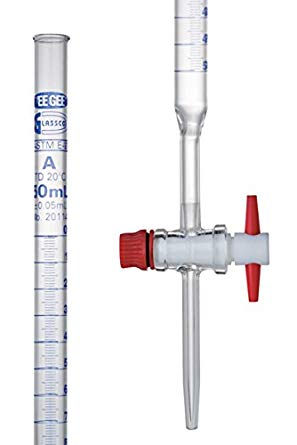
What is this piece of apparatus called
Pipette
Burette
Janette
Cuvette
Why do we perform a titration?
To determine the concentration of an unknown solution
To see if a reaction will occur between an acid and base
To find the mass of an unknown acid
To find the molar mass of an unknown solution
To calculate the viscosity of the solution
What are some things we will need for a titration?
A solution of known concnetration
A burette
indicator
mass balance
a bunsen burner
If it takes 54 mL of 0.1 M NaOH to neutralize 125 mL of an HCl solution, what is the concentration of the HCl? (record you answer with the correct unit)
0.043 M
0.034 M
0.065 M
0.77 M
A 25.0 mL sample of HCl was titrated to the endpoint with 15.0 mL of 2.0 M NaOH. What is the molarity of HCl?
1.6 M HCl
0.03 M HCl
0.6 M HCl
1.2 M HCl
A(n) (a) is a procedure in which a solution of known concentration is used to determine the concentration of an unknown solution.

Buret 1: What is the volume in mL of this buret?
(a)
A 0.125L solution of NaOH is neutralized by 0.0425L of a 0.65 M H2SO4 solution. What is the concentration of the NaOH solution?
0.1 M
1.6 M
0.44 M
None of the above
What is an equivalence point?
It is the point when enough analyte has been added.
It is the point when the amount of added titrant is equal to the amount of analyte in the solution.
It is the point when the volume of titrant is equivalent the volume of analyte.
It is the point when the concentration of titrant added is equivalent to the volume of analyte.

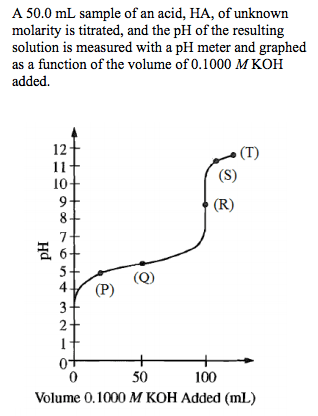
Which point on the titration curve corresponds to the point at which the moles of the added strong base are equal to the moles of the weak acid initially present?
Q
R
S
T

