wayground logo

Free Printable Worksheets

Font size

S
M
L
XL
Worksheets

Gen MidTerm Review Practice

Total questions: 162

Worksheet time: 4hrs 38mins

Name
Class
Date
1.

What does the Conservation of Mass mean?

a)

Mass cannot be created or destroyed, only transformed.

b)

Mass cannot be transformed.

c)

You can only create as much mass as you destroy.

2.
What is anything that has mass and takes up space?
a)
atom
b)
matter
c)
molecule
d)
physical property
3.
What is a characteristic of matter that can be measured or observed without changing matter into something new?
a)
matter
b)
molecule
c)
physical property
d)
states of matter
4.
Which item is not made of matter?
a)
air
b)
water
c)
a pencil
d)
a shadow
5.
What is the small particle that is the building block of all matter?
a)
mass
b)
atom
c)
molecule 
d)
electron 
6.
A substance made of only one type of atom.
a)
molecule 
b)
compound 
c)
element 
d)
proton
7.
_________________ are the elements and compounds that react, or you start with, in a chemical reaction. 
a)
Polymers
b)
Bonds
c)
Reactants
d)
Products
8.
Which of the following could indicate a chemical change? 
a)
All of the answers could indicate Chemical Change 
b)
a color change has occurred 
c)
bubbles appear 
d)
creation of one or more new chemical products 
9.
 Which is NOT an example of chemical change?
a)
production of gas.
b)
change in color.
c)
change in size.
d)
transfer of energy.
10.
A copper penny turning greenish after a few years is an example of...
a)
Chemical Change
b)
Physical Change
11.
My symbol is K. What is my name?
a)
Krypton
b)
Potassium
c)
Chromium
d)
Does not exist
12.

Chemical equations are used to describe

a)

changes in state

b)

Chemical changes

c)

chemical properties

13.

Color change, odor change, and bubbles are signs that a ________ might have occurred.

a)

energy change

b)

physical change

c)

chemical change

14.

matter in which individual substances are not evenly mixed

a)

element

b)

compound

c)

homogeneous mixture

d)

heterogeneous mixture

15.

matter containing atoms of two or more elements chemically bonded together

a)

element

b)

compound

c)

homogeneous mixture

d)

heterogeneous mixture

16.

element in which substances are evenly mixed but not chemically bonded

a)

element

b)

compound

c)

homogeneous mixture

d)

heterogeneous mixture

17.

Characteristics of matter that can be observed without changing the identity of the matter

a)

Chemical properties

b)

chemical changes

c)

physical properties

d)

physical changes

18.

which are examples of physical properties

a)

melting point

b)

freezing point

c)

ability to burn

d)

density

19.

Which is an example of a chemical property?

a)

ability to burn

b)

boiling point

c)

melting point

d)

dissolving

20.
Which of the following is NOT made of matter?
a)
you
b)
your phone
c)
light
d)
backpack
21.
Oxygen is an example of 
a)
an element.
b)
a compound.
c)
a substance.
d)
a mixture.
22.
Which of the following is an example of a compound?
a)
sugar
b)
hydrogen
c)
boron
d)
apple juice
23.
How many sig figs are there?
100.00
a)
1
b)
3
c)
4
d)
5
24.
How many sig figs are there?
100000000
a)
1
b)
9
c)
10
25.
How many sig figs are there?
4004
a)
1
b)
2
c)
3
d)
4
26.
How many sig figs are there?
0.000008
a)
1
b)
2
c)
6
d)
7
27.
How many sig figs are there?
0.00400
a)
1
b)
3
c)
5
d)
6
28.
How many sig figs are there?
9009.00
a)
2
b)
4
c)
5
d)
6
29.
How many sig figs are there?
0.0009009090000
a)
3
b)
10
c)
14
30.
How many Significant Figures in the number below?
4.56 x 10³
a)
5
b)
4
c)
6
d)
3
31.
Round 0.010229 to four sig figs
a)
1022
b)
1023
c)
0.01023
d)
0.01022
32.
How would you write 564,000,000 in scientific notation?
a)
5.64 x 10⁻⁷
b)
5.64 x 10⁶
c)
5.64 x 10⁸
d)
56.4 x 10⁷
33.
How do you write
1001
in scientific notation?
a)
1.0001 x 10⁴
b)
1.01 x 10⁵
c)
1.001 x 10³
d)
10.1 x 10³
34.

Express the following in scientific notation:

0.000457

a)

457 x 106

b)

457 x 10-6

c)

4.57 x10⁴

d)

4.57 x 10⁻⁴

35.
How would you write -5.6 x 10⁻³ in standard form?
a)
0.0056
b)
-5,600
c)
0.00056
d)
-0.0056
36.
How would you write 4.3756 x 10in standard form?
a)
437,560,000
b)
0.00043756
c)
43,756
d)
4,3756
37.
What is the formula for density?
a)
density = mass x volume
b)
density = mass / volume
c)
density = mass + volume
d)
density = mass - volume
38.
Frank has an eraser. It has a mass of 4 g, and a volume of 2 cm3. What is its density?
a)
8 g/cm3
b)
2 g/cm3
c)
1/2 g/cm3
d)
24 g/cm3
39.
What is the measurement using the correct number of sig. figs.?
a)
39.5 mL
b)
40 mL
c)
39 mL
d)
40.0 mL
40.
What is the measurement using the correct number of sig. figs.?
a)
8.5mL
b)
8.50mL
c)
8.45mL
d)
8.4mL
41.
What is the measurement using the correct number of sig. figs.?
a)
89cm
b)
88.9cm
c)
88.90cm
d)
88cm
42.
A testable statement about the natural world that can be used to build more complex inferences and explanations. To be a hypothesis, a statement must contain a possible explanation.
a)
Fact
b)
Theory
c)
Law
d)
Hypothesis
43.

Which SI unit is used to measure length?

a)

mol

b)

m

c)

kg

d)

m2

44.

Which SI unit is used to measure mass?

a)

s

b)

m

c)

kg

d)

Pa

45.

Which SI unit is used to measure time?

a)

K

b)

s

c)

mol

d)

N

46.

Which SI unit is used to measure amount of a substance?

a)

K

b)

kg

c)

mol

d)

kg/m3

47.
Convert from meters to cm:  9 meters
a)
900 cm
b)
90 cm
c)
0.9 cm
d)
0.09 cm
48.
15.6 L = ___________ mL
a)
15,600
b)
156,000
c)
1,560,000
d)
15,600,000
49.
It is a measure of how close measurements come to each other when they are made in the same way
a)
Accuracy
b)
Precision
c)
Error
d)
Extrapolation
50.

How close a measurement is to the accepted value is called..

a)

Accuracy

b)

Precision

c)

Significant

d)

Estimate

51.
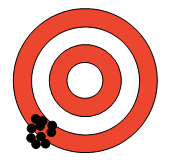
This bullseye demonstrates...
a)
High Accuracy & High Precision
b)
High Accuracy & Low Precision
c)
Low Accuracy & High Precision
d)
Low Accuracy & Low Precision
52.
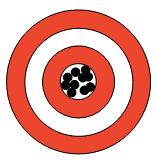
?
a)
High Accuracy & High Precision
b)
High Accuracy & Low Precision
c)
Low Accuracy & High Precision
d)
Low Accuracy & Low Precision
53.
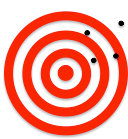
Describe the accuracy and precision of the image
a)
Accurate and Precise
b)
Accurate and not precise
c)
Not Accurate and Precise
d)
not accurate and not precise
54.
Name group 1 on the periodic table.
a)
alkali metals
b)
alkaline earth metals
c)
noble gases
noble gases
d)
halogens
55.
Name group 2 on the periodic table.
a)
alkali metals
b)
alkaline earth metals
c)
noble gases
d)
transition metals
56.
Name group 18 on the periodic table.
a)
alkali metals
b)
alkaline earth metals
c)
transition metals
d)
noble gases
57.
Name groups 3 - 12 on the periodic table.
a)
noble gases
b)
halogens
c)
metalloids
d)
transition metals
58.
Name group 17 on the periodic table.
a)
transition metals
b)
metalloids
c)
halogens
d)
alkali metals
59.
Where are the nonmetals located on the periodic table?
a)
top left corner
b)
bottom left corner
c)
top right corner
d)
bottom left corner
60.
The period for Bromine is ___________.
a)
3
b)
2
c)
4
61.
Beryllium is in group number______.
a)
Group 2
b)
Group 3
c)
Group 4
d)
Group 7
62.
The majority of elements on the periodic table are
a)
man made.
b)
nonmetals.
c)
metals.
d)
gases.
63.
Which of the following is not a property of metals?
a)
brittle
b)
malleable
c)
lustrous
d)
conductive
64.
The atoms along the staircase are called 
a)
metals
b)
nonmetals
c)
metalloids
d)
noble gases
65.
The Lanthanide elements are known as the:
a)
Common earth metals
b)
Alkaline earth metals
c)
Rare earth metals
d)
Heavy earth metals
66.

A substance made of two or more PHYSICALLY combined substances is--

a)

an element

b)

a mixture

c)

a salt

d)

a compound

67.

Which of the pictures represents a mixture?

a)

A

b)

B

c)

C

68.

Which picture represents a compound?

a)

A

b)

B

c)

C

69.
Type of mixture that has the SAME COMPOSITION in every part.
a)
Homogenous
b)
Heterogeneous
70.
Type of mixture that DOESN'T HAVE the same composition in every part.
a)
Homogeneous
b)
Heterogeneous
71.
The air around was is  a mixture of gases.
a)
True
b)
False
72.

What does the Xe represent?

a)

Atomic number

b)

Element Symbol

c)

Atomic Mass

d)

Element Name

73.

What does the 54 represent?

a)

Atomic Number

b)

Element Symbol

c)

Atomic Mass

d)

Element Name

74.

What does the 131.29 represent?

a)

Atomic Number

b)

Element Symbol

c)

Atomic Mass

d)

Element Name

75.

What does Xenon represent?

a)

Atomic number

b)

Element Symbol

c)

Atomic mass

d)

Element Name

76.

Which element has an atomic number of 29?

a)

Iron

b)

Copper

c)

Nickle

d)

Silver

77.

Which element has the atomic mass of 6.941?

a)

Lithium

b)

Beryllium

c)

Chlorine

d)

Argon

78.

Which element has the elemental symbol of Hg?

a)

Hydrogen

b)

Zinc

c)

Argon

d)

Mercury

79.

Which element has the atomic number of 14?

a)

Silicon

b)

Nitrogen

c)

Arsenic

d)

Germanium

80.

Which element has the atomic mass of 40.078?

a)

Zirconium

b)

Palladium

c)

Calcium

d)

Iodine

81.

Subatomic particles with a negative charge

a)

Electrons

b)

Neutrons

c)

Protons

d)

Quarks

82.
subatomic particles found on the outermost shell & responsible for the atom's reactivity
a)
neutrons
b)
valence electrons
c)
isotopes
d)
ions
83.
Measure mainly of the nuclear particles: protons + neutrons
a)
Subatomic Particles
b)
Atomic Number
c)
Atomic Mass
d)
Gluons
84.
Subatomic particles with a positive charge
a)
neutrons
b)
atomic mass
c)
protons
d)
isotopes
85.
Subatomic particles that are neutral in charge
a)
Neutrons
b)
Protons
c)
Nucleus 
d)
Electrons
86.
Atoms of the same element with a different number of neutrons
a)
Ion
b)
Gluons
c)
Isotope
d)
Quarks
87.
A charged atom
a)
Ion
b)
Isotope
c)
Electron Cloud
d)
Quark
88.
A tiny but very dense, positively charged portion of the atom that holds most of the atomic mass
a)
Electron Shells
b)
Orbitals
c)
Electron Cloud
d)
Nucleus
89.
Arrangement of elements organized by atomic number
a)
Electron Cloud 
b)
Periodic Table 
c)
Electron Configuration
d)
None of these
90.

A horizontal row of elements in the periodic table

a)

Molecule

b)

Period

c)

Family

d)

Atom

91.

Elements in the same vertical column of the periodic table; also called group

a)

Family

b)

Atom

c)

Element

d)

Metals

92.
True or False - Protons and Neutrons have about the same mass.
a)
True - They have about the same mass
b)
False - They do not have about the same mass
93.
Where is the nucleus located in an atom?
a)
Near the electron shells/levels
b)
Near the center of an atom
94.
Which two subatomic particles make up the nucleus of an atom?
a)
Protons and Electrons
b)
Neutrons and Electrons
c)
Electrons and Protons
d)
Protons and Neutrons
95.
What is an atom mostly made up of?
a)
protons
b)
electrons
c)
empty space
d)
neutrons
96.

If X is the symbol for an element, which of the following two symbols represent isotopes of the same element?

I. 7735X II. 7733X III. 8137X IV. 8135 X

a)

I and II

b)

III and IV

c)

I and IV

d)

I and III

97.
If an atom loses an electron it is a(n)
a)
Positive ion
b)
Negative ion
c)
Isotope
d)
Neutral Atom
98.
If an atom gains an electron it is a(n)
a)
Positive ion
b)
Negative ion
c)
Isotope
d)
Neutral Atom
99.
Carbon-14 is an example of a(n)
a)
Positive ion
b)
Negative ion
c)
Isotope
d)
Neutral Atom
100.
Can an atom of Hydrogen have 2 protons?
a)
Yes, because it can be an ion
b)
No, because protons identify the atom
c)
Yes, because it can be an isotope
d)
No, because only neutral atoms exist
101.
Isotopes are atoms that have different
a)
Mass numbers
b)
Element names
c)
Atomic Numbers
102.
What is the number of neutrons?
a)
34
b)
79
c)
45
d)
35
103.
In a correctly written symbol what would be located in the "A" position?
a)
number of neutrons
b)
atomic number
c)
number of electrons 
d)
mass number
104.
What atom matches this electron configuration?
1s22s22p63s23p64s23d10
a)
Zinc
b)
Copper
c)
Nickel
d)
Germanium
105.
What electron configuration matches an oxygen atom?
a)
1s22s22p63s2, 3p64s23d104p5
b)
1s22s22p4
c)
1s22s22p6
d)
1s22s22p63s23p64s23d1
106.
How many electrons can the first energy level hold?
a)
1
b)
2
c)
8
d)
0
107.
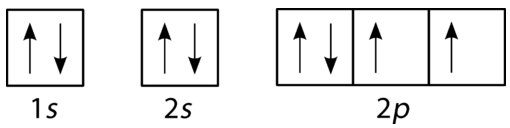
This orbital diagram represents:  
a)
C
b)
B
c)
N
d)
O
108.
How many electrons can the d sublevel hold?
a)
14
b)
10
c)
2
d)
6
109.
How many electrons can the s sublevel hold?
a)
14
b)
10
c)
2
d)
6
110.
How many electrons can the p sublevel hold?
a)
14
b)
10
c)
2
d)
6
111.
Which has the greater EN: 
Cl or Al?
a)
Cl
b)
Al
112.
Which of the following will have a larger radius than Zinc?
a)
Gallium
b)
Aluminum
c)
Magnesium
d)
Strontium
113.
Which of the following will have a lower ionization energy than Scandium (Sc)?
a)
Helium (He)
b)
Titanium (Ti)
c)
Calcium (Ca)
d)
Magnesium (Mg)
114.
As you move down the periodic table atoms get bigger.  This is because ____________.
a)
The atoms have more mass.
b)
The atoms have more protons.
c)
The atoms have more energy levels
d)
The atoms have more nuetrons
115.
Atoms that have a high electronegativity, _______________.
a)
give up their electrons more easily.
b)
hold on to their electrons more tightly.
c)
have more electron shells.
116.
Ionization energy is...
a)
the energy required to add an electron to a specific atom
b)
how much energy it takes to remove an electron from an atom
c)
the energy required to shield the outer electrons from the nucleus
d)
a measure of the ability of an atom to attract electrons
117.
The element with the largest electronegativity in the halogens is - 
a)
At
b)
F
c)
Cl
d)
Br
118.
Substances that form as the result of a chemical reaction
a)
products
b)
reactants
c)
coefficients
d)
subscripts
119.

In a correctly written symbol what would be located in the "Z" position?

a)

number of neutrons

b)

atomic number

c)

number of electrons

d)

mass number

120.

Which of the following is NOT a property of ionic compounds?

a)

They conduct electricity when molten

b)

They conduct electricity when in solution

c)

They have high boiling points

d)

They are insoluble in water

121.
A(n) _________ is an ion with a positive (+) charge.
a)
anion
b)
cation
c)
ion
d)
solute
122.
Which of the following is a characteristic property of ionic compounds?
a)
They form hard, brittle crystals with characteristic shapes
b)
They have low melting points
c)
They have low boiling points
d)
They contain no charged particles
123.
Ionic bonds form between metals and ____.
a)
metalloids
b)
metals
c)
nonmetals
124.
Atoms gain or lose electrons to become stable by satisfying this rule.
a)
Lewis Structure rule
b)
Periodic Law
c)
octet rule
d)
Ionic Law
125.
What do you call a bond that forms when electrons are transferred from one atom to another?
a)
a compound bond
b)
an ionic bond
c)
a crystal bond
d)
an atomic bond
126.
Definition:  a regular, ordered arrangement of atoms, ions, or molecules
a)
crystal lattice
b)
atomic lattice
c)
ionic lattice 
d)
molecular lattice
127.
Which group of the periodic table is most stable (already has 8 valence electrons)?
a)
Alkali metals
b)
Transition metals
c)
Halogens
d)
Noble gases
128.
What is the basis of a metallic bond?
a)
the attraction of neutral metal atoms.
b)
the attraction between protons and neutrons.
c)
the attraction between positive metal ions and interlocking electrons.
d)
the attraction between positive metal ions and free floating electrons.
129.
At room temperature, most metals are
a)
liquid
b)
solid
c)
gas
d)
an alloy
130.
What does malleable mean?
a)
able to be shaped
b)
will break easily
c)
can be used for wire
d)
is shiny
131.
What do metals conduct?
a)
heat
b)
electricity
c)
both
d)
neither
132.
In metals, the _______ electrons form a shared sea of electrons.
a)
Metallic
b)
Inner
c)
Outer
d)
Ionic
133.
How many electrons are shared in a triple bond?
a)
6
b)
3
c)
6 pairs
d)
5
134.
What two types of atoms make a covalent bond?
a)
2 Nonmetals
b)
1 Nonmetal and 1 Metal
c)
2 Metals
d)
2 Noble Gases
135.
Which of the following is NOT formed by a covalent bond?
a)
K2S
b)
H2O
c)
I2
d)
CO2
136.

Which of these is not a property of covalent compounds? (2)

a)

High boiling point

b)

Low melting point

c)

Bad conductors of heat and electricity

d)

Forms electrolytes

137.
What kind of bond forms between a cation and an anion?
a)
Chemical bond
b)
Ionic bond
c)
Covalent bond
d)
Electron bond
138.
What kind of bond forms between two nonmetals?
a)
Chemical bond
b)
Ionic bond
c)
Covalent bond
d)
Electron bond
139.
What are ionic bonds?
a)
valence electrons transferred between atoms
b)
Inner most electrons transferred between atoms
140.
Why do ionic bonds form?
a)
so the number of protons equals the number of electrons
b)
to fill the outermost energy level
c)
so an atom can become unstable
141.
An atom that has gained or lost electrons is called ...
a)
a winner
b)
an isotope
c)
an ion
d)
a loser
142.
How many valence electrons does a bromine atom have?
a)
1
b)
2
c)
6
d)
7
143.

Which of the following is NOT a property of ionic compounds?

a)

They conduct electricity when molten

b)

They conduct electricity when in solution

c)

They have high boiling points

d)

They are insoluble in water

144.
This type of model shows only the valence electrons of an element? 
a)
Bohr diagram 
b)
Childers model
c)
Lewis-dot diagram 
d)
What is a valence electron again?
145.
How are covalent bonds explained?
a)
When one atom takes the other atom's electron
b)
When the atom shares an electron with an another atom
c)
When the two nucleus merge
d)
When the neutrons leave the nucleus
146.
Are the atoms more stable when they are bonded together or when they are apart? 
a)
Bonded Together
b)
Apart
147.
How do covalent bonds form?
a)
Donating & receiving valence e- between atoms.
b)
Opposite slight charges attract each other between compounds.
c)
Scientists are still not sure how they form.
d)
Sharing valence e- between atoms.
148.
How many valence electrons does nitrogen have?
a)
3
b)

2

c)
5
d)
1
149.
The desire for an element to have 8 atoms around it is called 
a)
Octet Rule
b)
Resonance
c)
Ionization energy
d)
Electronegativity
150.
Which of these would be covalently bonded
a)
Fr and K
b)
Sc and O 
c)
F and Cl
d)
He and Pt
151.

In the Lewis structure for sulfur, how many dots should be around the symbol “S”?

a)

2

b)

3

c)

4

d)

6

e)

8

152.

Which of the following contains a double bond?

a)

C2H4

b)

H2

c)

OF2

d)

CF4

e)

OH-

153.
Three pairs of electrons are shared in a
a)
Single bond
b)
Double bond
c)
Triple bond
154.

How many lone pairs of electrons (the ones not in bonds) in the molecule pictured above?

a)

2

b)

3

c)

6

d)

8

155.

Which is the correct Lewis Dot Structure for NH3?

a)
b)
c)
156.

Which is the correct Lewis Dot Structure for H2S?

a)
b)
c)
157.

According to the octet rule most elements need _______ valence electrons.

a)

2

b)

8

c)

6

d)

18

158.

Hydrogen needs _____ electrons in its valence shell to be stable.

a)

4

b)

6

c)

8

d)

2

159.
A mixture of two or more metals is called:
a)
mixture
b)
solution
c)
compound
d)
alloy
160.
Metallic bonding is...
a)
a type of covalent bond.
b)
a type of ionic bond.
c)
an attraction between positive ions and electrons.
161.
What is the ability of a substance to be pulled into a thin strand?
a)
Malleability
b)
Ductility 
c)
Conductivity
d)
Solubility
162.

Which of these are considered properties of metals? (choose ALL that apply)

a)

brittleness

b)

low melting point

c)

luster (shininess)

d)

malleability

e)

ductility