wayground logo

Free Printable Worksheets

Font size

S
M
L
XL
Worksheets

Section 1 Test Review PRACTICE

Total questions: 162

Worksheet time: 6hrs 51mins

Name
Class
Date
1.

490,000 g =____ kg

a)

490

b)

49

c)

4,900

d)

0.49

2.

Is 20 g greater than, less than, or equal to 2 kg?

a)

greater than

b)

less than

c)

equal to

3.

285 kg = ____ g

a)

285,000

b)

285

c)

2,850

d)

28,500

4.

240 cm = ___________ m

a)

2400

b)

24

c)

2.4

d)

0.24

5.

240 cm = ___________ m

a)

2400

b)

24

c)

2.4

d)

0.24

6.

15.6 L = ___________ mL

a)

15,600

b)

156,000

c)

1,560,000

d)

15,600,000

7.

0.57 mL = ___________ L

a)

5.7

b)

0.057

c)

0.0057

d)

0.00057

8.

3 km = ___________ mm

a)

30

b)

300

c)

3,000

d)

3,000,000

9.

What is the basic unit of mass in the metric system?

a)

gram

b)

meter

c)

Liter

d)

cm3

10.

What is the basic unit of liquid volume in the metric system?

a)

gram

b)

meter

c)

Liter

d)

cm3

11.

The metric unit of measurement for length is the:

a)

gram

b)

liter

c)

meter

d)

cm

12.
120 mm = ______ cm 
a)
1,200
b)
20
c)
12
d)
120,000
13.
Write 0.00000707 in scientific notation.
a)
7.07 x 10⁻⁶
b)
7.07 x 10⁶
c)
707 x 108
d)
707 x 10-8
14.
Write 2.08 x 10²  in standard form.
a)
208
b)
0.0208
c)
20,800
d)
0.208
15.
3 km = ___________ mm
a)
30
b)
300
c)
3,000
d)
3,000,000
16.
There are ___ millimeters(mm) in 2.7 centimeters (cm)
a)
270 mm
b)
.27 mm
c)
27 mm
d)
.027 mm
17.
Multiply:
(3.4 x 10⁵)(1.2 x 10⁻³)
a)
4.08 x 10⁻⁸
b)
4.8 x 10²
c)
4.08 x 10²
d)
4.08 x 10⁻¹⁵
18.
Write the answer in scientific notation.
7.3 x 10⁵  +   3.7 x 105  =
a)
11.0 x 10⁵
b)
1.1 x 10¹⁰
c)
1.10 x 10¹¹
d)
1.1 x 10 6
19.
You know 16 cups = 1 gallon. Convert 3.5 gallons into cups.
a)
56 cups
b)
0.21875 cups
c)
19.5 cups
d)
48 cups
20.
What is measured with a graduated cylinder?
a)
Passage of time
b)
Distance from one thing to another
c)
Weight of an object
d)
Volume of liquid
21.
This piece of lab equipment is called a _______________.
a)
beaker
b)
spring scale
c)
graduated cylinder
d)
thermometer
22.

The density of an object can be determined by....

a)

dividing the mass by it's volume (D=m/v)

b)

dividing the volume by it's mass (D=v/m)

c)

multiplying the volume by it's mass (D=V x m)

d)

multiplying the mass by it's volume (D=m x V)

23.
What is the volume in the cylinder?
a)
6.60 mL
b)
6.6 mL
c)
6.1 mL
d)
6.10 mL
24.
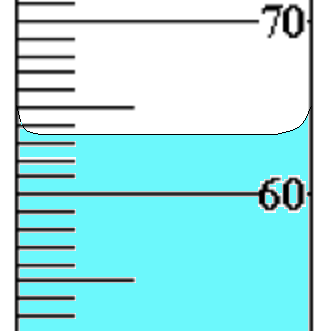
What is the volume of liquid in this graduated cylinder?
a)
43.0 mL
b)
43 mL
c)
43.05 mL
d)
44.5 mL
25.
What is the length of this line?
a)
5 cm
b)
4.300 cm
c)
4.30 cm
d)
4.3 cm
26.
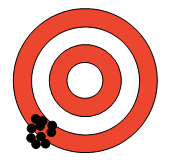
This bullseye demonstrates...
a)
High Accuracy & High Precision
b)
High Accuracy & Low Precision
c)
Low Accuracy & High Precision
d)
Low Accuracy & Low Precision
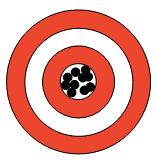
27.
?
a)
High Accuracy & High Precision
b)
High Accuracy & Low Precision
c)
Low Accuracy & High Precision
d)
Low Accuracy & Low Precision
28.
When a measurement is repeatable and consistent it is said to have...
a)
High precision
b)
Low precision
c)
High accuracy
d)
Low accuracy
29.

How close a measurement is to the accepted value is called..

a)

Accuracy

b)

Precision

c)

Significant

d)

Estimate

30.
If you break glassware in the lab, you should...
a)
Tell the teacher
b)
Clean it up quickly before the teacher notices
c)
Scream at the top of your lungs
31.
A series of steps used by scientists to solve a problem or answer a question. 
a)
scientific method
b)
recipe
c)
data collection
d)
metric system
32.
You have been injured in the laboratory (cut, burn, etc.). First you should
a)
apply first aid yourself
b)
tell the science instructor at once
c)
see a doctor after school
d)
visit the school nurse after class
33.
Approved eye protection devices (such as goggles) are worn in the laboratory
a)
 to avoid eye strain
b)
to improve your vision
c)
only if you don’t have corrective glasses
d)
 any time chemicals, heat or glassware are used
34.
If you are not sure what to do during a lab activity:
a)
guess
b)
change lab partners
c)
ask a teacher
d)
just sit quietly and do nothing
35.
When is it OK to eat or drink in the lab?
a)
Always
b)
Never
36.
To put out a fire on a person's hair or clothes, use:
a)
the fire blanket.
b)
the wind from running.
c)
the fire extinguisher.
d)
any wet chemical you can find.
37.
Long hair in the laboratory must be 
a)
A. cut short. 
b)
B. held away from the experiment with one hand.
c)
 C. always neatly groomed.
d)
D. tied back or kept entirely out of the way with a hair band, hairpins, or other confining device.
38.

What does MSDS stand for?

a)

Material Safety Data Sheet

b)

Modern Safety Day Special

c)

Medium Small Data Stuff

d)

Made Something Doing Something

39.

A hazard diamond uses four colors to indicate areas of possible hazard. Which color represents health?

a)

Blue

b)

Red

c)

Yellow

d)

White

40.

Which primary safety measure must be adhered to when using a chemical with the hazard rating of Blue 1, Red 3, Yellow 1, and White Blank?

a)

Keep away from flames

b)

Keep away from water

c)

Wear a hazmat suit

d)

Watch out for an explosion

e)

Do not mix with other chemicals

41.

How should a student interpret the following hazardous materials symbol: Blue 1, Red 3, Yellow 1, White blank?

a)

The substance is completely safe

b)

The substance is slightly hazardous to health, highly flammable, and slightly unstable

c)

The substance is highly unstable, only slightly flammable, and health concerns are minor

d)

The substance is highly reactive, nonflammable, and a health danger

42.

What is the flash point?

a)

measure of how volatile a chemical is

b)

temperature where a chemical produces enough vapor to burn

c)

a way to implicate your coworkers that violate safety rules

d)

temperature at which a chemical freezes

e)

measure of health hazard of a chemical

43.

Which area is the most significant and the most hazardous for anhydrous ammonia?

a)

health

b)

fire

c)

reactivity

d)

specific hazards

e)

they are equally significant and hazardous

44.
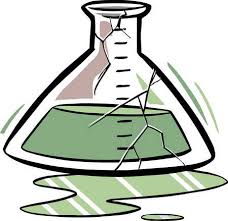
Identify the piece of lab equipment seen in the image.
a)
Erlenmeyer Flask
b)
Graduated Cylinder
c)
Beaker
d)
Test Tube
45.

What does the blue color on the NFPA diamond stand for?

a)

Special Information

b)

Health Hazard

c)

Flammability Hazard

d)

Reactivity Hazard

46.

What does the white color on the NFPA diamond stand for?

a)

Special Information Hazard

b)

Health Hazard

c)

Flammability Hazard

d)

Reactivity Hazard

47.

What does the red color on the NFPA diamond stand for?

a)

Special Hazard

b)

Health Hazard

c)

Flammability Hazard

d)

Reactivity Hazard

48.

What does the yellow color on the NFPA diamond stand for?

a)

Reactivity Hazard

b)

Radioactivity Hazard

c)

Flammability Hazard

d)

Health Hazard

49.
Which hazard does this pictogram represent?
a)
Flammable
b)
Oxidizing
c)
Health Hazard
d)
Danger to the Environment
50.
How many significant figures does the following number have: 0.002040
a)
6
b)
4
c)
3
d)
2
51.
How many significant figures does the following number have: 100.00210
a)
7
b)
5
c)
10
d)
8
52.
Round 1047.78 to three sig figs
a)
104
b)
105
c)
1050
d)
1050.00
53.

What is the measurement 1042 Liters rounded to 2 significant figures?

a)

1040 L

b)

1.1 x 10³ L

c)

1.0 x 10³ L

d)

1050 L

54.
Determine the number of Significant Figures in 506020-km.
a)
5
b)
4
c)
3
d)
2
55.
Determine the number of Significant Figures in 13410000-m.
a)
4
b)
3
c)
2
d)
1
56.
Determine the number of Significant Figures in 10-L.
a)
4
b)
3
c)
2
d)
1
57.
calculate the following to the correct number of sig figs.
13.2017/ 17.10
a)
.772
b)
.7720
c)
.772030
d)
.77
58.
calculate the following to the correct number of sig figs.
32.451 - 21.5
a)
11.0
b)
10.951
c)
11
d)
10.95
59.
Solve and round accordingly.
25.0 x 17 = ?
a)
430
b)
425
c)
425.0
d)
430.0
60.
You know that 12 inches = 1 foot.  Convert 60 inches to feet.
a)
720 feet
b)
5 feet
c)
5 inches
d)
72 feet
61.
How many minutes are in a year?
a)
I can't count that high.
b)
525,600min
c)
52,560min
d)
31,536,000min
62.

What is the volume of the purple liquid using correct sig figs?

a)

8.4 mL

b)

8.5 mL

c)

8.43 mL

d)

8.50 mL

63.

What is the volume of the liquid shown in this graduated cylinder?

a)

4.30 mL

b)

4.35 mL

c)

4.4 mL

d)

4.40 mL

64.

What is the length of the green rod using correct sig figs?

a)

89 cm

b)

88.9 cm

c)

88.89 cm

d)

88.875 cm

65.

Which of these could be a correct measurement for the volume shown?

a)

40 mL

b)

43 mL

c)

43.0 mL

d)

43.00 mL

66.
What two types of measurements make up DENSITY
a)
Mass and Volume
b)
Temperature and Mass
c)
Grams and Centimeters
d)
Volume and Weight
67.
Jack has a rock. The rock has a mass of 14g and a volume of 2cm3. What is the density of the rock?
a)
7 mL
b)
7 g/cm3
c)
28 g/cm3
d)
1/7 g/cm3
68.
What is the formula for density?
a)
density = mass x volume
b)
density = mass / volume
c)
density = mass + volume
d)
density = mass - volume
69.
How many Significant Figures in the number below?
0.456
a)
3
b)
4
c)
2
d)
1
70.
How many Significant Figures in the number below?
4,500
a)
3
b)
4
c)
2
d)
1
71.
How many Significant Figures in the number below?
400,506
a)
5
b)
4
c)
6
d)
3
72.
How many Significant Figures in the number below?
406,000
a)
5
b)
4
c)
6
d)
3
73.
Solve & Round to Correct Sig Figs.
4.5 + 4.32 = 
a)
8.8
b)
8.7
c)
8
d)
8.0
74.
Solve & Round to Correct Sig Figs.
4.5 x 2.34 = 
a)
11
b)
10.52
c)
10.5
d)
10
75.
Solve & Round to Correct Sig Figs.
103.45 + 2 = 
a)
105
b)
104
c)
105.45
d)
106
76.
Solve & Round to Correct Sig Figs.
100 / 2 = 
a)
50
b)
50.
c)
50.0
d)
50.00
77.
Your teacher has asked you to explain the difference between quantitative and qualitative observations. Which statement is correct?
a)
Quantitative observations use numbers, qualitative uses the senses.
b)
Quantitative observations use the senses, qualitative uses numbers.
c)
Quantitative observations use measurement, qualitative uses numbers.
d)
Quantitative observations use colors, qualitative uses the senses.
78.
The leaves on the plant are turning brown.
a)
Qualitative
b)
Quantitative
c)
Both
d)
Neither
79.
The plant has grown 4 cm since yesterday.
a)
Qualitative
b)
Quantitative
c)
Both
d)
Neither
80.
The speed of the car was 45 mph.
a)
Qualitative
b)
Quantitative
c)
Both
d)
Neither
81.

Which type of data involves numbers and units that are obtained by counting or measuring?

a)
quantitative
b)
qualitative
c)

both

quantitative & qualitative

d)

None of the following

82.

Express the product of 22.22 mm and 4.01 mm using the correct number of significant digits.

a)

89.01 mm

b)

89.0 mm

c)

89 mm

d)

8.9 x 10⁻²

83.

Which of the following volumes is the smallest?

a)

Kiloliter

b)

Liter

c)

centiliter

d)

milliliter

84.

Which type of data do you collect during lab?

a)
quantitative
b)
qualitative
c)

both

quantitative and qualitative

d)

None of the following

85.

Express the product of 5.66 mm and 8.0 mm using the correct number of significant digits.

a)

45.28 mm

b)

45.3 mm

c)

45 mm

d)

4.53 x 10⁻³

86.

Which of the following volumes is the largest?

a)

Kiloliter

b)

Liter

c)

centiliter

d)

milliliter

87.

What is the density of 9.60 grams of an unknown substance with a volume of 0.990 cm3?

a)

9.696 g/cm3

b)

9.697 g/cm3

c)

9.70 g/cm3

d)

9.697 g/cm3

88.

Which lab glassware that you have used gives you the ability to make the most precise measurements of liquids?

a)

graduated cylinder

b)

beaker

c)

Erlenmeyer flask

d)

All of the following

89.

Express the product of 2.06 x 10⁻¹² m and 5.1 x 1012 m

using the correct number of significant digits.

a)

10.506 m

b)

10.51 m

c)

10.5 m

d)

11 m

90.

Which is the smaller or shorter distance?

a)

1 inch

b)

1 centimeter

c)

1 mile

d)

1 foot

91.
The SI base units for time and temperature are
a)
hour and degree Celsius.
b)
second and degree Celsius.
c)
hour and kelvin.
d)
second and kelvin.
92.

Volume: Which of the following would be your best measurement?

a)
63.5 mL
b)
63 mL
c)
63.55 mL
d)
6 mL
93.

Which of these pieces of equipment is beaker?

a)
b)
c)
d)
94.

How do you measure the volume using a graduated cylinder?

a)

Measurements must be taken from the top of the meniscus and at eye level

b)

Measurements must be taken by looking from above the cylinder

c)

Measurements must be taken by looking from below the cylinder

d)

Measurements must be taken from the bottom of the meniscus and at eye level

95.

In a measurement, significant figure consist of the digits known ___________.

a)

only

b)

plus one estimated digit

c)

plus two estimated digits

96.

How would you record measurement A?

a)

7.8

b)

7.82

c)

7.825

d)

7.90

97.

What is the volume shown in this graduated cyclinder?

a)

24.0 mL

b)

24 mL

c)

23.7 mL

d)

23 mL

98.

What is the volume shown in this graduated cyclinder?

a)

56 mL

b)

60 mL

c)

57.0 mL

d)

56.0 mL

99.

How many sig figs are found in 0.020 mL?

a)

1

b)

2

c)

3

d)

4

100.

How many sig figs are found in 2000 miles?

a)

1

b)

2

c)

3

d)

4

101.

Convert 500.05 meters into kilometers?

a)

500,000.05 km

b)

0.50005 km

c)

0.500 x 10⁻³ km

d)

5.005 x 10⁻⁶ km

102.

Which nugget of gold would you rather find? Meaning, which is the larger of the two?

Nugget A: 3.30 mg Nugget B: 0.330 g

a)

A

b)

B

c)

A & B have the same mass

d)

Not sure, I need help.

103.

How many pounds are in 50.0 grams of sugar? (2.2 lbs = 1000 g) Make sure your answer has the correct number of sig figs.

a)

0.110 lbs

b)

0.11 lbs

c)

11 lbs

d)

11.0 lbs

104.

Convert 348 kilometers to miles (1 miles = 1.609 km)

a)

560 mi

b)

216 mi

c)

348 mi

105.

Convert 60 inches to feet.

12 in = 1 ft

a)

720 feet

b)

5 feet

c)

5 inches

d)

72 feet

106.

How many minutes are in 180 days? Don't use sig figs.

a)

259,200 minutes

b)

10,800 minutes

c)

4,320 minutes

d)

1,440 minutes

107.

What is the density of 26.0 grams of an unknown substance with a volume of 1.890 cm3?

a)

13.756 g/cm3

b)

13.8 g/cm3

c)

0.0737 g/cm3

d)

7.37 x 10⁻² g/cm3

108.
How many sig. fig. are in the number below:
0.0005
a)
1
b)
2
c)
3
d)
4
109.
How many Significant Figures in the number below?
0.456
a)
3
b)
4
c)
2
d)
1
110.
Round 1009 to three sig figs
a)
100
b)
101
c)
1010
d)
1000
111.
How many Significant Figures in the number below?
4,500
a)
3
b)
4
c)
2
d)
1
112.
How many significant figures does 10.1 cm have?
a)
1
b)
2
c)
3
d)
4
113.
How many significant figures does 0.010 m have?
a)
1
b)
2
c)
3
d)
4
114.
Round 720.36 to two sig figs
a)
72
b)
73
c)
720
d)
720.00
115.

Convert the following # into standard form with 3 sig figs.

4.56 x 10³

a)

456

b)

456,000

c)

4,560

d)

0.0456

e)

0.00456

116.

345.009 - 23.009 =

a)

322.000

b)

322.00

c)

322.0

d)

322

117.
Solve & Round to Correct Sig Figs.
4.5 + 4.32 = 
a)
8.8
b)
8.7
c)
8
d)
8.0
118.
Solve & Round to Correct Sig Figs.
4.5 x 2.34 = 
a)
11
b)
10.52
c)
10.5
d)
10
119.
Solve & Round to Correct Sig Figs.
103.45 + 2 = 
a)
105
b)
104
c)
105.45
d)
106
120.
Calculate 12.47 m ÷ 3.2 s and give your answer with the correct number of significant figures.
a)
4 m/s
b)
3.9 m/s
c)
3.90 m/s
d)
3.897 m/s
121.
Calculate 923 g ÷ 20312 cm3 and give your answer with the correct number of significant figures.
a)
0.04 g/cm3
b)
0.045 g/cm3
c)
0.0454 g/cm3
d)
0.05 g/cm3
122.
Multiply 5.4L x 8.99g/L
a)
49g
b)
48.5g
c)
48.55g
d)
48.546g
123.

0.58 x 1.838 x 7.021

a)

7.5

b)

8.0

c)

7.48

d)

7.484

e)

7.4

124.

What is the sum of 3.35 + 1.4 + 3.65?

a)

8.4

b)

8.40

c)

8

d)

8.0

125.

0.495 - 0.1 =

a)

0.395

b)

0.40

c)

0.4

d)

0.3

126.

Which of the following would apply to lab safety?

a)

Wear Goggles

b)

Wear Closed Toed Shoes

c)

Eat and Drink in the lab

d)

Long hair should be tied back

e)

All apply except the one about eating and drinking in lab. You should never do either of those

127.

In a laboratory, the following should NOT be worn

a)

gloves

b)

open toed shoes

c)

apron

d)

goggles

128.

If you do not understand a direction or part of a lab procedure, you should

a)

figure it out on your own as you go

b)

ask your teacher

c)

guess

d)

write a pros and cons list

129.
Horseplay or practical jokes in the laboratory are
a)
ok as long as  you're done
b)
always accepted
c)
dangerous and could cause harm and invalidate the experiment
d)
fun
130.

When is it OK to eat or drink at the lab tables?

a)

Always

b)

During group work, but not during lab activities

c)

NEVER

d)

During lab activities

131.
Long hair in the laboratory must be 
a)
A. cut short. 
b)
B. held away from the experiment with one hand.
c)
 C. always neatly groomed.
d)
D. tied back or kept entirely out of the way with a hair band, hairpins, or other confining device.
132.

What does MSDS stand for?

a)

Material Safety Data Sheet

b)

Modern Safety Day Special

c)

Medium Small Data Stuff

d)

Made Something Doing Something

133.

A hazard diamond uses four colors to indicate areas of possible hazard. Which color represents health?

a)

Blue

b)

Red

c)

Yellow

d)

White

134.

Which primary safety measure must be adhered to when using a chemical with the hazard rating of Blue 1, Red 3, Yellow 1, and White Blank?

a)

Keep away from flames

b)

Keep away from water

c)

Wear a hazmat suit

d)

Watch out for an explosion

e)

Do not mix with other chemicals

135.

How should a student interpret the following hazardous materials symbol: Blue 1, Red 3, Yellow 1, White blank?

a)

The substance is completely safe

b)

The substance is slightly hazardous to health, highly flammable, and slightly unstable

c)

The substance is highly unstable, only slightly flammable, and health concerns are minor

d)

The substance is highly reactive, nonflammable, and a health danger

136.

Which area is the most significant and the most hazardous for anhydrous ammonia?

a)

health

b)

fire

c)

reactivity

d)

specific hazards

e)

they are equally significant and hazardous

137.

This is used to produce flame for science experiments

a)

scoop

b)

funnel

c)

bunsen burner

d)

goggles

138.

This is used to clean chemicals or debris (stuff) out of your eyes

a)

test tube holder

b)

eye wash

c)

eye dropper

d)

lab apron

139.

This is used to put out a fire

a)

fire extinguisher

b)

thermometer

c)

beaker

d)

tongs

140.
Identify the piece of lab equipment seen in the image.
a)
Erlenmeyer Flask
b)
Graduated Cylinder
c)
Beaker
d)
Test Tube
141.
What are the states of matter?
a)
solid, liquid, and juice
b)
solid and liquid
c)
solid and gas
d)
solid, liquid, and gas
142.
Cutting an orange is a physical change.
a)
True
b)
False
143.
A pure substance containing only one kind of atom.
a)
element
b)
mixture
c)
compound
144.
Can only be separated by chemical means.
a)
element
b)
mixture
c)
compound
145.

What is matter?

a)

Any subtance that doesn't take up space or have mass.

b)

Any substance that takes up space and has mass.

c)

Any substance that exists on Earth.

d)

Any substance that exists in space.

146.

A mixture that appears to be evenly mixed throughout and is known as a true solution?

a)

an atom

b)

a compound

c)

a homogeneous mixture

d)

a heterogeneous mixture

147.
 mixture that does NOT appear to be evenly mixed throughout:
a)
an atom
b)
a compound
c)
a homogeneous mixture
d)
a heterogeneous mixture
148.

Can a mixture be separated by physical means?

a)

No

b)

Yes

c)

Only sometimes

149.

Matter composed of 2 or more elements in a fixed ratio and properties differ from those of individual elements are known as ______________

a)

Elements

b)

Atoms

c)

Compounds

d)

Mixtures

150.

Which of the following is classified as a colloid?

a)

Paint

b)

Orange Juice

c)

Fog

d)

Gold

151.

Which of the following is classified as a suspension?

a)

Fog

b)

Gold

c)

Paint

d)

Salt Water

152.

Which of the following is considered a homogeneous mixture?

a)

Fog

b)

Gold

c)

Paint

d)

Salt Water

153.

The Tyndall Effect occurs when medium or larger particles ________.

a)

Let light pass through

b)

Block & Scatter Light

c)

Settle to bottom

d)

Make a Solution

154.

The density of an object can be determined by....

a)

dividing the mass by it's volume (D=m/v)

b)

dividing the volume by it's mass (D=v/m)

c)

multiplying the volume by it's mass (D=V x m)

d)

multiplying the mass by it's volume (D=m x V)

155.

The meter is the base SI unit for

a)

Length

b)

Mass

c)

Volume

d)

Time

e)

Temperature

156.

⁰C, degrees Celsius, is the SI unit for

a)

Temperature

b)

Time

c)

Length

d)

Volume

e)

Mass

157.
What do we call the curve that a liquid forms in a container?
a)
a curvy thingy
b)
a manipole
c)
a meniscus
d)
a hibiscus
158.
What is mass?
a)
the distance between two points
b)
the amount of matter (stuff) in an object
c)
the amount of space an object takes up
d)
the distance between three points
159.
The students measured length during a science experiement, they got 12 cm. But the actual measurement was 14.25 cm. What was the percent error?
a)
15.79%
b)
18.75%
c)
2.25%
d)
18%
160.
The deer population is estimated to be 17,600 in northern Illinois, but an actual count was 21,300. What is the percent error?
a)
21%
b)
17.37%
c)
17.4%
d)
21.02%
161.

The attendance for the basketball game was estimated to be 15,000 people but 12,500 people attended. What was the percent error?

a)

16.67%

b)

20%

c)

2500%

d)

80%

162.

How many minutes are in a school year, 187 days?

a)

269,280 min.

b)

16, 200 min.

c)

16, 156 min.

d)

269,000 min.