
 Worksheets
Unit 5 Review
Total questions: 25
Worksheet time: 25mins

Which layer of Earth is located above the outer core and has convection currents that move tectonic plates?
crust
inner core
mantle
lithosphere
What is the rigid layer of the Earth's surface made up of the crust and upper mantle called?
asthenosphere
lithosphere
mesosphere
continental crust

What layer is the thinnest and least dense?
Crust
Mantle
Core
They are all the same size
Earth's magnetic field results from convection currents in the
mantle
outer core
inner core
crust
Which objects would a magnet attract?
a glass bottle
a piece of paper
a paper clip and compass
a rubber eraser and iron fillings
What force is caused by the attraction and repulsion between charged protons and electrons in atoms?
magnetic force
electric force
gravitational force
friction
What force is an attractive pull towards the center of an object's mass? Its strength depends on the mass and distance of the two objects involved.
magnetic force
electric force
gravitational force
friction
What is the formula for density?
mass x volume
mass / volume
volume x mass
volume/ mass
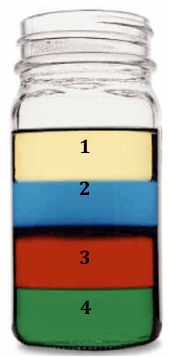


Which of the following correctly identifies each state of matter shown?
1= liquid, 2= gas, 3= solid
1= solid, 2= liquid, 3= gas
1= liquid, 2= solid, 3= gas
If you heat a liquid, which state of matter will it become?
solid
stay a liquid
gas
plasma
up a gas.
A gas changes in to a liquid when it is...
Heated and energy is added
Cooled and energy is removed
Heated and energy is removed
Cooled and energy is added
This is a low place in between two hills or mountains formed by erosion by a river or glacier.
Sinkhole
Valley
Delta
Lake

What process would form a delta at the mouth of a river?
Weathering
Erosion
Deposition

What landform is made from the chemical weathering of limestone, causing a depression in the surface?
delta
sinkhole
dune
valley

What landform is made from wind erosion and deposition as the wind hits obstacles like grass, causing it to drop sediment down in a pile?
bay
delta
plateau
dune
Which of the following created the Himalayan Mountains?
weathering and erosion from glaciers
chemical weathering of rock
wind depositing sediment into large piles
two tectonic plates colliding at a convergent boundary

