
 Worksheets
Unit 2 Lesson 1: Structure of the Universe
Total questions: 75
Worksheet time: 1hrs 28mins
Name
Class
Date
1.
Space and all the matter and energy in it.
a)
Space
b)
Solar System
c)
Universe
d)
Sun
2.
The sun and all of the planets and other bodies that travel around it.
a)
Universe
b)
Galaxy
c)
Star
d)
Solar System
3.
A relatively large spherical body that orbits a star.
a)
Star
b)
Planet
c)
Moon
4.
A large celestial body that is composed of gas and that emits light.
a)
star
b)
black hole
c)
element
d)
big bang
5.
A collection of stars, dust, and gas bound together by gravity.
a)
Nebula
b)
Galaxy
c)
Universe
d)
Protostar
6.
The distance that light travels in one year; about 9.46 trillion kilometers.
a)
Light Year
b)
Light Kilometer
c)
Light Second
d)
Warp Speed
7.
The actual brightness of an object such as a star
a)
Luminosity
b)
Apparent Magnitude
c)
Brightness
d)
Light Year
8.
Which of the following is the largest?
a)
star
b)
universe
c)
cluster
d)
galaxy
9.
Light Years are a measure of -
a)
time
b)
speed
c)
distance
d)
light
10.

Proxima Centauri is the closest star to Earth after the Sun and is located 4.3 light years away from Earth. How long does it take light from Proxima Centauri to reach Earth?
a)
1 year
b)
4.3 years
c)
43 years
d)
10 trillion years
11.
Gravity is the force objects put on each other because of their ______.
a)
mass
b)
friendliness
c)
acceleration
d)
speed
12.
________ holds all of the planets in orbit around the sun.
a)
Gravity
b)
String
c)
Bill Nye
d)
Duct tape
13.
The shape of our Milky Way galaxy can be classified as ____________.
a)
Spiral
b)
Elliptical
c)
Irregular
d)
French
14.
What is a light year?
a)
A unit of time
b)
The time light takes to travel though a vacuum in one year.
c)
10 thousand meters
d)
How far light travels through the vacuum in one year.
15.
Luminosity measures a star's _____________________.
a)
Color
b)
Temperature
c)
Brightness
16.
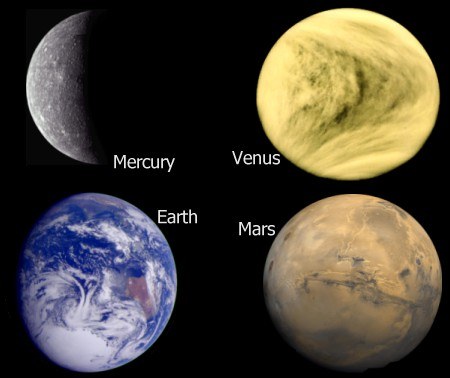
Earth and the other planets closest to the Sun are made mostly of _______
a)
gas
b)
metal
c)
water
d)
rock
17.

The moon is a natural ______ of Earth.
a)
comet
b)
axis
c)
satellite
d)
space probe
18.

Earth's ________ on its axis causes day and night.
a)
rotation
b)
revolution
c)
phase
d)
comet
19.

One full orbit of an object around another object is called a ________.
a)
axis
b)
rotation
c)
revolution
d)
satellite
20.

The __________ has planets, moons, comets, and asteroids.
a)
solar system
b)
earth
c)
rotation
d)
United States
21.
One of the main differences between the outer and inner planets is __________.
a)
The inner planets all have water
b)
the inner planets are much bigger than the outer planets
c)
the outer planets are gas planets
d)
the outer planets have rings, and the inner planets don't
22.
Where is the asteroid belt found?
a)
between earth and mars
b)
Between Uranus and Neptune
c)
Between Mercury and Venus
d)
Between Mars and Jupiter
23.
Select the order from smallest to largest.
a)
Sun, Milky Way, solar system, universe
b)
Sun, Milky Way, universe, solar system
c)
Sun, solar system, Milky Way, universe
d)
Sun, solar system, universe, Milky Way
24.
Day and night is caused by the _____________ of earth on its axis.
a)
revolution
b)
orbit
c)
rotation
25.

a pattern of stars that form an imaginary picture or design in the sky
a)
Orbit
b)
Rotate
c)
constellation
d)
Milky Way
26.
A spiral galaxy of stars that contains our Sun
a)
Planisphere
b)
Intensity
c)
Star
d)
Milky Way
27.
Which is the largest object in our solar system?
a)
Sun
b)
Jupiter
c)
Earth
d)
Pluto
28.
Which planet is closest to the sun?
a)
Uranus
b)
Mercury
c)
Neptune
d)
Earth
29.
Which is the second closest planet to the sun?
a)
Earth
b)
Saturn
c)
Venus
d)
Mercury
30.
Which planet is third from the sun?
a)
Mars
b)
Pluto
c)
Venus
d)
Earth
31.
Which is the fourth planet from the sun?
a)
Mars
b)
Saturn
c)
Earth
d)
Jupiter
32.
Which planet is fifth from the sun?
a)
Saturn
b)
Jupiter
c)
Mars
d)
Earth
33.
Which is the sixth planet from the sun?
a)
Earth
b)
Uranus
c)
Saturn
d)
Neptune
34.
Which planet is seventh from the sun?
a)
Saturn
b)
Earth
c)
Venus
d)
Uranus
35.
Which planet is farthest from the sun?
a)
Neptune
b)
Pluto
c)
Earth
d)
Uranus
36.
A natural satellite of a planet.
a)
Asteroid
b)
Comet
c)
Moon
d)
Meteor
37.
The number of minutes it takes light to travel from the Sun to Earth
a)
300,000
b)
eight
c)
Light year
d)
astronomical unit
38.
The unit used to measure distances within our solar system
a)
300,000
b)
eight
c)
light year
d)
astronomical unit
39.
The unit used to measure distances between objects like stars
a)
300,000
b)
eight
c)
light year
d)
astronomical unit
40.
Traveling at the speed of light it would take about _________ light years to reach Proxima Centauri, the next closest star to our Sun.
a)
three
b)
four
c)
light year
d)
9.5 trillion
e)
300,000
41.
Light can travel over 300,000 kilometers per second, which is about __________km in one year.
a)
three
b)
four
c)
light year
d)
9.5 trillion
e)
300,000
42.
Light Years are a measure of:
a)
time
b)
speed
c)
distance
d)
light
43.
A light year is...
a)
The speed light travels
b)
How long it takes light to get to you from the sun
c)
The distance light can travel in a year
d)
How many years it takes light to be emitted
44.
Scientist use Light years to measure objects in space rather than units such as Miles or Kilometers because of how massive the Galaxy and Universe is.
a)
True
b)
False
45.
The average distance between the earth and the sun is the
a)
astronomical unit
b)
The alpha unit
c)
Light year
d)
Light second
46.
What is a galaxy?
a)
A large storm of comets.
b)
A parallel universe that existed before the Big Bang.
c)
A collection of stars, dust, and gas bound together by gravity
d)
Unknown
47.
A light year is the
a)
distance that light travels in one year
b)
Speed at which light travels
c)
Distance between the sun and the earth.
d)
Distance at which light no longer exists.
48.
Which unit of measurement is used to measure distances within our solar system?
a)
inches
b)
kilometers
c)
miles
d)
Astronomical units
49.
Living things are part of one of the systems that affect the Earth's surface materials and processes. This system includes humans. Which of Earth's systems includes all living things?
a)
Biosphere
b)
Atmosphere
c)
Hydrosphere
d)
Geosphere
50.
The Earth's systems interact in many ways. Which system's winds and clouds interact with Earth's landforms to cause weather patterns?
a)
Geosphere
b)
Atmosphere
c)
Hydrosphere
d)
Biosphere
51.
Water can affect the surface of the Earth. Water might be absorbed into soil, run off of soil, or evaporate into the air. How are Earth's systems affecting each other in this example?
a)
The hydrosphere affects the geosphere
b)
The biosphere affects the geosphere
c)
The hydrosphere affects the biosphere
d)
The atmosphere affects the geosphere
52.
Heat transferred through molecular motion, hot rises and cool sinks.
a)
Conduction
b)
Convection
c)
Radiation
53.
Heat transferred through direct contact between two objects. Heat moves from the hot object to the cold object.
a)
Conduction
b)
Convection
c)
Radiation
54.
Heat transferred through electromagnetic waves.
a)
Conduction
b)
Convection
c)
Radiation
55.
Weathering of rocks by water, wind, ice.
a)
Physical weathering
b)
Chemical weathering
c)
Deposition
d)
Compacting
56.
Weathering of rocks oxidation or dissolved by acid.
a)
Physical weathering
b)
Chemical weathering
c)
Deposition
d)
Compacting
57.
Liquid portion of Earth's core.
a)
Inner core
b)
Outer core
c)
Mantle
d)
Crust
58.
Solid portion of Earth's core.
a)
Inner core
b)
Outer core
c)
Mantle
d)
Crust
59.
Atmospheric layer in which weather takes place and we live in it.
a)
Troposphere
b)
Stratosphere
c)
Mesosphere
d)
Thermosphere
60.
Rock that is the result of magma that cools and hardens underground.
a)
intrusive igneous
b)
extrusive igneous
c)
metamorphic
d)
sedimentary
61.
Rock that is the result of lava that cools and hardens above ground.
a)
intrusive igneous
b)
extrusive igneous
c)
metamorphic
d)
sedimentary
62.
Rock that is the result of extreme heat and pressure.
a)
intrusive igneous
b)
extrusive igneous
c)
metamorphic
d)
sedimentary
63.
Theory that describes and explains the way continents separated into today's land mass from one large landmass(Pangaea).
a)
Plate Tectonics
b)
Law of Superposition
c)
Natural Selection
d)
Evolution
64.
States that younger rocks are on the top layer and older rocks are on the bottom layer. Fossils that are found on the bottom of the rock layer are older than the fossils found at the top.
a)
Plate Tectonics
b)
Law of Superposition
c)
Natural Selection
d)
Evolution
65.
The process whereby organisms better adapted to their environment tend to survive and produce more offspring.
a)
Plate Tectonics
b)
Law of Superposition
c)
Natural Selection
d)
Evolution
66.
The process by which different kinds of living organisms are thought to have developed and diversified from earlier forms during the history of the earth.
a)
Plate Tectonics
b)
Law of Superposition
c)
Natural Selection
d)
Evolution
67.
Also known as relative dating.
a)
Plate Tectonics
b)
Law of Superposition
c)
Natural Selection
d)
Evolution
68.
Also known as absolute dating
a)
Plate Tectonics
b)
Law of Superposition
c)
Natural Selection
d)
Radioactive dating
69.
Evaporation from leaves of trees.
a)
Transpiration
b)
Evaporation
c)
Condensation
d)
Precipitation
70.
Rain, sleet, snow, and hail
a)
Transpiration
b)
Evaporation
c)
Condensation
d)
Precipitation
71.
The continuous movement of carbon and oxygen in an environment.
a)
Carbon-dioxide and oxygen cycle
b)
Nitrogen cycle
c)
Water cycle
72.
Equal to the average distance between the Earth and the sun.
a)
apparent magnitude
b)
absolute magnitude
c)
luminosity
d)
astronomical unit
73.
Luminosity
a)
apparent magnitude
b)
absolute magnitude
c)
light year
d)
astronomical unit
74.
A celestial body resembling a small planet but lacking certain technical criteria that are required for it to be classed as such.
a)
Star
b)
Dwarf Planet
c)
heliocentric
d)
geocentric
75.
Humans exhale carbon dioxide. Burning oil, coal, and natural gas also give off carbon dioxide. The ocean absorbs carbon dioxide from the air. This helps to clean some of the Earth's air pollution. Which of the Earth's systems interact when this happens?
a)
hydrosphere and atmosphere
b)
geosphere and biosphere
c)
atmosphere and biosphere
d)
hydrosphere and geosphere
100 %

