wayground logo

Free Printable Worksheets

NEW

Font size

S
M
L
XL
Worksheets

EA6: Homework week ending 3.15

Total questions: 70

Worksheet time: 50mins

Name
Class
Date
1.
A habitat is the place where an animal lives. Which animal's habitat is probably not in the desert?
a)
an insect
b)
lizard
c)
desert rat
d)
bear
2.
How does a bird "change its environment" to meet its NEEDS?
a)
builds a nest
b)
flies around
c)
catches bugs
d)
looks for something to eat
3.
6. A squirrel makes a change to its environment when it —
a)
climbs a tree
b)
digs a hole to bury an acorn
c)
collects acorns
d)
jumps from tree to tree
4.
What do scientist call organisms that are not native to an ecosystem and cause harm to native organisms?
a)
native plants
b)
invaders
c)
invasive species
d)
natural species
5.
Which of the following activities has a positive effect on the environment?
a)
recycling
b)
deforestation
c)
pollution
6.
When a certain population becomes so dense that it harms or changes the quality of life in that environment, we have...
a)
a population
b)
overpopulation
c)
pollution
7.
A ______________ is the place where an organism lives.
a)
adaptation
b)
equilibrium
c)
population
d)
habitat
8.
Which is NOT an example of a natural environmental change?
a)
a beaver dam
b)
a hurricane
c)
a volcanic eruption
d)
a housing development
9.
When the last member of a species dies, the species becomes
a)
extinct
b)
endangered
c)
threatened
d)
dead
10.
What is niche?
a)
The job an animal has within its population.
b)
The job a plant has in its community.
11.
An organism that feeds on other organisms
a)
consumer
b)
producer
c)
decomposer
d)
organism
12.
A living thing
a)
organism
b)
organic
c)
decomposer
d)
producer
13.
Organism that makes its own food
a)
organism
b)
product
c)
decomposer
d)
producer
14.
Which organism do the owl and the weasel compete for in the food web?
a)
Hawk
b)
Spider
c)
Grasshopper
d)
Shrew
15.

Why would humans cut down forests?

a)

to build roads

b)

to build buildings

c)

to build factorys

d)

all of the above

16.
Biodiversity refers to
a)
extinct species
b)
the variety of species on Earth
c)
nonrenewable resources
d)
the rate of species decline
17.
When taken to a new habitat, non-native plants often threaten native plants of the new habitat.  Why do they do this?
a)
Non-native plants are able to mutate rapidly
b)
Non-native  plants cause native animals to relocate
c)
Non-native plants are able to be used for medicine
d)
Non-native plants compete with native plants for resources
18.
What effect will an invasive species have on the carrying capacity of an ecosystem?
a)
The carrying capacity will increase
b)
The carrying capacity for everyone will decrease
c)
The carrying capacity will only decrease for those in competition for same resource
d)
The carrying capacity for all animals will stay the same
19.
Kudzu has overgrown many parts of southern Missouri and native ground plants have disappeared from the area. This is an example of:
a)
Parasitism between kudzu and the native plants
b)
A predator prey relationship between ground plants and kudzu
c)
Competition occurring between the native and invasive species
d)
Commesalism occurring between the kudzo and native plants
20.
Kudzu has overgrown many parts of southern Missouri and native ground plants have disappeared from the area. This is an example of:
a)
Parasitism between kudzu and the native plants
b)
A predator prey relationship between ground plants and kudzu
c)
Competition occurring between the native and invasive species
d)
Commesalism occurring between the kudzo and native plants
21.
1. What makes a species invasive?
a)
Moving to a new ecosystem and taking resources from natives 
b)
Not having papers
c)
Species that can't adapt
d)
Plants that take up too much space
22.
What kind of organisms can become invasive? 
a)
Lions, Tigers, Bears
b)
Plants, Animals, or Pathogens 
c)
Animals
d)
Plants
23.
If a blue catfish is introduced and eats the large fish who eat the smaller fish, what will happen to the population of the smaller fish?
a)
Increase
b)
Decrease
c)
Stay the same
d)
No affect on smaller fish
24.
Which of the following is a key characteristic of most invasive species?
a)
Ability to breathe in the air & in the water
b)
Large, sharp teeth
c)
Produce many offspring
d)
Is a top predator
25.

What is a native species?

a)

A specie that is local and has lived in the same place

b)

A specie who has come from another state or country

c)

A specie that has no "home" and travels for its whole life

d)

None of the above

26.

Invasive species can have a major impact on the ecosystem.

a)

TRUE

b)

FALSE

27.

Invasive species can crowd out native species, making the environment more likely to reach its carrying capacity.

a)

TRUE

b)

FALSE

28.

Invasive species alter the ecosystem by _____ in number quickly. This leads to _____ food for the native species.

a)

increasing, less

b)

increasing, more

c)

decreasing, less

d)

decreasing, more

29.

TRUE or FALSE? Invasive species grow quickly due to the lack of predators. This leads to a decline or extinction of the native population.

a)

True

b)

False

30.

A species that is not native to an area is called a ---

a)

Native Species.

b)

Natural Species.

c)

Invasive Species.

d)

Symbiotic Species.

31.

Which of these words does NOT describe an invasive species?

a)

alien

b)

intruder

c)

non-native

d)

natural

32.

The primary cause of the introduction of invasive species introduction is ---

a)

too much food.

b)

human action.

c)

weather events.

d)

asteroids.

33.

The place where an organism lives in order to obtain its food, water, shelter and other things needed for survival is called a ---

a)

Niche.

b)

Habitat.

c)

Home.

d)

Ecosystem.

34.

The particular role (job) of an organism in its environment, including types of food it eats, how it obtains its food and how it interacts with other organisms is called a ---

a)

Niche.

b)

Habitat.

c)

Home.

d)

Ecosystem.

35.

Which biome is characterized by moderate rainfall, cold winters, and the presence of fox and deer?

a)

grassland

b)

deciduous forest

c)

taiga

d)

tundra

36.

Which biome is characterized by coniferous trees, such as spruce, fir and pine as the dominant species of plant growth?

a)

taiga

b)

tropical rain forest

c)

tundra

d)

desert

37.

Most of the world’s rain forests are found close to the ________.

a)

Arctic circle

b)

equator

c)

Antarctic

d)

desert

38.

Which of the following terrestrial biomes has hibernating mammals?

a)

savanna

b)

deciduous forest

c)

tropical forest

d)

desert

39.

Grasslands are characterized by low amounts of rainfall, few trees, and lots of grass. Which of the following would be the primary inhabitants of the grasslands?

a)

Tree-dwelling primates

b)

Thick-furred mammals

c)

Large herbivores

d)

Water-conserving plants

40.

This biome has long cold winters and short summers. Biota includes evergreen trees with needle-like leaves.

a)

Tundra

b)

Taiga/coniferous forest

c)

Deciduous Forest

d)

Grassland

41.
This biome is extremely sandy & dry. Daytime temps are so warm most animals are active at night.
a)
Desert
b)
Grassland
c)
Tropical rainforest
d)
Tundra
42.

Biome that has some precipitation. Biota includes zebra and deer.

a)

Desert

b)

Grassland

c)

Tropical rainforest

d)

Deciduous forest

43.

Deciduous trees __________.

a)

do not lose leaves during the dry seasons.

b)

continue photosynthesis (or they’d die).

c)

lose their leaves during cooler seasons, ruining the soil in these areas.

d)

lose their leaves during cooler seasons, making soils richer and better.

44.
An organism that hunts and feeds on another organism is a ______________________.
a)
prey
b)
producer
c)
predator
d)
decomposer
45.
An animal that is hunted as food
a)
prey
b)
predator
c)
decomposer
d)
producer
46.
The role an organism plays in its ecosystem
a)
niche
b)
behavior
c)
structure
d)
function
47.
When an organism copies a characteristic of something else in order to better its chances for survival and reproduction
a)
hibernation
b)
camouflage
c)
mimicry
d)
migration
48.
The place or environment where an organism naturally lives
a)
function
b)
habitat
c)
community
d)
ecosystem
49.
The goal of every species on earth is...
a)
to survive and reproduce 
b)
divide and conquer 
c)
survive and conquer 
d)
reproduce and die 
50.
What is the mean?
a)
The number that occurs the most
b)
The number in the middle
c)
The difference between the highest and lowest values
d)
The Average
51.
To find the average of a set of numbers, add up all the items and divide by...
a)
2
b)
The minimum
c)
The maximum
d)
The number of items
52.

The range is...

a)

greatest number minus the smallest number

b)

the one that occurs the most

c)

the average

53.

Mosquitos bite humans and suck out blood, which they use as food. The human may become sick from the bite. Which symbiosis is this?

a)

mutualism

b)

parasitism

c)

commensalism

d)

predation

54.

A tapeworm attaches to the inside of the intestines of a dog. The tapeworm gets food by eating the dog's partly digested food. The dog loses nutrients. Which symbiosis is this?

a)

mutualism

b)

parasitism

c)

commensalism

d)

predation

55.

Barnacles are crustaceans that cannot move independently. They attach to the bodies of whales. When the whale moves, the barnacles catch plankton for food. The whale is not harmed. What kind of symbiosis is this?

a)

mutualism

b)

parasitism

c)

commensalism

d)

predation

56.

In oceans, goby fish and coral share a relationship. The small goby fish eats seaweed that is competing with the coral. The fish gets a protective shelter in the coral. What type of relationship is this?

a)

mutualism

b)

parasitism

c)

commensalism

d)

predation

57.

Clown fish live in the tentacles of the sea anemone. These tentacles sting the sea anemone's prey. Anemones get their food from the waste of the clown fish. The clown fish is protected from predators by the stinging tentacles. Which symbiosis is this?

a)

mutualism

b)

parasitism

c)

commensalism

d)

predation

58.

Butterfly gets nectar from the flower and transfers pollen to other flowers to allow flowers to reproduce.

a)

mutualism

b)

commensalism

c)

parasitism

59.

Clown fish lives among the deadly tentacles of the sea anemone and is protected. The clown fish eats food left over by the anemone keeping the area clean and also acts as “bait”.

a)

mutualism

b)

commensalism

c)

parasitism

60.

Remora eats food left over by the shark. The shark makes no attempt to prey upon the remora.

a)

mutualism

b)

commensalism

c)

parasitism

61.

Fleas on a dog…

a)

mutualism

b)

commensalism

c)

parasitism

62.
If two objects have different temperatures, heat will flow from the cooler object to the warmer one.
a)
True
b)
False
63.

If you burn your hand on the handle of a hot pot, heat was transferred to your skin by ______.

a)

conduction

b)

convection

c)

radiation

d)

equilibrium

64.

What type of energy transfer occurs when hot water flows through cool water?

a)

insulation

b)

radiation

c)

conduction

d)

convection

65.

The transfer of energy by waves or particles is called _______.

a)

conduction

b)

convection

c)

radiation

d)

insulation

66.

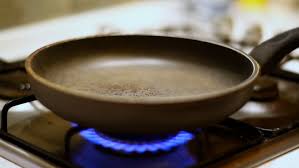
What type of heat transfer is occurring in the picture below? (the pan is touching the burner)

a)

conduction

b)

convection

c)

radiation

d)

insulation

67.

Energy from the Sun travels to Earth as _______.

a)

Conduction

b)

Convection

c)

Insulation

d)

Radiation

68.

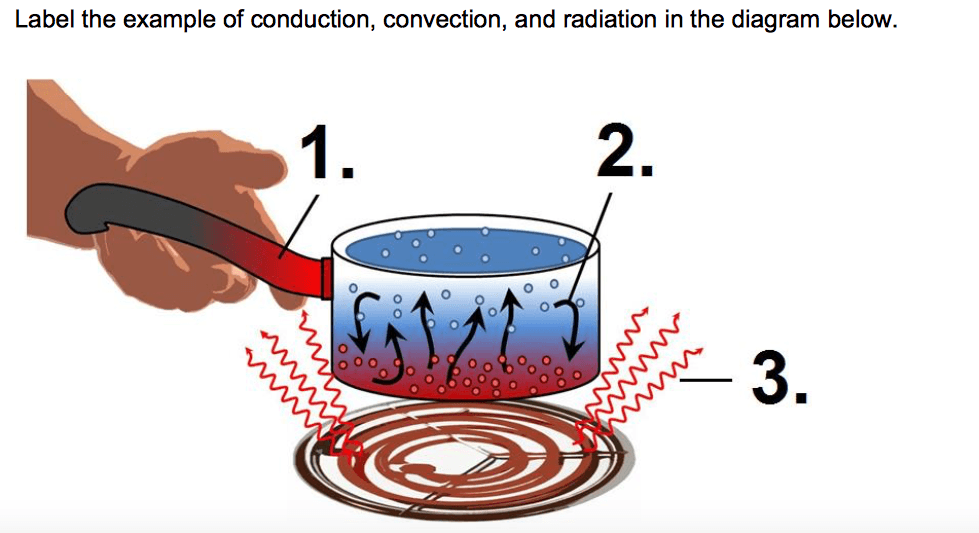
What type of thermal energy transfer is number 1 pointing to?

a)

Convection

b)

Conduction

c)

Radiation

d)

Insulation

69.

What type of thermal energy transfer is number 2 pointing to?

a)

Convection

b)

Conduction

c)

Radiation

d)

Insulation

70.

All energy on earth begins _______.

a)

with the heat produced by pressure inside the earth

b)

photosynthesis by producers

c)

with the sun

d)

with the magma inside the earth