wayground logo

Free Printable Worksheets

NEW

Font size

S
M
L
XL
Worksheets

Cells and Asexual/Sexual Reproduction

Total questions: 31

Worksheet time: 26mins

Name
Class
Date
1.
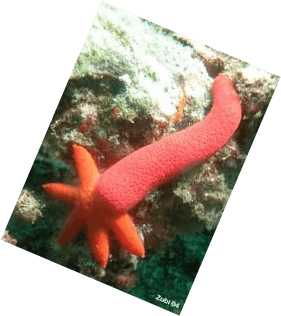
When a starfish grows a new body off a broken arm, what kind of reproduction is this?
a)
Sexual
b)
Differentiation
c)
Asexual 
d)
Specialization
2.
Where does an off spring get its traits in asexual reproduction?
a)
From both parents
b)
From only one parent
c)
From neither parent
d)
There are no traits handed down
3.

Each parent hands down how much DNA to their offspring in sexual reproduction?

a)

75%

b)

25%

c)

50%

d)

100%

4.
Sexual reproduction requires _____ parents and asexual reproduction requires ___ parents
a)
1,1
b)
2,2
c)
2,1
d)
1,2 
5.
What is an advantage of sexual reproduction?
a)
Allows genetic variation
b)
Only needs one parent
c)
Happens very quickly
d)
Offspring are exact copies of parent
6.
What is one disadvantage of sexual reproduction?
a)
Only one parent needed
b)
Off spring are exact copies of parents
c)
Happens very quickly
d)
Needs two parents
7.

Which is a type of Asexual Reproduction

a)

Sexual

b)

Binary fission

c)

Offspring

d)

Nucleus

8.

All of the offspring of an organism have the same genetic material, which is identical to the parent organism. From this, we can conclude that this organism -

a)

makes its own food

b)

is unicellular

c)

live in a marine habitat

d)

reproduces asexually

9.
When comparing the offspring of sexually and asexually reproducing organisms, we would expect the genetic material (DNA) of the sexually reproducing organism to -
a)
contain fewer mutations
b)
be lesser in quantity
c)
be simpler overall
d)
show more variation
10.
What are some of the facts about sexual reproduction?
a)
Takes two mates to reproduce and takes a longer time to reproduce
b)
Takes one mate to reproduce and takes a shorter amount of time to reproduce
c)
Takes two mates to reproduce and takes a shorter amount of time to reproduce
d)
Takes one mate to reproduce and takes a shorter amount of time to reproduce
11.
What are some of the facts about asexual reproduction?
a)
Takes only one mate to reproduce and takes a longer time to reproduce
b)
Takes a shorter amount of time to reproduce and it takes two mates to reproduce
c)
Reproduces diverse offspring and takes a longer time to reproduce
d)
Takes only one mate to reproduce and takes a shorter time to reproduce
12.
A hydra reproduces when an outgrowth, or bud, forms and continues to develop until if falls off of the parent. This is an example of:
a)
Binary Fission
b)
Sporulation
c)
Budding
d)
Vegetative Propagation
13.

Which type of asexual reproduction is occurring here (Hint: Almost *all* cells reproduce this way)

a)

budding

b)

binary fission

c)

sporulation

d)

regeneration

14.

What type of asexual reproduction is taking place?

Fishermen work hard to catch and remove all the starfish that get into their favorite shell fishing beds and the “underwater farms” where they raise clams and oysters. In the past, they put the starfish into their boats, cut them up with knives, and then throw the pieces of starfish overboard. They thought this would kill the starfish. What they did not know was that each piece of starfish will grow into a whole new animal.

a)

Fragmentation

b)

Vegetative propagation

c)

Budding

d)

Fission

15.
When a starfish grows a new body off a broken arm, what kind of reproduction is this?
a)
Sexual
b)
Differentiation
c)
Asexual 
d)
Specialization
16.
Which type of cell has no nucleus?
a)
Eukaryote
b)
Prokaryote
c)
Animal
d)
Plant
17.

True or False: Prokaryotes have a nucleus.

a)

True

b)

False

18.

Of the two types of cells we have studied in class, which is bigger?

a)

Prokaryotic

b)

Eukaryotic

19.

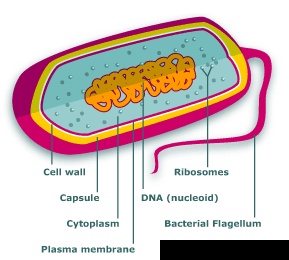
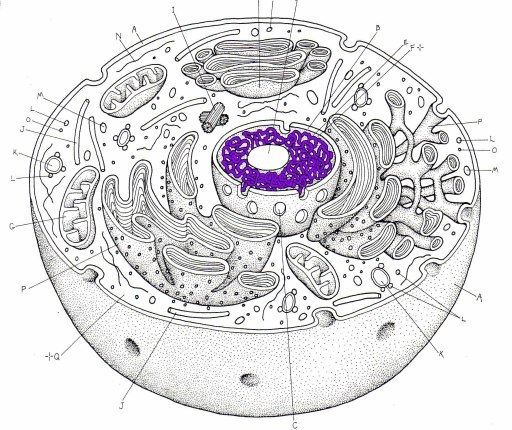
Is this cell prokaryotic or eukaryotic?

a)

Prokaryote

b)

Eukaryote

20.
Where is the DNA found in a prokaryotic cell? 
a)
floating around in the cytoplasm 
b)
in the nucleus 
21.
What type of cell has a nucleus? 
a)
eukaryotic
b)
prokaryotic 
22.
One example of a prokaryote is a...
a)
fungus
b)
bacteria
c)
animal
d)
plant
23.

Which type of cell is seen here; prokaryotic or eukaryotic?

a)

Prokaryote

b)

Eukaryote

24.

True or False: Both prokaryotes and eukaryotes have a nucleus.

a)

True

b)

False

25.

What kind of cell is this? Prokaryotic or Eukaryotic?

a)

Eukaryotic

b)

Prokaryotic

26.
Which of the following is not a characteristic of a Prokaryotic cell?
a)
unicellular
b)
floating DNA
c)
very small
d)
complex
27.
Plants and animal cells are examples of ___ cells 
a)
prokaryotic cells 
b)
eukaryotic cells 
28.
Which type of cell has no nucleus?
a)
Eukaryote
b)
Prokaryote
c)
Animal
d)
Plant
29.

Which is an example of a single-celled organism?

a)

acorn

b)

amoeba

c)

honey bee

30.

Which best describes a function of both multi-celled and single-celled organisms?

a)

to create specialized tissues

b)

to rely on specialized cells to complete certain tasks

c)

to obtain energy from nutrients to maintain life and growth

31.

Which is a multi-cellular organism?

a)

algae

b)

cricket

c)

bacteria