
 Worksheets
Tectonics DCA Retake
Total questions: 20
Worksheet time: 13mins
Which of the following statements demonstrates balanced forces at work on the Earth?
Gravitational forces pulling on a plate
Two transform plates become locked in place
Convection currents in the Asthenosphere pulling on the plates
A transform boundary slips resulting in a release of energy
Which of the following evidence was not proposed for the theory of Continental Drift?
Older rock samples found further from Mid Ocean ridges
Matching mountain ranges across continents
Continents appear to fit like puzzle pieces
Similar fossils found far apart from each other

Which type of pate boundary is shown in this image at letter G and what does it form?
Convergent: Oceanic-Continental, Volcanic Arc
Divergent: Oceanic-Oceanic, Mid ocean ridge
Transform: Continental-continental, earthquake
Convergent: Oceanic-Oceanic, island arc
When an oceanic plate converges with a continental plate what is formed?
Trench
Subduction zone
Volcanic Arc
All of these
At a subduction zone the ____________plate is more dense than the _______________plate and will sink under.
Transform, Divergent
Oceanic, Continental
Continental, Oceanic
Convergent, Divergent
Which of these could occur along a transform boundary?
Deep-sea trench
Earthquake
Volcano
Rift Valley

Which of these events is occurring at letter C?
Subduction Zone
Rift Valley
Hot Spot
Island Arc

Which side of the hill pictured would be the steepest?
North
South
East
West

What is the contour interval for this map?
10
100
1000
50
After the theory of Plate Tectonics was developed further, geologists understood how plates interacted because they determined...
There were only a few plates
There were different types of plate boundaries
Plates are created by volcanoes
Plates are destroyed at mid ocean ridges
This plate boundary produces subduction zones.
Transform
Diverging
Converging
All of these
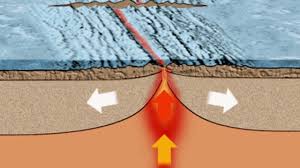
In sea-floor spreading, molten material rises from the mantle and erupts
along the edges of all the continents.
along mid-ocean ridges.
in deep-ocean trenches.
at the north and south poles.

Most geologists think that the movement of Earth’s plates is caused by _______
convection.
continental drift.
subduction.
conduction.
The geological theory of _______ states that pieces of Earth’s lithosphere are in constant, slow motion.
subduction
plate tectonics
deep-ocean trenches
sea-floor spreading

Below is a picture of sea-floor spreading. How are the ocean crusts moving?
Converging
Diverging
Sliding
No movement
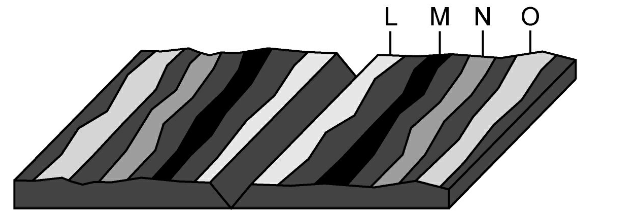

How is it possible for new crust to be formed without increasing the surface area of the Earth?
Crust is destroyed at the same time it is created
New crust is underwater where it sinks
New crust breaks more easily than old crust

