
 Worksheets
Invertebrate Review
Total questions: 55
Worksheet time: 32mins
Name
Class
Date
1.
Which of the following is the correct description of how Porifera get food?
a)
They hunt and capture prey using tetacles
b)
They surround food particles using cytoplasmic extensions
c)
They secrete digestive enzymes and absorb the nutrients
d)
They are suspension feeder that filter food particles out of the water
2.
What type of symmetry do Porifera have?
a)
asymmetrical
b)
bilateral
c)
radial
d)
exoskeleton
3.
Sponges belong in which phylum?
a)
Cnidaria
b)
Porifera
c)
Chordata
d)
Arthropoda
4.

Because sponges cannot move around they are considered ______.
a)
sessile
b)
senile
c)
sedementary
d)
spongin
5.

The protein that makes up a squishy sponge skeleton is called _____.
a)
silica
b)
spongin
c)
spicules
d)
sessile
6.

large opening at the top of a sponge where water exits.
a)
ostia
b)
osculum
c)
orifice
d)
opening
7.

skeleton structures made of silica or calcium carbonate
a)
spicules
b)
spongin
c)
sessile
d)
something
8.

Asexual sponge reproduction where a piece of the adult sponge breaks off and settles in a new area growing to adulthood.
a)
broadcast spawning
b)
branching
c)
budding
d)
forcast spawning
9.

Who lives in a pineapple under the sea?
a)
Spongebob Squarepants
b)
Patrick Star
c)
Mr. Krab
d)
Squidward
10.
What type of symmetry do cnidarians have
a)
asymmetrical
b)
bilateral
c)
radial
d)
medial
11.
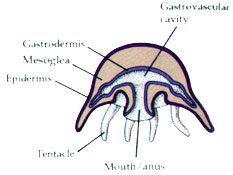
Which body form is represented by this diagram?
a)
Mesoglea
b)
Medusa
c)
Moses
d)
Nematocyst
12.
Polyps are ______, while medusa are ______.
a)
sessile, motile
b)
motile, sessile
c)
both motile and sessile, just motile
13.
When a jellyfish attacks its prey, it using stinging cells called ________________.
a)
Colloblasts
b)
Stingers
c)
Cnidocytes
d)
Blastoscytes
14.

Corals have a mutualistic relationship with a dinoflagellate called:
a)
Ocelli
b)
Zooxanthellae
c)
Sponges
d)
Diatom
15.
All Cnidarians have _____, but no _____.
a)
stinging cells, tissue cells
b)
organs, tissue
c)
tissues, organs
d)
tissue, stinging cells
16.
Which of the following is a correct description of the Cnidarian digestive tract?
a)
A complete digestive tract consisting of two openings.
b)
A complete digestive tract consisting of one opening
c)
An incomplete digestive tract consisting of two openings.
d)
An incomplete digestive tract consisting of one opening.
17.
What surrounds the mouth of Cnidarians?
a)
guard cells
b)
pinococytes
c)
tentacles
d)
spines
18.
What is the hard structure that provides the foundation for the reef?
a)
limestone
b)
sandstone
c)
concrete
d)
granite
19.
Flat body
a)
Phylum Platyhelminthes
b)
Phylum Nematoda
c)
Phylum Annelida
20.
One hole in digestive system
a)
Phylum Platyhelminthes
b)
Phylum Nematoda
c)
Phylum Annelida
21.
When an animal regrows a missing body part it has...
a)
Budded
b)
Regenerated
22.
The majority of flatworms are parasitic.
a)
True
b)
False
23.

Which phylum of worms has a bilateral symmetry, one-way digestive system, respiration through skin, hydrostatic skeleton and segmented body?
a)
Annelida
b)
Platyhelminthes
c)
Nemotoda
d)
Nemertea
24.
Which phylum do roundworms belong to?
a)
Turbellaria
b)
Cestoda
c)
Nematoda
d)
Porifera
25.

This Bobbit worm has a segmented body. What Phylum of Marine Worm would that be?
a)
Platyhelminthes
b)
Annelida
c)
Tube Worm
d)
Nematoda
26.
Which class of Mollusks include clams, oysters, and mussels?
a)
Gastropods
b)
Bivalves
c)
Cephalopods
d)
Arthropods
27.

Which mollusk group does this represent?
a)
Class Gastropoda
b)
Class Bivalvia
c)
Class Cephalopoda
d)
Class Polyplacophora
28.
The word 'arthropod' means...
a)
eight foot
b)
jointed foot
c)
flexible foot
d)
hard foot
29.
All arthropods have segmented bodies, jointed appendages, and ________________.
a)
tails
b)
lungs
c)
wings
d)
an exoskelton
30.
Which of the following is a correct description of the polyp body form?
a)
It is sessile and the tentacles and mouth point downward.
b)
It is sessile and the mouth and tentacles point upward.
c)
It is mobile and the tentacles and mouth point downward.
d)
It is mobile and the tentacles and mouth point upward.
31.

To which group of mollusks does this animal belong?
a)
Class Gastropoda
b)
Class Bivalvia
c)
Class Cephalopoda
d)
Class Polyplacophora
32.
Phylum Cnidaria is known as
a)
"stinging cells"
b)
"Tentacles"
c)
"Cleaners"
d)
"Sponges"
33.

I am spiny and have a water vascular system with tube feet. I am a sea cucumber.
a)
Cnidarian
b)
Echinoderm
c)
Mollusk
d)
Annelid
34.

These all belong to the phylum _________, the largest phylum.
a)
porifera
b)
annelida
c)
arthropoda
d)
cnidaria
35.

I am spiny, have a water vascular system with tube feet, radial symmetry, and am called a brittle star.
a)
Mullosk
b)
Arthropod
c)
Echinoderm
d)
Cnidarian
36.
Which of the following is an example of a crustacean?
a)
squid
b)
crab
c)
earth worm
d)
bumble bee
37.

I have a soft-body, a hard shell, and live on land and water. What am I?
a)
Mollusk
b)
Arthropod
c)
Echinoderm
d)
Cnidarian
38.

Which is not a main class within the phylum of mollusca?
a)
crustacean
b)
cephalopod
c)
gastropod
d)
bivalve
39.
Which of the following is an example of a arthropod?
a)
squid
b)
crab
c)
earth worm
d)
sea star
40.

What does cephalopod mean?
a)
head foot
b)
stomach foot
c)
having two shells
d)
soft bodied
41.
What does the term echinoderm mean?
a)
"jointed limbs"
b)
"spiny skinned"
c)
"endoskeleton"
d)
"shiny tube foot."
42.

The "blue dragon" is really what kind of animal?
a)
arthropod
b)
nudibranch
c)
nemertea
d)
cnidarian
43.

What makes the flamboyant cuttlefish special?
a)
it's the largest cuttlefish
b)
it's highly toxic
c)
it has great camoflauge
d)
it pretends to be a female cuttlefish during mating season
44.

Appendages on the abdomen that create water currents, transfer sperm and carry young
a)
Maxillipeds
b)
Chelipeds
c)
Swimmerets
d)
Uropods
45.

Echinoderms are the only marine invertebrates with this type of body structure:
a)
Exoskeleton
b)
Adductor muscles
c)
Spicules
d)
Endoskeleton
46.
Which of the following is NOT a trait that Mantis Shrimp are known for?
a)
swift and powerful punch
b)
bright color
c)
protruding stomach
d)
keen eyesight/vision
47.
WHAT ARE THE COLOR CELLS LOCATED ON THE DORSAL SIDE OF THE SQUID?
a)
COLOR CELLS
b)
CHROMATOPHORES
c)
BROWN CELLS
d)
CAMOUFLAGE
48.
WHAT DO SQUID USE TO MOVE QUICKLY?
a)
ARMS
b)
EYES
c)
SIPHON
d)
TENTACLES
49.
Which class of Mollusks includes snails and slugs?
a)
Cephalapods
b)
Bivalves
c)
Gastropods
50.
Which part of the Mollusk body is specialized for burrowing, feeding, and movement?
a)
trochophores
b)
visceral mass
c)
mantle
d)
foot
51.

What's the common name of the deep sea, gutless worm that live near hot water sea vents?
a)
Tusk shells
b)
Giant tube worms
c)
Sand worms
d)
Krill
52.

What is the spear like appendage on the head of some worms that are used for killing prey?
a)
Coelom
b)
Parapodia
c)
Ganglia
d)
Proboscis
53.
Most anterior legs on crayfish that have pincers for capturing food and defense
a)
chelipeds
b)
swimmerets
c)
mandibles
d)
maxillae
54.
What is molting?
a)
The process in which arthropods reproduce
b)
The process in which arthropods shed their exoskeleton and grow a larger one.
c)
The process in which larval forms develop into adult forms
d)
The process in which arthropods breathe
55.

The cells in skin of cephalopods that allow them to change colors are called
a)
pigmentocytes
b)
chromatophores
c)
dermatophores
d)
branchiocytes
100 %

