
 Worksheets
Quarter 3 Review
Total questions: 49
Worksheet time: 2hrs 40mins
Name
Class
Date
1.
Which of the following was not conquered by the Greeks during the Hellenistic period?
a)
China
b)
Persia
c)
Mesopotamia
d)
Egypt
2.
What is the name of a place in Egypt named after Alexander the Great? This is also known for its vast library.
a)
Alexander
b)
Aleandrio
c)
Alexandria
d)
Alessandria
3.
Hellenistic civilization refers to the fusion of Greek civilization with other civilization due to the conquests made by Alexander the Great.
a)
True
b)
False
4.
which society was the first to practice direct democracy?
a)
city-state of Athens
b)
empire of Alexander the great
c)
city-state of Sparta
d)
Persian Empire
5.
Why is the Hellenistic Empire considered a great achievement?
a)
allowed for the emergence of Christianity
b)
promoted the development of democracy
c)
the establishment of Greek city-states
d)
facilitated the spread and preservation of Greek knowledge
6.

What word best describes the land of the Greek peninsula?
a)
rocky and mountainous
b)
flat
c)
desert
d)
rolling plains
7.

Who was the leader of Athens after the defeat of the Persians and took Athens into a "Golden Age" of prosperity and achievement?
a)
Pericles
b)
Leonidas
c)
Themistocles
d)
Socrates
8.

A city-state which favored democracy and a well-rounded education.
(Also, the largest city-state by a wide margin)
(Also, the largest city-state by a wide margin)
a)
Sparta
b)
Athens
c)
Delphi
d)
Corinth
9.
Which of these was a result of the geographic conditions of Greece in their early civilization?
a)
unified political organization
b)
withdrawal from international contact
c)
a society centered around plantations
d)
a reliance of sea-based commerce
10.
Which statement is TRUE?
a)
Athenian women were expected to receive a formal education.
b)
Athenian women were expected to participate in athletic events.
c)
Athenian women were expected to be housekeepers.
d)
Athenian women were expected to train for military service.
11.
Who could vote in Ancient Athens?
a)
Only male citizens
b)
Only female citizens
c)
Both male and female citizens
12.
________are 2 officials elected by the senators who serve for 1-year terms.
a)
Consuls
b)
Senate
c)
Tribunes
d)
Dictators
13.
This group was part of the lower or middle class. Common people.
a)
Patricians
b)
Plebeians
c)
Slaves
d)
Priests
14.
Composed of 300 men that advised consuls and dictated political appointments.
a)
Consuls
b)
Senate
c)
Tribunes
d)
Tribal Assembly
15.
We were posted in the Forum for all to see, the recorded laws of Rome
a)
The Ten Commandments
b)
Hammurabi's Code
c)
Justinian's Code of Law
d)
The Twelve Tables
16.
What term describes an action taken by a leader in which they say no to a law?
a)
consul
b)
legion
c)
tribune
d)
veto
17.
What is a main difference between the current U.S. government and that of the Roman republic?
a)
Women are allowed to vote.
b)
A system of checks and balances is in place.
c)
The senate is a branch of government.
d)
Officials can veto other officials.
18.

What does Republic mean?
a)
Common people in Rome.
b)
A form of government with elected leaders,
c)
Wars fought in Rome.
d)
A person trained to fight.
19.
What was one major benefit of living near the Mediterranean Sea
a)
winters were always very cold
b)
it was easy to get invaded
c)
it helped facilitate trade
d)
the sea was too rough for foreigners to navigate
20.
Rome’s 200 years of peace was called the...
a)
Age of Augustus.
b)
Resurrection.
c)
Pax Romana.
d)
Crucifixion.
21.

What Roman architectural contribution allowed the construction of higher, more stable structures such as the aqueducts and the Colosseum?
a)
columns
b)
arches
c)
lintels
d)
marble
22.

Roman roads were built primarily in order to allow...
a)
senators to get to the Senate.
b)
Rome’s armies to travel through the empire.
c)
merchants to travel safely.
d)
slaves to travel into the countryside.
23.
How did Constantine affect Christianity?
a)
He made Christianity legal in 313 AD
b)
He placed even more bans on the religion.
c)
He persecuted Christians in the Colosseum.
d)
He moved the capital of Rome to the Eastern Empire.
24.
The Roman Empire fell for all of the following reasons EXCEPT...
a)
barbarian invasions
b)
strong leadership
c)
inflation
d)
political corruption
25.
What event do many historians consider the end of the Western Roman Empire?
a)
Constantine dividing the empire
b)
a barbarian general overthrowing the emperor and naming himself king
c)
a Roman general overthrowing the emperor and naming himself king
d)
Justinian moving the capital to the east
26.
What is a martyr?
a)
A person who dies for Christianity
b)
A person who protests against war
c)
A person who dies for their political beliefs
d)
A person who dies for their beliefs
27.
Which was NOT a cause of the fall of the Empire?
a)
Political Instability
b)
The empire became too small
c)
Economic problems
d)
It became too large to manage effectively.
28.
Who moved the capital from Rome to Byzantium?
a)
Augustus
b)
Nero
c)
Constantine
d)
Caesar
29.
What was the Byzantine empire often called?
a)
Eastern Roman Empire
b)
Europa
c)
Persia
d)
World rulers
30.
Which of the following was not a cause of the fall of the Roman empire?
a)
Internal conflicts over power
b)
External attacks from the Huns, Franks, Goths, and Vandals
c)
Over-extending borders beyond their capability of defense
d)
Drought and disease
31.
Which achievement allowed Rome to maintain contact with its large empire?
a)
the Colosseum
b)
the aqueduct system
c)
the road system
d)
the Julian calendar
32.
What was the primary language of the Byzantine Empire?
a)
Greek
b)
Roman
c)
Latin
d)
Turkish
33.
Constantinople saw natural protection due to its location on a
a)
Mountain
b)
Island
c)
Fjord
d)
Peninsula
34.
Justinian's most famous achievement is the
a)
Wall of Constantine
b)
Holy Crusade
c)
Crowning of Charlemagne
d)
Justinian Code
35.

Which groups had the most influence on the government, culture and beliefs of the Byzantine Empire?
a)
Arians, Huns and Vandals
b)
Muslims and Persians
c)
Jews and Visigoths
d)
Romans, Greeks and Christians
36.
Why was Constantinople such a prosperous city?
a)
Trade hub for Europe, Asia, and Africa
b)
Great architecture
c)
Autocratic rulers
d)
The pope lives there
37.
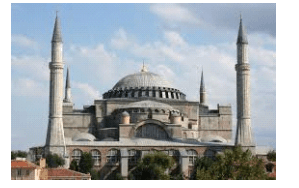
Identify this Byzantine Church that was commissioned by Justinian.
a)
Hagia Sophia
b)
National Cathedral
c)
Notre Dame
d)
Taj Mahal
38.

Justinian was the ruler of the Byzantine Empire from 537 AD until 565 AD. He contributed to the field of law by creating the Justinian Code. The Justinian Code was significant because
a)
it stated that the emperor had to follow the same laws that the people did.
b)
it preserved Roman laws and influenced legal systems of the Middle Ages.
c)
it established the principle of separation of church and state.
d)
it was the first written constitution to protect citizens' rights.
39.

All of the following were legacies of Byzantine Empire EXCEPT
a)
Preservation of Roman Laws that would serve as the basis for modern European law
b)
Spread of Christianity throughout Russia and Eastern Europe
c)
Continuation of Greek democratic traditions
d)
Lasting accomplishments in the arts, architecture and literature
40.
All of the following were achievements of the GOLDEN AGE of ISLAM EXCEPT.....
a)
Algebra
b)
Weighing of Minerals
c)
Creation of Hospitals and Universities
d)
The Renaissance
41.
Read the passage and use context clues to complete the statement that follows.
"Muhammad was troubled by the moral ills of Meccan society, especially greed. He often went to a cave in the hills near Mecca to meditate. According to Muslim belief, when he was about 40 years old he heard the voice of the angel Gabriel calling him to be the messenger of God. Muhammad was terrified and puzzled. How could he, an illiterate merchant, become the messenger of God? [His wife] Khadija encouraged him to accept the call."
This passage predicts that...
"Muhammad was troubled by the moral ills of Meccan society, especially greed. He often went to a cave in the hills near Mecca to meditate. According to Muslim belief, when he was about 40 years old he heard the voice of the angel Gabriel calling him to be the messenger of God. Muhammad was terrified and puzzled. How could he, an illiterate merchant, become the messenger of God? [His wife] Khadija encouraged him to accept the call."
This passage predicts that...
a)
Muhammad established the first caliphate.
b)
Muhammad began to urge Arabs to give up pagan gods and worship the one true God.
c)
Muhammad won the loyalty of his first converts.
d)
Muhammad first formulated the Five Pillars.
42.
Which list places events in the correct sequence?
a)
Muhammad dies , Abu Bakr unifies followers , Arab Muslims defeat Byzantines and Persians , Abbasid Caliphate established , Umayyad Caliphate established
b)
Arab Muslims defeat Byzantines and Persians, Muhammad dies, Abu Bakr unifies followers, Abbasid Caliphate established, Umayyad Caliphate established
c)
Abu Bakr unifies followers, Muhammad dies, Umayyad Caliphate established, Arab Muslims defeat Byzantines and Persians, Abbasid Caliphate established
d)
Muhammad dies, Abu Bakr unifies followers, Arab Muslims defeat Byzantines and Persians, Umayyad Caliphate established, Abbasid Caliphate established
43.
What cities became cultural centers for the Islamic Empire?
a)
Cordoba and Mecca
b)
Mecca and Damascus
c)
Kaaba and Bagdad
d)
Bagdad (House of Knowledge) and Cordoba
44.
One of the two groups that divided Islam, they believed that caliphs did not have to be related to Muhammed.
a)
Shia/Shiites
b)
Sunni
c)
Safavids
d)
Ottomans
45.
Because they could not show animal or human images, Muslim artists turned into an art form.
a)
Trading
b)
Missionary work
c)
Calligraphy
d)
Mosiac
46.
How did trade affect the spread of Islam?
a)
They allowed trade over sea
b)
Trade did not affect spread of Islam
c)
It allowed interaction with others to spread the word about Islam
d)
They traded their word for goods
47.
Where did Islam spread after Muhammad's death?
a)
all around the world
b)
the entire continent of Africa
c)
across Asia and Africa and into Spain
d)
into Australia
48.
What does caliph mean?
a)
Leader/king
b)
Teacher
c)
Coach
d)
Doctor
49.
When Muslims conquered new territories they allowed Christians and Jews to keep their own religion.
a)
True
b)
False
100 %

