
 Worksheets
#19 - What do you know about SPACE...The Final Frontier?
Total questions: 40
Worksheet time: 32mins
Name
Class
Date
1.
The spinning of the Earth on its axis that causes night and day.
a)
Rotate
b)
Revolve
2.
The sun and everything that revolves around it.
a)
solar system
b)
galaxy
c)
universe
d)
rotation
3.
The imaginary line running through the center of Earth.
a)
axis
b)
moon
c)
constellation
d)
orbit
4.
The star at the center of our solar system.
a)
Sun
b)
moon
c)
orbit
d)
axis
5.
The moon appears to change shape because of _____.
a)
the Moon's revolution around Earth
b)
the seasons of the year
c)
the movement of stars in they sky
d)
Earth's rotation on its axis
6.
What causes Earth's seasons?
a)
the tilt of Earth's axis
b)
Earth's rotation
c)
the revolution of the Moon
d)
Earth's distance from the Sun
7.
The rotation of Earth on its axis causes the pattern of _____.
a)
night and day
b)
constellations
c)
Earth's seasons
d)
the phases of the moon
8.
It takes Earth _________ to make one complete rotation on its axis.
a)
24 hours
b)
365 days
c)
28 days
d)
24 days
9.
It takes Earth _____________ to make one revolution or orbit around the Sun.
a)
365 days
b)
365 hours
c)
28 days
d)
24 hours
10.
It takes about _____________ for the moon to go through all of its phases.
a)
28 days
b)
365 days
c)
24 hours
d)
24 days
11.
A large body made of gas or rock that orbits around a star.
a)
planet
b)
moon
c)
star
d)
super nova
12.
To increase or get bigger.
a)
Waxing
b)
Waning
13.
To decrease or get smaller
a)
waning
b)
waxing
14.
A rocky body that orbits around a planet.
a)
moon
b)
star
c)
axis
d)
Sun
15.
A tool used to make distant objects appear larger, brighter, and sharper.
a)
telescope
b)
planet
c)
moon
d)
microscope
16.
The ____________ of an object effects its gravitational pull.
a)
Atmosphere
b)
Escape Velocity
c)
Mass
d)
Light
17.
The largest planet in our solar system is
a)
Uranus
b)
Neptune
c)
Pluto
d)
Jupiter
18.
How many Earth's will fit inside the sun?
a)
A little over 1 million
b)
1500
c)
A little over 2 million
d)
4 million
19.
Why is the Hubble telescope located in space?
a)
So it can be closer to the stars it magnifies
b)
They have very large optical lenses
c)
So its images arent distorted by Earth's atmosphere
d)
So it can be operated by astronauts
20.
What is an asteroid?
a)
rocky, metallic tiny planet that orbits the sun
b)
chunk of dirt and ices
c)
a mixture of gases
d)
a smaller chunk of stony matter, also known as a shooting star
21.
What is a meteor?
a)
rocky, metallic tiny planet that orbits the sun
b)
chunk of dirt and ices
c)
a mixture of gases
d)
a smaller chunk of stony matter, also known as a shooting star
22.
What is a comet?
a)
rocky, metallic tiny planet that orbits the sun
b)
chunk of dirt and ices
c)
a mixture of gases
d)
a smaller chunk of stony matter, also known as a shooting star
23.
Which of the following is true?
a)
Earth is the center of the solar system
b)
The sun orbits the earth
c)
Gravity exists only on Earth
d)
The sun is the center of the solar system
24.
How long is Earth's revolution?
a)
one day
b)
one year
c)
one decade
d)
one hour
25.
How long is Earth's rotation?
a)
one day
b)
one year
c)
one decade
d)
one hour
26.

How many planets are there?
a)
6
b)
7
c)
8
d)
9
27.
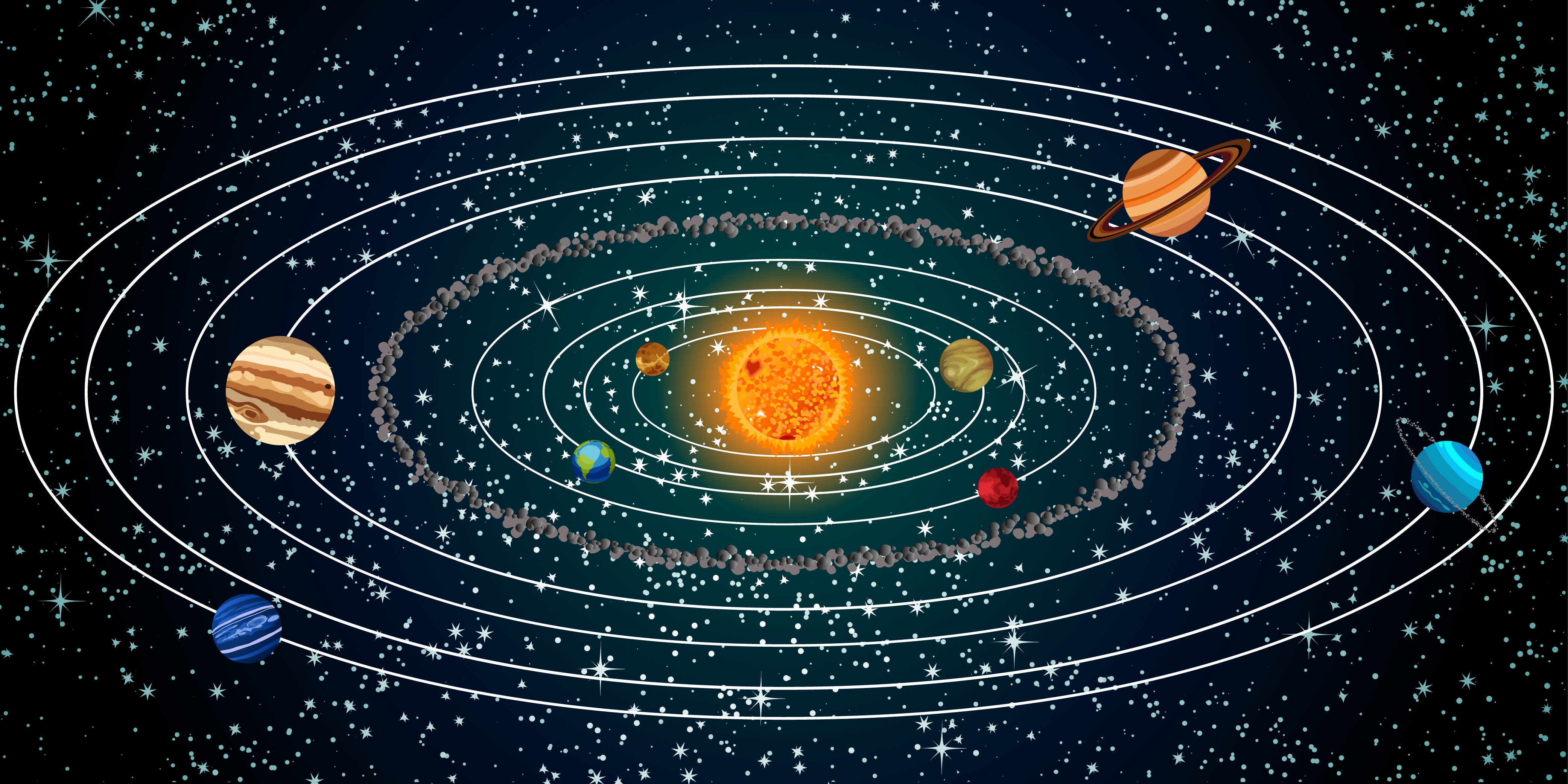
Why do planets orbit the sun (and not float around in space)?
a)
the moons are keeping them in place
b)
They were hit by an asteroid
c)
they were hit by a comet
d)
the sun's gravity keeps them in place
28.
What do scientists use to take pictures in space?
a)
mirror
b)
microscope
c)
oscilloscope
d)
satellite
29.
What is the hottest planet in our System?
a)
The Sun
b)
Mars
c)
Mercury
d)
Venus
30.
What is the farthest planet in our Solar System?
a)
Neptune
b)
Uranus
c)
Pluto
d)
Saturn
31.
Which planet has been re-classified as a dwarf planet?
a)
Mars
b)
Mercury
c)
Neptune
d)
Pluto
32.
A sun centered system of planets was developed by __________
a)
Galileo
b)
Ptolemy
c)
Copernicus
d)
Issac Newton
33.
When the Moon appears completely dark with no lit part visible from Earth, it is called _____________.
a)
full moon
b)
waning gibbous moon
c)
old moon
d)
new moon
34.
Which planet is between Venus and Mars?
a)
Earth
b)
Neptune
c)
Mercury
d)
Jupiter
35.

Earth and the other planets closest to the Sun are made mostly of _______
a)
gas
b)
metal
c)
water
d)
rock
36.

For a solar eclipse to occur,
a)
the sun must be directly between Earth and the moon.
b)
The moon must be directly between Earth and the moon
c)
the moon must be directly behind Earth
d)
Earth must be directly between the sun and the moon
37.

This Greek philosopher promoted the geocentric theory that Earth was the center of the universe
a)
Ptolemy
b)
Copernicus
c)
Galieo
d)
Socrates
38.

This planet is the "jewel" of the solar system because it is surrounded by rings of dust, ice, and rocks.
a)
Neptune
b)
Earth
c)
Jupiter
d)
Saturn
39.

This planet is known as the Red Planet due to the breakdown of iron rich rocks. Like Earth it has four seasons and rotates on it's axis a little more than 24 hours day
a)
Mars
b)
Mercury
c)
Venus
d)
Neptune
40.
Unlike Earth, the Moon has no _____________.
a)
gravity
b)
atmosphere
c)
surface
d)
landforms
100 %

