
 Worksheets
5th 6 Weeks Review: Earth Science
Total questions: 34
Worksheet time: 26mins
Name
Class
Date
1.

Name this boundary
a)
Convergent
b)
Divergent
c)
Transform
d)
Sergent
2.

Name the boundary
a)
divergent
b)
convergent
c)
transform
d)
sergent
3.

Name the boundary
a)
convergent
b)
transform
c)
divergent
d)
sergent
4.
Which of the following is where one plate slides under another plate?
a)
submarine zone
b)
divergence zone
c)
subduction zone
d)
lower zone
5.
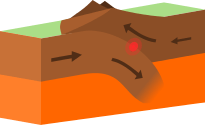
What type of plate boundary is this?
a)
Plate
b)
Divergent
c)
Convergent
d)
Transform
6.

One large landmass of all continents together...
a)
North America
b)
Pangaea
c)
South America
d)
PanAmerica
7.

The _________ is the thinnest layer of Earth.
a)
outer core
b)
inner core
c)
mantle
d)
crust
8.

Plates move apart at _________ boundaries.
a)
volcanic
b)
divergent
c)
convergent
d)
transform
9.

What type of event will occur at this boundary?
a)
Earthquake
b)
Volcano Eruption
c)
Tornado
d)
Mountain Building
10.
The part of the earth that includes the crust and the upper mantle and is split into tectonic plates is the
a)
lithosphere
b)
crust
c)
asthenosphere
d)
mantle
11.
The hottest layer
a)
crust
b)
inner core
c)
mantle
d)
outer core
12.
The coolest layer
a)
crust
b)
inner core
c)
mantle
d)
outer core
13.
The circular pattern of heating, rising, cooling, sinking of magma in the mantle causing tectonic plates to move.
a)
Plate Tectonics
b)
Convection Currents
c)
Pangaea
d)
Subduction
14.

Plate 1
a)
Indo-Australian
b)
Pacific Plate
c)
South American
d)
Eurasian
15.

Plate 2
a)
Indo-Australian Plate
b)
Pacific Plate
c)
South American Plate
d)
Eurasian Plate
16.

Plate 3
a)
North American Plate
b)
South American Plate
c)
African Plate
d)
Eurasian Plate
17.

Plate 4
a)
North American Plate
b)
African Plate
c)
Antarctic Plate
d)
Nazca Plate
18.

Plate 5
a)
Indo-Austrailian
b)
South American
c)
African
d)
North American
19.

Plate 6
a)
South American
b)
Antarctic
c)
African
d)
Nazca
20.

Plate 7
a)
Pacific Plate
b)
Eurasian Plate
c)
African Plate
d)
Nazca Plate
21.

Plate 8
a)
North American
b)
South American
c)
Antarctic Plate
d)
African
22.
What is a subduction zone?
a)
where plates move into each other
b)
where plates are moving away form each other
c)
where plates move past each other
d)
area where one plate slips under another plate
23.
What type of boundary will create mountains?
a)
Convergent Plates
b)
Divergent Plates
c)
transforming plates
24.
Which type of rock results from melting and cooling of magma?
a)
Igneous
b)
Metamorphic
c)
Sedimentary
d)
Extrusive
25.
Which type of rock forms from extreme heat and pressure?
a)
Igneous
b)
Sedimentary
c)
Organic
d)
Metamorphic
26.
A metamorphic rock changes into an igneous rock by what two processes?
a)
Melting and cooling
b)
Extreme heat and pressure
c)
Compaction and cementation
d)
Weathering and erosion
27.
What is the MAIN way rocks are classified?
a)
Their color and shapes
b)
How they form
c)
Mineral bands
d)
Where they form
28.
Which type of rock results from melting and cooling of magma?
a)
Igneous
b)
Metamorphic
c)
Sedimentary
d)
Extrusive
29.
A metamorphic rock changes into an igneous rock by what two processes?
a)
Melting and cooling
b)
Extreme heat and pressure
c)
Compaction and cementation
d)
Weathering and erosion
30.
True/False: Igneous rocks can only turn into metamorphic rocks.
a)
True
b)
False
31.

Each rock type can follow only one pathway of the rock cycle.
a)
True
b)
False
32.

This rock was formed by lots of fossils that settled on top of each other over time. What type of rock is this?
a)
Sedimentary
b)
Igneous
c)
Metamorphic
33.

This rock is made from tiny pieces of other rocks that settled to the bottom of a valley millions of years ago. What type of rock is this?
a)
Sedimentary
b)
Igneous
c)
Metamorphic
34.

This rock started as molten magma. What type of rock is this?
a)
Sedimentary
b)
Igneous
c)
Metamorphic
100 %

