
 Worksheets
Post-Test Review
Total questions: 65
Worksheet time: 55mins
Name
Class
Date
1.
Identify the basic force that drives plate tectonics.
a)
Earth's magnetic field
b)
convection currents in the mantle
c)
tidal influence of the sun
d)
gravitational pull of the sun
2.
What process forms new oceanic lithosphere?
a)
subduction
b)
volcanic eruptions along mid-ocean ridges
c)
volcanic eruptions in the ocean trenches
d)
earthquakes in rift zones
3.
What theory states the Earth's lithospheric plates move slowly relative to one another driven by convection currents?
a)
plate evolution
b)
uniformitarianism
c)
plate tectonics
d)
paleomagnetism
4.
What theory states the Earth's lithospheric plates move slowly relative to one another driven by convection currents?
a)
plate evolution
b)
uniformitarianism
c)
plate tectonics
d)
paleomagnetism
5.
What process involves old ocean lithosphere being pulled by gravity deep into the mantle?
a)
rising mantle plumes
b)
formation of hot spots
c)
ridge-push
d)
slab-pull
6.
Volcanic activity is associated with all of the following plate boundaries except...
a)
transform fault boundaries
b)
oceanic-continental convergent boundary
c)
divergent boundaries
d)
oceanic-oceanic convergent boundaries
7.
Choose the best answer that describes a subduction zone.
a)
where an oceanic plate is forced beneath a second plate
b)
where an oceanic plate grinds past a second plate
c)
where a continental plate grinds past a second plate
d)
where an oceanic plate moves away from a second plate
8.
Which one of these pieces of evidence does NOT support the hypothesis of the sea-floor spreading?
a)
magnetic strips in the ocean floor rock
b)
similar aged fossils found on different continents
c)
age of the ocean floor
d)
earthquake patterns in the subduction zones
9.
_____ has occurred when rocks formed millions of years ago show the location of the magnetic poles at the time of their formation.
a)
fossilization
b)
metamorphism
c)
cementation
d)
paleomagnetism
10.
Which one of the following is not a type of a plate boundary?
a)
convergent boundary
b)
divergent boundary
c)
subduction boundary
d)
transform-fault boundary
11.
Which law/principle states that in an undisturbed rock layer, the oldest layer is at the bottom?
a)
superposition
b)
radiocarbon dating
c)
cross-cutting relationships
d)
original horizontality
12.
What is the mechanism of plate motion in which the sinking plate pulls on the plate?
a)
ridge-push
b)
mantle convection
c)
slab-pull
d)
tectonic sinking
13.
What is the mechanism of plate motion in which the force of the new crust formed at the ridge pushes on the plate?
a)
ridge-push
b)
mantle convection
c)
slab-pull
d)
tectonic sinking
14.
Where would a geologist find the youngest oceanic crust?
a)
at the continental margins
b)
at mid-ocean ridges
c)
between the continental margins and the ridge crust
d)
at a transform boundary
15.
Which Law/Principle states that layers of sediments are generally deposited in a horizontal or nearly horizontal position?
a)
superposition
b)
uniformitarianism
c)
cross-cutting relationships
d)
original horizontality
16.
The dating process that places rock layers in proper sequence is called what?
a)
numerical dating
b)
temporary dating
c)
relative dating
d)
radiometric dating
17.
How long ago did Earth form?
a)
2.34 billion years ago
b)
4.56 billion years ago
c)
3.45 billion years ago
d)
5.67 billion years ago
18.
What is made up of nickel and iron in the Earth?
a)
core
b)
crust
c)
mantle
d)
atmosphere
19.
Mountains are formed by...
a)
wind slowly building up rocks
b)
erosion
c)
lowering of the sea level
d)
folding and faulting of the Earth's crust
20.
What is Half-life?
a)
The amount of time it takes for some of the nuclei in a sample of the isotope to decay
b)
The amount of time it takes for half the electrons in a sample of the isotope to decay
c)
The amount of time it takes for half the nuclei in a sample of the isotope to decay
d)
the amount of time it takes to double the nuclei in a sample of the isotope to decay
21.

What percent of carbon-14 would be left after 5730 years?
a)
100%
b)
75%
c)
50%
d)
25%
22.
The process by which water, wind, ice, and changes in temperature break down rock into fragments called sediments.
a)
Deposition
b)
Erosion
c)
Weathering
d)
Igneous Rock
23.
Rock that forms when pressure, temperature, or chemical processes change existing rock.
a)
Igneous Rock
b)
Sedimentary Rock
c)
Metamorphic Rock
d)
Rock Cycle
24.
Rock that forms when minerals form from solutions or sediment from older rocks get pressed and cemented together.
a)
Sedimentary Rock
b)
Metamorphic Rock
c)
Igneous Rock
25.
The process by which metamorphic rocks are formed...
a)
heat and pressure
b)
compaction and cementation
c)
melting and cooling
26.
The process by which igneous rocks are formed...
a)
heat and pressure
b)
melting and cooling
c)
compaction and cementation
27.
The name rock is given when it is broken down into smaller pieces.
a)
texture
b)
weathering
c)
sediment
d)
erosion
28.
The process by which sediment is moved from one place to another. Can be caused by water, wind, ice, and gravity.
a)
Rock Cycle
b)
Uplift
c)
Deposition
d)
Erosion
29.

This rock was formed by lots of fossils that settled on top of each other over time. What type of rock is this?
a)
Sedimentary
b)
Igneous
c)
Metamorphic
30.

This rock cooled on the outside of a volcano and contained air bubbles when it was forming. What type of rock is this?
a)
Sedimentary
b)
Igneous
c)
Metamorphic
31.

This rock was another type of rock that was heated and compressed over time. What type of rock is this?
a)
Sedimentary
b)
Igneous
c)
Metamorphic
32.

This rock started as molten magma. What type of rock is this?
a)
Sedimentary
b)
Igneous
c)
Metamorphic
33.
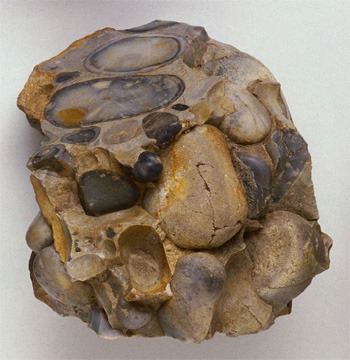
This rock was formed by smaller pieces of rock that settled at the bottom of a lake millions of years ago. What type of rock is this?
a)
Sedimentary
b)
Igneous
c)
Metamorphic
34.
What does it mean for a rock to be extrusive
a)
Have layers
b)
Have Rounded Edges
c)
Form from Lava
d)
Form By Sediment
35.
Which of the following is NOT a cause of an earthquake?
a)
Collapse of Cavern
b)
Eruption of Volcano
c)
Lightning Strikes
d)
Moving Tectonic Plates
36.
What is a smaller earthquake that follows a larger earthquake?
a)
Aftershock
b)
Liquefaction
c)
Seismic Gap
d)
Tsunami
37.
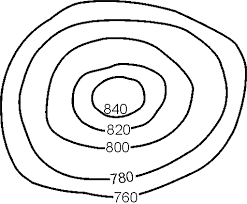
Determine the contour interval:
a)
5 m
b)
10 m
c)
15 m
d)
20 m
38.

In which direction is Mill River flowing?
a)
Southeast
b)
Southwest
c)
Northeast
d)
Northwest
39.

Which direction is the river flowing?
a)
north
b)
south
c)
east
d)
west
40.
"Where the water filters into the ground and into the tiny pores in the soil" What am I?
a)
Infiltration
b)
Percolation
c)
Precipitation
d)
Interception
41.
"I am the movement of water sideways through the soil" What am I?
a)
Throughflow
b)
Rock flow
c)
Soil flow
d)
Groundwater flow
42.

I am the land that gets flooded when the river overflows. What am I?
a)
Levee
b)
Delta
c)
Floodplain
d)
Meander
43.
any form of water that falls to Earth’s surface from the clouds, including rain, snow, sleet, and hail
a)
desalination
b)
delta
c)
tributary
d)
precipitation
44.
change of state from a gas to a liquid
a)
evaporation
b)
condensation
c)
desalination
d)
precipitation
45.
area of land drained by a river system
a)
tributary
b)
delta
c)
floodplain
d)
watershed
46.
volume of water moved by a stream in a given time period
a)
tributary
b)
delta
c)
discharge
d)
evaporation
47.
Stream discharge is a function of the channel's width, depth, and
a)
length
b)
velocity
c)
sediment size
d)
slope
48.
Porosity refers to...
a)
the shape of the particles
b)
The sorting of the particles
c)
% of pore space in a material
d)
% of cement in a material
49.
The measure of how easily water can flow through an aquifer.
a)
porosity
b)
permeability
c)
gradient
d)
divide
50.
All frozen water on Earth is...
a)
Hydrosphere
b)
Geosphere
c)
Cryosphere
d)
Atmosphere
51.

The movement of ocean water is controlled by
a)
Density
b)
Temperature
c)
Salinity
d)
Wind
52.
large whirls of water within and ocean basin are called
a)
gyres
b)
ocean currents
c)
surface currents
d)
eddys
53.
What factors control ocean circulation?
a)
salinity and temperature
b)
latitude and longitude
c)
continental and maritime
d)
polar and tropical
54.
Two types of ocean currents are
a)
local and global
b)
sea and land
c)
surface and deep
d)
warm and cold
55.
Temperature and salinity differences in ocean water cause:
a)
Mid-ocean ridges
b)
Deep Currents
c)
Surface Currents
d)
High tide and low tide
56.
______ is the pattern of temperature and precipitation typical of an area over a long period of time.
a)
Climate
b)
Weather
c)
A season
d)
The Coriolis Effect
57.
In general, surface currents that flow from the tropics toward the poles carry ______________ water.
a)
warm
b)
cold
c)
fresh
d)
oxbow lake
58.
Why is the increase of Greenhouse gasses a big issue?
a)
It causes climate change and increase in the global temerature
b)
It can lead to a major increase in Greenhouses
c)
It leads to more factories
d)
It causes a major decrease in people
59.
What is the greenhouse effect?
a)
The warming of a planet due to trapped radiation.
b)
The cooling of Earth due to air pollution.
c)
The heating of a solid, such as a rock.
60.
What do humans do that releases greenhouse gases into the atmosphere?
a)
Burn fossil fuels (like gas and coal)
b)
Build cement buildings
c)
Ride bikes and use solar energy
d)
Compete in the Olympics
61.
Which of the following have been linked to climate change?
a)
droughts
b)
flooding
c)
melting of polar ice caps
d)
all of the above
62.

Which of the following is the best conclusion that can be made from this graph?
a)
atmospheric carbon dioxide levels have been decreasing since 1960
b)
Hawaii has a lot of carbon dioxide
c)
humans have been working hard to decrease carbon dioxide levels
d)
atmospheric carbon dioxide levels have increased steadily since 1960
63.
Which of the following natural events would be most likely to contribute to the cooling of Earth's atmosphere?
a)
Earthquake
b)
Hurricane
c)
Volcanism
d)
Monsoon
64.

The average temperature of the surface of Earth has increased approximately 1°C in the past century. Which reason best explains this increase in temperature?
a)
lower levels of ozone in the atmosphere
b)
lower levels of nitrogen in the atmosphere
c)
higher levels of carbon dioxide in the atmosphere
d)
higher levels of oxygen in the atmosphere
65.
Which of the following is not a greenhouse gas?
a)
Carbon dioxide
b)
Methane
c)
Water vapor
d)
Nitrogen
100 %

