
 Worksheets
Atomic Structure and Periodic Table
Total questions: 59
Worksheet time: 48mins
Name
Class
Date
1.
Which particle has a positive charge?
a)
electron
b)
orbital
c)
proton
d)
neutron
2.
Choose the particle that has no charge.
a)
nucleus
b)
neutron
c)
proton
d)
electron
3.
This causes the mass of the nucleus to increase.
a)
adding an electron
b)
adding a neutron
c)
more orbitals
d)
adding negatively charged particles
4.
An electron has a _____ charge.
a)
negative
b)
positive
c)
neutral
5.
What are valence electrons?
a)
electrons on the first orbital always
b)
nucleus
c)
the outermost shell
d)
the number of electrons on the outermost orbital
6.
Which particles make up the nucleus of an atom?
a)
protons and neutrons
b)
electrons and protons
c)
electrons, protons, and neutrons
d)
electrons and neutrons
7.
The subatomic particle that determines the identity of an element.
a)
neutron
b)
proton
c)
electron
d)
outer shell
8.
What charge does the nucleus have and why?
a)
positive - the neutrons do not have a charge
b)
positive - the neutrons and protons are positively charged particles
c)
neutral - the neutral charge dominates the positive charge
d)
neutral - electrons cancel out the positive charge of the atom
9.
What is the mass number and name of an element with 8 protons and 8 neutrons?
a)
16 - Carbon
b)
16 - Oxygen
c)
24 - Oxygen
d)
8 - Neon
10.
An element with a mass number of 10 and an atomic number of 6 has how many protons?
a)
5
b)
8
c)
6
d)
10
11.
An element with a mass number of 11 and an atomic number of 5 has how many neutrons?
a)
11
b)
5
c)
6
d)
16
12.
Elements on the periodic table increase by...
a)
atomic mass
b)
size
c)
mass number
d)
atomic #
13.
An atom has 13 protons, 15 neutrons and ___ electrons what is its mass number?
a)
13
b)
26
c)
28
d)
15
14.
Most of the mass of an atom is contained here.
a)
electron orbitals
b)
nucleus
c)
shells
d)
atomic #
15.

True or False - Protons and Neutrons have about the same mass.
a)
True - They have about the same mass
b)
False - They do not have about the same mass
16.
Which subatomic particle has a neutral or no charge?
a)
Proton
b)
Electron
c)
Neutron
17.

Where are the Electrons found in the structure of an atom?
a)
In the nucleus
b)
In spaces around the nucleus
18.

How many electron shells/levels does this atom have?
a)
1
b)
2
c)
3
d)
4
19.
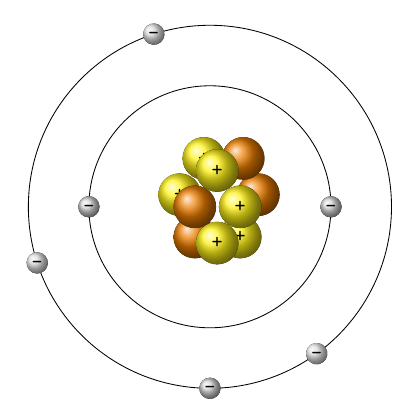
How many protons does this atom have?
a)
3
b)
6
c)
4
d)
2
20.

How many electrons does this picture show?
a)
4
b)
5
c)
6
d)
3
21.

How many neutrons does this atom have?
a)
4
b)
5
c)
6
d)
7
22.
Which element is located at Period 5, Group 2?
a)
Niobium
b)
Strontium
c)
Nitrogen
d)
Phosphorus
23.
Which element is located at Period 7, Group 4?
a)
Maganese
b)
Chlorine
c)
Rutherfordium
d)
Iodine
24.
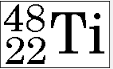
How many protons does this isotope of titanium have?
a)
48
b)
22
c)
26
d)
70
25.

How many neutrons does the isotope of lithium have?
a)
8
b)
3
c)
4
d)
5
26.
How many neutrons does uranium-235 have?
a)
238
b)
92
c)
146
d)
143
27.

What do these isotopes of carbon all have in common?
a)
neutrons & mass number
b)
atomic number and neutrons
c)
atomic number and electrons
d)
protons, atomic number, and mass number
28.

What element is this? What is the mass number of this atom?
a)
sodium, 23
b)
magnesium, 23
c)
magnesium, 12
d)
sodium, 11
29.
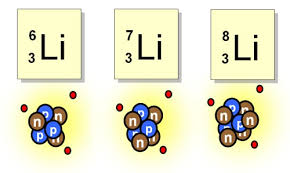
which atom has 4 neutrons?
a)
Li-6
b)
Li-7
c)
Li-8
d)
they have the same # of neutrons
30.

What is an ion?
a)
A Charged Atom
b)
A Large Atom
c)
A Small Atom
d)
A Cute Atom
31.

Why are ions formed?
a)
To make our lives difficult
b)
Because atoms want 8 valence electrons
c)
Because atoms have the same number of protons and electrons
d)
Because atoms gained neutrons
32.

Cations are...
a)
Positive
b)
Negative
c)
Neutral
d)
Purring
33.

Anions are...
a)
Positive
b)
Negative
c)
Neutral
d)
Crying
34.

An atom becomes _________ when it gains electrons.
a)
Positive
b)
Negative
c)
Neutral
d)
Invinsible
35.

An atom becomes _______ when it loses electrons.
a)
Positive
b)
Negative
c)
Neutral
d)
Invinsible
36.
What is an ion?
a)
An atom that has lost or gained protons
b)
An atom that has lost or gained neutrons
c)
An atom that has lost or gained electrons
d)
An atom with a charge of zero
37.
Which electrons are lost or gained when an atom forms and ion?
a)
core electrons
b)
valence electrons
38.
If an atom loses two valence electrons, what is its oxidation number?
a)
-1
b)
+1
c)
-2
d)
+2
39.
What is the typical oxidation number for all elements in the Alkali Metals group?
a)
+1
b)
+2
c)
+3
d)
+4
40.
What is the typical oxidation number of the Noble Gases?
a)
+2
b)
-3
c)
-1
d)
0
41.
What are the most common oxidation states for iron?
a)
+1, +2
b)
+3, +4
c)
+2, +3
d)
+1, +3
42.
If an atom gains electrons, what type of ion is formed?
a)
cation
b)
anion
43.
If an atom loses electrons, what type of ion is formed?
a)
cation
b)
anion
44.
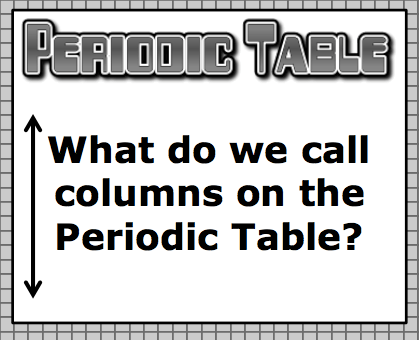
a)
Periods
b)
Groups
45.
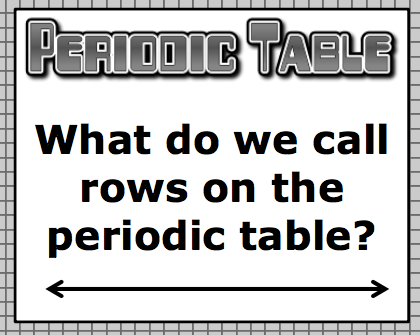
a)
Periods
b)
Groups
46.

a)
energy levels
b)
valence electrons
c)
protons
d)
neutrons
47.
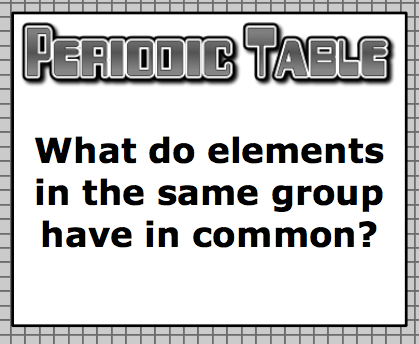
a)
energy levels
b)
valence electrons
c)
protons
d)
neutrons
48.
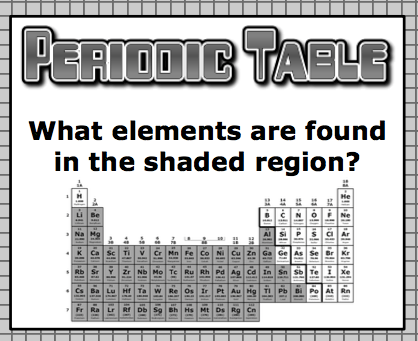
a)
Metals
b)
Nonmetals
c)
Metalloids
49.

Most of the elements on the periodic table are classified as _____.
a)
Metals
b)
Nonmetals
c)
Metalloids
d)
Periods
50.
The atomic number tells you what?
a)
number of electrons
b)
number of protons
c)
number of neutrons
d)
both electrons and protons in an atom.
51.
Which is an alkali metal?
a)
Magnesium
b)
Iron
c)
Sodium
d)
Europium
52.
A neutron has a charge of
a)
+2
b)
No charge
c)
-1
d)
+1
53.

What element is this?
a)
Helium
b)
Hydrogen
c)
Argon
d)
Silver
54.

In the Bohr model of the atom, what is the maximum number of electrons in the first shell?
a)
1
b)
2
c)
6
d)
8
55.

What's a valence electron?
a)
electrons in the second energy level
b)
electrons in the outermost energy level
c)
the atomic number
d)
electrons in the first level
56.
An element with five valence electrons is
a)
phosphorus
b)
oxygen
c)
beryllium
d)
rubidium
57.

This could be the dot diagram of
a)
Be
b)
B
c)
C
d)
Ne
58.

This could be the dot diagram of
a)
O
b)
B
c)
Li
d)
Ne
59.
What element is this?
a)
Helium
b)
Hydrogen
c)
Argon
d)
Silver
100 %

