
 Worksheets
7th grade 3/4 Review
Total questions: 100
Worksheet time: 1hrs 20mins
Name
Class
Date
1.
Located at the leading edge of a temperature drop off. Bring heavy thunderstorms, rain, and hail. Cool, fair weather is likely to follow.
a)
Warm Front
b)
Cold Front
c)
Occluded Front
d)
Stationary Front
2.
Located at the leading edge of a warm air mass. Brings gentle rain or light snow, followed by warmer, milder weather.
a)
Warm Front
b)
Cold Front
c)
Occluded Front
d)
Stationary Front
3.
Where the warm and cold air meet and stall, clouds and fog form, and it may rain or snow. It could bring many days of clouds and precipitation.
a)
Warm Front
b)
Cold Front
c)
Occluded Front
d)
Stationary Front
4.
When a cold front overtakes a warm front, the temperature drops as the warm air mass is cut off from the ground and pushed upward. It can bring strong winds and heavy precipitation.
a)
Warm Front
b)
Cold Front
c)
Occluded Front
d)
Stationary Front
5.

This is the symbol for a...
a)
Cold Front
b)
Warm Front
c)
Stationary Front
d)
Occluded Front
6.

This is the symbol for a...
a)
Occluded Front
b)
Stationary Front
c)
Warm Front
d)
Cold Front
7.

This is the symbol for a...
a)
Stationary Front
b)
Occluded Front
c)
Cold Front
d)
Warm Front
8.

This is the symbol for a...
a)
Stationary Front
b)
Occluded Front
c)
Cold Front
d)
Warm Front
9.

Identify the type of front that is shown in the image.
a)
Occluded Front
b)
Cold Front
c)
Stationary Front
d)
Warm Front
10.

Identify the type of front that is shown in the image.
a)
Occluded Front
b)
Cold Front
c)
Stationary Front
d)
Warm Front
11.

Identify the type of front that is shown in the image.
a)
Occluded Front
b)
Cold Front
c)
Stationary Front
d)
Warm Front
12.

Identify the type of front that is shown in the image.
a)
Occluded Front
b)
Cold Front
c)
Stationary Front
d)
Warm Front
13.
Which gas in our atmosphere is most abundant?
a)
Argon
b)
Oxygen
c)
Nitrogen
d)
Carbon Dioxide
14.
The air in the troposphere has a greater density than the air in any other layer of the atmosphere,
a)
True
b)
False
15.
What percentage of our atmosphere is made up of other gases such as argon, water vapor, and carbon dioxide?
a)
1%
b)
21%
c)
78%
d)
90%
16.
What is the percentage of oxygen in Earth's atmosphere?
a)
1%
b)
21%
c)
78%
d)
90%
17.
What is the percentage of nitrogen in Earth's atmosphere?
a)
1%
b)
21%
c)
78%
d)
90%
18.
In which layer of the atmosphere does weather occur?
a)
Mesosphere
b)
Thermosphere
c)
Stratosphere
d)
Troposphere
19.
What is the lowest main layer of Earth's atmosphere?
a)
Thermosphere
b)
Troposphere
c)
Stratosphere
d)
Mesosphere
20.
What is the second lowest main layer of Earth's atmosphere?
a)
Thermosphere
b)
Troposphere
c)
Stratosphere
d)
Mesosphere
21.
What are the 2 most abundant gases in Earth's atmosphere?
a)
carbon dioxide and oxygen
b)
carbon dioxide and nitrogen
c)
nitrogen and oxygen
d)
nitrogen and hydrogen
22.
This layer is where weather occurs.
a)
troposphere
b)
thermosphere
c)
exosphere
d)
stratosphere
23.
Which of the following is the correct order of the atmosphere layers from Earth to space?
a)
troposphere, stratosphere, mesosphere, thermosphere, exosphere
b)
troposphere, mesosphere, thermosphere, exosphere, stratosphere
c)
thermosphere, stratosphere, mesosphere, troposphere, exosphere
d)
troposphere, stratosphere, mesosphere, exosphere, thermosphere
24.
Which layer protects the earth from meteors?
a)
Troposphere
b)
Stratosphere
c)
Mesosphere
d)
Thermosphere
25.
Which layer is the coldest?
a)
Troposphere
b)
Stratosphere
c)
Mesosphere
d)
Thermosphere
26.
Describe how the ozone layer protects the earth.
a)
Absorbs solar radiation, Protects Earth from UV Rays, and emits heat
b)
Ozone in the lower atmosphere is a pollutant
27.
Airplanes fly in which layers of the atmosphere?
a)
Troposphere, Stratosphere, and Mesosphere
b)
Stratosphere and Mesosphere
c)
Troposphere and Stratosphere
d)
Troposphere Stratosphere, Mesosphere, and Thermosphere
28.
As altitude increase, the air pressure
a)
does not change
b)
increases
c)
decreases
29.
The force that air exerts on all objects is called-
a)
density
b)
altitude
c)
infrared radiation
d)
air pressure
30.
Which layer of the atmosphere do most satellites orbit the Earth?
a)
Stratosphere
b)
Mesosphere
c)
Exosphere
d)
Ionosphere
31.
Which layer has the hottest molecules?
a)
Thermosphere
b)
Mesosphere
c)
Exosphere
d)
Stratosphere
32.
Which layer contains the ionosphere, a layer of charged particles, that interact with solar winds to cause the auroras?
a)
Exosphere
b)
Stratosphere
c)
Thermosphere
d)
Mesosphere
33.
Which layer protects humans from most of the harmful UV radiation received from the sun?
a)
Clouds
b)
Exosphere
c)
Ionosphere
d)
Ozone Layer
34.
The layers of the atmosphere are calssified according to changes in
a)
temperature and air pressure
b)
altitude and air quality
c)
humidity and temperature
d)
air pressure and oxygen
35.

A magician pulls a tablecloth out from under dishes and glasses on a table without disturbing them.
a)
Newton's 1st Law
b)
Newton's 2nd Law
c)
Newton's 3rd Law
36.

Pushing a child on a swing is easier than pushing an adult on the same swing, because the adult has more mass and requires more force to accelerate.
a)
Newton's 1st Law
b)
Newton's 2nd Law
c)
Newton's 3rd Law
37.

This person bought coffee and put it on the seat next to them. If they stopped quickly and the coffee spilled which law would that represent?
a)
Newton's 1st Law
b)
Newton's 2nd Law
c)
Newton's 3rd Law
38.

When you step on a Lego. You push on the Lego and the Lego pushes back on you.
a)
Newton's 1st Law
b)
Newton's 2nd Law
c)
Newton's 3rd Law
39.

Force = Mass x Acceleration
a)
Newton's 1st Law
b)
Newton's 2nd Law
c)
Newton's 3rd Law
d)
Newton's 4th Law
40.

"For every action, there is an equal and opposite reaction."
a)
Newton's 1st Law
b)
Newton's 2nd Law
c)
Newton's 3rd Law
d)
Newton's 4th Law
41.

"An object in motion (or at rest) will to stay in motion (or at rest) until an outside force acts upon it."
a)
Newton's 1st Law
b)
Newton's 2nd Law
c)
Newton's 3rd Law
d)
Newton's 4th Law
42.
"An object in motion (or at rest) will to stay in motion (or at rest) until an outside force acts upon it."
a)
Newton's 1st Law
b)
Newton's 2nd Law
c)
Newton's 3rd Law
d)
Newton's 4th Law
43.

Any push or pull on an object.
a)
force
b)
velocity
c)
inertia
d)
momentum
44.
Any push or pull on an object.
a)
force
b)
velocity
c)
inertia
d)
momentum
45.

The force that opposes motion between two surfaces in contact with each other.
a)
inertia
b)
friction
c)
momentum
d)
gravity
46.

A force that opposes motion between a surface in contact with the atmosphere.
a)
air resistance
b)
gravity
c)
momentum
d)
terminal velocity
47.
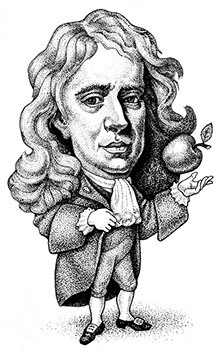
A Newton is a unit of...
a)
force
b)
inertia
c)
acceleration
d)
velocity
48.

When all the forces on an object are equal and opposite, & the net force is zero, that's...
a)
balanced forces
b)
unbalanced forces
c)
terminal velocity
d)
reaction forces
49.

The combination of all the forces acting on an object is the...
a)
net force
b)
action force
c)
reaction force
d)
balance force
50.

An archer pulls the bowstring back, then releases the string and the arrow flies forward. Pulling the string back is the...
a)
action force
b)
reaction force
c)
net force
d)
inertia
51.

An archer pulls the bowstring back, then releases the string and the arrow flies forward. The arrow flying forward is the...
a)
action force
b)
reaction force
c)
net force
d)
inertia
52.
An archer pulls the bowstring back, then releases the string and the arrow flies forward. The arrow flying forward is the...
a)
action force
b)
reaction force
c)
net force
d)
inertia
53.

A cannonball with a mass of 10 kg is flying at an acceleration of 5 m/sec/sec. What is it's force?
a)
50 Newtons
b)
5 Newtons
c)
20 Newtons
d)
9.5 Newtons
54.

Mass x acceleration = ?
a)
force
b)
inertia
c)
momentum
d)
velocity
55.

Mass x velocity= ?
a)
force
b)
inertia
c)
momentum
d)
velocity
56.
Which of the following is the smallest unit of life that can carry out all life functions?
a)
the mitochondria
b)
the vacuoles
c)
the nucleus
d)
the cell
57.
Which structures are found in every living cell?
a)
cell membrane and cytoplasm
b)
chloroplasts and mitochondria
c)
a cell wall and nucleus
d)
chloroplasts and cell wall
58.
Which cell structure is found in plant and animals cells and controls what can come into or leave a cell?
a)
cell membrane
b)
cytoplasm
c)
nucleus
d)
vacuole
59.
What is the function of the cell nucleus found in both plant and animal cells?
a)
to produce energy
b)
to control cell activity
c)
to remove waste products
d)
to allow molecules to enter the cell
60.
Cell organelles that are responsible for digesting food, worn out organelles and other cellular wastes are called ___________________.
a)
Mitochondria
b)
Vacuoles
c)
Lysosomes
d)
Chlororplasts
61.
What is one basic function of the vacuoles?
a)
circulating oxygen
b)
producing food
c)
controlling cell processes
d)
storing water
62.
Chloroplasts in plant cells allow the plant to perform a function that animal cells cannot do. What is the main function of the chloroplasts found in plant cells?
a)
to absorb light energy and manufacture food
b)
to remove waste materials by active transport
c)
to manufacture chemical energy from food
d)
to control the shape of the cell
63.
All cells need energy to function. Which cell organelle is responsible for producing energy in the cell?
a)
chloroplasts
b)
mitochondria
c)
nucleus
d)
vacuoles
64.
What is the function of a cell wall?
a)
to protect and support the cell
b)
to perform different functions in each cell
c)
to prevent water from passing through it
d)
to prevent oxygen from entering the cell
65.
In what part of the plant cell does the process of photosynthesis take place?
a)
nucleus
b)
mitochondria
c)
chloroplasts
d)
vacuoles
66.
Cells with a nucleus and membrane-bound organelles are called ____________________.
a)
prokaryotes
b)
eukaryotes
c)
bacteria
d)
protists
67.
Which of the following is not part of the cell theory?
a)
cells must contain DNA
b)
all living things are made from cells
c)
cells can only come from other cells
d)
cells are the basic unit of life
68.
Who was the first person to see cells under the microscope and give them their name?
a)
Mattias Schleiden
b)
Robert Hooke
c)
Theordor Schwann
d)
Anton van Leeuwenhoek
69.
The main purpose of the ____________ system is to break food particles into pieces that can be used.
a)
circulatory
b)
respiratory
c)
digestive
d)
skeletal
70.
What is responsible for delivering oxygen and removing carbon dioxide from the body?
a)
cell nucleus
b)
excretory system
c)
nervous tissue
d)
respiratory system
71.
The __________ is the main organ of the nervous system.
a)
heart
b)
lungs
c)
brain
d)
skin
72.
___________ are the building blocks of life.
a)
cells
b)
legos
c)
blocks
d)
blood
73.
The circulatory system uses _________ to deliver oxygen to the rest of the body.
a)
blood cells
b)
lungs and nose
c)
blood vessels
d)
brain and spinal cord
74.
When tissues come together, they form ___________.
a)
cells
b)
atoms
c)
organs
d)
systems
75.
A(n) _________ is made of small parts connected together to make a whole.
a)
system
b)
problem
c)
evidence
d)
illustration
76.
Which of the following shows the levels of organization of an organism from LEAST to MOST complex.
a)
cells-tissues-systems-organs
b)
organs-cells-systems-tissues
c)
systems-organs-tissues-cells
d)
cells-tissues-organs-systems
77.
What is Newtons 1st law of motion?
a)
Force= Mass multiplied by acceleration
b)
An object at rest stays at rest unless acted on an unbalanced force. (inertia)
c)
For every action there is a equal and opposite re-action.
d)
law of gravity
78.
Clouds are made up of tiny drops of ______ or ice. The moisture in the cloud affects the weather.
a)
dust
b)
water
c)
cloud particles
d)
precipitation
79.
They are highest clouds in the sky. They look curly, white and feathery. Usually mean good weather.
a)
Cumulus
b)
Cumulonimbus
c)
Cirrus
d)
Stratus
80.
This is sometimes called a thunderhead cloud. It looks very tall like mountains and heavy rain comes from it.
a)
Cumulus
b)
Cirrus
c)
Stratus
d)
Cumulonimbus
81.
These clouds are the closest to the ground. Their name means layer- or sheet like. They bring rain or snow and cover most of the sky.
a)
Cirrus
b)
Stratus
c)
Cumulonimbus
d)
Cumulus
82.
Low clouds (like fog), that are thick, cover the sky, and block the sun. Usually bring continuous precipitation (rain or snow).
a)
stratus
b)
cumulus
c)
cirrus
d)
nimbo
83.

what type of cloud is shown?
a)
cumulus
b)
cirrus
c)
stratus
84.

what type of cloud is shown?
a)
cumulus
b)
cirrus
c)
stratus
85.
How do we characterize an air mass that forms over the ocean?
a)
Dry
b)
Wet
c)
Cold
d)
Warm
86.
How do we characterize an air mass that forms over land?
a)
Dry
b)
Wet
c)
Cold
d)
Warm
87.
How do we characterize an air mass that forms over near the equator?
a)
Dry
b)
Wet
c)
Cold
d)
Warm
88.
How do we characterize an air mass that forms near the poles?
a)
Dry
b)
Wet
c)
Warm
d)
Cold
89.
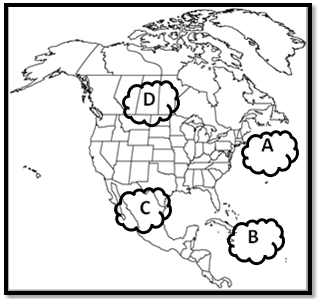
Which type of air would you find at air mass A?
a)
cold, dry
b)
warm, humid
c)
warm, dry
d)
cold, humid
90.
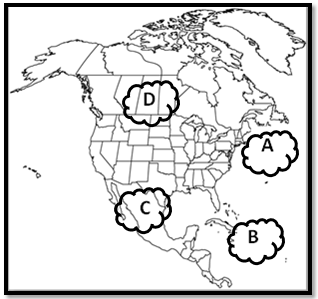
Which type of air would you find at air mass B?
a)
cold, dry
b)
warm, humid
c)
warm, dry
d)
cold, humid
91.
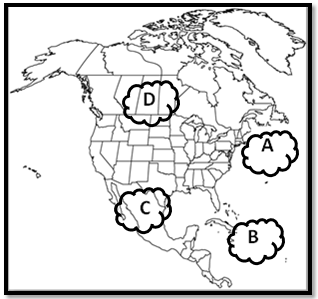
Which type of air would you find at air mass C?
a)
cold, dry
b)
warm, humid
c)
warm, dry
d)
cold, humid
92.
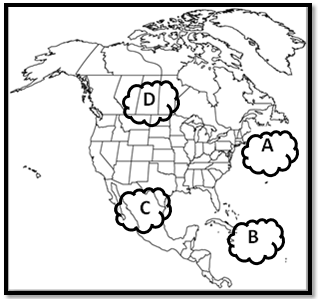
Which type of air would you find at air mass D?
a)
cold, dry
b)
warm, humid
c)
warm, dry
d)
cold, humid
93.

What type of front is this?
a)
warm front
b)
cold front
c)
stationary front
d)
occluded front
94.
_________ fronts are associated with more violent weather
a)
cold
b)
warm
c)
stationary
d)
occluded
95.

What type of front is this?
a)
warm front
b)
cold front
c)
stationary front
d)
occluded front
96.
What type of front moves quickly and can produce severe thunderstorms?
a)
Stationary
b)
Warm
c)
Cold
d)
Occluded
97.
An ____ is a large body of air that has the same properties as the Earth's surface over which it develops.
a)
front
b)
air mass
c)
cloud
d)
tornado
98.
What type of weather follows a warm front?
a)
warm and humid weather
b)
fair (clear) and cool weather
c)
very stormy weather
d)
cool and humid weather
99.

What kind of weather will Pennsylvania (upper east coast) be getting in the next day and why?
a)
Heavy precipitation and warm temps due to a warm front.
b)
Cold temps and clear skies because of a cold front
c)
Heavy precipitation and cold temps due to a cold front.
d)
Light rain and warm temps due to a warm front.
100.
If a cold front is currently passing through the city of Denver, what type of weather conditions is Denver most likely experiencing?
a)
warm, foggy weather
b)
cooler, dry weather
c)
hot, dry weather
d)
thunderstorms
100 %

