
Font size
S
M
L
XL
 Worksheets
AP Geo, Economics [Population, Agriculture, Development]
Total questions: 128
Worksheet time: 1hrs 22mins
Name
Class
Date
1.
According to von Thunen's Model, which agricultural zone is closest to the market?
a)
Livestock
b)
Commercial Grain
c)
Dairy Farming
d)
Forestry
2.
All of the following are assumptions made in the von Thunen model EXCEPT
a)
Terrain has forested areas with several small lakes and rivers
b)
Farmers sell all of their harvest
c)
The city is located centrally within an isolated state
d)
Soil and climate are the same
3.
According to Carl Sauer, there are two distinctive types of agriculture
a)
vegetative planting and double-cropping
b)
shifting cultivation and vegetative planting
c)
vegetative planting and seed agriculture
d)
slash-and-burn agriculture and double-cropping
4.
Farmers that produce food that they need to survive on a daily basis are called
a)
Commercial agriculture
b)
Industrial agriculture
c)
Slash-and-burn agriculture
d)
subsistence agriculture
5.

Agricultural hearths developed in four areas around the world EXCEPT
a)
Central America
b)
Eastern Europe
c)
Northwestern South America
d)
Western Africa
6.
The Third Agricultural Revolution is also known as
a)
GMO Revolution
b)
Seed Agricultural Revolution
c)
Green Revolution
d)
Industrial Revolution
7.
All of the following are true about the Green Revolution EXCEPT
a)
Takes place mainly in science laboratories
b)
Only tested on farms in MDCs
c)
Allows for plants and animals that grow in conditions they normally would not
d)
Led to the increase in industrial farming
8.
All of the following are aspects of commercial agriculture EXCEPT
a)
a heavy reliance on machinery
b)
the product is consumed off the farm
c)
there is little relationship to other businesses
d)
a small percentage of the workforce is engaged directly in agriculture.
9.
According to geographer Carl Sauer, agriculture probably first originated in
a)
the Fertile Crescent.
b)
Southeast Asia
c)
South America
d)
Europe
10.
All of the following are types of subsistence agriculture EXCEPT
a)
pastoral nomadism.
b)
shifting cultivation.
c)
swidden agriculture
d)
truck farming
11.
Which of the following is NOT a major grain exporter?
a)
China
b)
Canada
c)
USA
d)
Australia
12.
Corn was first domesticated in
a)
the Tibetan Plateau
b)
the Canadian Prairie.
c)
Central Mexico
d)
Northern Argentina.
13.
The second agricultural revolution coincided with
a)
the Industrial Revolution.
b)
the first wave of European migration
c)
Imperialism
d)
the Enlightenment.
14.
Which best describes colonization?
a)
country creates separate territories that they rule
b)
country expands its borders to include more land
c)
country converts people to the same religion and language
d)
country chooses a new leader to run government
15.
European countries wanted the ________ in Africa so they could take them back to their mills and factories in Europe to make ________ to sell and make money from.
a)
raw materials; finished goods
b)
finished goods; raw materials
c)
natural resources; raw materials
d)
fossil fuels; finished goods
16.
Nearly all the world's population growth is clustered in what areas?
a)
Urban areas
b)
MDC's
c)
LDC's
d)
Suburban areas
17.
There are NO countries in which stage?
a)
Stage 3
b)
Stage 2
c)
Stage 4
d)
Stage 1
18.
If the GNP(Gross National Product) increases the birth rate of that country?
a)
decreases
b)
increases slowly
c)
doesn't change
d)
increases rapidly
19.
In what stage are most European countries?
a)
1
1
1
b)
2
c)
3
d)
4
20.
Zero population growth occurs when the TFR (total fertility rate) is at
a)
1.2
b)
2.1
c)
2.7
d)
1.9
21.
What does an "upside down" population pyramid indicate?
a)
lots of children
lots of children
lots of children
b)
lots of middle age people
c)
lots of elderly/older people
d)
lots of teens
22.
Thomas Malthus thought
a)
population would increase at the same rate as farming production
b)
population would eventually decline due to birth control and family planning
c)
population would eventually outgrow food production
d)
moral restraint would lower population growth
23.
The ratio of people who are too young or too old to work compared to the working population is called the
a)
dependency ratio
b)
population pyramid
c)
interconnected ratio
d)
retirement ratio
24.
Death rates fall rapidly due to increased hygiene and medical advances during stage
a)
1
b)
2
c)
3
d)
4
25.
Highest population growth occurs during stage
a)
1
b)
2
c)
3
d)
4
26.
In LDC's this would be typically low.
a)
CDR
b)
CBR
c)
Infant mortality
d)
life expectancy
27.
The annual worldwide natural increase rate is
a)
1.2%
b)
12%
c)
12 million
d)
12 trillion
28.
This caused a jump in the worlds' population.
a)
the Renaissance
b)
the Industrial Revolution
c)
the Medical Revolution
d)
the Scientific Revolution
29.
The ___________ __________ stabilized the world's population 10,000 years ago.
a)
Industrial Revolution
b)
Reformation
c)
Black Plague
d)
Agricultural Revolution
30.
Which area has the highest urbanization rate?
a)
Indochina
b)
Western Europe
c)
East Asia
d)
South Asia
31.
The world's most populated country is
a)
India
b)
Nigeria
c)
China
d)
Indonesia
32.
The world's most populated region is
a)
North America
b)
East Asia
c)
South Asia
d)
Africa
33.
Overpopulation is
a)
too many darn people for the world
b)
too many darn people for a country
c)
too many darn people for an area
d)
too many darn people for the resources
34.
ZPG stands for
a)
Zero population growth
b)
Zero pending growth
c)
Zero pollution growth
d)
Zero pounds growth
35.

ARABLE land is land suitable for ____________.
a)
raising livestock, like cattle
b)
Agriculture, or farming
c)
growing cactus, it means desert
d)
wind farming
36.
Which of the following is a pull factor?
a)
Insufficient Food Supply
b)
High Crime Rate in Native Country
c)
Higher Paying jobs in New Country
d)
High Crime Rate in New Country
37.
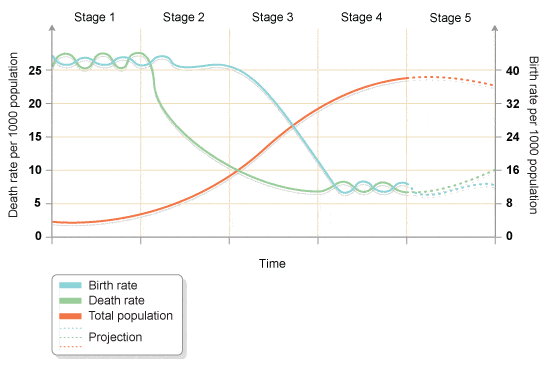
A characteristic of stage Three of the DTM shows?
a)
High birth and death rates
b)
Low death and high birth rates
c)
Declining birth and death rates
d)
High death and low birth rates
38.

Whose model is this?
a)
Colin Renfrew
b)
Julian Simo
c)
Thomas Malthus
d)
John Snow
39.

A characteristic of stage one of the DTM shows
a)
High birth and death rates
b)
Low death and high birth rates
c)
Low birth and death rates
d)
High death and low birth rates
40.
A population pyramid is a graphic device that represents a population's
a)
age and gender composition
b)
total fertility rate
c)
arithmetic population growth
d)
demographic momentum
41.
According rank-size rule, how big is the 2nd largest city in a country in relationship to the largest city?
a)
1/2 the size
b)
1/3 the size
c)
1/4 the size
d)
1/5 the size
42.
The maximum distance people are willing to travel for a service is
a)
hinterland
b)
range
c)
threshold
d)
median
43.
The area surrounding a service from which customers are attracted is the
a)
hinterland
b)
range
c)
threshold
d)
median
44.
The process whereby an increasing percentage of people live in an urban area is known as
a)
demographic transition
b)
rank-size rule
c)
urbanization
d)
central place theory
45.

According to the concentric zone model, a city develops into
a)
wedges
b)
corridors
c)
rings
d)
nodes
46.

What pattern represents market areas in the Central Place Theory?
a)
squares
b)
circles
c)
hexagons
d)
none of the above
47.
A city is described as a/an
a)
Center of Services
b)
Geographic area with high density of people
c)
urban settlement that is self governing
d)
CBD and surrounding suburbs
48.
What is movement?
a)
Characteristics of earth
b)
Physical movement form place to place
c)
People, goods, and ideas move from one place to another
d)
Migration
49.
Thomas Malthus believed that
a)
the government should encourage population growth in order to fully staff the factories being built during the Industrial Age.
b)
the world would soon be overpopulated because population grows at an exponential rate while the food supply increases at an arithmetic rate.
c)
the world would find new sources of food production to offset population growth.
d)
population increase will continue because many religions discourage the use of contraceptives.
50.
The theory that farmers will adopt new and modern methods to keep up withdemand caused by an increasing population was proposed by
a)
Thomas Malthus.
b)
Neo-Malthusians.
c)
Esther Boserup.
d)
Ernest Ravenstein.
51.
The theory that farmers will adopt new and modern methods to keep up withdemand caused by an increasing population was proposed by
a)
Thomas Malthus.
b)
Neo-Malthusians.
c)
Esther Boserup.
d)
Ernest Ravenstein.
52.
Why was the Demographic Transition Model based on England’s experience?
a)
England was the first country to pass through all stages of the model.
b)
England’s territory has changed little.
c)
The church kept excellent birth and death records from the year 1000 CE.
d)
all of the above
53.
Into which stage of the demographic transition model would Australia and Canada fit?
a)
1
b)
2
c)
3
d)
4
54.
According to Ravenstein’s Laws of Migration, every migration flow generatesa return migration flow. This phenomenon is known as
a)
counter-migration.
b)
counter-urbanization.
c)
reverse migration.
d)
transposed migration.
55.
According to Ravenstein’s Laws of Migration, which group is most likely to move?
a)
older adults
b)
younger adults
c)
children
d)
families
56.
According to the von Thunen model, what costs does a commercial farmer consider when deciding what crops to plant?
a)
transportation costs
b)
cost of land
c)
transaction costs
d)
both transportation and cost of land
57.
According to the von Thunen model, what type of agricultural practice would locate in the outer most concentric ring?
a)
dairy
b)
grazing
c)
foresty
d)
horticulture
58.
Which of the following development strategies would be consistent with Rostow’s preconditions for take off stage?
a)
Build hydroelectric dam and roads.
b)
Exploit comparative advantage by trading with poorer countries.
c)
Increase tariffs on trade in order to keep out competition.
d)
Increase international trade of manufactured goods.
59.
The Human Development Index (HDI) was derived with which of the following purposes in mind?
a)
Create a completely objective ranking of countries based on economic conditions within a country.
b)
Create a method of measuring development that includes all elements of development.
c)
Create a method of measuring development that focuses on social elements of literacy and politics.
d)
Create a method of measuring development that attempts to include social and economic elements.
60.
A primate city is
a)
when the largest city is located on the periphery.
b)
the largest city in a region of a country.
c)
the most important city in a country.
d)
when the largest city in a country is twice the size of the next largest city.
61.
What assumption(s) are in Christaller’s Central Place Theory?
a)
A flat isototropic plane with no physical barriers.
b)
Uniform soil fertility.
c)
Population and purchasing power would be evenly distributed.
d)
all of these
62.
Large cities are economic hubs with radiating connections for commerce according to
a)
Von Thunen
b)
Concentric Ring
c)
Central Place Theory
d)
none of these
63.
A city grows outward from a central location in a series of rings in the
a)
von thunen model
b)
concentric ring model
c)
sector model
d)
multiple nuclei model
64.
According to the Burgess model, the housing stock is most deteriorated and a sizable percent of residents are immigrants in the
a)
zone of transition
b)
CBD
c)
zone of urban renewal
d)
zone of better residents
65.
In Hoyt’s Sector Model lower income neighborhoods are usually located
a)
in the first ring around the CBD.
b)
adjacent to the industrial and transportation corridor.
c)
on the east side of the city.
d)
in a wedge that extends from the CBD to the suburbs.
66.
What did Hoyt’s research uncover regarding the highest social class district in a city?
a)
High-class residential areas don’t change much over time.
b)
High-class residential sector migrated towards the west.
c)
Gentrification improved the property values of the high-class residential sector.
d)
High-class neighborhoods were susceptible to ghettoization.
67.
Large cities develop many nodes around which different types of people and activities cluster. This describes the
a)
Peripheral Model.
b)
Multiple Nuclei Model.
c)
Latin American Model.
d)
Concentric Zone Model.
68.
The elite residential section in the Latin American Model is located
a)
in a ring around the CBD.
b)
on either side of the main boulevard that leads to the CBD.
c)
in gated communities on either side of the CBD.
d)
in the western suburbs.
69.
According to the classic bid-rent curve, what happens to the value of land as one gets closer to the Central Business District (CBD)?
a)
Land gets used more extensively.
b)
Land gets more expensive.
c)
Land gets used less intensively.
d)
Land gets more affordable along busy streets.
70.

What demographic characteristic does this population pyramid show?
a)
Low population growth
b)
High natural increase
c)
High crude death rate
d)
Low elder dependency ratio
71.

What economic activities does this population pyramid show?
a)
Tertiary Economic Activities
b)
Subsistence Farmers
c)
Post Industrial Activities
d)
Guest Worker Program
72.

What demographic characteristics does this population pyramid show?
a)
Increasing Population
b)
Declining Population
c)
Stable Population
d)
High Natural Increase
73.

According to the map of interregional migration, what region in the U.S. has the highest emigration?
a)
Midwest
b)
South
c)
Northeast
d)
West
74.
According to the map of interregional migration, what region in the U.S. has the highest immigration?
a)
Midwest
b)
South
c)
Northeast
d)
West
75.

Which country on the map would have the lowest agricultural density as a result of less arable land?
a)
Argentina
b)
India
c)
Germany
d)
Ukraine
76.

What state has the lowest Amish population density?
a)
Pennsylvania
b)
Ohio
c)
Illinois
d)
Virginia
77.
Recent immigration to the U.S. has come from what two regions?
a)
Asia and Latin America
b)
Northern Europe and Western Europe
c)
Western Europe and Eastern Europe
d)
Latin America and Europe
78.
Physical characteristics of a place (ex. climate, water bodies, topography, soil, vegetation, elevation) are known as
a)
Site
b)
Situation
c)
Absolute location
d)
Physical geography
79.
When a country controls the lands of another to gain from their resources...
a)
imperialism/colonialism
b)
segregation
c)
enclave
d)
partition
80.
True or False: LDCs depend on MDCs for most all economic aid.
a)
True
b)
False
81.

This graphic most closely depicts which geographic theory?
a)
Ratzel's Organic Theory
b)
Mackinder's Heartland Theory
c)
Spykman's Rimland Theory
82.
What theory suggested a sea based power controlling the edges of Asia would eventually be able to control the world?
a)
Heartland theory
b)
Rimland theory
c)
Organic theory
d)
Supranationalism theory
83.
The continent of Africa owes most of its modern borders to
a)
Physical features
b)
European colonization
c)
American imperialism
d)
Ethnic borders
84.
The continent of Africa owes most of its modern borders to
a)
Physical features
b)
European colonization
c)
American imperialism
d)
Ethnic borders
85.
Who created the Least Cost theory?
a)
William Cooke
b)
Alex Weber
c)
Alfred Winburn
d)
Alfred Weber
86.
Which of these was a natural resource that helped Great Britain start the Industrial Revolution?
a)
Wind Resistence
b)
Lumber
c)
Steel
d)
Water Power
87.
A scientist would be considered part of the ____________ sector because they are higher education/research.
a)
Primary
b)
Secondary
c)
Quaternary
d)
Quinary
88.
A Wall Street stock broker would be part of the ________ sector because they are dealing with the exchange of money and information.
a)
Primary
b)
Secondary
c)
Quaternary
d)
Quinary
89.
Which of the following is an example of new technology from the 2nd agricultural revolution?
a)
Selective Breeding
b)
Hybrid Seeds
c)
Biotech Crops
d)
Seed Drill
90.
What is a concern of GMO's?
a)
Too healthy
b)
Blending with non-GMO seeds
c)
Blending with other GMO seeds
d)
Too effective
91.
The primary differences between agriculture practices in the world are between those of what two types of regions/countries?
a)
Africa and Asia
b)
Northern and Southern Hemispheres
c)
Eastern and Western Hemispheres
d)
MDCs and LDCs
92.
Coal, oil, and natural gas are all examples of
a)
A. alternative energy sources.
b)
B. capital resources.
c)
C. fossil fuels.
d)
D. renewable resources.
93.
Which of the following is NOT primarily an economic union?
a)
Organization of Petroleum Exporting Countries (OPEC)
b)
North American Free Trade Agreement (NAFTA)
c)
United Nations (UN)
d)
European Union (EU)
94.
Which of the following is NOT a capital resource
a)
money
b)
tools
c)
factories
d)
farmer
95.

This population pyramid demonstrates a country that is most likely...
a)
developed
b)
developing
c)
in transition
d)
highly developed
96.

Which economic alliance is this map showing?
a)
ASEAN
b)
NAFTA
c)
OPEC
d)
EU
97.
What is the total value of goods and services produced by a country
a)
Gross Product Domestic
b)
Domestic Gross Product
c)
Product Gross Domestic
d)
Gross Domestic Product
98.
Which region of the world produces the greatest amount of petroleum?
a)
Asia and Oceania
b)
Southwest Asia
c)
United States and Canada
d)
Europe
99.
Urban areas in the US are divided into these that contain approximately 5,000 residents and correspond, when possible, to neighborhood boundaries
a)
Census tract
b)
MSA
c)
CSB
d)
CBD
100.
A community's collection of basic industries
a)
Basic industry
b)
Non basic industry
c)
Economic foundation
d)
Economic base
101.
All of the following are true about the Green Revolution EXCEPT
a)
Takes place mainly in science laboratories
b)
Only tested on farms in MDCs
c)
Allows for plants and animals that grow in conditions they normally would not
d)
Led to the increase in industrial farming
102.
Shifting cultivation is most commonly found in which climate region?
a)
Dry
b)
Tropical
c)
Polar
d)
Warm temperate
103.
Physiological density is defined as
a)
the average farm production compared to arable land.
b)
the number of farmers as compared to the total population.
c)
the number of people compared to arable land.
d)
the number of farms compared to the total land area.
105.
Countries with high birth rates, and a large % of young people would be considered:
a)
More Developed
b)
Core Countries
c)
Wealthy Countries
d)
Developing Countries
105.
Countries with high birth rates, and a large % of young people would be considered:
a)
More Developed
b)
Core Countries
c)
Wealthy Countries
d)
Developing Countries
106.
The period of rapid technological advancement that began around 1800 is known as the
a)
Agricultural Revolution
b)
Roman Empire
c)
Sumerian Standard of Ur
d)
Industrial Revolution
107.
The number of people under age 15 and over age 64 compared to the number of people active in the labor force.
a)
demography
b)
zero population growth
c)
overpopulation
d)
dependency ratio
108.
The minimum number of people needed to support a business is called the
a)
range
b)
threshold
c)
bid rent
d)
radius
109.
Arithmetic density is
a)
the number of people per square mile of inhabitable
land.
b)
the number of people per square
mile of arable land.
c)
the number of farmers per square
mile of arable land.
d)
the
number of people per unit of measurement.
110.
When a country suffers from a “brain drain” it means the country has experienced
a)
an emigration of working age males.
b)
an
emigration of educated professionals
c)
an emigration of political leaders.
d)
an
emigration of female executives
111.
Oil Co. in Texas has chosen to build their industry closest to the oil rig. They decided that the gasoline is easier to transport by truck than the raw oil would be to transport to the refinery.
a)
site-capital
b)
situation-bulk reducing
c)
situation-bulk gaining
d)
site-land
112.
In recent years what type of agricultural practice has been most responsible for deforestation of the rain forest in parts of Central and South America?
a)
Swidden agriculture.
b)
aquaculture
c)
livestock ranching
d)
truck farming
113.
Because I live in the United States, the entrepreneur fever is far more acceptable than in other countries. I was able to open my own bakery, Mac’s mini-muffins because I was able to obtain a wonderful loan from the city who is working to “buy local.” I realized that I never would have accomplished my dreams if I still lived in my native country.
a)
Site-capital
b)
Situation-bulk gaining
c)
Site-labor
d)
Situation-Bulk reducing
114.
Your textile industry is a labor-intensive industry. Therefore, China produces 2/3rds of the world’s cotton thread (the spinning part of textile industry) because it is labor intensive and it can be done for low wages in this country.
a)
Site-capital
b)
Site-labor
c)
Site-situation
d)
Situation-labor
115.
Your Darren Creek timber company is located near the sawmill in Denver, Colorado. They mass produce chairs and classroom materials that will be transported via train across the Midwest.
a)
Situation-bulk gaining
b)
Situation-bulk-reducing
c)
Site-labor
d)
Site-neither
116.
Your Fridge for Sale wants to expand their stainless steel refrigerator company. They have decided to create their industry in Northern South Africa, far away from the Chromium mines which is the main component of stainless steel. The CEO’s decided that the refrigerator business needed to be close to the markets and the middle class who will be purchasing (hopefully) in high demand.
a)
Site-labor
b)
Situation-bulk reducing
c)
Situation-bulk gaining
d)
Site-land
117.

The Gender-Related Development Index is lowest in
a)
Sub-Saharan Africa
b)
Eastern Europe
c)
South America
d)
East Asia
118.
According to Rostow's development model, a country with a lot of heavy industry that uses modern technology is in Stage
a)
Two
b)
Three
c)
Four
d)
Five
119.

Stages of growth model is similar to ________ model.
a)
J. H von Thunen
b)
Ernst Ravenstein
c)
W.W. Rostow
d)
Immanuel Wallerstein
120.

GE, Coca-cola, Nokia, Samsung, Pepsi, Walt-Disney represent the many
a)
Back of Corporations
b)
World Trade Organizations
c)
Transnational Corporations
d)
Fairtrade Labeling Organizations
121.
Medical technology from MDCs to LDCs has reduced death rates in LDCs. This is a ____________ form of diffusion.
a)
Relocation
b)
Hierarchical
c)
Stimulus
d)
Contagious
122.

Of the following areas, the Human Development Index is highest in
a)
South Asia
b)
East Asia
c)
South America
d)
Europe
123.

Norilsk Nickel was a leading mining company in Russia in 2015. This is a form of _________.
a)
Primary Sector
b)
Secondary Sector
c)
Tertiary Sector
d)
Quaternary Second
124.

Core countries focuses all but
a)
higher ski
b)
extraction of raw materials
c)
low-skilled, labor intensive production
d)
capital intensive production
125.
A mining company operates in which industry sector?
a)
Primary
b)
Secondary
c)
Quaternary
d)
Quinary
126.
Toyota operates in which industry sector?
a)
Primary
b)
Secondary
c)
Quaternary
d)
Quinary
127.
A clothing store operates in which industry sector?
a)
Primary
b)
Secondary
c)
Quaternary
d)
Tertiary
128.
A business in the food court of a shopping centre is operating in which 2 industry sectors?
a)
Primary and Quinary
b)
Secondary and Tertiary
c)
Quaternary and Secondary
d)
Tertiary and Primary
Reset

