
 Worksheets
100 Facts of Science 26-50
Total questions: 43
Worksheet time: 2hrs 41mins
Name
Class
Date
1.
_________________ is a force caused when one object rubs against another object.
a)
gravity
b)
magnetism
c)
force
d)
friction
2.
You can separate sugar water by heating the solution up, which makes the water ______________
a)
magnetic
b)
evaporate
c)
electric
d)
a mixture
3.
Which of the following items is NOT soluble in water?
a)
sugar
b)
salt
c)
drink powder
d)
sand
4.
The Earth spins or _______ in place on its axis.
a)
rotates
b)
revolves
c)
refracts
d)
reflects
5.
The sun appears to move across the sky each day due to the rotation of the _____.
a)
moon
b)
Earth
c)
seasons
d)
Venus
6.
Because the Earth is tilted on its axis, one pole is always closer to the sun, which causes the Earth to have _______.
a)
day and night
b)
gravity
c)
seasons
7.
The Earth _____ around the sun in an orbit.
a)
rotates
b)
revolves
c)
refracts
8.
The gravity of the ______ causes the tides on Earth. High or low tides occur two times every day.
a)
Venus
b)
moon
c)
sun
9.
Shadows are caused when light is _______.
a)
blocked
b)
reflected
c)
refracted
d)
transmitted
10.
The light from the moon is ______ from the sun to the Earth, which makes the moon appear to light up.
a)
reflected
b)
refracted
c)
transmitted
d)
absorbed
11.

The diagram shows the phases of the moon for the month of June. About how many days will it take for the next new moon to appear?
a)
1 week or 7 days
b)
29 days
c)
4 month or 1 season
d)
2 weeks
12.
What feature does the Earth have that the moon DOES NOT have? Basically, the moon does not have.....
a)
craters
b)
sunlight
c)
mountains
d)
gravity
13.
A student learned that the movement of Earth in the solar system causes changes that can be seen on the planet. Which change could be seen on Earth in the time it takes Earth to rotate once on its axis?
a)
day becoming night
b)
winter changing into spring
c)
January changing to February
d)
a new moon becoming a full moon
14.
Which statement best describes the length of Earth's revolution?
a)
The Earth's revolution is equal to 365 days.
b)
The Earth's revolution is equal to 28 days.
c)
The Earth's revolution is equal to 4 months.
d)
The Earth's revolution is equal to 24 hours.
15.
_______ in an experiment are important to rule out errors and to confirm results.
a)
Repeated trials
b)
Conclusions
c)
Variables
d)
Hypotheses
16.
Sam is building a circuit board that will show how electrical energy can be transformed into light energy. Which materials does Sam need to build the circuit that will demonstrate this?
a)
Switch, battery, copper wire, tape
b)
Switch, bulb, copper wire, rubber eraser
c)
Switch, battery, bulb, copper wire, nail
d)
Switch, battery, bulb, nail, magnet
17.
With magnets, opposite poles like North and South will ______ each other.
a)
repel
b)
attract
c)
stay apart
d)
not move
18.
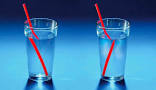
The image represents what relationship with light?
a)
refraction
b)
reflection
c)
transmission
d)
absorbtion
19.

The image represents what type of relationship with light?
a)
reflection
b)
refraction
c)
transmission
d)
absorption
20.

This tool is used to measure mass. It is called a
a)
triple beam balance
b)
graduated cylinder
c)
magnet
d)
beaker
21.
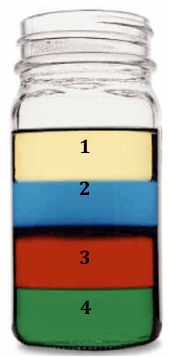
Mateo pours 4 different liquids into a beaker. He notices the layers settle at different depths in the beaker. Based on the picture, which property of the liquids is Mateo most likely studying?
a)
density
b)
length
c)
mass
d)
volume
22.
Plastic is an insulator. Because of this property, plastic would most likely be used to cover ______.
a)
metal
b)
wood
c)
liquids
d)
gases
23.
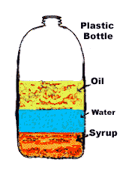
Some students were studying different types of mixtures. They stirred together one cup of oil and one cup of water in a glass beaker. They observed that the water settled to the bottom and the oil floated on top. Which of the following does this experiment demonstrate?
a)
The oil completely mixes with the water.
b)
The oil is less dense than the water.
c)
The oil is more dense than the water.
d)
The oil melts in water.
24.
It takes 365 days, or 1 year, for the Earth to _______ around the sun.
a)
rotate
b)
revolve
c)
spin
d)
observe
25.
What is the name of the force that pulls objects toward each other?
a)
Gravity
b)
Orbit
c)
Rotation
d)
Revolution
26.
Things that affect or change the results of an experiment are called:
a)
predictions
b)
hypotheses
c)
conclusions
d)
variables
27.
When 2 or more substances are mixed and have one or more properties that change, it is a _____________.
a)
solution
b)
mixture
c)
evaporate
d)
chemical
28.
__________________ is created by vibrating air.
a)
Light
b)
Earth's refraction
c)
Sound
d)
Rotation
29.
A planet's _____________________ is like the path, or road, it takes to revolve around the sun.
a)
orbit
b)
rotation
c)
attraction
d)
sound
30.
________________________ travels in straight lines.
a)
Light
b)
The sun
c)
Sound
d)
The moon
31.
_______________________ is caused when light bounces off an object.
a)
Refraction
b)
Reflection
c)
Closed circuit
d)
Rotation
32.
When light passes from air into water, it bends and this is called______________________.
a)
rotation
b)
refraction
c)
reflection
d)
orbit
33.
Electricity flows in a ________________ path to form a complete circuit.
a)
Open
b)
Closed
34.
An electromagnet is a type of magnet where a magnetic field is produced by a/an __________________.
a)
rotation
b)
insulator
c)
conductor
d)
electric current
35.
The _____________________ is the center of our solar system.
a)
Earth
b)
Moon
c)
Sun
d)
Mars
36.

What is shown by the model? (Click the picture)
a)
The orbits of the planets around the sun.
b)
The orbit of the earth around the sun.
c)
The orbit of the moon around the earth.
d)
The orbits of the earth and the moon.
37.
Scientists _____________ when they put things into groups based on similar characteristics.
a)
organize
b)
classify
c)
contrast
d)
observe
38.
An experiment is being conducted to test the effects of different fertilizers on vegetable growth. One group of beans is planted in soil without fertilizer. How should the rest of the experiment be set up?
a)
Plant three more groups of beans without fertilizers.
b)
Plant two groups of pea plants, each in different fertilizers.
c)
Plant two more groups of beans, each with different fertilizers.
d)
Plant a group of corn and a group of pea plants without fertilizers.
39.
A teacher mixes a white powder into a beaker of water. The powder cannot be seen in the water. The teacher then heats the mixture until the water evaporates and the powder can be seen again. |Which property of the powder is the teacher demonstrating.
a)
Density
b)
Solubility
c)
Mass
d)
Magnetism
40.

What planet is closest to the sun?
a)
Mercury
b)
Mars
c)
Earth
d)
Jupiter
41.
What planet is the fifth planet from the sun?
a)
Jupiter
b)
Saturn
c)
Earth
d)
Neptune
42.
How would you classify these substances?
Group A: cotton, plastic, wood, glass
Group B: aluminum, copper, tap water, steel
a)
One group is man made; the other is natural
b)
One group conducts electricity; the other insulates
c)
One group is permanent; the other cycles through nature
d)
One group is inexpensive; the other group is costly
43.
What happens when ice is heated?
a)
There is a change in chemical properties.
b)
There is a change in solubility.
c)
There is a change in physical properties.
d)
There is a change in magnetism.
100 %

