wayground logo

Free Printable Worksheets

Font size

S
M
L
XL
Worksheets

Bacteria and Virus Test Review

Total questions: 50

Worksheet time: 2hrs 40mins

Name
Class
Date
1.
Prokaryotes are unlike all other organisms in that their cells 
a)
do not have a nucleus
b)
have organelles
c)
have cell walls
2.
Name the three cell shapes of prokaryotes
a)
rod, circle spiral
b)
cocci, bacilli, spirilli
c)
crystal, tube, spaghetti
3.
Name this bacteria shape
a)
coccus
b)
spirillum
c)
bacillus
4.
Name this bacteria shape
a)
bacillus
b)
coccus
c)
spirillum
5.
Name this bacteria shape
a)
coccus
b)
bacillus
c)
spirillum
6.
The first living organism probably belonged to which kingdom?
a)
Archaebacteria
b)
Fungus
c)
Plant
d)
Animal
7.
How does pasteurization make food safe to eat?
a)
It changes dangerous chemicals in the food into safer chemicals
b)
It encourages the growth of important gut-bacteria
c)
It heats the food enough to kill all bacteria without affecting taste
d)
It causes milk to sour and turn into butter
8.
most bacteria reproduce by
a)
using a cell
b)
binary fission
9.

A bacterium, virus, or protist that causes disease is called a ____.

a)

bioremediation

b)

antibiotic

c)

pathogen

d)

a retrovirus

10.
Bacteria come in all of the following shapes EXCEPT which?
a)
spiral
b)
rod-like
c)
rectangular
d)
spherical
11.
All bacteria are
a)
unicellular
b)
multicellular
c)
eukaryotic
12.
Which of the structures is NOT found in bacteria?
a)
ribosome
b)
cell membrane
c)
cytoplasm
d)
nuclear membrane
13.
Some bacteria move by using a long, whip-like structure called a(n) ____________________
a)
tail
b)
cillia
c)
organs
d)
flagellum
14.
What is found in the cytoplasm of bacteria cells?
a)
The DNA
b)
The Nucleus
c)
the protein coat
d)
the flagellum
15.
Which of the following is NOT an adaptation of bacteria?
a)
reproduce rapidly
b)
high rate of mutation
c)
CANNOT exist under adverse(harmful) conditions
d)
can use substances harmful to other conditions
16.
Bacteria are used in
a)
farming
b)
the medical industry
c)
the food industry
d)
all of these
17.
Which of the following processes brings about an exchange of genetic information between bacterial cells?
a)
binary fission
b)
mutulaism
c)
conjugation
d)
replication
18.
The name streptococcus tells you the bacteria are arranged as ___.
a)
pairs of round cells
b)
long chains of round cells
c)
groups of spirals
d)
chains of rods
19.
What do viruses need to reproduce?
a)
they need genetic material
b)
They need a host cell
c)
They need  bacteria
d)
They need insulin
20.
When a virus invades a living cell, its _______
takes over the cell's functions.
a)
outer coat
b)
genetic material
c)
core
d)
cytoplasm
21.
Antibiotics kill viruses
a)
True
b)
False
22.
What part of a virus is the protein capsule that houses the genetic material (DNA/RNA)?
a)
tail
b)
nucleus
c)
capsid
d)
glycoprotein
23.
Which viral life cycle kills its host cell by lysing?
a)
lytic
b)
mitosis
c)
lysogenic
d)
S phase
24.
Which viral life cycle allows viral genetic material to lay dormant while the host cell reproduces?
a)
lytic
b)
mitosis
c)
lysogenic
d)
S phase
25.
What happens in the lytic cyle?
a)
Virus goes in and leaves the host cell
b)
Virus quickly kills the host cell
c)
Virus sleeps inside of the host cell
d)
Virus stay dormant for a long time
26.
What happens in the lysogenic cycle? 
a)
Virus goes in and leaves the host cell
b)
Virus quickly kills the host cell
c)
Virus inject the nucleic acid into the host cell, and the nucleic acid integrates into the host cell DNA, and stay dormant for a long time
d)
Bacteria injects DNA into a host cell
27.
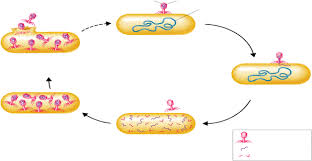
What process is this?
a)
phagocytosis
b)
lytic cycle
c)
lysogenic cycle
d)
formation of antibodies
28.
What is shown here?
a)
Lysogenic Cycle
b)
Lytic Cycle
c)
Binary Fission
d)
Conjugation
29.
The lysing of a cell occurs in which phase?
a)
1
b)
2
c)
4
d)
5
30.
Host DNA is compromised and viral DNA takes over in which phase?
a)
1
b)
2
c)
4
d)
5
31.
A pathogen.........
a)
makes proteins
b)
causes infection or disease
c)
is made of cells
d)
is a living thing
32.
Viruses are made up of
a)
Nucleus, membrane
b)
Capsid, nucleus
c)
Capsid, nucleic acid
d)
Mitochondria, nucleus
33.
What is the difference between the lytic and lysogenic virus reproductive cycles?
a)
lysogenic is longer
b)
they are the same
c)
Lytic is longer
d)
Both are different each time
34.
Koch's postulates say
a)
germs cause disease
b)
certain germs cause certain diseases
c)
germs do not cause disease
d)
a germ may cause many different diseases
35.
Some antibiotics attack and destroy disease-causing bacteria. This occurs because the antibiotic causes cell walls to rupture, or break. These antibiotics would not work on viruses because viruses...
a)
have a protein coat
b)
have cytoplasm
c)
have nucleic acids
d)
do not have cell walls
36.
Although controversial at first, the germ theory of disease proposed that microorganisms were the cause of many diseases. Which of these was a result of the general acceptance of the germ theory?
a)
The development and use of antibiotics
b)
The belief in spontaneous generation
c)
The proof of a supernatural cause for illness
d)
The link between viruses and RNA
37.
Vaccines work by...
a)
killing pathogens that are already infecting a host
b)
helping antibodies build immunity against a specific pathogen
c)
causing the body to expel pathogens faster than normal
d)
preventing a specific pathogen from entering the body
38.
Koch's Postulates are a set of guidelines that help us determine which pathogens cause which diseases. After you have isolated the pathogen you believe to be causing the disease from an infected host, you must...
a)
reintroduce it to the diseased host to see if it gets worse.
b)
introduce it to a healthy host of the same species to see if it also becomes diseased.
c)
try to infect a host of a different species than the original.
d)
kill the pathogen and make a vaccine out of it.
39.
Which is a place that you might find a member of archaea?
a)
the human gut
b)
a hot tub
c)
volcanic vent 
d)
your own freezer
40.
Infectious diseases are diseases caused by a __________, such as a virus or a bacterium.
a)
pathogen
b)
toxicant
c)
pandemic
d)
carcinogen
41.

It is an inactivated or attenuated pathogen or a component of a pathogen (nucleic acid, protein) administered to the host, stimulates a protective response of the cells in the immune system.

a)

Vacca

b)

Vaccine

c)

Injection

42.
Your body's ability to destroy pathogens that it has previously encountered is called
a)
Inflammation
b)
Immunization
c)
Immunity
d)
Vaccine
43.
The best way to stop the spread of disease is through _____________.
a)
hand washing
b)
not breathing
c)
staying home
d)
wrapping up in plastic
44.
What is the difference between a Bacterial and Viral STD?
a)
Bacterial STD's can be treated and cured while viral STD's can not
b)
Viral STD's can be treated and cured
c)
Both viral and bacterial STD's can be cured
d)
None of the above
45.

A(n) _____ is a virus that enters a bacterial cell.

a)

endospore

b)

decomposer

c)

plasmid

d)

bacteriophage

46.

What is the 1st step of virus infection?

a)

Entry

b)

Attachment

c)

Replication

d)

Assembly

47.

Which 2 are important differences between a virus and a bacterial cell?

a)

a virus is much smaller in size than a bacterial cell

b)

only viruses cause illness

c)

a virus can never reproduce on its own, but a bacterial cell can

d)

viruses are living, but bacteria are non-living

48.

The ability of bacteria to survive after misuse of antibiotics such as penicillin is called

a)

cellular respiration

b)

endospore formation

c)

antibody resistance

d)

antibiotic resistance

49.

Which structures connect bacteria to other surfaces or 2 bacteria cells during conjugation ?

a)

pili

b)

flagella

c)

ribosome

d)

cytoplasm

50.

According to fossil records, which organism was probably the first to photosynthesize, releasing oxygen into the atmosphere?

a)

Cyanobacteria

b)

Methanogens

c)

Algae

d)

Trees