wayground logo

Free Printable Worksheets

NEW

Font size

S
M
L
XL
Worksheets

Ecology

Total questions: 50

Worksheet time: 41mins

Name
Class
Date
1.
Which of the following would apply to invasive species?
a)
They are able to outcompete other native species.
b)
They ultimately increase the biodiversity of the habitat in which they are introduced.
c)
They typically only apply to plant species like weeds.
d)
They stabilize the habitats of other native species.
2.
What is the original source of almost all energy in most ecosystems?
a)
carbohydrates
b)
sunlight
c)
water
d)
carbon
3.
An organism that produces its own food supply from inorganic compounds is called a(an)
a)
heterotroph
b)
consumer
c)
detritivore
d)
autotroph
4.
A living relationship between two species in which one organism is harmed is called...
a)
mutualism
b)
commensalism
c)
parasitism
d)
niche
5.
symbiotic relationship in which both organisms benefit
a)
competition
b)
Mutualism
c)
nitrogen fixation
d)
energy pyramid
6.
The amount of energy that usually transfers from one trophic level to the next...
a)
10%
b)
20%
c)
80%
d)
50%
7.
An illustration that uses arrows to show the many possible directions in which matter and energy can pass through the organisms in an ecosystem.
a)
Food chain
b)
Food web
c)
Energy Pyramid
d)
Succession Map
8.
Organisms that can capture energy from inorganic, nonliving sources.
a)
Producers
b)
Consumers
c)
Detritivores
d)
Carnivores
9.
Organisms that feed on both living producers and other consumers.
a)
Carnivores
b)
Omnivores
c)
Herbivores
d)
Detritivores
10.
The general name for organisms like animals and fungi that get their energy from eating other organisms.
a)
Producers
b)
Consumers
c)
Detritivores
d)
Carnivores
11.
Use Figure 3-3. What type of organism would you expect to find on the lowest level of the pyramid above?
a)
gazelle
b)
lion
c)
vulture 
d)
grasses
12.
The rabbit in this food web would be considered a:
a)
Decomposer
b)
Producer
c)
Secondary Consumer
d)
Primary Consumer
13.
Use Figure 3-2. Which ecosystem is the most productive?
a)
tundra
b)
tropical rainforest
c)
coral reefs
d)
swamps and marshes
14.
What part of the food chain is missing?
a)
Producer
b)
Consumer
c)
Decomposer
d)
Heterotroph
15.
The fox in this food web would be considered a:
a)
Tertiary Consumer
b)
Producer
c)
Secondary Consumer
d)
Primary Consumer
16.
Cattle egrets forage (feed) in fields among cattle. The egret gets easy access to flying insects stirred up by the cattle, and the cattle don't care if they are there or not.
a)
mutualism
b)
commensalism
c)
competition
d)
parasitism
17.
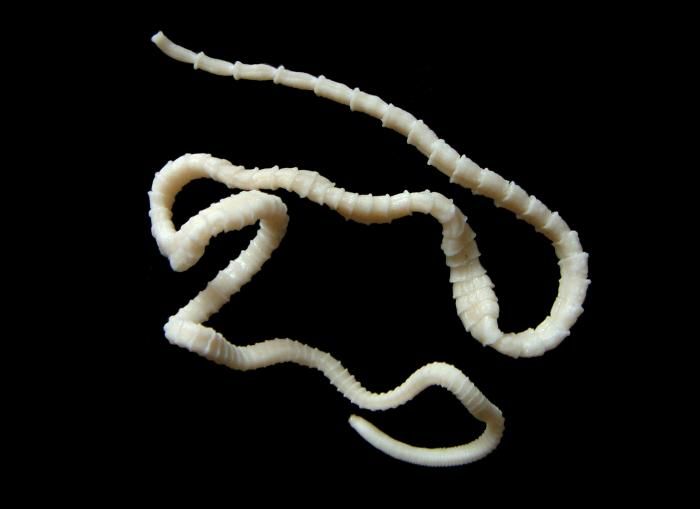
A tapeworm and a cat have this type of relationship.
a)
mutualism
b)
parasitism
c)
commensalism
d)
competition
18.
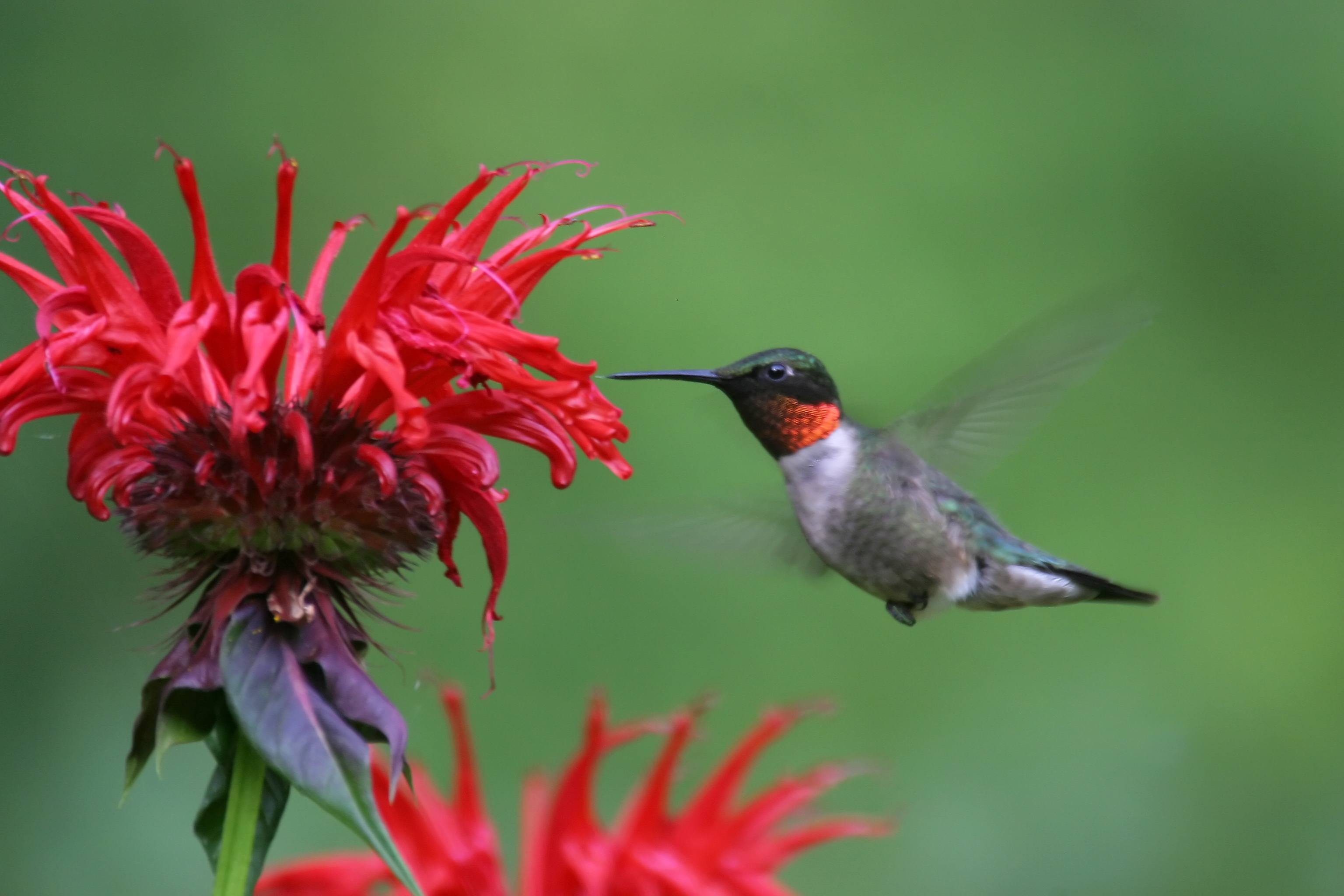
Hummingbirds feed on nectar from flowers.  The flowers are pollinated by hummingbirds as they move from flower to flower.  What type of symbiosis is this?  
a)
commensalism
b)
mutualism
c)
parasitism
d)
predation
19.
In a forest ecosystem, which of the following is the best example of a limiting factor for a rabbit population?
a)
Squirrel Population
b)
Sunlight
c)
Grass available
20.
In the energy pyramid here, which organisms have the most energy available?
a)
Producers
b)
Carnivores
c)
Herbivores
d)
Top Predator
21.
If there is 1000 Kcal available in the producers in trophic level 1, how much energy is available in the herbivores in trophic level 2?
a)
10 Kcal
b)
1 Kcal
c)
100 Kcal
d)
1000 Kcal
22.
A pond ecosystem is shown in the diagram below. Which statement describes an interaction that helps maintain the dynamic equilibrium of this ecosystem?
Which statement describes an interaction that helps maintain the dynamic equilibrium of this ecosystem?
a)
The frogs make energy available to this ecosystem through the process of photosynthesis.
b)
The algae directly provide food for both the rotifers and the catfish.
c)
The green-backed heron provides energy for the mosquito larvae.
d)
The catfish population helps control the populations of water boatman and waterfleas.
23.
A food chain is illustrated below:
The arrows represented most likely indicate
a)
A. Energy released from metabolism into the environment as heat.
b)
B. Oxygen released from metabolism produced by cellular respiration.
c)
C. The absorption of energy from the environment that has been created.
d)
D. The transport of glucose away from the organism through photosynthesis.
24.
Abiotic means____________.
a)
Nonliving
b)
Living
25.
Biotic means ____________. 
a)
Nonliving
b)
Living
26.
Which of the following is an example of competition?
a)
Two vultures fight over a dead rabbit
b)
A bear eats a fish
c)
Birds migrate south
d)
Pet dog keeps a man company
27.
The largest number of individuals in a species that an environment can support long term
a)
carrying capacity
b)
emigration
c)
immigration
d)
population density
28.
Any thing or organism that regulates the size of a population is known as __________.
a)
a limiting measure
b)
a limiting factor
c)
carrying capacity
d)
biodiversity
29.
Which of the following would INCREASE the carrying capacity of an ecosystem?
a)
increase in predators
b)
disease
c)
increase in available food
d)
drought
30.
The parasitic wasp injects its larvae into caterpillars . Acid rain has destroyed the caterpillar population. What will happen to the wasp population?
a)
Stay the same
b)
Increase
c)
Decrease
31.
If the carrying capacity of a predator decreases, what will happen to the carrying capacity of the prey?
a)
Will Increase
b)
Will Decrease
c)
Will stay the same
d)
Will fluctuate
32.
If the amount of food or resources available increases, the carrying capacity for an animal:
a)
Stays the same
b)
Increases
c)
Decreases
d)
Fluctuates
33.
A snake is eaten by a hawk. The hawk is the _______.
a)
prey
b)
parasite
c)
predator
d)
all of these
34.
What is the carrying capacity of the following graph?
a)
1000
b)
8000
c)
800
d)
600
35.
If the number of births is greater than the number of deaths in a population, what will happen to the growth of the population?
a)
It will increase
b)
It will decrease
c)
It will stay the same
d)
It don't matter
36.
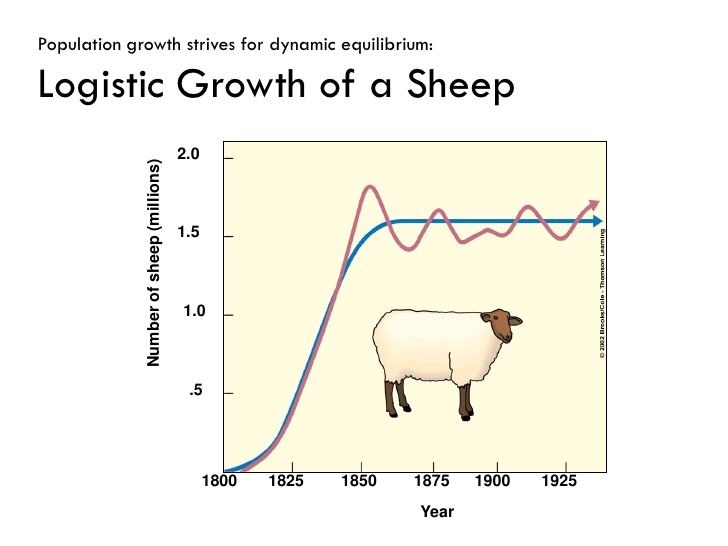
What is the carrying capacity for this sheep population?
a)
1.8 million
b)
1.25 million
c)
1.6 million
d)
1.o million
37.
Plants and animals that are not native to a habitat are called:
a)
predators
b)
biological magnification
c)
invasive species
d)
prey
38.
When taken to a new habitat, non-native plants often threaten native plants of the new habitat.  Why do they do this?
a)
Non-native plants are able to mutate rapidly
b)
Non-native  plants cause native animals to relocate
c)
Non-native plants are able to be used for medicine
d)
Non-native plants compete with native plants for resources
39.
What effect will an invasive species have on the carrying capacity of an ecosystem?
a)
The carrying capacity will increase
b)
The carrying capacity for everyone will decrease
c)
The carrying capacity will only decrease for those in competition for same resource
d)
The carrying capacity for all animals will stay the same
40.
Biodiversity refers to
a)
extinct species
b)
the variety of species on Earth
c)
nonrenewable resources
d)
the rate of species decline
41.
When humans burn fossil fuels, most of the carbon quickly enters the                       as carbon dioxide.
a)
Water
b)
Atmosphere
c)
Sun
d)
Air
42.
How do living organisms return carbon to the atmosphere in the carbon cycle?
a)
respiration and photosynthesis
b)
 decomposition and respiration
43.
The average temperature of the surface of Earth has increased approximately 1°C in the past century. Which reason best explains this increase in temperature?
a)
lower levels of ozone in the atmosphere
b)
lower levels of nitrogen in the atmosphere
c)
higher levels of carbon dioxide and other greenhouse gases in the atmosphere
d)
higher levels of oxygen in the atmosphere
44.

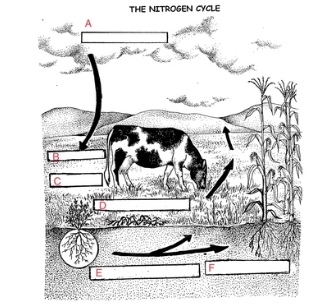
In the nitrogen cycle, what does label A in the diagram represent?

a)

Gas

b)

Clouds

c)

Carbon dioxide in the atmosphere

d)

Nitrogen in the atmosphere

45.

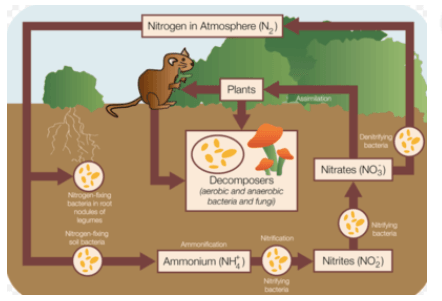
why do animals and plants need nitrogen?

a)

it helps to synthesize proteins

b)

it helps to synthesize lipids

c)

it helps to synthesize water

d)

it helps to synthesize glucose

46.

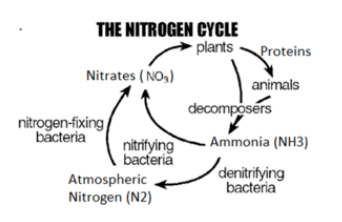
A correct path that nitrogen could take would be

a)

air -> animals -> plants -> bacteria

b)

animals -> air -> bacteria -> plants

c)

bacteria -> air -> plants -> animals

d)

air -> bacteria -> plants -> animals

47.

According to this diagram, animals get proteins from eating ________________________

a)

decomposers

b)

bacteria

c)

plants

d)

sunlight

48.

Plants and animals cannot use nitrogen directly from the air.

a)

True

b)

False

49.
Organisms that break down dead plants & animals and release nitrogen back into atmosphere...
a)
bacteria
b)
plants
c)
animals
d)
producers
50.

Nitrates are poisonous to fish. What should you add more of to get rid of nitrates without having to change the water in your fish tank?

a)

More fish

b)

Nitrobacter bacteria

c)

Nitrosomonas bacteria

d)

Plants