
 Worksheets
Review: Basic Mendelian Genetics
Total questions: 45
Worksheet time: 1hrs 20mins
The passing of genetic material from parents to offspring
Traits
Heredity
Characteristics
Phenotype
An Austrian monk known as the "father of genetics"
Rosalind Franklin
Francis Crick
Gregor Mendel
James Watson
The different or alternative versions of a gene
Genotype
Phenotype
DNA
alleles
What are segments of DNA called?
Genes
Alleles
Genotype
Traits
An allele represented by a lowercase letter
Recessive
Trait
Dominant
Allele
The genetic makeup for a set of alleles, represented by a combination of capital or lower case letters (Bb)
Phenotype
Genes
Genotype
DNA
Physical expression of a gene, an observable characteristic
Phenotype
Genotype
allele
trait
To inherit a recessive trait, it needs to be inherited from ___ parents to be expressed (physically apparent)
One
Both
Pick all genotypes that show dominance
TT
tt
Bb

(mark all correct answers) The picture shown is called a:
punnett square
monohybrid cross
dihybrid cross
molecular cross
An allele that masks the presence of another allele is known as a _______________ allele.
genotype
recessive
codominant
dominant
What phenotypic ratio would you expect from a cross of 2 heterozygous offspring for a single trait?
1:0
3:1
1:2:1
4:0
Choose all correct answers - When both alleles in the pair are the SAME, the organism could be considered:
homozygous
purebred
heterozygous
sex-linked
What phenotype ratio is a clue that a dihybrid cross a mating of two fully heterozygous parents?
1:2:1
4:2:2
1:1:1:1
9:3:3:1
Choose all correct answers: when an organism has 2 diferent alleles for a single gene, they are considered:
heterozygous
hybrid
purebred
homozygous
In pea plants, flowers can either be pink (P, dominant) or white (p, recessive). If a pink flowered (Pp) and a white flowered pea plant (pp) are crossed, what is the predicted phenotype of the offspring?
1 : 1 ratio of pink to white flowers
3 : 1 ratio of pink to white flowers
1 : 3 ratio of pink to white flowers
All pink flowers
The allele for purple flowers is dominant to the allele for white flowers. Which would be correct?
A cross between two white flowers could never produce offspring with purple flowers.
A cross between two purple flowers could never produce offspring with white flowers.
A cross between a purple and a white flower could never produce offspring with white flowers.
A cross between a purple and a white flower could never produce offspring with purple flowers.
In Holstein cattle the allele for black hair color (B) is dominant over the allele for red hair
color (b), and the allele for polled (P), or lacking horns, is dominant over the allele for having
horns (p).
What is the expected phenotypic ratio of the offspring of a BbPp × BbPp cross if these alleles
sort independently?
16 black/polled : 0 black/horned : 0 red/polled : 0 red/horned
12 black/polled : 0 black/horned : 0 red/polled : 4 red/horned
4 black/polled : 4 black/horned : 4 red/polled : 4 red/horned
9 black/polled : 3 black/horned : 3 red/polled : 1 red/horned
Facial dimples and free earlobes are both considered dominant human traits. What are the
expected phenotypes of the offspring of a female with dimples and free earlobes (DDFf) and a
male with no dimples and attached earlobes (ddff)?
50% with dimples and free earlobes and 50% with dimples and attached earlobes
50% with dimples and free earlobes and 50% with no dimples and attached earlobes
75% with dimples and free earlobes and 25% with no dimples and attached earlobes
75% with dimples and attached earlobes and 25% with no dimples and free earlobes
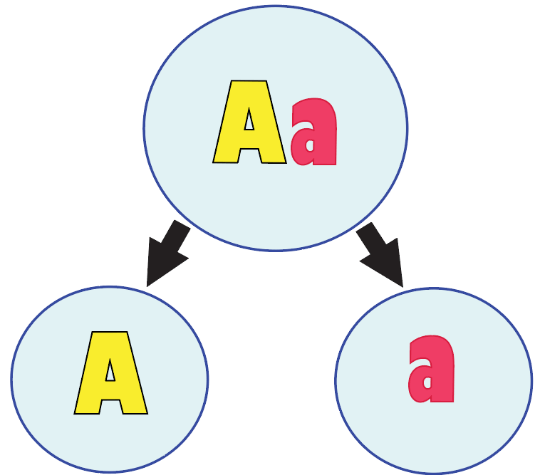
During meiosis and gamete formation, homologous (paired up) alleles split up
Phenotype
Law of Segregation
Genotype
Dihybrid Cross
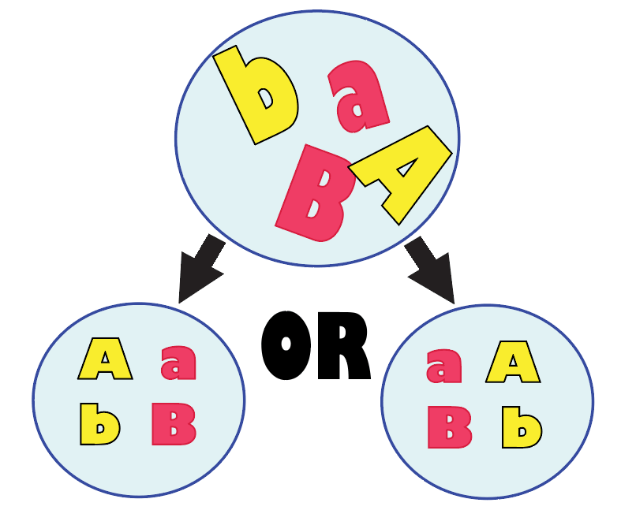
During meiosis, the homologous pairs of chromosomes and the matching alleles are lined up independently.
Offspring are a mix of maternal genes and paternal genes.
This increases genetic variation.
Homozygous Dominant
Law of Segregation
Crossing Over
Independent Assortment
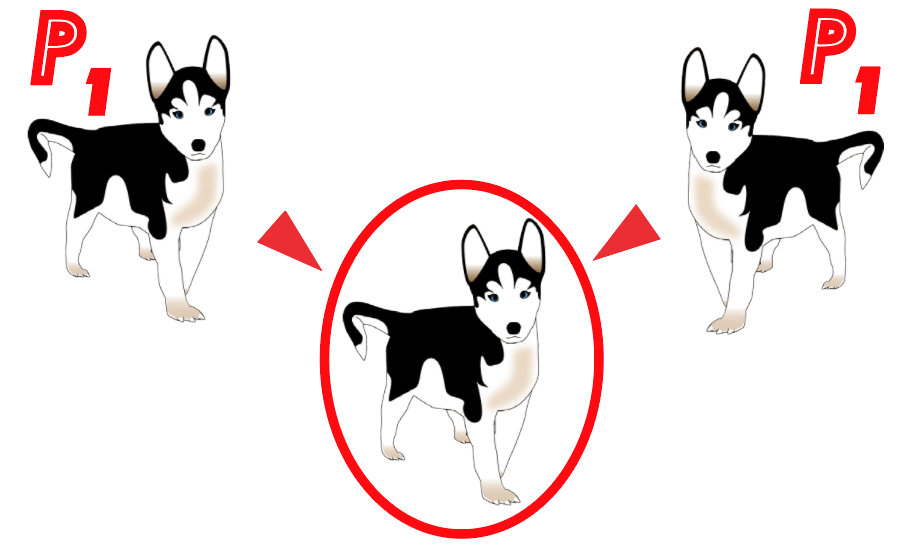
Referring to the original parents.
P1
F1
F2
Homozygous
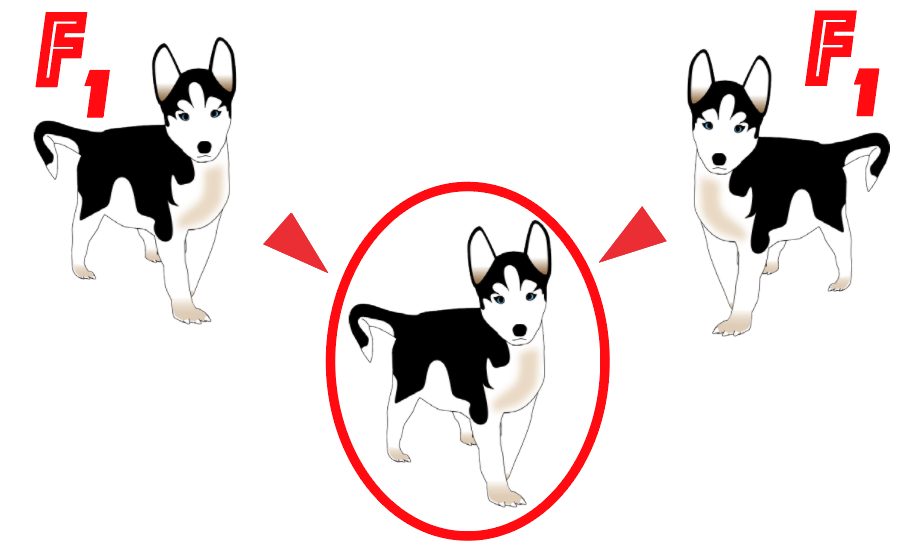
Second Filial Generation: the offspring of F1
P1
F1
F2
Homozygous Recessive
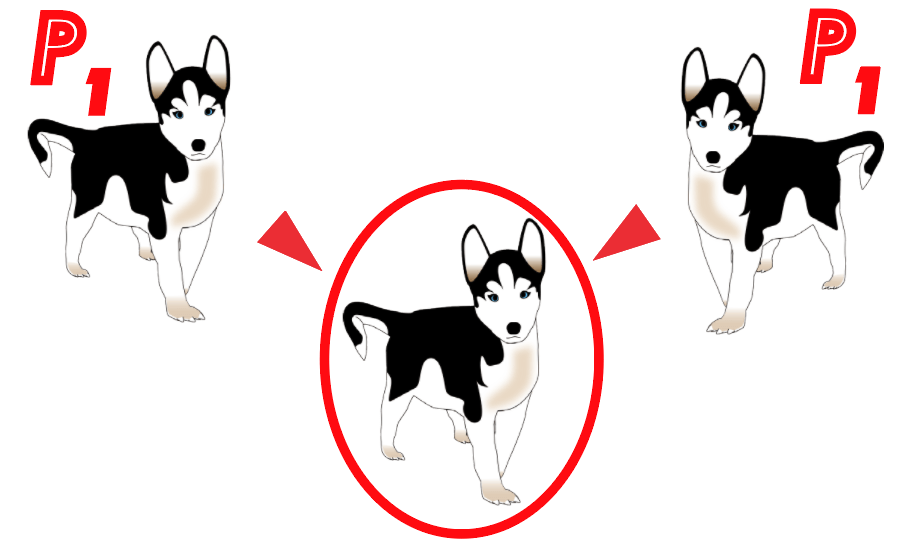
First Filial (child) Generation: the offspring of P1
P1
F2
F1
Heterozygous
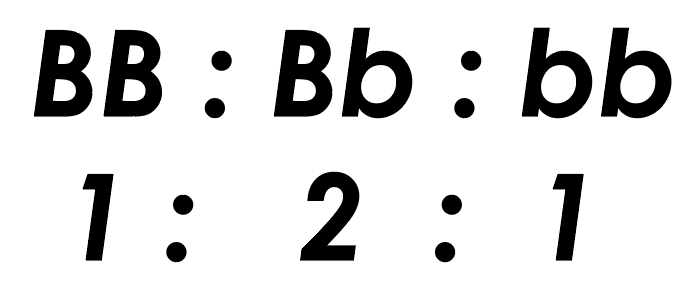
The ratio of homozygous dominant to heterozygous
to homozygous recessive offspring
Genotypic Ratio
Phenotypic Ratio
Monohybrid Cross
Homologous Pair

The ratio of phenotypes in a Punnett Square
Phenotypic Ratio
Genotypic Ratio
Dihybrid Cross
Independent Assortment
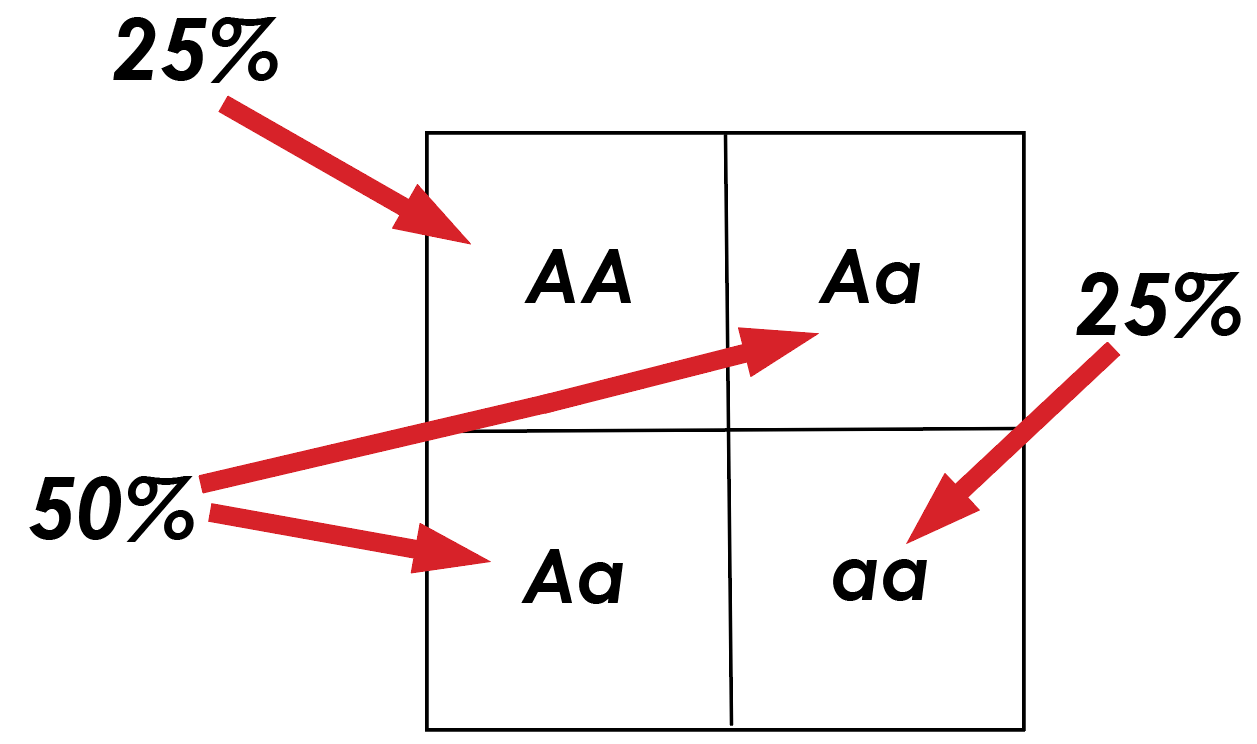
The chance that a genotype or phenotype
will actually occur in offspring
Probability
Phenotype
Genotype
Homozygous Recessive
Hitchhiker's thumb (H) is dominant to no hitchhiker's thumb (h). A woman who does not have hitchhiker's thumb marries a man who is heterozygous for hitchhiker's thumb. What is the probable genotypic ratio of their children?
100% Hh: 0% hh
75% Hh: 25%hh
50% Hh: 50% hh
0% Hh: 100% hh
A cat with curled ears was crossed with a cat with non curled ears. All of the kittens born had non curled ears. Later when the offspring were crossed with each other, the phenotypic ration was 3 to 1 non-curled to curled ears. What conclusions can be made about curled ears?
curled ears are a result of crossing over
it is a dominant trait
It is a recessive trait
more crosses need to be done to determine how the trait is inherited.

What is the genotypic ration of the offspring in the cross above?
1:2:1
1:1
3:1
1:2
Round peas (R) are dominant to wrinkled peas (r). In the P generation, a homozygous round parent was crossed with a homozygous wrinkled parent. (Hint: it may be helpful to sketch out a Punnett square with these as the parents).
What is true of the F1 generation (the offspring of the P generation)?
all heterozygous plants
all true breeding plants (homozygous round and homozygous wrinkled)
all wrinkled plants
round and wrinkled plants
Round peas (R) are dominant to wrinkled peas (r). In the P generation, a homozygous round parent was crossed with a homozygous wrinkled parent. (Hint: it may be helpful to sketch out a Punnett square with these as the parents).
If two F1 generation plants were crossed together, Mendel’s law of segregation supports…
that each parent can give only one allele making all pea plants of this generation round
that each parent can give only one allele, making it possible for wrinkled offspring to be produced
the allele for wrinkled is dominant over the allele for round
the gene for pea shape will act independently of the gene for pea color


What goes in box 3
Aabb
AABB
AAbb
aaBb
(RRYY x rryy)
R = round seeds, r = wrinkled seeds Y = yellow seeds, y = green seeds
What percent will have Round and Yellow seeds?
A white mouse with red eyes is crossed with a black mouse with brown eyes. The white mouse is recessive for both of its traits. The black mouse is dominant for both of its traits.
This cross would be
BBEE x bbee
BBEe x BbEe
BbEE x BbEe
BBee x BBEE
A male beetle has the genotype Ttbb. If this beetle mates with a female with genotype TTBb, what is the chance their offspring will have the genotype TtBb? [Type the answer in fraction]
(a)
In certain camels, one hump (H) is dominant over two humps (h) while long necks (N) are dominant over short necks (n). Cross a camel that is heterozygous for both traits with a camel that is homozygous recessive for hump & heterozygous for the neck.
What is the probability for an offspring to be homozygous recessive for both traits? [Answer in fraction]
(a)
A male alligator has the genotype RrAa. If this alligator mates with a female with genotype RrAa, what is the chance their offspring will have the genotype rrAa? [Type the answer in fraction]
(a)
Cross Two Homozygous plants
(RrYy x rrYy)
R = round seeds, r = wrinkled seeds Y = yellow seeds, y = green seeds
What is the probability for an offspring to have Wrinkled and Green seeds? [Answer in fraction]
(a)


