
 Worksheets
Geometry Review #4: Quadrilaterals/Polygons/Transformations
Total questions: 40
Worksheet time: 3570secs

120
125
130
135
Not enough information
The sum of a regular polygons interior angles measure 3,420 degrees. What is the value of a single interior angle to the nearest degree?
180
163
135
90
17
If the exterior angle of a regular octagon measures (11x+1) degrees, what is the value of x to the nearest tenth?
8.1
16.3
32.6
4.0
12.2
In which figure are the diagonals congruent but not necessarily perpendicular?
Parallelogram
Rhombus
Rectangle
Square
Trapezoid

Given parallelogram DEFG, find m<G.
67
71
109
113
Not enough infomation

In rhombus JKLM, if m<KLJ = 38, find m<JML.
38
76
104
112
142
What is the approximate perimeter of a rhombus with diagonals that measures 12 feet and 18 feet?
39.8 feet
43.3 feet
58.5 feet
60 feet
Not enough information

If WXYZ is a rectangle, Z is located at (-4, -5) and Y is located at (-1, -7), find the slope of WZ.


Undefined

If the diagonals of square ABCD intersect at (5, 1) and point A is located at (2, 3), find the approximate length of BD.
3.6
7.2
9.5
10.4
12.8

(7,8)
(7,4)
(-1,-5)
(-1, 3)
(-1,7)

Identify the scale factor that was used to graph D' E' F'.
2
3
1/2
1/3
2/3

Name that shape.
square
square
rhombus
quadrilateral
parallelogram
rhombus
quadrilateral
parallelogram
square
diamond
Kate built a garden box with 4 sides. It has two sets of parallel sides. Which of the following shapes could her garden NOT be?
rectangle
trapezoid
square
parallelogram
rhombus
I am searching for a shape that has 4 sides. It has 4 right angles. Which shapes could work? Select all that apply.
square
rhombus
rectangle
trapezoid
parallelogram
Select ALL the statements that are correct
All quadrilaterals have right angles.
A rectangle is a parallelogram.
A rhombus has equal sides.
Trapezoids don't have parallel lines.
All parallelograms have equal sides
Which of the following is NOT true for a rectangle?
all four angles are right angles
diagonals are perpendicular
diagonals are congruent
diagonals bisect each other
Two sets of parallel sides
I know that LMNO is a Rhombus by its most restrictive definition because ____________.
L(6, 7), M(11,7), N(8,3), O(3, 3)
Opposite sides are congruent
It has 4 congruent sides and diagonals are not congruent
It has 4 congruent sides and diagonals are congruent
LMNO is not a Rhombus
The slopes are opposite reciprocals of one another
Which point is the intersection of the diagonals of parallelogram ABCD?
A(5, 4), B(5, 10), C(9, 8), D(9, 2)
(6, 7)
(7, 6)
(8, 6)
(6, 8)
(8,7)
Given Square PQRS, what is the slope of diagonal PR if the slope of diagonal QS is 1.
-1
0
1
undefined
not enough information
In the parallelogram PARL, what is the slope of side RL given P(7, 5) and A(12, 4)?
not enough information
-5
1/5
-1/5
5

Write a rule for the translation.
(x,y) -> (x -1, y + 2)
(x,y) -> (x -2, y + 1)
(x,y) -> (x +2, y - 1)
(x,y) -> (x +1, y - 2)
(x,y) -> (-x, 2y)

Identify the transformation from ABCD to A'B'C'D'.
Translation (x,y)-> (x+7,y)
Reflection across the y-axis
Reflection across the x-axis
90o counter clockwise Rotation
Translation (x,y)->(x-7,y)

Identify the transformation from ABC to A'B'C'.
90o clockwise rotation
90o counter clockwise rotation
Reflection across the y-axis
Reflection across the x-axis
Translation (x,y)->(x, y-2)

Identify the transformation.
Reflection across y-axis
90 Rotation counter clockwise
Translation 5 units left, 1 unit up.
Translation 5 units right, 1 unit down
Reflection over the line y=x

Which rule would dilate shows a scale factor of 4
(x, y) → (y, x)
(x, y) → (x + 4, y + 4)
(x, y) → (x, -y)
(x, y) → (4x, 4y)
(x, y) → (1/4x, 1/4y)

Which rule would result in a clockwise rotation of 90° about the origin?
(x, y) → (y, -x)
(x, y) → (4x, 4y)
(x, y) → (x, -y)
(x, y) → (x + 4, y + 4)
(x, y) → (-y, x)
The coordinates of triangle JRB are ,J(1, -2) , R(-3, 6) and B(4, 5) . What are the coordinates of the vertices of its image after the transformation T<2, -1> then Ry-axis ?
(3, 1), (-1, -7), (6, -6)
(-3, -3), (1, 5), (-6, 4)
(1, -3), (5, 5), (-2, 4)
(-1, 3), (-5, -5), (2, -4)
(3,3), (-1,-5), (6,-4)
What are the coordinates of point A'' , the image of point A(-4, 1) after the composite transformation r90 then Ry=x where the origin is the center of rotation?
(-1, -4)
(-4, -1)
(1, 4)
(4, 1)
(-1, 4)
What is an isometry?
A transformation that changes the preimage size.
A transformation that translates the image.
A transformation that preserves the preimage shape and size, such as, a reflection, translation, and rotation.
A transformation that morphs the preimage to a new shape.
A transformation that creates similar figures, same shape different size like a dilation.

What is the rule for the following reflection?
Reflection across y = −2
Reflection across x = −2
Reflection across x = 2
Reflection across y = 2
Reflection across y=x
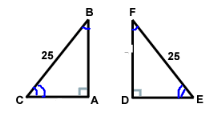
Triangle ABC has been reflected to form DFE. If ∠C is 40o find the measure of ∠F.
40o
50o
90o
45o
140o
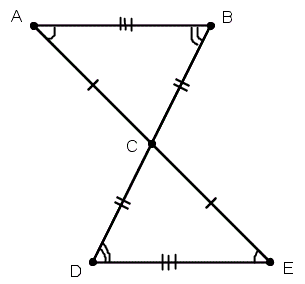
Triangle ABC has been rotated 180 degrees to form triangle EDC. If ∠E is 45o and ∠B is 55o what is the measure of ∠ACB?
45o
55o
80o
100o
Not enough information

What is the sequence of transformations?
Reflect over the line x=0 then reflect over the line y=0
Reflect over the line y=0 then reflect over the line x=0
Translate 4 units left then rotate 90˚
Rotate 90˚ then reflect over the the line y=0
Rotate 180 degrees clockwise

What are the series of rigid motions that would map ∆ABC onto ∆A''B''C''?
a reflection in the x-axis followed by a rotation 90 degrees clockwise about the origin
a reflection in the x-axis followed by a translation 5 units left and 2 units down
a translation 5 units right,2 units up followed by a rotation 90 degrees about the origin
a translation 5 units right, 2 units up followed by a reflection in the x-axis
rotation of 90 degrees clockwise then a reflection over the y-axis

Name the series of transformations that maps ABC onto DEF
reflect over x-axis then translate left 6 up 1
reflect over y-axis then translate down 6 left 1
translate right 6 down 1, then reflect over x-axis
rotate 90 degrees clockwise then reflect over y-axis
rotate 90 degrees counterclockwise then reflect over the y-axis

How many lines of symmetry does the picture have?
0 lines of symmetry
1 line of symmetry
2 lines of symmetry
3 lines of symmetry
Not enough information
A rigid motion ...
preserves size and location
preserves shape and location
preserves size and shape
makes the figure larger
creates similar figures with proportional sides and congruent angles

1/2
3/2
2
1
2/3
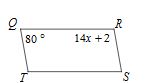
The figure is a parallelogram.
What is the value of x
7
12.7
100
80
5.6

Identify the angles of rotation that maps the image of the regular polygon to itself.
multiples of 72°
multiples of 180°
multiples of 144°
multiples of 45°
not enough information

