wayground logo

Free Printable Worksheets

Font size

S
M
L
XL
Worksheets

CW Qz Pedigree, April 19

Total questions: 250

Worksheet time: 4hrs 10mins

Name
Class
Date
1.
What percentage of the female offspring will be a carrier for this recessive disease?
a)
0%
b)
50%
c)
100%
d)
25%
2.
What type of heredity is shown in the pedigree?
a)
Sex-Linked Dominant
b)
Sex-Linked Recessive
c)
Autosomal (normal) Dominant
d)
Autosomal (normal) Recessive 
3.
What type of heredity is shown in the pedigree?
a)
Sex-Linked Dominant
b)
Sex-Linked Recessive
c)
Autosomal Dominant
d)
Autosomal Recessive 
4.
Is the following genotype homozygous or heterozygous?
TT
a)
homozygous
b)
heterozygous 
5.
Is the following genotype homozygous or heterozygous?
Gg
a)
homozygous
b)
heterozygous 
6.

Would the following genotype exhibit the dominant or recessive trait?

Hh

a)

Dominant

b)

Recessive

7.
Colorblindness is a recessive, X chromosome sex-link disorder. Cross the parents to figure out which percentage of their offspring will be colorblind.
a)
25%
b)
0%
c)
75%
d)
50%
8.
This type of inheritance pattern shows BOTH traits in possible offspring
a)
complete dominance
b)
incomplete dominance
c)
co-dominance
d)
dominant pattern
9.
A dog gives birth to 5 puppies. What percentage of the chromosomes does each puppy share with the mother?
a)
25%
b)
50%
c)
75%
d)
100%
10.
Hemophilia is a recessive x-linked disorder.
Which genotype represents a female who is a carrier for hemophilia?
a)
XHXh
b)
XhXh
c)
XHXH
d)
XhY
11.
Hemophilia is a recessive x-linked disorder.
Which genotype represents a male with hemophilia?
a)
XHXh
b)
XhXh
c)
XHY
d)
XhY
12.
Colorblindness is a recessive x-linked disorder.
Which genotype represents a male with normal vision?
a)
XNXN
b)
XnXn
c)
XNY
d)
XnY
13.
Colorblindness is a recessive x-linked disorder.
Which genotype represents a female who is colorblind?
a)
XNXn
b)
XnXn
c)
XNXN
d)
XnY
14.
Which of the following genotypes belongs in the red box in the Punnett square?
a)
XBXb
b)
XbXb
c)
XbY
d)
XBY
15.
Which of the following genotypes belongs in the red box in the Punnett square?
a)
XBXb
b)
XbXb
c)
XBXB
d)
XbY
16.
In fruit flies, red eye color (R) is a sex-linked trait that is dominant over white eye color (r).
According to the Punnett square, what percentage of female offspring will have red eyes?
a)
0%
b)
25%
c)
50%
d)
100%
17.
In fruit flies, red eye color (R) is a sex-linked trait that is dominant over white eye color (r).
According to the Punnett square, what percentage of offspring will have white eyes?
a)
0%
b)
25%
c)
50%
d)
100%
18.
Duchenne muscular dystrophy is a recessive x-linked disorder.
According to the Punnett square, what percentage of male offspring will have the disorder?
a)
0%
b)
25%
c)
50%
d)
100%
19.
Duchenne muscular dystrophy is a recessive x-linked disorder.
According to the Punnett square, what percentage of offspring will have the disorder?
a)
0%
b)
25%
c)
50%
d)
100%
20.
Hemophilia is a recessive x-linked disorder. According to the Punnett square, what percentage of offspring will have the disorder?
a)
0%
b)
25%
c)
50%
d)
100%
21.
Hemophilia is a recessive x-linked disorder. According to the Punnett square, what percentage of offspring will have the disorder?
a)
0%
b)
25%
c)
50%
d)
100%
22.

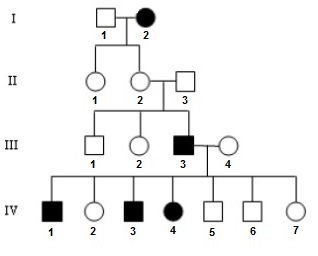
If hemophilia is a sex-linked recessive trait, what genotype would individual III-3 have?

a)

XhX

b)

XhXh

c)

XhYh

d)

XhY

23.
In the second generation-how many people are carriers of the trait?
a)
2
b)
3
c)
5
d)
6
24.
How many individuals are there in the 3rd generation?
a)
2
b)
3
c)
4
d)
6
25.
a)
Not affected Female
b)
Not affected Male
c)
Affected Male
d)
Affected Female
26.
a)
Not Affected Male
b)
Not Affected Female
c)
Affected Male
d)
Affected Female
27.

What do we use pedigrees for?

a)

To look at families

b)

To make determinations about the offspring

c)

To track a trait in families

d)

Nothing

28.
How are individuals III-2 and II-4 related?
a)
Cousins
b)
Dad and Daughter
c)
Uncle and Niece
d)
Grandpa and Granddaughter
29.
Which individual in the first generation is a carrier?
a)
The male
b)
The female
c)
individual 1
d)
None of the above
30.
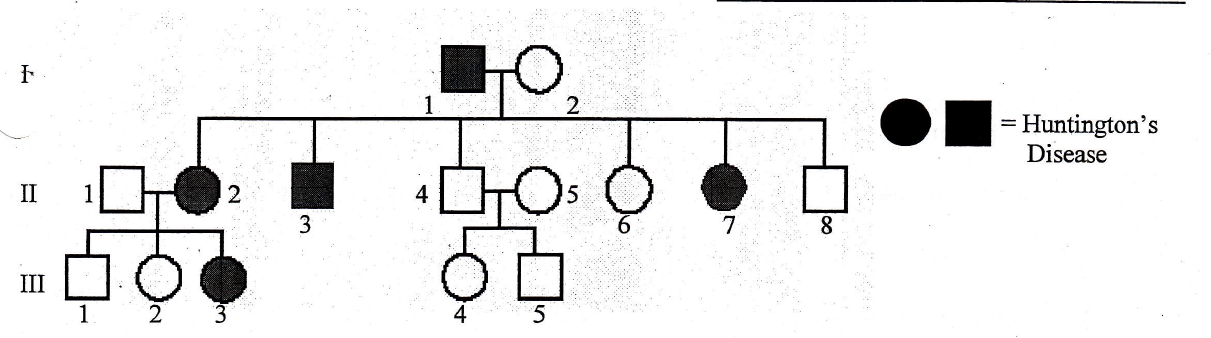
Which members of the family above are afflicted with Huntington's Disease?
a)
I-1, II-2, II-3, II-7, and III-3
b)
I-1, I-2, II-3, II-7, and III-5
c)
I-1, I-3, II-8, and III-2
d)
I-2, II-1, II-4, II-5, II-6, II-8, III-1, III-2, III-4, and III-5
31.
There are no carriers for Huntington's Disease- you either have it or you don't. Is Huntington's disease caused by a dominant or recessive trait?
a)
Dominant
b)
Recessive
32.
How many children did individuals I-1 and I-2 have?
a)
2
b)
4
c)
6
d)
8
33.
How are individuals I-2 and III-5 related?
a)
Grandpa and grandson
b)
Mom and son
c)
Uncle and nephew
d)
Grandma and grandson
34.

How are individuals III-1 and III-2 related? (Besides Cousins)

a)

Married

b)

Brother and sister

c)

Cousins

d)

Aunt and nephew

35.
Is it possible for individual IV-2 to be a carrier? Why?
a)
No, because her parents don't have the trait.
b)
No, because she doesn't have the trait.
c)
Yes, because her siblings have it.
d)
Yes, because her parents are carriers.
36.
What is the symbol for an Affected Male? 
a)
Half Circle 
b)
Half Square 
c)
Full Shaded Circle 
d)
Full Shaded Square 
37.
How are mates identified in a Pedigree? 
a)
Vertical Line 
b)
Horizontal Line 
38.
A carrier is represented by what symbol? 
a)
Clear 
b)
Shaded 
c)
Half Shaded
d)
1:4 ratio 
39.
Offsprings are represented by....
a)
Horizontal Line 
b)
Vertical Line 
40.
What does this shape represent in a pedigree?
a)
Not Affected Male (doesn't have the trait)
b)
Not Affected Female (doesn't have the trait)
c)
Affected Male (has the trait)
d)
Affected Female (has the trait)
41.
What does this shape represent in a pedigree?
a)
Not affected male (doesn't have the trait)
b)
Not affected female (doesn't have the trait)
c)
Affected male (has the trait)
d)
Affected female (has the trait)
42.
This pedigree represents the inheritance of hemophilia in this family. How many of the males have the hemophilia trait?
a)
8
b)
5
c)
2
d)
3
43.
If hemophilia is a sex-linked recessive trait, what genotype would individual I-2 have?
a)
XBXb
b)
XbXb
c)
XBY
d)
XbY
44.
How are individuals III-1 and III-2 related? (Besides marriage)
a)
Mother and son
b)
Brother and sister
c)
Cousins
d)
Aunt and nephew
45.
What type of heredity is shown in the pedigree?
a)
Sex-Linked Dominant
b)
Sex-Linked Recessive
c)
Autosomal Dominant
d)
Autosomal Recessive 
46.
What type of heredity is shown in the pedigree?
a)
Sex-Linked Dominant
b)
Sex-Linked Recessive
c)
Autosomal Dominant
d)
Autosomal Recessive 
47.
Is the following genotype homozygous or heterozygous?
TT
a)
homozygous
b)
heterozygous 
48.
Is the following genotype homozygous or heterozygous?
Gg
a)
homozygous
b)
heterozygous 
49.

Would the following genotype exhibit the dominant or recessive trait?

Hh

a)

Dominant

b)

Recessive

50.
This type of inheritance pattern is a MIXTURE of both traits. (Red + White = Pink)
a)
incomplete dominance
b)
co-dominance
c)
complete dominance
d)
recessive pattern
51.
Colorblindness is a recessive, X chromosome sex-link disorder. Cross the parents to figure out which percentage of their offspring will be colorblind.
a)
25%
b)
0%
c)
75%
d)
50%
52.
This type of inheritance pattern shows BOTH traits in possible offspring
a)
complete dominance
b)
incomplete dominance
c)
co-dominance
d)
dominant pattern
53.
A dog gives birth to 5 puppies. What percentage of the chromosomes does each puppy share with the mother?
a)
25%
b)
50%
c)
75%
d)
100%
54.
What you see, or the physical appearance.
a)
Genotype
b)
Phenotype
c)
Homozygous
d)
Heterozygous
55.
Stem cells can be obtained from
a)
embryos
b)
some adult tissues
c)
umbilical cord blood
d)
all of the above
56.
What is the difference between embryonic stem cells and adult stem cells?
a)
Embryonic stem cells can differentiate into more cell types than adult stem cells
b)
Adult stem cells are pluripotent, just like embryonic stem cells
c)
Adult stem cells can differentiate into more cell types than embryonic stem cells
d)
Adult stem cells grow bigger than embryonic stem cells
57.
Adult stem cells can also be referred to as 
a)
somatic stem cells 
b)
embryonic stem cells 
c)
starter cells 
d)
IPS cells 
58.
neural stem cells from the brain can differentiate into which types of cell 
a)
only specialized brain cells 
b)
specialized brain cells and specialized skin cells 
c)
all types of specialized cells 
d)
only specialized blood cells 
59.
stem cells are defined as 
a)
a cell that has the ability to divide only once and stay the same as other kinds of cells 
b)
A cell that has the ability to continuously divide and differentiate into various other kinds of cells/tissues
c)
any cell of a living organism other than the reproductive cells
d)
a cell that contains a nucleus surrounded by a membrane and whose DNA is bound together by proteins
60.
What process best explains how muscle cells and nerve cells can develop from the same fertilized egg?
a)
genetic engineering
b)
survival of the fittest
c)
differentiation
d)
selective breeding
61.
Which best explains why muscle cells are different from blood cells?
a)
Muscle cells are produced by the brain, but blood cells are produced by the heart. 
b)
Different genes are activated in muscle cells than in blood cells. 
c)
Muscles cells experience different environmental influences than blood cells. 
d)
A mutation occurs during the development of muscle cells but not in blood cells. 
62.
Which of the following is NOT TRUE about somatic cells?
a)
They have a complete set of chromosomes
b)
They have chromosomes which come in pairs
c)
Skin cells and liver cells would be examples
d)
Sperm cells and egg cells would be examples
63.
Which best explains why bone marrow cells are a good example of adult stem cells?
a)
They aren't. Bone marrow cells are embryonic stem cells.
b)
Bone marrow cells are multipotent and can only become red blood cells, white blood cells, and platelets.
c)
Bone marrow cells have the potential to become every type of cell in the body.
d)
Bone marrow cells are only found in humans 18 and over.
64.
What do stem cells have to do with clones?
a)
Stem cells can divide and differentiate  and grow into a clone
b)
Clones can be grown from stem cells
c)
Both choices are correct
d)
None of these choices are correct
65.
Name the previous phase.
a)
Prophase
b)
Metaphase
c)
Anaphase
d)
Telophase
66.
The diagram shows the process of cell specialization from a single stem cell. Which of the following statements is true about the process of specialization.
a)
Specialized cells (blood, skin, nervous etc) cannot be produced from a single stem cell
b)
Specialized cells are produced immediately following fertilization
c)
Even though all the cells in an organism come from one single cell, they can specialize into different cell types
d)
Sincce all the cells in an organism come from one single cell, they must all have the same structure and function
67.
How do stem cells know what type of cells to differentiate into?
a)
The nucleus has instructions to turn some genes on and some genes off
b)
Signals from chemicals in the organism or from the environment determine which genes will be turned on and off
c)
Genes turn on and off randomly
d)
The cell has unique DNA that determines what the cell will become.
68.
What is the purpose of cell division?
a)
infection
b)
growth
c)
repair
d)
growth and repair
69.
The longest phase of the cell cycle 
a)
prophase
b)
interphase
c)
metaphase
d)
mitosis
70.
Using carbon dioxide and water to create glucose and oxygen is
a)
photosynthesis
b)
respiration
c)
diffusion
d)
osmosis
71.
Which of the following is the correct equation for PHOTOSYNTHESIS?
a)
CO+ light + H2O --> O+ glucose
b)
CO+ glucose + H2O --> O+ light
c)
O2 + light + H2O --> CO+ glucose
d)
CO+ O2 + H2O --> Light+ glucose
72.
The overall equation for cellular respiration is:
a)
C6H12O+ energy -> 6CO6H2O + energy
b)
CH2O + O2 -> CO6H2O + energy
c)
C6H12O+ 6O2 -> 6CO6H2O + energy
d)
C6H12O+ 6CO2 -> 6O6H2O + energy
73.
This type of cell sends messages throughout the body in the form of electrical impulse.
a)
nerve cell
b)
sperm cell
c)
muscle cell
d)
skin cell
74.
This type of cell is found in males and is responsible for reproduction.
a)
sperm cell
b)
egg cell
c)
muscle cell
d)
nerve cell
75.
This type of cell fights infection.
a)
red blood cell
b)
platelet
c)
white blood cell
d)
antibacterial cell
76.
In what way is the DNA of a nerve cell different from the DNA of a muscle cell?
a)
The DNA is the same but each cell contains different genes
b)
The DNA is the same but different genes are turned on and turned off in each cell
c)
The DNA is different, but the same genes are turned on and off in each cell
d)
The DNA is different, but each cell contains the same genes
77.
This type of cell carries oxygen throughout the body.
a)
gamete
b)
platelet
c)
white blood cell
d)
red blood cell
78.
Compared to the parent cell after mitosis, daughter cells are - 
a)
differentiated
b)
more motile
c)
less specialized
d)
genetically identical
79.
All of the cells in a person's skin, liver, heart, and kidneys contains the exact same - 
a)
genes
b)
energy needs
c)
set of proteins
d)
number of atoms
80.
What is cancer?
a)
Uncontrolled cell growth, leading to a tumor
b)
When cells grow normally
c)
A virus
d)
A bacteria
81.
What biomolecule is DNA/RNA?
a)
Nucleic Acids
b)
Carbohydrate
c)
Lipid
d)
Protein
82.
All our cells, except sex cells like eggs or sperm, have ___________ DNA
a)
different
b)
similar
c)
exactly the same
d)
half the amount of 
83.
The order of nucleotides is important for
a)
making lipids
b)
making carbohydrates
c)
making proteins
d)
making nucleic acids
84.
Mitosis only occurs in eukaryotes. Mitosis does not occur in prokaryotes because they lack - 
a)
nuclei
b)
ribosomes
c)
proteins
d)
cell membranes
85.
A goldfish has 102 chromosomes in each body cell. How many chromosomes will be in each daughter cell after mitosis?
a)
51
b)
76
c)
98
d)
102
86.
Using your knowledge of root words, if a cell is "multi-nucleated', what would be TRUE about it?
a)
It has more than one nucleus.
b)
It has one giant nucleus.
c)
It has many cell parts.
d)
It has tiny cell parts. 
87.
Which of these statements are NOT true about stem cells? 
a)
Stem cells have the potential to be helpful in treating many diseases. 
b)
Embryonic stem cells are pluripotent cells taken from a 5-day-old human embryo.
c)
Stem cells are only found in human embryos. 
d)
Stem cells are undifferentiated cells that can help regenerate damaged tissues. 
88.
What is the name for cells that do not have nucleus? 
a)
eukaryotic
b)
prokaryotic
c)
stem cells
d)
none of these
89.
Which is a disadvantage of asexual reproduction?
a)
It takes longer than sexual
b)
It is more complicated than sexual
c)
It produces no variety in offspring
d)
It cannot produce as many offspring as sexual
90.
How does cancer spread to other parts of the body?
a)
Cancerous cells get into the circulatory system (blood, lymph)
b)
Cancerous cells cannot spread, they just develop in all parts of the body
c)
Cancerous cells are carried by bacteria and viruses to other parts of the body
d)
None of these
91.
Which of the following is NOT a reason we need mitosis.
a)
Growth
b)
Recovering from injuries
c)
Replacement of dead cells
d)
Sexual Reproduction
92.
This cell structure's function is to make ATP from glucose and oxygen during cellular respiration. BOTH plant and animal cells. 
a)
mitochondria
b)
chloroplast
c)
DNA
d)
cell membrane
93.
The muscular, skeletal, and nervous systems work together the most when
a)
you run the mile in P.E.
b)
your cells do cellular respiration to make ATP
c)
you fight off an infection or illness
d)
you get rid of waste
94.
Which cellular process takes place in the ribosomes that are bound to the endoplasmic reticulum?
a)
The breakdown of waste material
b)
The conversion of radiant energy to glucose
c)
The synthesis of new proteins
d)
The replication of nucleic acids
95.
Nuclear membrane forms around chromosomes and begins to separate.
a)
Anaphase
b)
Telophase
c)
Prophase
d)
Interphase
96.
Identify the Cell Cycle Stage.
a)
Prophase
b)
Interphase
c)
Anaphase
d)
Telophase
97.
Identify the Cell Cycle Stage.
a)
Anaphase
b)
Cytokinesis
c)
Telophase
d)
Metaphase
98.
Identify the Cell Cycle Stage.
a)
Cytokinesis
b)
Interphase
c)
Anaphase
d)
Metaphase
99.
Identify the Cell Cycle Stage.
a)
Anaphase
b)
Cytonkinesis
c)
Interphase
d)
Prophase
100.
Identify the Cell Cycle Stage.
a)
Interphase
b)
Anaphase
c)
Telophase
d)
Prophase
101.
The phase in mitosis where chromosomes move away and are pulled apart by spindles to opposite sides of the cell.
a)
prophase
b)
anaphase
c)
metaphase
d)
telephase
102.
Which is Metaphase?
a)
A
b)
E
c)
C
d)
F
103.
The process by which the nuclear material is divided equally between two new cells
a)
mitosis
b)
cancer
c)
spindle
d)
centromere
104.
In mitosis, the two resulting cells are
a)
different from the starting cell and identical to each other.
b)
different from the starting cell and different from each other.
c)
identical to the starting cell and different from each other.
d)
identical to the starting cell and identical to each other.
105.
The time between cell divisions in the life cycle of the cell is called
a)
anaphase
b)
interphase
c)
prophase
d)
metaphase
106.
Where does a cell contain it's genetic material?
a)
nucleus
b)
nucleolus
c)
cytoskeleton
d)
golgi
107.
Chromatin is found during which phase?
a)
Prophase
b)
Metaphase
c)
Interphase
d)
Telophase
108.
Asexual reproduction will result in
a)
Identical offspring to the parent
b)
Twins
c)
Meiosis
d)
Non-identical offspring to the parent
109.
The nuclear membrane breaks down occurs during which stage?
a)
Interphase
b)
Metaphase
c)
Prophase
d)
Telophase
110.
The chromosomes align in the middle of the cell occurs during which stage?
a)
Anaphase
b)
Metaphase
c)
Interphase
d)
Telophase
111.
What do centrioles do?
a)
Attach 2 sister chromatids together
b)
Pull the nuclear membrane apart
c)
Pull chromosomes apart
d)
Condense during Interphase
112.
90% of the cell's life is spent during what stage?
a)
Prophase
b)
Anaphase
c)
Metaphase
d)
Interphase
113.
What stage is a cell in when cleavage is present in the cell division?
a)
Interphase
b)
Prophase
c)
Cytokinesis
d)
Metaphase
114.
When during the cell cycle are chromosomes visible?
a)
Interphase
b)
When they are being replicated
c)
During cell division
d)
During the G1 phase
115.
During which state of the cell cycle is DNA Replicated?
a)
Interphase
b)
Prophase
c)
Anaphase
d)
Cytokinesis
116.
The nucleus divides into 2 nuclei during...
a)
Mitosis
b)
Replication
c)
Cytokinesis
117.
Structure A refers to the _____.
a)
chromatid
b)
chromosome
c)
centromere
118.
Structure B is pointing to the _____. 
a)
chromosome
b)
centromere
c)
DNA
d)
chromatid
119.
identical halves of a chromosome
a)
sister chromotids
b)
genes
c)
centromere
120.
The final part of the cell cycle and actually contains two separate processes: Mitosis and Cytokinesis
a)
Cell Cycle
b)
Cell Division
c)
Mitosis
d)
Cyclin
121.
This develops in the middle plane of a plant cell separating it into two daughter cells during cell division.
a)
cell wall
b)
cell plate
c)
cell membrane
d)
cytoplasm
122.
A jelly-like substance found inside a cell surrounding its organelles is
a)
cytokenisis
b)
cytoplasm
c)
mitosis
d)
epithelial
123.
These form during prophase and attach to chromosomes at the centromere to pull them apart during cell division
a)
prophase
b)
nucleus
c)
spindle fibers
d)
gene
124.
During which process is the cytoplasm divided into two new cells?
a)
Interphase
b)
Mitosis
c)
Cytokinesis
d)
DNA Replication
125.
Which process divides the nucleus into two nuclei?
a)
DNA Replication
b)
Mitosis
c)
Cytokinesis
d)
Reproduction
126.
The cell spends 90% of it's life in ________________.
a)
Mitosis
b)
Cytokinesis
c)
Interphase
d)
Meiosis
127.
_______________________ are condensed (tightly wound) DNA.
a)
Chromosomes
b)
Ribosomes
c)
Mitochondria
d)
Proteins
128.
The cell spends most of it's life in ________________.
a)
mitosis
b)
cytokinesis
c)
Interphase
d)
None of the above
129.
In the G1 stage of the cell cycle, the cell ______.
a)
Grows
b)
Rests
c)
Replicates DNA
d)
Divides
130.
In the G1 stage of the cell cycle, the cell
a)
Grows
b)
Increases surface area
c)
Carries on normal activities
d)
All of the above
131.
In the S stage of interphase, the cell ____.
a)
Grows
b)
Rests
c)
Replicates DNA
d)
Divides
132.
In the S stage of interphase_______________
a)
the cell grows
b)
the nucleus divides
c)
the cell membrane divides
d)
the DNA is replicated
133.
In the G2 stage of cell division, ______________ are made.
a)
organelles
b)
structures for cell division
c)
proteins
d)
all of the above
134.
In the G2 stage of the cell cycle, the cell ______.
a)
Grows
b)
Rests
c)
Replicates DNA
d)
Divides
135.
Before cellular division, _______ must be copied.
a)
mitochondria
b)
cytoplasm
c)
DNA
d)
Cell Wall
136.
Why would it be important to replicate DNA before a cell divides in mitosis?
a)
In order for genetic information to be transferred into daughter cells.
b)
In order for the cell to be able to increase in size.
c)
In order for the DNA to be contained in the nucleus.
d)
In order for the cell to re-order the DNA sequencing in the new cells.
137.
Fruit fly body cells have 8 chromosomes. After mitosis, you would expect a resulting fruit fly daughter cell to have -
a)
16 chromosomes.
b)
46 chromosomes.
c)
8 chromosomes.
d)
4 chromosomes.
138.

Cancer is...

a)

Uncontrolled cell division

b)

Normal cell division

c)

A protein

d)

A type of DNA

139.

A substance that is known to promote cancer is called a

a)

carcinogen

b)

nicolyte

c)

pathogen

d)

retrovirus

140.

Which of these is a tumor that is noncancerous and does not spread?

a)

Malignant

b)

Benign

141.

Name the 3 checkpoints of the cell cycle

a)

Anaphase checkpoint, metaphase checkpoint, and telophase checkpoint

b)

Interphase checkpoint, S phase checkpoint, and M phase checkpoint

c)

G1 checkpoint, G2 checkpoint, and S phase checkpoint

d)

G1 checkpoint, G2 checkpoint, and metaphase checkpoint

142.

True or False? Cancer cells can respond when they are too closely packed and cell division can be turned off.

a)

True

b)

False

143.
What phase of mitosis is occuring in the picture?
a)
Prophase
b)
Metaphase
c)
Cytokinesis
d)
Telophase
144.
What phase of mitosis is pictured?
a)
Metaphase
b)
Telophase
c)
Prophase
d)
Anaphase
145.

Which phase of mitosis is pictured?

a)

Anaphase

b)

Cytonkinesis

c)

Interphase

d)

Prophase

146.

Which phase of mitosis is pictured?

a)

Prophase

b)

Interphase

c)

Anaphase

d)

Telophase

147.
In the G1 stage of the cell cycle, the cell
a)
grows
b)
matures
c)
carries on normal activities 
d)
all of the above
148.
In the G2 stage of cell division, ______________ are made.
a)
proteins
b)
organelles
c)
structures for cell division
d)
all of the above
149.
During which stage of the cell cycle does mitosis and cytokinesis occur?
a)
Interphase 
b)
G1 phase
c)
S phase
d)
M phase
150.
During what phase of the cell cycle does the cell prepare for mitosis?
a)
G1 phase
b)
S phase
c)
G2 phase
d)
M phase
151.
How many checkpoints are in the cell cycle?
a)
1
b)
2
c)
3
d)
4
152.
Before cells can divide, what must be copied?
a)
RNA
b)
cell wall
c)
DNA
d)
all of the above
153.
True or false.  Cancer begins when mutations disrupt the normal cell cycle, causing cells to divide in an uncontrolled way.
a)
True
b)
False
154.
What is cancer?
a)
Colon Cancer
b)
Uncontrolled Cell growth
c)
Gentic Links
d)
Hair Loss
155.
Cells are either in
a)
intercourse, DNA
b)
Interphase, mitosis
c)
interphase, meiosis
d)
Outerphase, Mitosis
156.
In interphase what occurs?
a)
Replication of DNA, shrinking, Cell Collapse
b)
Apoptosis
c)
Growth, Replication of DNA, and Cell Function
d)
Duplication
157.
What happens in Mitosis?
a)
Removing old cells
b)
Growing, Replicating DNA, cell function
c)
Dividing & making new cells
d)
Apoptosis
158.
Cancer creates abnormal cells by disrupting
a)
the cell cycle
b)
red blood cell formation
c)
DNA replication
d)
ATP synthesis
159.
An abnormal mass of cancer cells is called a 
a)
tumor
b)
cyst
c)
lesion
d)
polyp
160.
Metastasis is
a)
the spread of cancer from one part of the body to another.
b)
the growth of tumors in the lungs
c)
cancer of the blood cells
d)
cancer that is found in connective tissues
161.
A cancerous tumor is called
a)
benign
b)
malignant
c)
apoptosis
d)
cyclin
162.
Non-cancerous tumors are called _____. Cancerous tumors are called _____.
a)
metastatic ; malignant
b)
malignant ; benign
c)
benign ; malignant
d)
benign ; metastatic
163.
Which of these is a risk factor for developing cancer? 
a)
growing older
b)
genetic inheritance
c)
exposure to carcinogens
d)
all of the above
164.
The causes of cancer may include which of the following?
a)
poor diet & activity levels
b)
UV radiation
c)
inheritance
d)
all of these
165.
The spreading of cancerous cells is called
a)
metastasis
b)
carcinogenesis
c)
angiogenesis
d)
homeostasis
166.
Programmed cell death is called
a)
apoptosis
b)
cytokinesis
c)
interphase
d)
cancer
167.
Type of tumor that remains at original site
a)
Benign
b)
Malignant
c)
Metastaasis
d)
checkpoint
168.
Which of the following is a type of protein that regulates the cell cycle? 
a)
actin 
b)
myosin 
c)
cyclin 
d)
pepsin 
169.
Which of the following is a treatment for cancer? 
a)
antibiotics 
b)
radiation therapy 
c)
herbal supplements 
d)
candy 
170.
Which phrase best describes cancer?
a)
absence of cyclins
b)
multiple gene mutations
c)
uncontrolled cell growth
d)
precesnce of genetic defects
171.

These type of stem cells are the most versatile and can become any type of cell in the body including cells from the placenta

a)

MULTIPOTENT

b)

PLURIPOTENT

c)

TOTIPOTENT

d)

OMNIPOTENT

172.

These type of stem cells are tissue specific and can turn into mature body cells, usually related types, and mesenchymal cells are an example of these

a)

totipotent

b)

multipotent

c)

plutipotent

d)

unipotent

173.

A very early embryo that has not been implanted in the uterus and contains the inner cell mass

a)

Blastocyst

b)

Gastrula

c)

Zygote

174.
Which  is of the following is not an example of cell differentiation? 
a)
Stem cells from bone marrow develop into blood cells
b)
Bone marrow cells are used to repair damage to heart tissue
c)
a leaf cell divides as a plant leaf grows
d)
A fertilized egg develops limbs and a hand
175.
where can totipotent cells be found?
a)
heart cells
b)
bone marrow
c)
inner cell mass
d)
fertilized egg
176.
Which is NOT a goal of agricultural bioengineering?
a)
to boost nutrient content
b)
to increase food production
c)
forensic science
d)
to extend the average human life by preventing malnutrition
177.
Transgenic organisms have
a)
genes combined from a male and female of the same species
b)
a small number of genes
c)
genes added from a different organism
d)
genes living outside their bodies
178.
Which of the following would be an example of biotechnology?
a)
studying rock layers
b)
monitoring water quality
c)
developing plants that are resistant to week killers
d)
developing hydropower energy sources
179.
Which best describes biotechnology?
a)
a field of science that has not impacted our lives
b)
technological application of living and nonliving organisms to produce beneficial products
c)
a slowly growing field of science
d)
technological application of living organisms to produce beneficial products
180.
Why was U.S. federal funding for embryonic stem cell research restricted?
a)
controversy over using discarded human embryos
b)
controversy over research that could cure diseases
c)
controversy over using bodies donated to medical reseaarch
d)
controversy over scientists being paid too much money
181.
What is the difference between embryonic stem cells and adult stem cells?
a)
Embryonic stem cells can differentiate into more cell types than adult stem cells
b)
Adult stem cells are pluripotent, just like embryonic stem cells
c)
Adult stem cells can differentiate into more cell types than embryonic stem cells
d)
Adult stem cells grow bigger than embryonic stem cells
182.
Although he lied, what did Hwang Woo Suk claim to have done?
a)
Used cells from healthy adults and turned them into embryonic stem cells
b)
Cloned a human
c)
Used cells from mice and changed them into human stem cells
d)
Cloned a sheep
183.
Which bond of the ATP molecule is broken in order to release energy?
a)
A
b)
B
c)
C
d)
D
184.
Which of the following is components can transform ADP to ATP?
a)
Adenosine
b)
Phosphate group
c)
Nitrogenous Base
d)
Ribose
185.
Which of the following can be compared to a battery in need of recharging?
a)
ADP
b)
ATP
c)
Ribose
d)
Adenosine
186.
Which cellular organelle is responsible for manufacturing ATP?
a)
Ribosome
b)
Nucleus
c)
Mitochondria
d)
Chloroplast
187.
Which of the following is NOT a component of ATP?
a)
Glucose
b)
Adenosine
c)
Phosphate 
d)
Ribose
188.
Which of the following results in the release of energy in terms of the ATP/ADP cycle?
a)
The breaking of the bond between the 5-carbon sugar and the 1st phosphate group
b)
The addition of a phosphate group
c)
The removal of a phosphate group
d)
The addition of glucose 
189.
Which of the following results in the storage of energy in terms of the ATP/ADP cycle?
a)
The breaking of the bond between the 5-carbon sugar and the 1st phosphate group
b)
The addition of a phosphate group
c)
The removal of a phosphate group
d)
The addition of glucose 
190.
Energy is released from ATP when
a)
a phosphate group is added
b)
adenine bonds to ribose
c)
ATP is exposed to sunlight
d)
a phosphate group is removed
191.
What are the parts of the ATP molecule?
a)
adenine, thylakoids, stroma
b)
stroma, grana, chlorophyll
c)
adenine, ribose, phosphate groups
d)
NADH, NAHPH, FADH
192.
What do all cells use as energy?
a)
Carbs
b)
Protein
c)
Fat
d)
ATP
193.
Which structures shown in the Figure make up the ATP molecule?
a)
A and B
b)
A, B and C
c)
A, B, C, and D
d)
C and D
194.
Which structures shown in the Figure make up the ADP molecule?
a)
A and B
b)
A, B and C
c)
A, B, C, and D
d)
C and D
195.
About how many molecules of ATP can be generated from one molecule of glucose?
a)
2
b)
6
c)
36
d)
4
196.
What are the parts of the ATP molecule?
a)
adenine, thylakoids, stroma
b)
stroma, grana, chlorophyll
c)
adenine, ribose, phosphate groups
d)
NADH, NAHPH, FADH
197.
Energy is released from ATP when
a)
a phosphate group is added
b)
adenine bonds to ribose
c)
ATP is exposed to sunlight
d)
a phosphate group is removed
198.
What is the function of ATP in living things?
a)
provides energy for cells
b)
stores genetic information
c)
provides structure in the nucleus
199.
Enzymes break down ATP by breaking off a _______________.
a)
ribose group
b)
phosphate group
200.
ATP minus a phosphate group does not yield ADP.
a)
True
b)
False
201.
Is ATP an atom or a molecule?
a)
molecule
b)
atom
202.
The energy in ATP is contained inside the __________ between the phosphate groups.
a)
bond
b)
molecule
203.
ATP molecules remove a phosphate group to _______________ energy.
a)
store
b)
release
204.
ATP = adenine + ribose + 3Pi
a)
True
b)
False
205.
Pi stands for _____________
a)
potassium
b)
phosphate group
206.
Using the figure, between which parts of the molecule must the bonds be broken to form an ADP molecule?all of the above
a)
A and B
b)
B and C
c)
C and D
207.
Energy is released from ATP when _______________________.

a)
a phosphate group is added
b)
adenine bonds to ribose
c)
a phosphate group is removed
d)
ATP is exposed to sunlight
208.
Which of the following can be compared to a battery in need of recharging?  (empty wallet)
a)
ADP
b)
ATP
c)
Ribose
d)
Adenosine
209.
What type of energy is glucose?
a)
carbohydrate
b)
protein
c)
nucleic acid
d)
lipid
210.
What are the products of photosynthesis? 
a)
water and carbon dioxide
b)
oxygen and glucose
c)
oxygen and carbon dioxide
d)
oxygen and water
211.
Plants need carbon dioxide from their environment to produce glucose during which stage of photosynthesis? 
a)
The light-dependent stage
b)
The light-independent stage
c)
The electron transport chain
d)
ATP formation
212.
What molecule absorbs sunlight for photosynthesis?
a)
chloroplast
b)
thylakoid
c)
grana
d)
chlorophyll
213.
The interaction of sunlight, chlorophyll pigment and water create ______________________.
a)
low-energy electrons
b)
high-energy electrons
c)
photons
d)
wavelengths
214.
Another name for the light-independent stage is the _____________________.
a)
water cycle
b)
rock cycle
c)
Calvin cycle
d)
reproductive cycle
215.
Where do the light-dependent reactions occur? 
a)
thylakoid 
b)
stroma
c)
mesophyll
d)
mitochondria
216.
What is the source of energy for photosynthesis?carbohydrates-chemicalsunlightheat-thermalelectrical
a)
electrical energy
b)
sunlight
c)
carbohydrates - chemical engery
d)
heat -thermal energy
217.
Which of the following is the correct equation for PHOTOSYNTHESIS?
a)
CO+ light + H2O --> O+ Sugar
b)
CO+ sugar + H2O --> O+ light
c)
O2 + light + H2O --> CO+ Sugar
d)
CO+ O2 + H2O --> Light+ Sugar
218.
What process occurs when light energy is captured in autotrophs and converted into sugar?
a)
Photosynthesis
b)
Cellular Respiration
219.
What are the products of photosynthesis?
a)
water and carbon dioxide
b)
oxygen and glucose
c)
oxygen and carbon dioxide
d)
oxygen and water
220.
What is the pigment in chloroplasts that performs photosynthesis?
a)
Chlorosynthesis
b)
Chlorophyll
c)
ADP
d)
Electron Transport
221.
Most plants appear green because chlorophyll
a)
absorbs green light.
b)
absorbs violet light.
c)
does not absorb green light.
d)
does not absorb violet light.
222.
Plants need carbon dioxide from their environment to produce glucose during which stage of photosynthesis? 
a)
The light-dependent stage
b)
The light-independent stage (The Calvin Cycle)
c)
The electron transport chain
d)
ATP formation
223.
The light independent reactions of photosynthesis happen where?
a)
stroma of chloroplast
b)
mitochondrial matrix
c)
stem
d)
thylakoid membrane
224.
Does the Calvin Cycle require light?
a)
yes
b)
no
c)
depends on the amount of carbon dioxide
225.
Which of the following would have affect the rate of photosynthesis?
a)
amount of water
b)
carbon dioxide concentration
c)
temperature
d)
all of these
226.
Use the diagram to answer the question. Which molecule is an electron carrier?
a)
H2O
b)
carbon dioxide
c)
NADP+
d)
oxygen
227.
Which product is produced by the splitting of water during the light-dependent reactions of photosynthesis?
a)
NADPH
b)
oxygen
c)
glucose
d)
carbon dioxide
228.
Where do the light-dependent reactions occur? 
a)
thylakoid membrane
b)
stroma
c)
mesophyll
d)
mitochondria
229.
What is the function of NADPH and ATP?
a)
They absorb light
b)
They power the light-dependent reactions
c)
They are light-reflecting pigments
d)
They are short term energy carriers
230.
The calvin cycle takes place in __________.
a)
stroma
b)
thylakoid membrane
c)
chlorophyll
d)
granum
231.
#4 is pointing to an individual "pancake" in this stack.  What is this called?
a)
Stroma
b)
Thylakoid
c)
Granum
d)
Stomata
232.
 #3 is pointing to the space outside the stacks in this chloroplast.  What is this area called?
a)
Thylakoid space
b)
Thylakoid
c)
Stroma
d)
Stomata
233.
The Calvin Cycle occurs in the ___________.
a)
Stroma
b)
Thylakoid Membrane
c)
Enzyme ATP Synthase
d)
Chlorophyll
234.
In the Calvin Cycle, ________ and ________ from the light dependent reactions convert PGA into G3P
a)
O2, ATP
b)
CO2, H2
c)
ADP, NADPH
d)
NADPH, ATP
235.
In order to efficiently create 1 glucose molecule, the Calvin Cycle must occur how many times?
a)
3
b)
6
c)
1
d)
12
236.
The energy provided by ATP comes from what?
a)
Adenosine
b)
The phosphate groups
c)
The bonds between the phosphate groups
d)
The excited electron
237.
After reaching an excited state, electrons jump from the chlorophyll molecules to the __________.
a)
Stroma
b)
Electron transport chain
c)
Photosystem 2
d)
H+ ion reservoir 
238.
What happens to the Ocreated in the light phase?
a)
Is transferred to the Calvin Cycle
b)
Donates its electrons to the Chlorophyll molecules
c)
Provides a carbon to form the unstable 6-carbon molecule
d)
Diffuses out through the stoma
239.
Adenosine Triphosphate is created after an H+ passes through ____________. 
a)
The Stroma
b)
ATP Synthase 
c)
The Calvin Cycle
d)
The electron transport chain
240.
The energy required to pump H+ ions into the H ion reservoir comes from the _____________
a)
ATP molecules
b)
Electron Transport Chain
c)
Light 
d)
Thylakoid Membrane
241.
The process which joins together ADP and P is called ______________
a)
ATP Creation
b)
Glycolysis 
c)
Active Transport
d)
Chemiosmosis
242.
The light dependent phase occurs in the __________.
a)
Stroma
b)
Thylakoid Membrane
c)
Chlorophyll
d)
Chloroplast Membrane
243.
True or False: While the light dependent phase can only occur during the day, the Calvin Cycle may occur during the day or night
a)
True
b)
False
244.
The COused in the Calvin Cycle originates from ___________.
a)
The light phase
b)
The breakdown of the remaining G3P's
c)
Diffusion through the stoma
d)
Lumen of the Thylakoid
245.
The final step of the Light Dependent Phase involves the creations of _____________.
a)
NADPH
b)
Glucose
c)
ATP
d)
CO2
246.
In the process of efficiently creating 3 glucose molecules, how many PGA molecules would be produced?
a)
18
b)
6
c)
36
d)
12
247.
True or False: If Photosystem's did not need to replace their electrons, photosynthesis could occur without H2O
a)
True
b)
False
248.
True or False: The Calvin Cycle returns ADP and NADP to the light dependent phase.
a)
True
b)
False
249.

The Calvin Cycle takes place in the:

a)

Stroma

b)

Thylakoid

c)

Grana

d)

Stomata

250.
In the Calvin Cycle, carbohydrate molecules are:
a)
Reduced
b)
Oxidized