wayground logo

Free Printable Worksheets

Font size

S
M
L
XL
Worksheets

Ecology Biology Review

Total questions: 25

Worksheet time: 15mins

Name
Class
Date
1.
An organism that needs to eat other organisms to obtain energy is known as a:
a)
Autotroph
b)
Producer
c)
Consumer
d)
Mutualist
2.
Consumer that eats plants
a)
heterotroph
b)
herbivore
c)
producer
d)
community
3.
The rabbit in this food web would be considered a:
a)
Decomposer
b)
Producer
c)
Secondary Consumer
d)
Primary Consumer
4.
What is the term for each step in the transfer of energy and matter within a biological community?
a)
energy path
b)
food web
c)
trophic level
d)
food pyramid
5.
The amount of energy that usually transfers from one trophic level to the next...
a)
10%
b)
20%
c)
80%
d)
50%
6.
The nonliving aspects of an ecosystem.
a)
Abiotic factors
b)
Biotic factors
7.
As you move upward, from level to level, in an energy pyramid, energy _____.
a)
increases
b)
decreases
c)
stays the same
d)
increases exponentially
8.

An ant lives on an acacia tree- the ant protects the tree and the tree feeds the ant. What kind of relationship is this?

a)

Mutualism

b)

Commensalism

c)

Parasitism

d)

Predation

9.

Which of the following are the ecosystem’s main decomposers?

a)

Scavengers

b)

Fungi and Bacteria

c)

Birds

d)

Lions and Bears

10.

The Insect population would most likely DECREASE if there were…

a)

An increase in decomposers

b)

An increase in the amount of grass

c)

A decrease in Mice and Shrews

d)

A decrease in the amount of available sunlight

11.

The least amount of available energy is found at level--

a)

4

b)

3

c)

2

d)

1

12.

An environmental change that removed which of the following organisms would cause the most instability in the ecosystem?

a)

Humans

b)

Zooplankton

c)

Harbour Porpoise

d)

Salmon

13.

DTR: Leech sucking blood

a)

Mutualism

b)

Commensalism

c)

Parasitism

d)

Predation

14.

DTR: Barnacles live on a whale and get nutrients that float nearby. The whale does not receive a benefit and doesn't get hurt from this relationship

a)

Mutualism

b)

Commensalism

c)

Parasitism

d)

Predation

15.

Which organism has the most available energy?

a)

Snakes

b)

Insects

c)

Grasses

d)

Rabbits

16.

A Sea Lamprey will attach to a fish, like a Brown Trout, and will slowly suck all the liquid out of the Brown Trout. What type of relationship is being described?

a)

Symbiotic

b)

Parasitism

c)

Mutualistism

d)

Commensalism

17.
Organisms that break down dead plants & animals and release nitrogen back into atmosphere...
a)
bacteria
b)
plants
c)
animals
d)
producers
18.
How nitrogen is "fixed" into  a useable form for plants...
a)
through action of bacteria only
b)
through lightning only
c)
through action of bacteria & lightning
d)
through photosynthesis
19.
How do decomposers help plants?
a)
The eat other insects that might eat the plants.
b)
The do not compete against the plants for food.
c)
They scare away potential predators of plants. 
d)
The release nutrients into the soil that plants use to grow.
20.
When a population grows past the ecosystem's carrying capacity, what happens to the population?
a)
Continues to grow
b)
The population starts to die off to return to carrying capcity
c)
The population will go extinct due to lack of resources
d)
The population grows then finds a new carrying capacity
21.
The largest number of individuals in a species that an environment can support long term
a)
carrying capacity
b)
emigration
c)
immigration
d)
population density
22.
the process by which a new community forms where no community lived before 
a)
resource
b)
invasive (non- native) species
c)
primary succession
d)
competition
23.
What is the goal of the pioneer species in Primary Succession?
a)
To kill the dead materials after a disaster
b)
To rebuild soil
c)
To feed Johnny
d)
To put fresh oxygen into the air
24.
After a volcanic eruption, lava covers the land. What is the order that plants grow to repopulate the area?
a)
Lichens → Shrubs → Grasses → Trees
b)
Lichens → tree → shrubs→Grasses
c)
Grasses → Lichens → Shrubs → Trees
d)
Lichens → Grasses → Shrubs → Trees
25.
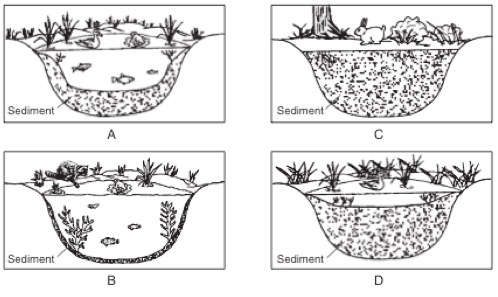
What is the correct order from oldest (happened first) to youngest (happened last) in this pond succession?
a)
A, B, C, D
b)
D, C, B, A
c)
B, A, D, C
d)
C, D, A, B