
NEW
Font size
S
M
L
XL
 Worksheets
Milestones Review
Total questions: 54
Worksheet time: 44mins
Name
Class
Date
1.
What are the three states of matter?
a)
solid, volume, mass
b)
density, volume, mass
c)
solid, liquid, gas
d)
density, gas, volume
2.
Something that takes up space and has mass.
a)
volume
b)
matter
c)
mass
d)
density
3.
A state of matter that has a definite volume and shape.
a)
solid
b)
liquid
c)
gas
d)
matter
4.
The amount of space something takes up
a)
density
b)
volume
c)
mass
d)
matter
5.
Shape is a ____ that helps identify an object.
a)
physical property
b)
chemical property
c)
mass
d)
matter
6.
Iron + oxygen = rust is an example of a ___________.
a)
physical property/change
b)
chemical property/change
c)
mass
d)
volume
7.
A watermelon has more matter than a grape, so it has more
a)
mass
b)
eat
c)
solid
d)
greater
8.
You can measure ______ with grams.
a)
mass
b)
volume
c)
conductivity
d)
melting point
9.
The ability of a metal to allow heat or electricity to pass through it.
a)
conductivity
b)
insulator
c)
mass
d)
density
10.
What is a PUSH or PULL of an object?
a)
Motion
b)
Force
c)
Friction
d)
Gravity
11.
Which force produces a change in motion?
a)
unbalanced force
b)
balanced force
c)
gravitational force
d)
frictional force
12.
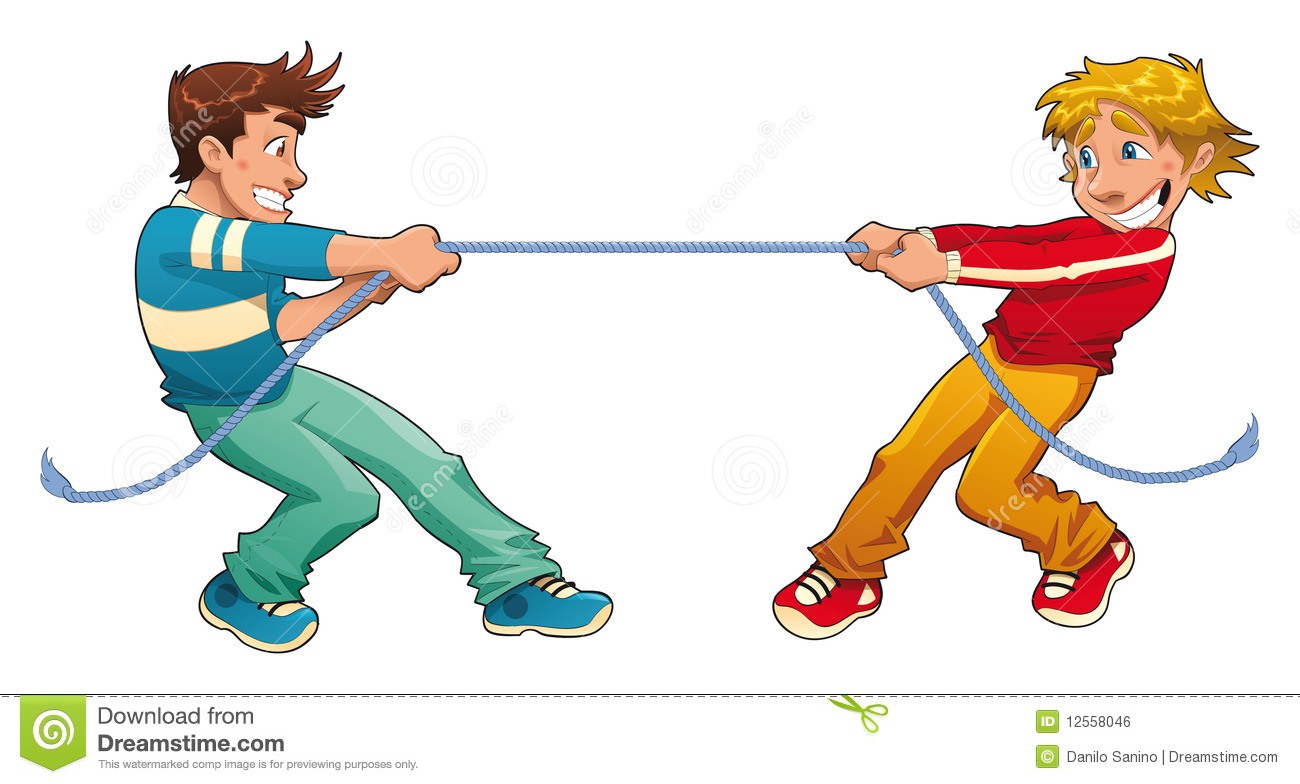
If these boys are pulling with the same amount of force. What will happen?
a)
The boy in blue will win.
b)
They will not move at all.
c)
The boy in red will win.
d)
Both will fall down.
13.
What is the formula for force?
a)
F=M/A
b)
F=A/M
c)
F=M*A
d)
F=M*F
14.
Any time the forces are unbalanced, an object will remain at rest. True or false?
a)
true
b)
false
15.
When you tell the direction and speed of an object, you give its
a)
motion
b)
velocity
c)
acceleration
d)
mass
16.
Which of the following statements is true?
a)
Balanced forces cause a change in motion.
b)
Unbalanced forces cause a change in motion.
c)
Forces do not effect the change in motion.
17.
Speed is different from velocity because
a)
Velocity has a direction
b)
Speed uses Distance /Time
c)
Velocity doesn't include time
d)
Velocity doesn't include distance
18.

What type of energy is in this picture?
a)
Kinetic
b)
Potential
c)
Electromagnetic
19.
When plants convert the sun's energy into food, which type of energy does the sun energy become?
a)
kinetic
b)
chemical
c)
thermal
20.

What form of energy?
a)
Mechanical (kinetic) energy
b)
Chemical (kinetic) energy
c)
Sound (potential) energy
d)
Sound (kinetic) energy
21.

What kind of energy?
a)
Thermal (kinetic) energy
b)
Chemical (kinetic) energy
c)
Chemical (potential) energy
d)
Mechanical (kinetic) energy
22.

What form of energy is stored in the bonds between molecules of matter?
a)
chemical energy
b)
heat energy
c)
kinetic energy
d)
mechanical energy
23.
the ability to do work
a)
energy
b)
Matter
c)
photons
d)
potential energy
24.
Stored energy that results from the position or shape of an object is called...
a)
Thermal
b)
Potential
c)
Kinetic
d)
Gravitational
25.
Energy is made out of...
a)
Matter
b)
Atoms
c)
Photons
d)
Nothing
26.
Energy takes up space
a)
True
b)
False
27.
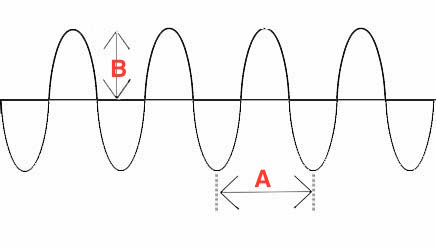
What property of this wave is represented by the letter "A"
a)
amplitude
b)
crest
c)
trough
d)
wavelength
28.
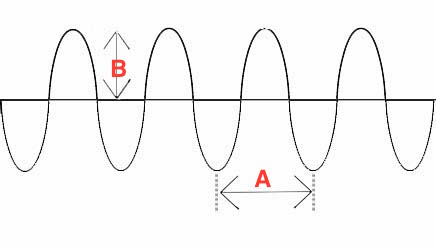
What property of the wave is represented by the letter "B"?
a)
amplitude
b)
crest
c)
trough
d)
wavelength
29.
The highest point on a wave is:
a)
the crest
b)
the trough
c)
the top
d)
the coast
30.
The lowest point on a wave is the:
a)
Amplitude
b)
Crest
c)
Trough
d)
Wavelength
31.
The number of wavelengths that pass a point each per second is:
a)
frequency
b)
period
c)
longitudinal
d)
transverse wave
32.
The type of waves that require medium to pass:
a)
Mechanical Waves
b)
Electromagnetic Waves
33.

Which vocabulary term is used to identify the distance between points C & G?
a)
Amplitude
b)
Crest
c)
Frequency
d)
Wavelength
34.
When the frequency of a wave increases, what happens to the wavelength?
a)
The wavelength is not directly affected by the frequency of a wave.
b)
The wavelength increases.
c)
The wavelength decreases.
d)
More specific information is needed to form a conclusion about the wavelength.
35.
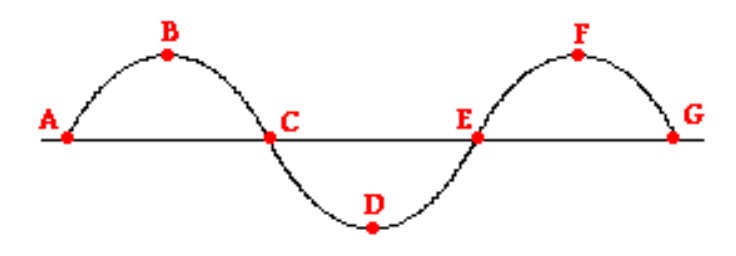
Which letter(s) represent the trough of the wave?
a)
A
b)
B & D
c)
D
d)
C & G
36.
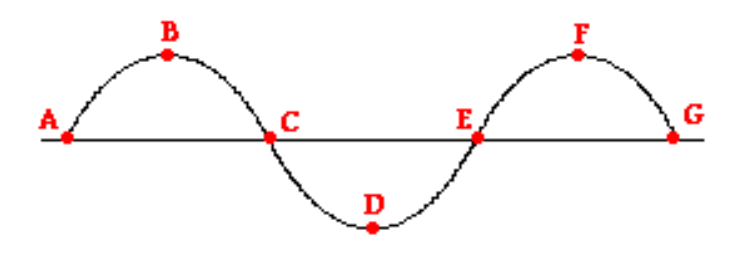
Which letter(s) represent the crest of the wave?
a)
A
b)
B & D
c)
B & F
d)
F
37.
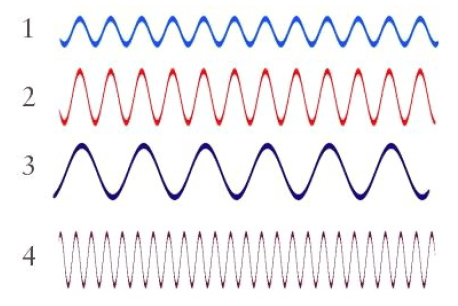
Which wave in the diagram has the greatest frequency?
a)
1
b)
2
c)
3
d)
4
38.
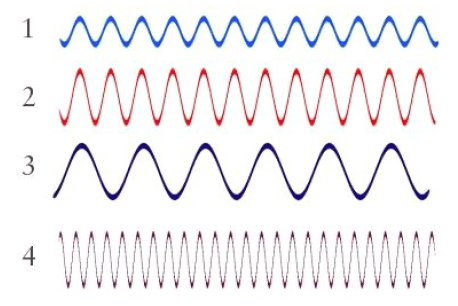
Which wave in the diagram has the greatest wavelength?
a)
1
b)
2
c)
3
d)
4
39.
Which of the following can sound travel through?
a)
solid
b)
liquid
c)
gas
d)
all of the above
40.
crest to crest or trough to trough
a)
crest
b)
trough
c)
amplitude
d)
wavelength
41.
Electromagnetic waves include the following except
a)
radio waves
b)
X-rays
c)
doing the wave at a football game
d)
microwaves
42.
regular disturbances that carry energy through matter or space
a)
crest
b)
energy
c)
wave
d)
trough
43.
When a wave bends as it passes through at an angle from one medium to another.(example: pencil in a glass of water-)
a)
medium
b)
refraction
c)
reflection
d)
interference
44.
When a wave strikes and object and bounces off. (example echo)
a)
medium
b)
refraction
c)
reflection
d)
interference
45.
Electricity that flows in a closed path is called a
a)
path
b)
current
c)
circuit
46.
The flow of electricity in a circuit-
a)
current
b)
flow
c)
circuit
47.
Magnetism created by an electric current
a)
electricity
b)
electromagnetism
c)
wind energy
48.
____________ allows electricity to flow.
a)
A conductor
b)
An insulator
c)
A magnet
49.
____________ stops the flow of electricity.
a)
A conductor
b)
An insulator
c)
A magnet
50.
The plastic around the wire is
a)
conductor
b)
insulator
c)
decoration
51.
In a parallel circuit the current
a)
makes one circle
b)
stays in one path
c)
splits and goes through two components
52.
Two types of circuits are
a)
parallel and magnetic
b)
electromagnetic and series
c)
series and parallel
53.
An example of a parallel circuit is
a)
the wiring in a house
b)
a flashlight
c)
a single circular path
54.
The flow of electricity requires a
a)
complete path
b)
incomplete path
c)
insulated current
Reset

