wayground logo

Free Printable Worksheets

Font size

S
M
L
XL
Worksheets

MEGA Biology EOC Review

Total questions: 238

Worksheet time: 3hrs 10mins

Name
Class
Date
1.
Before mitosis begins, which happens before the nucleus starts dividing?
a)
The cytoplasm separates.
b)
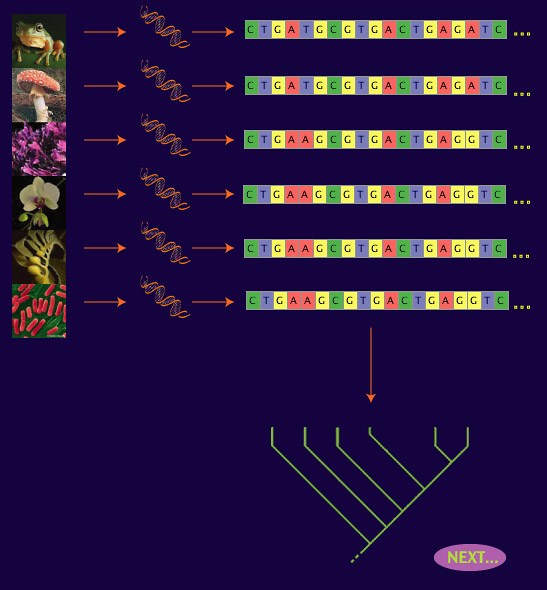
The DNA replicates. 
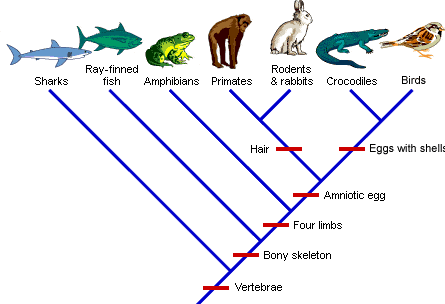
c)
The sister chromatids separate. 
d)
The homologous chromosomes cross over. 
2.
What is the function of autotrophs in the carbon cycle?
a)
to use oxygen to produce glucose 
b)
to take in excess water
c)
to use carbon dioxide to produce glucose
d)
to feed on herbivores 
3.
A strand of DNA has these bases:
 AGC CAT GTA TAC What is the complementary DNA strand?
a)
ACG GAT CTA TAG
b)
TCG GTA CAT ATG
c)
TGC CTA GAT ATC
d)
UCG CUA CAU AUG
4.
Why is meiosis important for sexual reproduction?
a)
It allows the zygote formed from fertilization to have triple the chromosome number of the organism. 
b)
It allows gametes to have twice the original number of chromosomes of the organism.
c)
It allows gametes to have half the original number of chromosomes of the organism. 
d)
It allows the zygote formed from fertilization to have half the original number of chromosomes of the organism. 
5.
A freshwater plant is placed in a container of saltwater. What will most likely happen to the cells of the plant?
a)
They will swell because water will move into them.
b)
They will swell because salt will move into them
c)
They will shrink because water will move out of them.
d)
They will shrink because salt will move out of them.
6.
How does the amount of energy resulting from fermentation compare with that of aerobic respiration? 
a)
Aerobic respiration results in less energy.
b)
Aerobic respiration results in more energy.
c)
Each process results in equal amounts of energy.
d)
Each process results in variable amounts of energy.
7.
What does the peak of the dotted line represent?
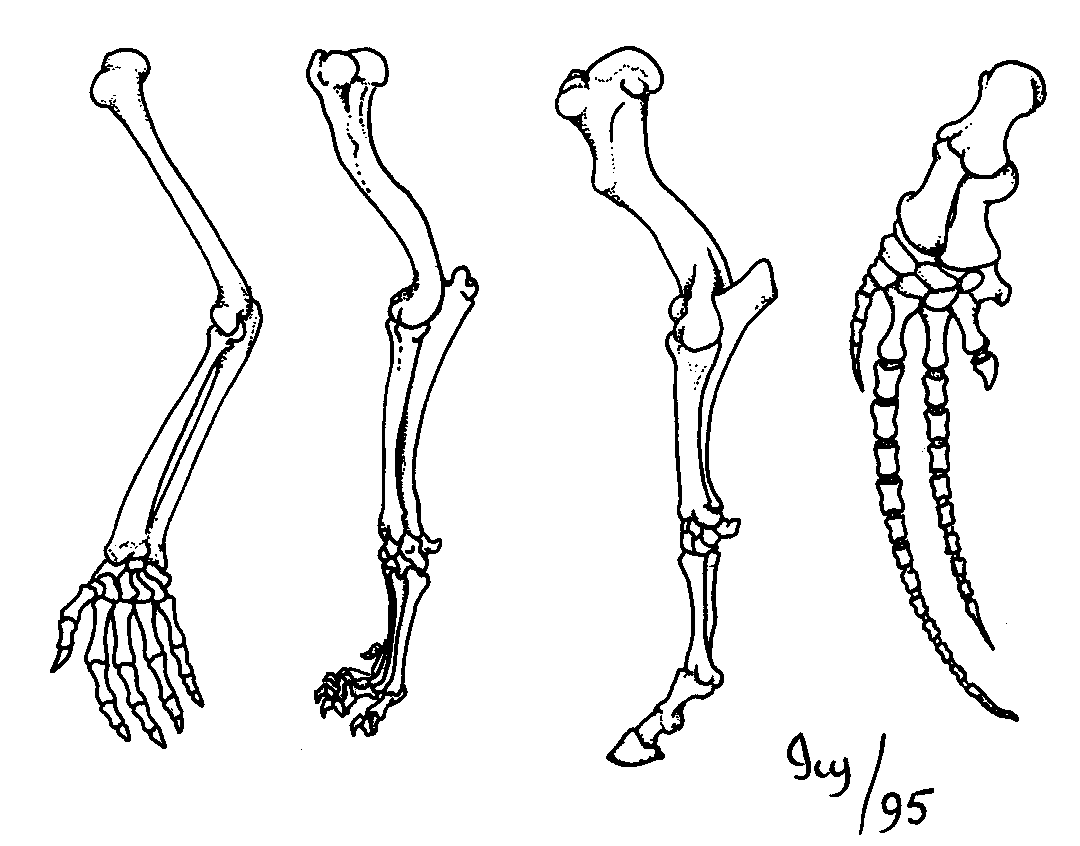
a)
energy of the products
b)
reaction progress
c)
activation energy without a catalyst
d)
activation energy with a catalyst
8.
Which of the following best describes cellular respiration?
a)
external breathing
b)
the breakdown of sugar to release energy in cells
c)
the movement of water from outside a cell to inside the cell
d)
the removal of water from a cell
9.
What disease is likely to result if a cell begins to reproduce abnormally?
a)
HIV
b)
influenza
c)
cancer
d)
Tay-Sachs disease
10.
Which class of biomolecules include monosaccharides, disaccharides, and polysaccharides?
a)
carbohydrates
b)
lipids
c)
proteins
d)
nucleic acids
11.
Which class of biomolecules include fats, oils, and steroids?
a)
carbohydrates
b)
lipids
c)
proteins
d)
nucleic acids
12.
Which class of biomolecules is considered the main structural molecule?  This same class also makes up enzymes..
a)
carbohydrates
b)
lipids
c)
proteins
d)
nucleic acids
13.
Which class of biomolecules includes DNA and RNA?
a)
carbohydrates
b)
lipids
c)
proteins
d)
nucleic acids
14.
How are cellular respiration and photosynthesis related, in terms of energy?
a)
The energy captured in photosynthesis is used to power cellular respiration.
b)
The energy transformed in cellular respiration is used to power photosynthesis.
c)
Photosynthesis and respiration perform the same task in terms of energy transformation
d)
Energy is not involved in either photosynthesis or cellular respiration.
15.
This diagram shows the cell cycle.

Which of the following activities occur in the S phase?
a)
Replication of the DNA
b)
Growth of the cell
c)
Formation of the mitotic spindle
d)
Breakdown of the nuclear membrane
16.
Which process is an example of asexual reproduction?
a)
An amoeba divides in half to form two amoebas.
b)
A bee transfers pollen from one flower to another.
c)
A female fish deposits eggs on a rock, then a male fish releases sperm on them.
d)
Earthworms exchange sperm
17.
Energy for most chemical reactions in cells is supplied by which of the following molecules?
a)
DNA
b)
ATP
c)
RNA
d)
Hemoglobin 
18.
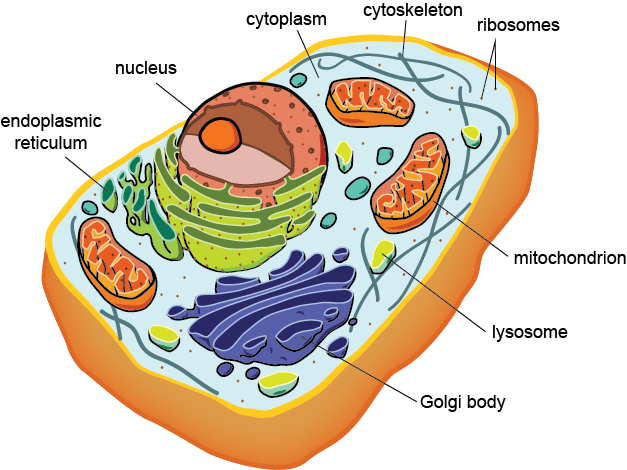
Which pair of structures best shows that plant cells have functions different from animal cells?
a)
Cytoplasm and mitochondria
b)
Chloroplasts and cell wall
c)
Ribosome and golgi
d)
Nucleus and cell membrane
19.
Two organisms that are closely related would have
a)
very similar DNA sequence
b)
exactly the same DNA sequences
c)
no proteins in common
d)
completely different DNA sequence
20.
What trait separates sharks from ray-finned fish?
a)
Vertebrae
b)
Bony skeleton
c)
Four limbs
d)
None
21.
Algae, seaweed and protozoa belong to kingdom:
a)
Protista
b)
Animalia
c)
Plantae
d)
Fungi
22.
Largest number of individuals of a population that the environment can support: 
a)
carrying capacity
b)
primary succession 
c)
denitrification
d)
mutualism
23.
Organism that makes its own food by using sunlight or chemicals; another word for autotroph:
a)
biome
b)
producer
c)
consumer
d)
herbivore
24.
SB2c. The diagram below represents division of a cell that produces two daughter cells. When new cells are formed through the process of mitosis, the number of chromosomes in the new cells
a)
increases every time the cell divides.
b)
remains the same as in the parent cell.
c)
decreases every time the cell divides.
d)
is half of that of the parent cell.
25.
SB2c. When gametes are produced from a parent cell during normal meiosis, which of the following describes the number of chromosomes in each resulting cell?
a)
Each resulting cell has the same number of chromosomes as the parent cell.
b)
Each resulting cell has twice the number of chromosomes as the parent cell.
c)
Each resulting cell has one-half the number of chromosomes as the parent cell.
d)
Each resulting cell has one-fourth the number of chromosomes as the parent cell.
26.
SB2d. A mutation is least likely to affect a cell when the mutation:
a)
reverses the order of bases in a DNA strand
b)
allows the total number of bases in a DNA sequence to remain the sam
c)
replaces a base with its complementary base
d)
produces a triplet that codes for the same amino acid as the original triple
27.
How do human diseases caused by bacteria and diseases caused by viruses react to antibiotics? 
a)
Neither responds to antibiotics.
b)
Both respond to antibiotics.
c)
Viral diseases respond to antibiotics; bacterial diseases do not.
d)
Bacterial diseases respond to antibiotics; viral diseases do not.
28.
Which statement correctly compares a eukaryote and a prokaryote?
a)
eukaryotes have a cell wall while prokaryotes have a cell membrane
b)
eukaryotes have membrane-bound organelles are prokaryotes have few  specialized structures
c)
eukaryotes use active transport to move substances across a cell  membrane, while prokaryotes use facilitated diffusion
d)
eukaryotes use flagella to move themselves through substances, while prokaryotes can't move at all
29.
While genetic engineering has positive benefits, there are also concerns associated with widespread use of genetic engineering in agriculture. If many farmers begin to plant more genetically modified crops that have an increased tolerance to insects, which of the following may result?
a)
an increase in the use of pesticides
b)
a decrease in the genetic diversity of crops
c)
an increase in the contamination of water supplies
d)
a decrease in crop productivity
30.
Which best represents one fundamental difference between the processes of mitosis and meiosis?
a)
meiosis results in 4 haploid cells, mitosis results in 4 diploid cells
b)
meiosis results in 4 haploid cells, mitosis results in 2 diploid cells
c)
meiosis results in 2 diploid cells, mitosis results in 2 haploid cells
d)
meiosis results in 2 diploid cells, mitosis results in 4 haploid cells
31.
What process is occurring in the picture?
a)
DNA replication
b)
mitosis
c)
protein synthesis
d)
meiosis
32.
What type of punnett square?
a)
codominance
b)
incomplete dominance
c)
complete dominance
d)
sex linked recessive
33.
In a genetics lab, two heterozygous tall plants are crossed. If tall is dominant over short what are the expected phenotypic results 
a)
23% tall, 72% short, 5% average
b)
75% Tall 25% short
c)
75% short 25% tall
d)
0% tall 100% short
34.
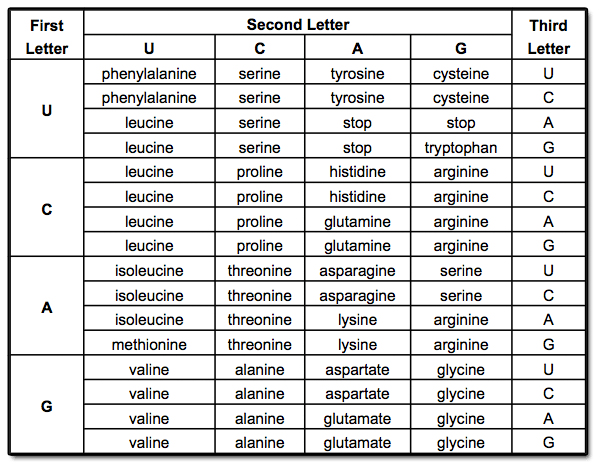
The genetic code is nearly universal. That means, with few exceptions, the same codons code for the same amino acids in all organisms. What does the near universality of the genetic code suggest? 
a)
All life-forms can reproduce with one another
b)
All life-forms have the same number of genes. 
c)
All life-forms have a common evolutionary ancestor. 
d)
All life-forms arose about the same time in Earth’s history.
35.
The intersection of the left, top, and right nitrogenous bases indicates which amino acid a mRNA codon represents.  This is true for all organisms.  This indicates that the ___.
a)
The genetic code is universal. 
b)
We, as organisms, differ only in our sequence of bases
c)
The genetic code determines the sequence of amino acids making up a protein 
d)
 All of the above
36.
 Which sequence depicts the correct order of protein synthesis within a cell? 
a)
DNA → mRNA → amino acids → proteins
b)
DNA → amino acids → mRNA → proteins
c)
 DNA → mRNA → proteins → amino acids
d)
DNA → proteins → amino acids → mRNA
37.
The figures show four process involving DNA and RNA.  Which figure shows the process of transcription?
a)
Figure A
b)
Figure B
c)
Figure C
d)
Figure D
38.
The chart shows the embryos and adult forms of animals from different classification groups.  What do the embryos suggest about these three animals?
a)
The animals are not related.
b)
The animals share a common ancestor and are therefore related
c)
Fish are more closely related to humans than are chickens.
d)
Fish and chickens ar closely related, but humans are not related to either fish or chickens.
39.
Fossils show that cyanobacteria evolved at least 3.5 billion years ago.  How did cyanobacteria change Earth's environment?
a)
They made it hotter.
b)
They added oxygen to the atmosphere.
c)
They added nitrogen to the soil.
d)
They added carbon dioxide to the atmosphere.
40.
The genetic variation that leads to evolution can occur when genes from one population are introduced into the gene pool of a different population.  This process is known as
a)
mutation
b)
crossing over
c)
natural selection
d)
gene flow
41.
  A membrane that keeps out some molecules but allows others to pass:
a)
semi-permeable
b)
permeable
c)
diffusion
d)
concentration gradient
42.
In which organelle does photosynthesis occur?
a)
mitochondria
b)
ribosome
c)
xylem
d)
chloroplast
43.
What are the products of photosynthesis?  (What do plants produce?)
a)
Carbon dioxide and ATP
b)
Carbon dioxide and oxygen
c)
Glucose and oxygen
d)
Glucose and water
44.
What are the products of cellular respiration?
a)
Energy (ATP), Water, and Carbon DIoxide.
b)
Water and Oxygen
c)
Oxygen and Carbon Dioxide
d)
Water, Oxygen and Energy (ATP)
45.
What is the function of the vascular system in plants?
a)
photosynthesis
b)
reproduction
c)
responding to stimuli
d)
transporting water and nutrients
46.
What type of molecule is a protein that acts as a catalyst by speeding up chemical reactions in living things?
a)
substrate
b)
product
c)
reactants
d)
enzymes
47.
 Under which environmental condition would primary succession occur?
a)
bare rocks exposed as glaciers melt
b)
meadow following a controlled burn
c)
forest after trees fall during a severe storm
d)
farm field no longer being used to cultivate crops
48.
An organism has a nucleus, is multicellular but has no cell wall and no chloroplast?
a)
Fungi
b)
Plantae
c)
Animalia
d)
Eubacteria
49.
What is a function of stems and trunks?
a)
To anchor the plant in its environment
b)
To produce new offspring
c)
To support the leaves and reproductive parts
d)
To collect water and minerals
50.
Which reproductive strategy is represented by the flower in the picture above?
a)
budding
b)
pollination
c)
conjugation
d)
fragmentation
51.
A population of salamanders that lice in a river require clear, fresh water to survive. A flood causes tons of sediment to be suspended in the river. Which of these most likely will happen to the salamander population?
a)
The salamanders will adapt to life on land
b)
The salamanders will move to another river
c)
The salamanders will adapt to living in the muddy water
d)
The salamanders will decrease in number because of the water quality 
52.
In a certain insect, round wings (R) are dominant to pointed wings (r). Which cross will produce the greates number of genotypic and phenotypic variations?
a)
rr X rr
b)
Rr X Rr
c)
Rr X RR
d)
RR X RR
53.
Polar bears swim across large expanses of ocean while hunting for seals, their main source of food. The bears use sea ice as a resting spots during their long swims. However, the sea ice is rapidly melting as a result of global warming. Which statement describes what most likely happen if global warming continues at its present rate?
a)
Polar bear and seal populations will both increase
b)
Polar bear populations will decrease, and seal populations will increase.
c)
Polar bear populations will increase, and seal populations will decrease.
d)
Polar bear populations will decrease, and seal populations will remain the same
54.
The loss of habitat in a forest region has caused some plant species to become extinct, while others survive. The process by which some plant species survive and others do not in a changing environment is best explained by 
a)
natural selection
b)
law of segregation
c)
biological magnification
d)
alternation of generations
55.
What is the result of the fertilization of an egg?
a)
it restores the diploid number of chromosomes
b)
it deletes polypeptide chains in the chromosomes
c)
it gives offspring more chromosomes that the parents 
d)
it gives offspring fewer chromosomes than the parents 
56.
A cell with 24 chromosomes undergoes meiosis. How many chromosomes will each daughter cell have? 
a)
6
b)
12
c)
24
d)
48
57.
A cell with 24 chromosomes undergoes mitosis. How many chromosomes will each daughter cell have? 
a)
6
b)
12
c)
24
d)
48
58.
Which of the following statements is not part of the cell theory?
a)
Cells are the basic unit of structure and function in all living things.
b)
All cells are produced from other cells.
c)
Only animal cells are composed of cells.
d)
All living things are composed of cells.
59.
Which statement reflects one of the major components of the cell theory?
a)
All living things are multi-cellular.
b)
Organs are the basic unit of structure and function for all living things.
c)
All cells come from previously existing cells.
d)
Every organism has a reproductive system to ensure survival of the species.
60.
What type of cell is pictured?
a)
Prokaryotic
b)
Eukaryotic
c)
Plant
d)
Animal
61.
Which of the following in NOT a characteristic of eukaryotic cells?
a)
DNA is separated from the cytoplasm by a nuclear membrane
b)
Large
c)
Complex 
d)
Lack membrane-bound organelles
62.
Which microscope would you use to see a bed bug in 3D, with a magnification of about 500,000X?
a)
Compound Light
b)
Scanning Electron
c)
Dissecting
d)
Transmission Electron
63.
Which type of microscope would you use to see the outside of a paramecium at 1000X magnification?
a)
Compound Light
b)
Scanning Electron 
c)
Dissecting
d)
Transmission Electron
64.
Which microscope would you use to see the outside of a bee with a magnification under 100X. 
a)
Compound Light
b)
Scanning Electron
c)
Dissecting
d)
Transmission Electron
65.
What is the function of ATP in living things?
a)
provides energy for cells
b)
stores genetic information
c)
provides structure in the nucleus
66.
Which bond of the ATP molecule is broken in order to release energy?
a)
A
b)
B
c)
C
d)
D
67.
Enzymes are capable of increasing the rate of a chemical reaction within a living cell.  Enzymes accomplish this through which of the following means?
a)
reducing the number of products   
b)
reducing the activation energy
c)
increasing the temperature of the cell
d)
increasing the concentration of reactants 
68.
What happens when enzymes are heated to a high temperature?
a)
The enzymes die.
b)
The shapes of the enzyme are altered denature
c)
The enzymes' amino acid sequence changes.
d)
The enzymes remain the same
69.

According to this cladogram, sharks are MOST closely related to which organism?

a)

Amphibians

b)

Ray finned fish

c)

Crocodiles

d)

Birds

70.
Which characteristics best describes the Animal Kingdom?
a)
unicellular, eukaryote, autotroph
b)
multicellular, prokaryote, heterotroph
c)
multicellular, eukaryote, autotroph
d)
multicellular, eukaryote, heterotroph
71.
Which characteristics best describe the Kingdom Protista?
a)
multicellular, eukaryote, heterotroph and autotroph
b)
multicellular and unicellular, heterotoph and autotroph, eukaryote
c)
unicellular, autotroph, prokaryote
d)
multicellular and unicellular, prokaryote, heterotroph
72.
Which characteristics best describes the Plant Kingdom?
a)
unicellular; eukaryote; autotroph
b)
multicellular, prokaryote, autotroph
c)
multicellular, eukaryote, autotroph
d)
unicellular, prokaryote, heterotroph
73.
Which characteristics best describe the Kingdom Fungi?
a)
multicellular and unicellular, eukaryote, autotroph
b)
multicellular and unicellular, prokaryote, heterotroph
c)
multicellular, eukaryote, heterotoph
d)
multicellular and unicellular, eukaryote, heterotroph
74.
Which characteristics best describes the Kingdoms Eubacteria and Archaebacteria?
a)
unicellular, prokaryote, heterotroph
b)
unicellular, prokaryote, heterotroph and autotroph
c)
multicellular, eukaryote, autotroph
d)
multicellular, prokaryote, heterotroph and autotroph
75.
Which term refers to the process by which individuals that are better suited to the environment survive and reproduce therefore passing down their genes to their offspring? 
a)
Evolution 
b)
Variation 
c)
Adaptation
d)
Natural Selection 
76.
Two organisms that are closely related would have
a)
very similar DNA sequence
b)
exactly the same DNA sequences
c)
no proteins in common
d)
completely different DNA sequence
77.
Structures with the same parts have different functions; suggests that organisms share a common ancestry
a)
vestigial structures
b)
homologous structures
c)
adaptive radiation
d)
fossil
78.
Why are advantageous traits more likely to be passed onto offspring?
a)
Because they are more likely to survive and reproduce.
b)
Because they come from dominant alleles.
c)
Because they come from recessive alleles.
d)
Because the trait is an acquired phenotype.
79.
The struggle for existence against other members of an organisms species is
a)
Competition
b)
Natural Selection
c)
gene flow
d)
genetic drift
80.
protein sequences in one organism that resemble those of another suggest a 
a)
coincidence
b)
lack of evolutionary relationship
c)
great number of mutations
d)
shared ancestry
81.
Genetic variation can arise from a random change in the DNA of a gene.  The change is called a(n)
a)
mutation
b)
gene flow
c)
gene pool
d)
allele
82.
What increases genetic variation when animals move  from one population to another
a)
genetic drift
b)
sexual selection
c)
bottleneck effect
d)
gene flow
83.
Mutations are important because they bring about
a)
death of the organism in which they develop
b)
genetic variation needed for a population to evolve
c)
benefits for the individual, not for the population
d)
Hardey-Weinberg equilibrium within a population
84.
Why do frogs and other organism reproduce so many eggs or offspring?
a)
so that their babies can have friends to play with
b)
the more offspring the more likely the offspring will survive
c)
the more offspring the less likely offspring will survive 
d)
the more offspring the less competition
85.
A virus killed most of the seals in the North Sea (e.g. dropped the population from    8000 to 800).  In an effort to help preserve the species, scientists caught 20 of the   remaining seals and used them to start a new population in the northwest Pacific   Ocean.  Which of the following statements would accurately describe the new   population?  
a)
The new seal population is genetically less diverse than the original population 
b)
The new seal population is genetically more diverse than the original population
c)
There is equal genetic variety compared  to the original population 
d)
None of the answers
86.
Endosymbiosis gave rise to which organelle(s)?
a)
Golgi bodies
b)
Chloroplasts and Mitochondria
c)
Ribosomes and Nuclei
d)
The rough and smooth endoplasmic reticulum
87.
Miller/Urey and other scientists have shown that:
a)
 Life on early Earth required material from space
b)
Cells survived in the primitive atmosphere
c)
Amino acids could be produced from inorganic molecules 
d)
Simple cells can be produced in a laboratory
88.

Why was having a larger brain advantageous for early hominins?

a)

It made them able to walk upright

b)

It helped them to see better

c)

It increased intelligence and helped them hunt and survive

d)

It prevented them from making dangerous weapons

89.

According to the theory of evolution, which of the following statements is true?

a)

Humans evolved from chimpanzees

b)

Chimpanzees evolved from humans

c)

There is no evolutionary relationship between humans and chimpanzees

d)

Humans and chimps evolved from common ancestors

90.
The unique characteristics of the hominids that is different from other primates is...
a)
bipedalism
b)
opposable thumbs
c)
binocular vision
d)
opposable toes
91.

Scientists have found evidence that about 2.4 million years ago a gene regulating jaw muscles mutated and may have led to the more graceful human jaw we see today. The diagram below shows the skulls of 3 hominid species

Which statement below most closely explains the link between JAW size and hominid evolution?

a)

The jaws of hominids evolved to be smaller and less protruding over time.

b)

The jaws of hominids evolved to be larger and more protruding over time.

c)

There appears to be no change in the jaws of hominids over time.

d)

The jaws of hominids changed over time due to a change in brain size.

92.

Scientists are studying the evolutionary history of a group of plants in the United States, and they developed an evolutionary tree. Which statement can be inferred from the evolutionary tree?

a)

Species 1 is most closely related to Species 8.

b)

Species 2 is most closely related to Species 3.

c)

Species 3 is most closely related to Species 7.

d)

Species 5 is most closely related to Species 6.

93.
What happened to the hominid jaw and brain size over time? 
a)
The jaw size decreased while the brain size decreased.
b)
The jaw size increased while the brain size decreased.
c)
The jaw size decreased while the brain size increased.
d)
The jaw size increased while the brain size increased.
94.
The physical expression of the genes is called this.
a)
allele
b)
chromosome
c)
gene
d)
phenotype
95.
The set of genes carried by an organism is called this.
a)
dominant
b)
genotype
c)
phenotype
d)
recessive
96.
In human beings, the allele for freckles (F) is dominant to the allele for no freckles (f). Which choice shows a freckle genotype?
a)
F
b)
f
c)
FF
d)
ff
97.
A red flowered plant (RR) breeds with a White flowered plant (WW). The gene for petal color in these plants expresses incomplete dominance.  What percentage of the offspring will have pink (RW) flowers?
a)
0%
b)
25%
c)
50%
d)
100%
98.
AB blood type is an example of what type of inheritance?
a)
complete dominance
b)
incomplete dominance
c)
codominance
d)
polygenic inheritance
99.
X-linked conditions are more common in men than in women because
a)
The genes associated with the  X linked conditions are linked to the X chromosome, which determines maleness.
b)
Men need to inherit only one copy of the recessive allele for the condition to be fully expressed
c)
Women simply do not develop the disease regardless of their genetic composition
d)
The sex chromosomes are more active in men than in women
100.
If a heterozygous tall pea plant is crossed with a short pea plant, what are the possible genotypes of the future offspring?
a)
100% Tt
b)
50% Tt, 50% tt
c)
75%Tt, 25%tt
d)
25%TT, 50%Tt, 25%tt
101.
Which of the following genotypes belongs in the red box in the Punnett square?
a)
XBXb
b)
XbXb
c)
XBXB
d)
XbY
102.
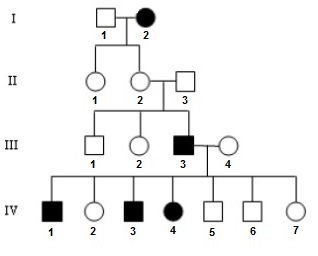
This pedigree represents the inheritance of hemophilia in this family. How many of the females have the hemophilia trait?
a)
8
b)
5
c)
2
d)
3
103.
In guinea pigs, black hair is dominant to white hair and short hair is dominant to long hair. What are the original genotypes of the PARENTS in this particular dihybrid cross?
a)
Bbss x bbSs
b)
bbSs x BBss
c)
BbSs x BbSs
d)
BBSS x bbss
104.
In this food chain, what will happen if the frogs become extinct?
a)
The snakes will increase.
b)
The grasshoppers will decrease.
c)
The eagles will remain the same.
d)
The grasshoppers will increase.
105.
What might happen if you remove a primary consumer from the ecosystem?
a)
There would be more food for secondary consumers.
b)
The number of primary consumers would increase.
c)
The number of plants would increase.
d)
The number of secondary consumers would increase.
106.
What may happen if the snowshoe hare was removed from the food web pictured?
a)
The insects in the habitat would increase.
b)
The shrew population would decrease due to being only hawk food source.
c)
The willow tree population would decrease.
d)
Foxes would dies due to no food source. 
107.
When individuals join a population
a)
Aliens
b)
migration
c)
Immigration
d)
Emigration
108.

How can a population grow?

a)

Emigration and death

b)

Immigration and death

c)

Immigration and birth

d)

Emigration and birth

109.
Secondary succession is most likely to occur
a)
on a volcanic island
b)
after a rainstorm
c)
after a Thanksgiving Turkey dinner
d)
after a forest fire
110.
How do living organisms return carbon to the atmosphere in the carbon cycle?
a)
respiration and photosynthesis
b)
 decomposition and respiration
111.
What is the water cycle?
a)
the 3 forms of water
b)
the movement of water on, above, or below the surface of the Earth
c)
when water melts
d)
when clouds form
112.
Organisms that break down dead plants & animals and release nitrogen back into atmosphere...
a)
bacteria
b)
plants
c)
animals
d)
producers
113.
What property of water allows it to be such a versatile solvent that it is often called the "universal solvent?"
a)
Purity
b)
Polarity and cohesion
c)
High heat capacity
d)
Expansion upon freezing
114.
Water striders can walk across the surface of calm water. Their feet push the surface of the water down slightly, but they do not break the surface. Why?
a)
The insects are light enough so they do not break the hydrogen bonds holding the water molecules together
b)
The insects actually use their wings to hover slightly above the water’s surface and they only skim it with their feet.
c)
The insect’s feet are non-polar, so they are repelled by the polar water molecules and are pushed away from the water’s surface.
d)
The insects are small enough to see the individual water molecules, so they are able to step carefully from one molecule to the next
115.
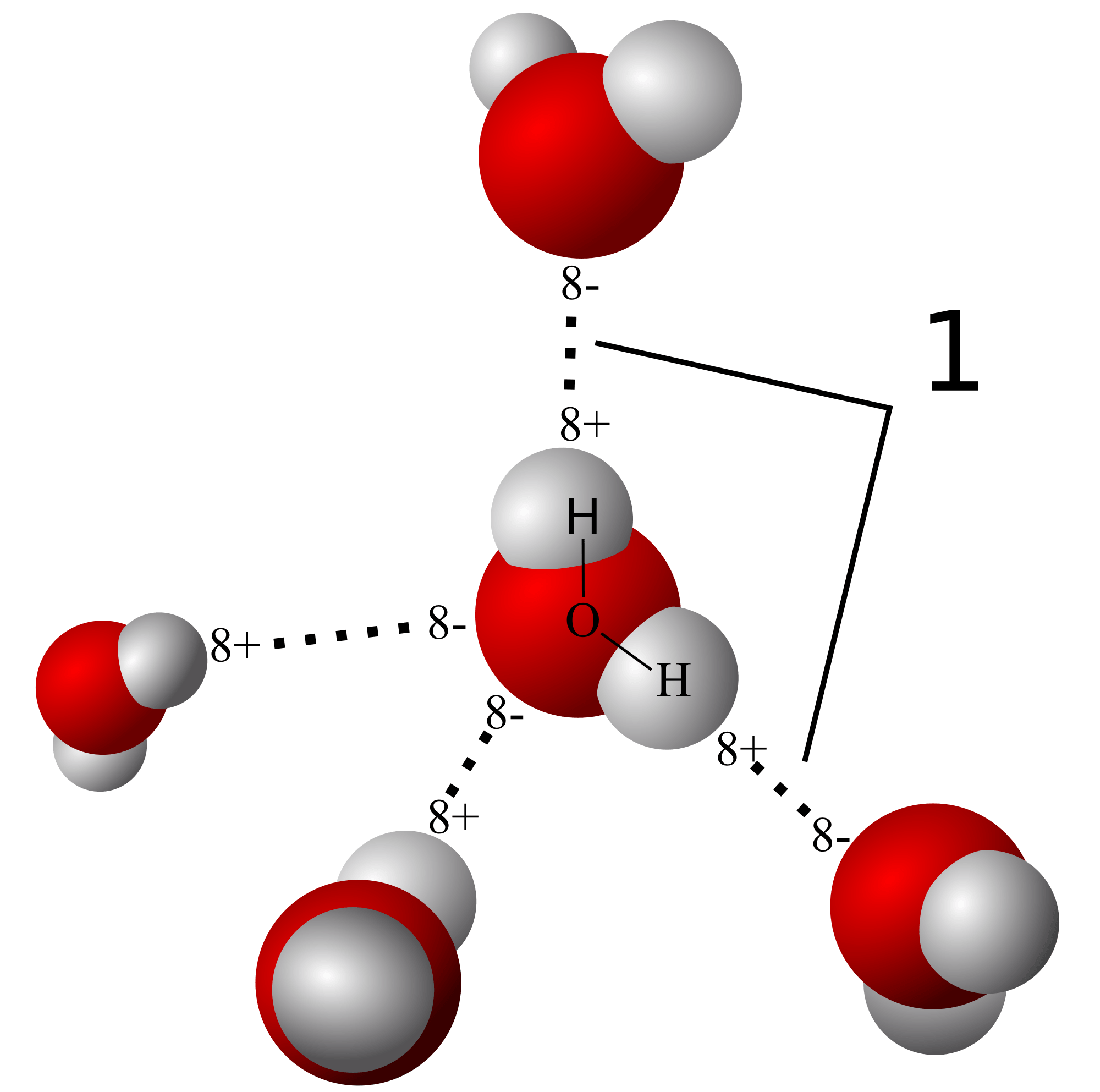
Why can water have no net charge but have slight charges in different parts of the molecule?
a)
The oxygen end is slightly negative and the hydrogen end is slightly positive
b)
The hydrogen end is slightly negative and the oxygen end is slightly positive
c)
The hydrogen and oxygen ends change in polarity
d)
Because it is hydrophobic
116.
Attractions between water molecules are called
a)
Covalent bonds
b)
Ionic bonds
c)
Polar bonds
d)
Hydrogen bonds
117.
What amino acid is represented by the codon UUA?
a)
Phenylalanine
b)
Tyrosine
c)
Leucine
d)
Stop codon
118.
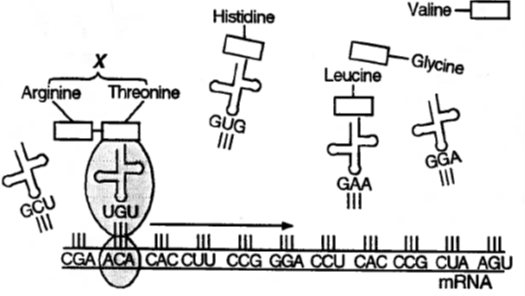
What process is going on in this photo? 
a)
Transcription 
b)
Translation 
c)
Replication 
d)
All the above 
119.
How many amino acids are coded for by this sequence of nucleotides:
ATG GGA ACT CCA
a)
4
b)
2
c)
6
d)
12
120.
Anything that triggers an immune response is a/n
a)
lymph cell
b)
antigen
c)
antibody
d)
neutrop
121.
What do scientists call bacteria and viruses that can make people sick?  
a)
diseases
b)
vaccines
c)
antibodies
d)
pathogens
122.
The picture below illustrates one internal part of the body’s immune system. What process is illustrated in the picture?  
a)
a skin cell destroying germs.
b)
inflammation near an opened wound
c)
a white blood cell destroying pathogens
d)
mucus in the lungs destroying pathogens
123.
 Like all other body systems, the immune system helps the body maintain homeostasis.  Which statement best describes how the immune system does this?  
a)
it protects other organs and tissues from infection and disease
b)
it breaks down food to provide cells with nutrients
c)
it gathers information through the senses and controls all other body systems
d)
 it transports oxygen and carbon dioxide
124.
Diseases are passed from human to human by these four types of germs: 
a)
Viruses, influenza, HIV, and vaccines
b)
Viruses, bacteria, fungi, and parasites
c)
Viruses, cancers, mutagens, and DNA
d)
Viruses, blood, pollutants, and symptoms
125.
What do B cells produce?
a)
antigens
b)
macrophages
c)
T cells
d)
antibodies
126.

True/False: Your body cannot make antibodies for pathogens that you have never been in contact with.

a)

True, because your body needs to encounter the pathogen at least once in order to create the antibodies.

b)

False, because you can make antibodies via immunizations given by a doctor.

127.

Which of the following statements are TRUE about vaccinations?

a)

Allow B cells to make antibodies for any type of antigen the body comes in contact with.

b)

Triggers the body to make memory cells for specific pathogens.

c)

They are substances prepared from killed or weakened pathogens.

d)

Always allows the body to resist an infectious disease any time it comes into contact with it.

128.

What happens after the second time you are exposed to a pathogen?

a)

The body will not be able to fight off the pathogen quickly, because it knows how to get into the body easier.

b)

The body's immune system will react the same was as it did during the first exposure.

c)

The body can only be exposed to a pathogen a second time if you do not have a vaccine.

d)

The body will know how to fight off the pathogen quickly, because memory cells have been created after the first encounter.

129.

How do T cells differ from B cells?

a)

T cells fight pathogens by killing pathogens directly, while B cells fight pathogens by making antibodies.

b)

T cells only make memory cells, and B cells only make antigens

c)

T cells fight pathogens by making antibodies, while B cells fight pathogens by killing pathogens directly.

d)

T cells can only fight off pathogens the body has encountered once, and B cells can fight off any pathogen the body comes across.

130.
Antibiotics work against most
a)
Bacteria
b)
Bacteria & Viruses
c)
Vaccines
d)
Viruses
131.
Vaccinations are used for
a)
Curing the illness
b)
Preventing the Illness
c)
Getting the illness
132.
Vaccines stimulate the body to produce...
a)
autoimmune diseases
b)
helper t-cells
c)
fever
d)
antibodies
133.
What does the non-specific immune system attack?
a)
Only particular pathogens
b)
Any pathogen present
c)
Only bacteria
d)
Only viruses
134.
What is a main cause of the antibiotic resistance crisis?
a)
Too many pharmacies
b)
Overuse
c)
Common cold
d)
Pharmaceutical representatives
135.
Which lobe is the yellow area?
a)
Occipital lobe
b)
Parietal lobe
c)
Temporal lobe
d)
Frontal lobe
136.

What is the yellow part on the brain stem?

a)

Medulla

b)

Cerebellum

c)

Midbrain

d)

Thalamus

137.

Which lobe is represented by the purple area?

a)

Occipital lobe

b)

Temporal lobe

c)

Parietal lobe

d)

Frontal lobe

138.

The more times you are exposed to an antigen, then your antibodies will.....

a)

increase

b)

decrease

c)

stays the same

139.

If you have a disease before getting a vaccine then you ......

a)

need the vaccine anyway

b)

do NOT need the vaccine

c)

will get the disease again

140.

Which is an example of a non-specific immune response?

a)

B-cell binds to virus then makes antibody

b)

T-cell finds infected cells and kills the cells

c)

Macrophage engulfs virus and destroys it

141.

How does the resting heartbeat of an active person compare to a nonactive person?

a)

lower

b)

higher

c)

the same

142.

If arteries decrease in size, then the blood pressure will....

a)

increase

b)

decrease

c)

stay the same

143.

If you have a decrease in blood volume, then your blood pressure will......

a)

decrease

b)

increase

c)

stay the same

144.

Where does the blastocyst get implanted?

a)

Fallopian tubes

b)

uterus

c)

ovary

145.

what is the function of the epididymis?

a)

tube that sperm leaves the body

b)

stores mature sperm

c)

produces fluid for semen

146.

What is the function of the vas deferens?

a)

sperm is made there

b)

stores mature sperm

c)

Sperm travels through it

147.

what is the function of the fallopian tubes?

a)

eggs leave the body through them

b)

eggs travel through them

c)

stores all the eggs

148.

What is the correct order of forming the fetus?

a)

Fertilization - Zygote - Blastocyst - Embryo

b)

Embryo - Zygote - Fertilization - Blastocyst

c)

Fertilization - Embyro - Blastocyst - Zygote

149.

What is developing during the beginning of pregnancy?

a)

lungs

b)

Mouth

c)

brain and heart

150.
Where does fertilization usually occur?
a)
ovary
b)
uterus
c)
vagina
d)
fallopian tube
151.
Fallopian tubes are the structures that carry the released eggs from the ovaries.
a)
true
b)
false
152.
Birth canal is another name for the vagina.
a)
true
b)
false
153.
the process when a sperm cell joins an egg
a)
penis
b)
ovaries
c)
menstrual cycle
d)
fertilization
154.
sac of skin surrounding the testicles
a)
scrotum
b)
semen
c)
vagina
d)
ejaculation 
155.
mixture of sperm cells and fluids
a)
scrotum
b)
semen
c)
vagina
d)
ejaculation 
156.
A fertilized egg undergoes several stages before it is successfully implanted. The diagram below shows these stages as the fertilized egg travels through the female reproductive system. In which of the following structures of the female human reproductive system is the blastocyst implanted during normal human 
a)
ovary
b)
uterus
c)
vagina
d)
amniotic sac
157.
The drinking of alcoholic beverages by a pregnant woman is harmful to the development of her fetus. This is most damaging early in a pregnancy because during this time
a)
the lungs of the fetus become functional.
b)
alcohol can easily enter the mouth of the fetus.
c)
many of the essential organs of the fetus are forming.
d)
the fetus cannot excrete wastes.
158.
Which of the following is true of a zygote?
a)
It forms into a blastocyst
b)
It is an unfertilized egg
c)
It produces haploid male gametophytes
d)
It is made up of only one cell
159.
Below is a diagram of the male reproductive system. Which structure is represented by the letter D? 
a)
scrotum
b)
testes
c)
prostrate gland
d)
epididymus
160.
Abnormalities present in the cells that line the uterus may prevent the production of offspring by directly interfering with which process? 
a)
 the development of the embryo
b)
the differentiation of gametes into zygotes
c)
the secretion of estrogen by the ovary
d)
the production and release of egg cells
161.
For a human zygote to become an embryo, it must undergo
a)
fertilization
b)
recombination
c)
meiotic dvisions
d)
mitotic divisions
162.
Which produces egg cells and female hormones?
a)
cervix
b)
fallopian tube
c)
vagina
d)
ovaries
163.
Which statement best describes blood pressure?
a)
 The force applied by the heart and amount of blood pumped determine blood pressure.
b)
 It’s normal and healthy to have extended periods of high blood pressure.
c)
 Your blood pressure is higher when you sleep. 
d)
 Being nervous can decrease your blood pressure.
164.
Which of the following describes high blood viscosity?
a)
There is a high concentration of blood cells and solutes
b)
The blood is more thick and the heart has to pump harder
c)
Blood pressure goes up
d)
All are correct
165.
When an individual has high cholesterol, certain substances, such as calcium and fats, form plaque in arteries. How is this plaque, known as arterial plaque, most likely to affect blood flow?
a)
Arterial plaque clogs the arteries, limiting or stopping blood flow.
b)
Arterial plaque changes the direction of blood flow, which forces oxygenated blood to the heart.
c)
Arterial plaque changes the size of blood cells, which prevents blood from flowing in the arteries.
d)
Arterial plaque clears the arteries, increasing blood flow.
166.
What is the most likely affect a blood clot will have on blood flow through the cardiovascular system?
a)
A blood clot will increase blood flow in other areas, allowing more oxygen to reach tissue in those areas.
b)
A blood clot will change the direction of blood flow, allowing oxygen to reach tissue in a new area.
c)
A blood clot will not change blood flow, allowing the same amount of oxygen to reach tissue in a certain area.
d)
A blood clot will block blood flow, preventing oxygen from reaching tissue in a certain area.
167.
Elasticity in blood vessels allows the vessels to stretch and move based on changes in blood volume. A number of factors, including genetic disease, can cause the arteries to harden and lose their elasticity. How would the hardening of the arteries most likely affect blood flow?
a)
The hardening of the arteries would likely cause blood flow to remain constant.
b)
The hardening of the arteries would likely increase blood flow.
c)
The hardening of the arteries would likely cause blood flow to stop completely.
d)
The hardening of the arteries would likely restrict blood flow.
168.
Which of the following statements best describes blood flow in the human body?
a)
As the thickness of the blood decreases, the rate of blood flow increases.
b)
As the diameter of a blood vessel decreases, the rate of blood flow increases.
c)
As the length of a vein decreases, the resistance to blood flow decreases
d)
As blood pressure increases, the rate of blood flow decreases.
169.
Blood pressure will increase with an increase of what? 
a)
heart rate
b)
inactivity
c)
blood volume
d)
oxygen levels
170.
Arteriosclerosis is a disease which clogs arteries in the human body. In arteriosclerosis, artery walls become thick. Fatty deposits build up on inner walls of arteries. This condition reduces the ability of arteries to perform their function. The diagram above shows a comparison between a healthy artery and one with arteriosclerosis. Which body function is most affected by arteriosclerosis? 
a)
circulating blood to tissues
b)
assembling amino acids into proteins
c)
replacing damaged cells with new cells
d)
breaking down food particles into molecules
171.
Blood volume and blood pressure are related.  What happens to pressure and cardiac output when volume of fluid increases?
a)
increased fluid, decreased cardiac output, and decreased pressure
b)
increased fluid, decreased cardiac output, and increased pressure
c)
increased fluid, increased cardiac output, and decreased pressure
d)
increased fluid, increased cardiac output, and increased pressure
172.
A doctor prescribes a blood thinner to a patient with high blood pressure. What impact will this medication have on blood flow and viscosity?
a)
A doctor prescribes a blood thinner to a patient with high blood pressure. What impact will this medication have on blood flow and viscosity?
b)
The blood flow will decrease and the viscosity will increase.
c)
The blood flow will increase and the viscosity will decrease
d)
The blood flow will increase and the viscosity will increase.
173.
The rate at which blood flows through the human body changes in response to many factors. Which statement describes one of these factors and its effect on blood flow? 
a)
 A high viscosity of blood causes an increased resistance in the blood vessels and leads to slow blood flow. 
b)
A low blood pH decreases the rate of diffusion through the blood vessels and leads to slow blood flow.
c)
The changing of the shape of red blood cells to a crescent shape decreases resistance and lead to a faster blood flow.
d)
The narrowing of blood vessels increases pressure and leads to a faster blood flow. 
174.
How is the burning of fossil fuels related to global warming?
a)
Magic
b)
Fuels are hot
c)
Greenhouse effect
d)
Photosynthesis
175.
Which of the following removes carbon from the atmosphere?
a)
Combustion
b)
Respiration
c)
Photosynthesis
d)
Death
176.
Which of the following is an example of a decomposer?
a)
Owl
b)
Fish
c)
Tree
d)
Mushroom
177.
Organisms that do not decompose can be buried and become what?
a)
water
b)
nutrients
c)
air
d)
fossil fuels
178.
Which process converts carbon in the form of sugar into carbon dioxide gas?
a)
Bioremediation
b)
Photosynthesis
c)
Respiration
d)
Transpiration
179.
If the plant population decreased, the amount of carbon would _________.
a)
Stay the same
b)
Increase
c)
Decrease
180.

How do carbon emissions lead to global warming?

a)

By trapping the sun's heat in the atmosphere.

b)

By causing very hot volcanic eruptions.

c)

Rocks become richer in carbon as time goes by.

d)

By increasing the amount of carbon in the earth's crust

181.
The process by which plants release water through the pores in their leaves is called...
a)
accumulation
b)
dormancy 
c)
photosynthesis 
d)
transpiration
182.
If a rain drop lands in the ocean, it will eventually _______, and return to the clouds.
a)
condense
b)
evaporate
183.
Any form of water that falls from clouds and reaches Earth's surface as rain, snow, sleet, or hail is called...
a)
surface water
b)
precipitation 
c)
ground water
d)
runoff
184.
During which phase of the cell cycle does the cell spend the most time?
a)
Mitosis
b)
Cytokinesis
c)
Interphase
185.
During which part of the cell cycle does the cell divide?
a)
Interphase
b)
Mitosis
c)
S phase
186.
During which part of the cell cycle is DNA copied?
a)
Mitosis
b)
Cytokinesis
c)
S phase
187.
Which phase of mitosis is shown in the picture?
a)
Interphase
b)
Metaphase
c)
Telophase
188.
Which phase of mitosis is shown in the picture?
a)
Prophase
b)
Metaphase
c)
Anaphase
189.

Uncontrolled cell division which usually leads to tumors and disease is called:

a)

Metaphase

b)

Cytokinesis

c)

Cancer

d)

Diabetes

190.
During which stage of the cell cycle does mitosis and cytokinesis occur?
a)
Interphase
b)
S phase
c)
M phase
d)
G1 phase
191.
Put the following in order: G2, G1, S, mitosis, cytokinesis. 
a)
G1, G2, S, Mitosis, cytokinesis
b)
G1, S, G2, Mitosis, cytokinesis
c)
G1, G2, S, cytokinesis, mitosis
d)
G1, S, G2, cytokinesis, mitosis
192.
Why would it be important to replicate DNA before a cell divides in mitosis or meiosis?
a)
In order for genetic information to be transferred into daughter cells.
b)
In order for the cell to be able to increase in size.
c)
In order for the DNA to be contained in the nucleus.
d)
In order for the cell to re-order the DNA sequencing in the new cells.
193.
Proteins are made of monomers called ___________
a)
Nucleotides
b)
Monosaccharides
c)
Amino Acids
d)
Glycerol and fatty acids
194.
Nucleotides are monomers of
a)
Carbohydrates
b)
Lipids
c)
Proteins
d)
Nucleic Acids
195.
Which macromolecule is shown?
 View Figure 1 (if not visible)
a)
lipid
b)
protein
c)
nucleic acid
d)
carbohydrate
196.
Which macromolecule stores energy, insulates us, and makes up the cell membrane?
a)
lipids
b)
proteins
c)
carbohydrates
d)
nucleic acids
197.
Which group of biomolecules provide quick energy to organisms?
a)
proteins
b)
carbohydrates
c)
lipids
d)
nucleic acids
198.
Which are enzymes?
a)
simple carbohydrates
b)
proteins that speed up chemical reactions
c)
lipids that make up the cell membrane
d)
a building block of DNA
199.
Before mitosis begins, which happens before the nucleus starts dividing?
a)
The cytoplasm separates.
b)
The DNA replicates. 
c)
The sister chromatids separate. 
d)
The homologous chromosomes cross over. 
200.
What is the function of autotrophs in the carbon cycle?
a)
to use oxygen to produce glucose 
b)
to take in excess water
c)
to use carbon dioxide to produce glucose
d)
to feed on herbivores 
201.
How does the amount of energy resulting from fermentation compare with that of aerobic respiration? 
a)
Aerobic respiration results in less energy.
b)
Aerobic respiration results in more energy.
c)
Each process results in equal amounts of energy.
d)
Each process results in variable amounts of energy.
202.
A freshwater plant is placed in a container of saltwater. What will most likely happen to the cells of the plant?
a)
They will swell because water will move into them.
b)
They will swell because salt will move into them
c)
They will shrink because water will move out of them.
d)
They will shrink because salt will move out of them.
203.
This diagram shows a plant cell. Which structure is found in a plant cell but is absent in an animal cell? 
a)
1
b)
2
c)
3
d)
4
204.
The ability to taste a bitter chemical called PTC is a dominant trait in humans.  The Punnett square below shows a cross between two parents who are heterozygous for the ability to taste this chemical.  What is the probability, expressed as a percentage, that these parents will produce an offspring who is homozygous recessive for the tasting trait?
a)
0%
b)
25%
c)
50%
d)
75%
205.
A strand of DNA with the sequence A-C-T-T-G serves as a template to form a strand of mRNA with the sequence U-G-A-A-C.  During which process would this happen?
a)
replication
b)
transcription
c)
translation
d)
meiosis
206.
The diagram summarizes two stages in the production of the specialized cells used for sexual reproduction.
What happens in the stage labeled "process 2"?
a)
The chromosomes cross over.
b)
Th chromosomes number is reduced by half.
c)
The chromosomes move to opposite end of the cell.
d)
Four identical gametes form.
207.
Which of these is the key idea of the endosymbiont theory?
a)
Eukaryotes evolved from early prokaryotic cell that developed internal cell membranes.
b)
Prokaryotic cells evolved from early eukaryotes that were enclosed by cell walls.
c)
Early prokaryotic cells evolved from chloroplasts.
d)
Early prokaryotic cells evolved from chemicals that became joined together using the heat given off by deep ocean vents.
208.
What type of cell is shown?
a)
eukaryotic
b)
prokaryotic
c)
bacterial
d)
protist
209.
Proteins are assembled within this cell organelle.
a)
nucleus
b)
Golgi apparatus
c)
lysosome
d)
ribosome
210.
What is the movement of molecules or solutes from an area of high concentration to an area of low concentration?
a)
osmosis
b)
active transport
c)
merging
d)
diffusion
211.
Which of these requires ATP?
a)
osmosis
b)
diffusion
c)
active transport
d)
stasis
212.
What is the carrying capacity of the following graph?
a)
10
b)
30
c)
40
d)
45
213.
Natural selection is sometimes described as survival of the fittest. In this sence, what is meant by the fitness of an organism>
a)
The strength of the organism
b)
the intelligence of an organism
c)
the ability to survive and reproduce 
d)
the tendency to grow larger than others
214.
The legs of crocodiles and mice have similar bone structures and develop in a similar way.  What type of structures are the leg bones?
a)
homologous structures
b)
analogous structures
c)
fossilized structures
d)
vestigial structures
215.
Which statement describes a main difference between primary and secondary succession?
a)
Primary succession is always followed by secondary succession
b)
Secondary succession always ends in a climax community while primary does not
c)
Primary succession always starts with barren rock; secondary does not
d)
Secondary succession always reaches a climax community of trees while primary succession ends with pioneer species.
216.
The cell theory was first proposed in 1838. Evidence obtained through additional scientific investigations resulted in the current cell theory. Which statement describes a component of the original cell theory that was removed because of the new scientific knowledge?
a)
All living things are made of cells. 
b)
All cells come from other preexisting cells. 
c)
Cells form through spontaneous generation. 
d)
Cells are the basic structural and functional units of life. 
217.
A team of ecologists observed feeding patterns of several populations in the desert. The energy pyramid shown below depicts the feeding patterns the ecologists observed. Which of the following best explains the difference in the amount of available energy in the trophic levels of the desert ecosystem?
a)
There is less energy available in the producers because their tissues are less dense than those at higher trophic levels. 
b)
There is more energy available in the second trophic level because less energy is needed for hunting compared to the higher trophic levels. 
c)
There is less available energy in the fourth trophic level because of the loss of energy through metabolism in each of the lower trophic levels. 
d)
There is more available energy in the birds of prey because they have greater muscle mass for storing energy than organisms in lower trophic levels have. 
218.
The synthesis of a protein from an mRNA template is called ____________.
a)
transcription
b)
replication
c)
translation
d)
synthesis
219.
The synthesis of an RNA strand from a DNA template is called __________.
a)
transcription
b)
replication
c)
translation
d)
synthesis
220.
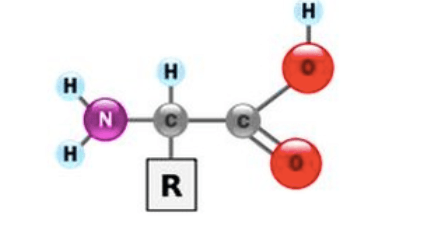
Which biomolecule is this a picture of?
a)
Protein
b)
Nucleic Acid
c)
Lipid
d)
Carbohydrate
221.
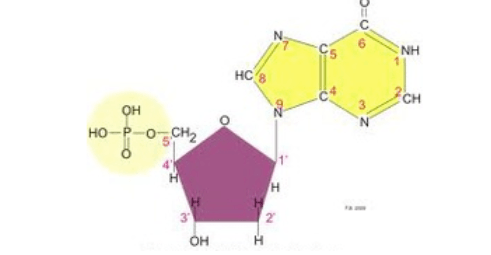
Which biomolecule is this a picture of?
a)
Protein
b)
Nucleic Acid
c)
Lipid
d)
Carbohydrate
222.
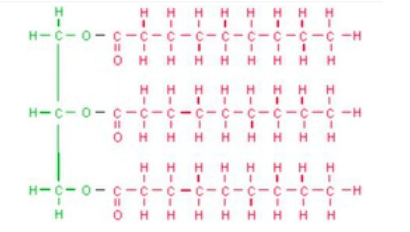
Which biomolecule is this a picture of?
a)
Protein
b)
Nucleic Acid
c)
Lipid
d)
Carbohydrate
223.
What are three parts of nucelotide that make up DNA?
a)
Dissacharide, nitrogen base, amino acid
b)
Phosphate group, protein, sugar
c)
sugar, nitrogen base, phosphate group
d)
Sugar, amino acid, nitrogen
224.
What is a catalyst?
a)
makes something happen faster
b)
stops something from happening
c)
makes something happen slower
225.
Which is true of prokaryotic and eukaryotic cells?
a)
Prokaryotic cells are larger than eukaryotic cells.
b)
Eukaryotic cells do not have nuclei, and prokaryotic cells do have nuclei.
c)
Prokaryotic cells lack membrane-bound organelles, and eukaryotic cells contain membrane-bound organelles.
d)
Eukaryotic cells are simpler than prokaryotic cells.
226.
What type of cell is pictured?
a)
Prokaryotic
b)
Eukaryotic
c)
Plant
d)
Animal
227.
A HYPERTONIC solution has a _____ concentration of solute than the interior of the cell and a cell will ______ when placed into this solution.
a)
lower; shrink
b)
lower; swell
c)
higher; shrink
d)
higher; swell
228.
Number 1 is  a (the) - 
a)
Golgi Bodies
b)
Mitochondrion
c)
ribosome
d)
Nucleus
229.
Which of these best completes this concept map?
a)
an animal cell
b)
a prokaryotic cell
c)
a plant cell
d)
a bacteria
230.
Only eukaryotic cells have....
a)
membrane-bound organelles 
b)
DNA
c)
ribosomes
d)
cell membranes 
231.
The common cold can be spread many different ways. One such way is through coughing and sneezing. Is the common cold caused by bacteria or by viruses?
a)
Bacteria
b)
Virus
232.
When comparing the offspring of sexually and asexually reproducing organisms, we would expect the genetic material (DNA) of the sexually reproducing organism to -
a)
contain fewer mutations
b)
be lesser in quantity
c)
be simpler overall
d)
show more genetic variation
233.
In meiosis, the haploid number of chromosomes in a human sex cell is:
a)
46
b)
92
c)
22
d)
23
234.
What is the diploid number of cells found in a human body cell?
a)
23
b)
46
c)
92
d)
47
235.
The process on the left is:
The process on the right is:
a)
Left: meiosis
Right: meiosis
b)
Left: meiosis
Right: cloning
c)
Left: mitosis
Right: meiosis
d)
Left: mitosis
Right: mitosis
236.
What scientific process is being shown?
a)
Mixing
b)
Crossing under
c)
Crossing over
d)
square dancing
237.
What are the 4 nitrogen bases?
a)
adenine, thymine, cytoplasm, and guanine
b)
adenine, thymine cytosine, and guanine
c)
adenine, thymine, cytosine, and gylcerol
d)
adenine, thymine, cytosine, and glucose
238.
Any change in the sequence of DNA is...
a)
transgenic shift
b)
Single Genotype
c)
Monohybrid Trait
d)
Mutation