wayground logo

Free Printable Worksheets

Font size

S
M
L
XL
Worksheets

Cells, Living Systems and Classification

Total questions: 30

Worksheet time: 38mins

Name
Class
Date
1.

What is the major difference between plants and animals?

a)

Plants make their own food and animals do not.

b)

Plants are shiny and animals are not.

c)

Plants are green and animals are not.

d)

Plants grow inside and animals grow outside

2.

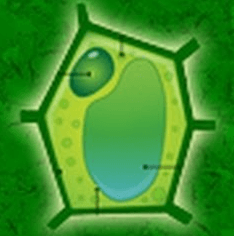
Animal and plant cells have similarities and differences.

Which of the following organelles belong in both an animal cell and a plant cell?

a)

chloroplast and cell membrane

b)

cell wall and cytoplasm

c)

vacuole and nucleus

d)

cholorplast and cell wall

3.

What part of a plant cell is used in photosynthesis?

a)

Cytoplasm

b)

Vacuole

c)

Nucleus

d)

Chloroplasts

4.

Which of these organisms has cells with cell walls?

a)

fox squirrel

b)

ladybug

c)

bluebird

d)

pine tree

5.

Which of the following is a nonvascular plant?

a)

celery

b)

moss

c)

rose

d)

pine tree

6.

Which of these animals are invertebrates

a)

spider

b)

rattle snake

c)

worm

d)

bald eagle

7.

Snakes and sponges are members of what kingdom?

a)

plant kingdom

b)

animal kingdom

c)

protist kingdom

d)

monera

8.

Which kingdom is made of multi-cellular organisms that produce their own food?

a)

Plant

b)

Animal

c)

Protist

d)

Fungi

9.

What type of plants do NOT have tube-like tissues and must absorb water and nutrients directly from the ground?

a)

vascular

b)

tubular

c)

nonvascular

d)

green

10.

Plants that have tube-like tissues to carry nutrients are —

a)

vascular

b)

tubular

c)

green

d)

nonvascular

11.

What is the control center of a cell?

a)

cell membrane

b)

cytoplasm

c)

vacuole

d)

nucleus

12.
The ___________ is the basic unit of life
a)
organ
b)
cell
c)
atom
d)
tissue
13.
A rigid layer that lies outside the cell's  membrane is...
a)
Cytoskeleton
b)
Cilia
c)
Cell Wall
d)
Flagella
14.

Which animals shown are invertebrates? (Click on each you want to select. You must select all the correct answers.)

a)
b)
c)
d)
e)
15.

Which plants shown are Nonvascular? (Click on each you want to select. You must select all the correct answers.)

a)
b)
c)
d)
e)
16.

Controls the cells activities (Control Center)

a)

Cell Membrane

b)

Cytoplasm

c)

Nucleus

d)

Vacuole

17.

Shape that animal cells tend to be......

a)

Round/Irregular

b)

Rectangular

18.

Two parts that are found in a plant cell, but not in an animal cell........

a)

Cell Wall

b)

Vacuole

c)

Nucleus

d)

Cell Membrane

e)

Chloroplast

19.

Shape that plant cells tend to be.....

a)

Round/Irregular

b)

Rectangular

20.
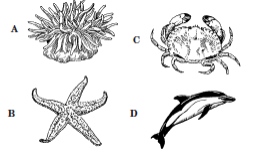
Which of the following would be classified as a vertebrate?
a)
A
b)
B
c)
C
d)
D
21.
How is a fish different from a jellyfish?
a)
A fish has a backbone.
b)
A fish is in the animal kingdom
c)
A fish can reproduce
d)
A fish lives in water
22.
Which cell part is the clear jelly-like fluid that all parts float in?
a)
mitochondria
b)
cytoplasm
c)
nucleus
d)
vacuole
23.
Which of the following lists ONLY vascular plants?
a)
trees, rosebushes, moss
b)
ferns, moss, liverwort
c)
grass, ferns, trees
d)
hornwork, liverwort, moss
24.
Which of the following lists only vertebrates?
a)
sharks, snails, birds
b)
snakes, turtles, frogs
c)
dolphins, gorillas, grasshoppers
d)
jellyfish, clams, worms
25.
This process happens inside chloroplasts
a)
Cellular Respiration
b)
Photosynthesis
c)
Protein Synthesis
d)
Osmosis
26.
What are vertebrates?
a)
Animals with a backbone
b)
Animals without a backbone
27.
1. What is an adaptation?
a)
A feature or behavior that helps an animal survie.
b)
The food that an animal eats.
c)
How energy moves in a food web.
28.
An animal's color or pattern that helps it blend into its surroundings
a)
Environment 
b)
Mimicry
c)
Camouflage
29.
 Which of these BEST describes how some birds survive when the weather gets cold? 

     
a)
 a.   They store twigs and sticks in their nest 
b)
 b. They migrate to a warmer climate 
c)
 c. They grow more feathers to stay warm in the winter 
d)
 d. They hide in bushes and wait for warm weather 
30.
Which of these would best describe the tube worms shown?
a)
Mammals
b)
Vertebrates
c)
Amphibians
d)
Invertebrates