wayground logo

Free Printable Worksheets

NEW

Font size

S
M
L
XL
Worksheets

Life Science Review: Scientists, and Quarter One

Total questions: 36

Worksheet time: 26mins

Name
Class
Date
1.

This scientist discovered cells for the first time by looking at cork.

a)

Anton van Leeuwenhoek

b)

Rosalind Franklin

c)

Robert Hooke

d)

Rudolf Virchow

2.

This scientist discovered single celled (unicellular) organisms swimming in water for the first time.

a)

Robert Hooke

b)

Anton van Leeuwenhoek

c)

Rudolf Virchow

d)

Charles Darwin

3.

I found out that all animals have cells! Crazy right?!

a)

Robert Hooke

b)

Theodor Schwann

c)

Matthias Schleiden

d)

Rudolf Virchow

4.

Did you know all plants have cells? If so, I was the one who discovered this!

a)

Matthias Schleiden

b)

Robert Hooke

c)

Theodor Schwann

d)

Anton van Leeuwenhoek

5.

Cells definitely don't just appear out of thin air! Cells come from other cells and I am the one who made this discovery!

a)

Anton van Leeuwenhoek

b)

Rosalind Franklin

c)

Charles Darwin

d)

Rudolf Virchow

6.

We totally stole this chick's photograph of DNA in order to discover that DNA has a double helix 3D structure.

a)

James Watson and Francis Crick

b)

Rosalind Franklin and Charles Darwin

c)

James Watson and Rudolf Virchow

d)

Francis Crick and Charles Darwin

7.

I took the first photograph of DNA!

a)

Charles Darwin

b)

Anton van Leeuwenhoek

c)

Francis Crick

d)

James Watson

e)

Rosalind Franklin

8.

I studied in the Galapagos and discovered that all things change, or evolve over time thanks to natural selection

a)

Charles Darwin

b)

Carolus Linnaeus

c)

Watson Crick

d)

Theodor Schwann

9.

I helped develop the modern classification system! I created the scientific naming system of binomial nomenclature

a)

Charles Darwin

b)

Carolus Linnaeus

c)

Matthias Schleiden

d)

James Watson and Francis Crick

10.
When experimenting with the growth of a plant, a scientist uses three (of the same type of) plants, two different fertilizers, equal light, and equal water. What type of variable is the fertilizer?
a)
Dependent
b)
Independent
c)
Control
d)
Compound
11.
Research Question: Does the type of gasoline put in a car effect how fast the car can drive. What is the independent variable?
a)
Type of gasoline
b)
which car the gas is put into
c)
how fast the car can drive
d)
how much gas is put into the car
12.
If plants are exposed to sunlight, then they will grow taller.
What part of the scientific method is this an example of?
a)
Procedure
b)
Hypothesis
c)
Question
d)
Results
13.
What step does every scientific experiment begin with?
a)
hypothesis
b)
question/problem
c)
procedures
d)
conclusion
14.
The variable that is being measured
a)
independent variable
b)
dependent variable
c)
control variable
15.
the variable that is observed at the end of the experiment
a)
independent variable
b)
dependent variable
c)
control variable
16.
A student is planning an experiment to find out how the height from which he drops a ball affects how high the ball bounces. The dependent variable is the _____.
a)
Diameter of the ball
b)
Force acting on the ball
c)
Height that the ball bounces
d)
Height from which the ball is dropped
17.
This part of the experiment serves as a basis of comparison; the one variable being tested has been omitted. 
a)
experimental group
b)
control group
c)
data
d)
variables
18.
In what organelle is the genetic material found inside?
 
a)
Endoplasmic Reticulum
b)
Golgi Complex
c)
Nucleolus
d)
Nucleus
19.
Using this image, what organelle is C?
a)
Cell Wall
b)
Mitochondria
c)
Large Cell Vacuole
d)
Chloroplast
20.
What is the function of the mitochondria?
a)
Structure that manufactures ribosomes
b)
Structures that converts nutrients to energy
c)
Stack of membranes that packages chemicals
d)
Structure that contains DNA and directs the cell
21.
What is the function of the vacuole?
a)
Sac that stores water, nutrients, and waste products
b)
Sac filled with digestive chemicals
c)
Jelly-like substance within the plasma membrane
d)
stack of membranes that packages chemicals
22.
Where does photosynthesis occur?
a)
mitochondria
b)
stomata
c)
xylem
d)
chloroplast
23.
I store water in both plant and animal cells. What am I?
a)
cytoplasm
b)
ribosomes
c)
vacuole
d)
lysosomes
24.
I make proteins for the cell. What am I?
a)
ribosome
b)
mitochondria
c)
chloroplast
d)
lysosome
25.
What can only be found in plant cells?
a)
Cell membrane
b)
Vacuole
c)
Chloroplast
d)
Mitochondrion
26.
The two kinds of cells are Prokaryotes and Eukaryotes. How are they different?
a)
Prokaryotes have a nucleus.
b)
Eukaryotes have a nucleus.
c)
Prokaryotes are plant cells.
d)
There is no difference.
27.
What cell part is NOT found in all cells?
a)
Cell Wall
b)
Cell Membrane
c)
Cytoplasm
d)
Genetic Material
28.
Where are proteins made?
a)
Golgi body
b)
Mitoichondria
c)
Chromosomes
d)
Ribosomes
29.
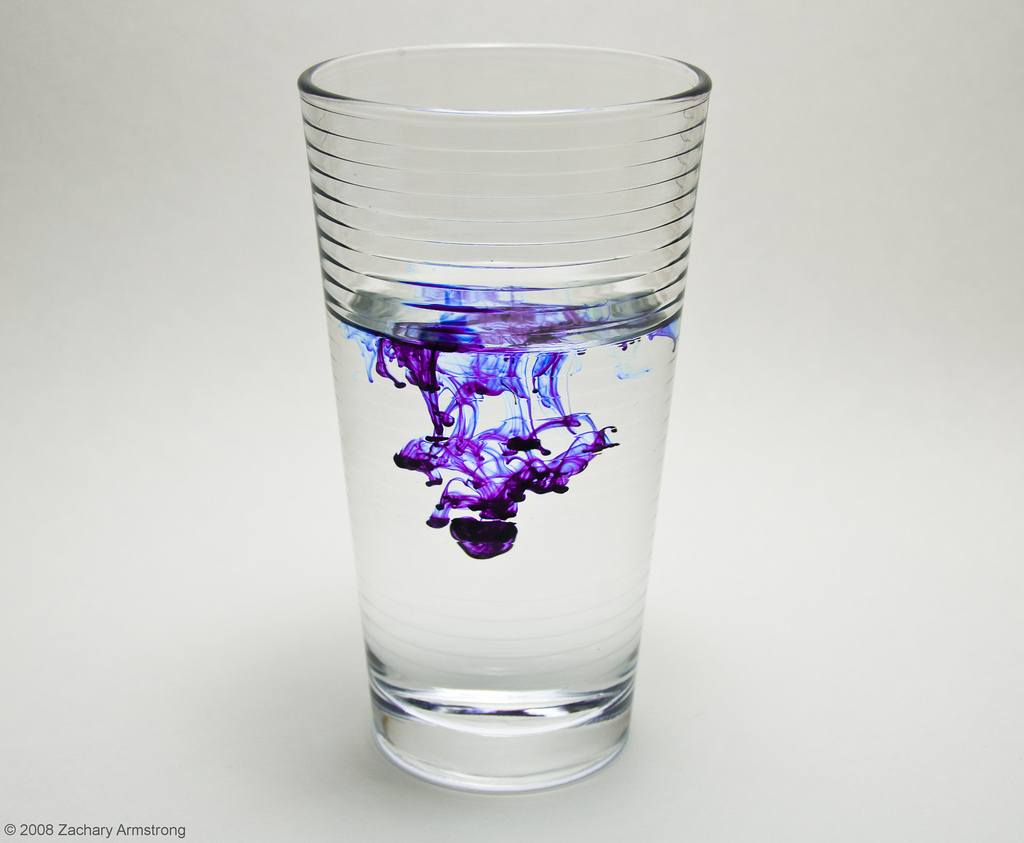
Where is there a low concentration of dye?
a)
at the bottom of cup
b)
in the color
c)
at the top of cup 
d)
no concenteraion gradient
30.
What is diffusion?
a)
when molecules move 
b)
when molecules move from a high concentration to a low.
c)
no movement 
d)
molecules move everywhere
31.
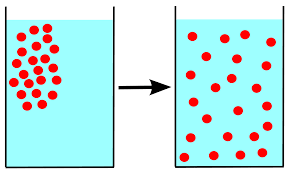
The picture below is an example of _________________.
a)
osmosis
b)
isotonic
c)
diffusion
d)
active transport
32.
Osmosis is the movement of _____ across a membrane.
a)
food
b)
energy
c)
oxygen
d)
water
33.
Permeable means
a)
things can pass through
b)
the concentration levels are different
c)
it is permanent
d)
things are stuck
34.
The diffusion of water through a semi-permeable membrane is called?
a)
Osmosis
b)
Cell wall
c)
Diffusion
d)
Respiration
35.
Where is there a high concentration of water?
a)
in the flower
b)
cannot be determined by picture.
c)
in the vase
d)
in the leaves
36.
When both inside and outside of a cell have the same amount of water it is said that the cell has reached a state of
a)
Osmosis
b)
Diffusion
c)
Equilibrium