Worksheets
Classification (VA SOL LS.3) Gr8 Science SOL Review
Total questions: 49
Worksheet time: 29mins
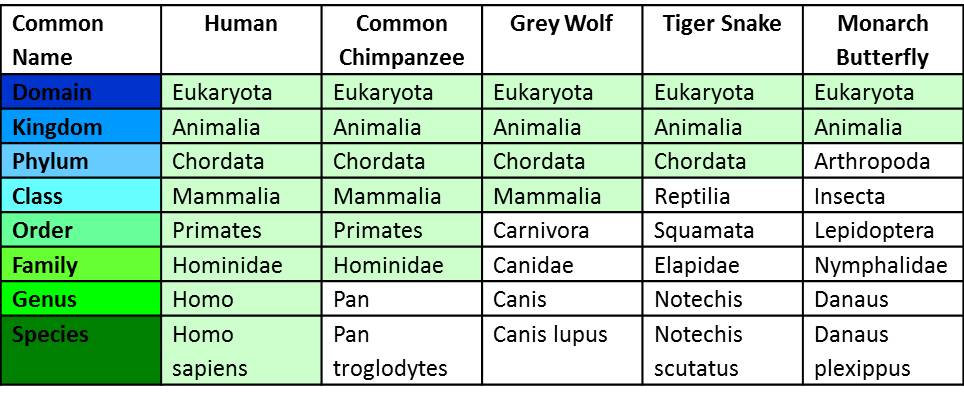
Which list shows the levels of classification in the correct order?
kingdom, phylum, class, order, family, genus, species, domain
domain, kingdom, phylum, class, order, family, genus, species
domain, kingdom, class, family, order, phylum, genus, species
kingdom, domain, family, class, order, phylum, species, genus
Grouping organisms into domains is based on what things? CHOOSE 3
the presence or absence of certain cellular structures
presence or absence of a liver organ
how they get their food
number of cells (unicellular or multicellular)
presence or absence of legs
One of the most important differences between the plant and animal kingdoms is-
plants do not move, but animals can
plants do not need water, but animals do
plants do not cell walls, but animals do
plants can produce their own food, but animals can not
Which of the following is NOT one of the kingdoms?
plants
protists
insects
fungi
A pine tree is a member of which kingdom?
Animalia
Protista
Fungi
Plantae
Which of the following organisms are in the plant kingdom? CHOOSE ALL THAT APPLY
tree
moss
algae
mushroom
yeast

Which of the following organisms belong in the same kingdom as the organism pictured? CHOOSE ALL THAT APPLY
wolf
jellyfish
algae
ladybug
mushroom
Many people get confused and think that fungi (like mushrooms and molds) are in the same kingdom as plants, but fungi are different from plants because fungi are-
autotrophic
unicellular
heterotrophic
prokaryotic

Euglena are classified as plant-like protists because -
they can live in the water
they have endospores
they have structures similar to roots on plants
they can produce their own food through photosynthesis
For an organism to be classified as an animal, it must have which of the following characteristics?
unicellular, without a nucleus, without a cell wall, autotrophic
multicellular, with a nucleus, with a cell wall, autotrophic
multicellular, with a nucleus, without a cell wall, heterotrophic
Archaebateria and Eubacteria are the only two kingdoms where the organisms do not have -
cell walls
a nucleus
flagella
cytolasm
Fungus-like protists are called that because, like fungi, they are -
autotrophic
decomposers
able to live in extreme environments
able to live where there is a lot of salt

Crustaceans are part of the domain Eukarya (organisms whose cells are eukaryotic) , the kingdom Animalia (animal kingdom), and the phylum Arthropoda (organisms with a hard exoskeleton and jointed legs). The class of crustaceans includes what other organisms? SELECT ALL THAT APPLY
lobsters
crabs
jellyfish
spiders
millipedes

Snails belong to the domain Eukarya (cells have a nucleus and no cell wall), Animal kingdom, and the phylum Mollusca (having a soft, muscular body and usually a shell). What are some other organisms in the same phylum? CHOOSE ALL THAT APPLY
clam
oyster
starfish
squid
jellyfish

Which of the following is NOT considered a flowering plant (angiosperm)?
violets
roses
lily pad
pine tree

Which of the following is NOT considered a conifer (or gymonsperm)?
pine tree
cedar tree
maple tree
spruce tree
Ferns are classified as -
angiosperms
gymnosperms
vascular seedless plants
nonvascular plants
Which organism is classified as an echinoderm?


Sea sponges belong to which phylum?
cnidarians
annelids
porifera
chordata

List the symmetry examples in the correct sequence.
A-radial symmetry; B-bilateral symmetry ; C-asymmetrical
A-bilateral symmetry; B-asymmetrical; C-bilateral symmetry
A-asymmetrical; B-radial symmetry; C-bilateral symmetry
A-bilateral symmetry; B-radial symmetry; C-asymmetrical

According to the chart which pairings of mice would be considered the same species? CHOOSE ALL THAT APPLY
Mouse 1 & 2
Mouse 2 & 3
Mouse 3 & 4
Mouse 1 & 3
Mouse 1 & 4

A horse and a donkey can mate to produce a mule. However, a horse and donkey are NOT considered the same species. What is one major reason?
the horse is larger than the donkey
the horse and donkey were able to reproduce
the mule offspring is sterile (unable to reproduce)
the horse and donkey are in different kingdoms

The last level of classification should be labeled -
class
species
family
domain

What is the scientific name of this wolf?
Eukarya lupus
eukarya Lupus
Canis lupus
canis Lupus
Lupus canus

Would these two organisms be able to mate and produce fertile young?
yes
no

Are these two organisms the same species?
yes
no

These two organisms are part of the same class, Aves (birds). Out of the following choices, which other levels of classification would they also have in common? SELECT ALL THAT APPLY
genus
species
domain
phylum
order
Which of the following would NOT be a feature that scientists would use when classifying a new species of fish?
type of skeleton
cell type
how it obtains its food
how fast it swims
Which of these organisms would be most closely related? CHOOSE TWO
Alligator mississippiensis
Elephas maximus
Felis domesticus
Felis bieti

Unicellular, prokaryotic organisms that tend to live in extreme places such as this hot spring are part of which domain?
eukarya
eubacteria
archaebacteria
protista

Unicellular, prokaryotic organisms that can be either helpful or harmful (such as the helpful ones in this yogurt) are part of which domain?
archaea
bacteria
eukarya
animalia
The domain that contains the kingdoms protista, plantae, animalia, and fungi is ----
eukarya
bacteria
archaea

What do protists, animals, plants, and fungi all have in common?
all have prokaryotic cells
all have eukaryotic cells
all are heterotrophs
all are autotrophs

Which phylum does this sea anemone belong to? It has multicellular, eukaryotic cells, is a heterotroph, has radial symmetry, no backbone, and has stinging cells that are used to trap and kill prey.
echinoderms
mollusks
chordates
cnidarians

Which phylum do these organisms belong to?
annelids
mollusks
cnidarians
fungi

To which phylum do these organisms belong?
mollusks
chordates
annelids
arthropods

To what phylum do these organisms belong? They all have jointed legs and an exoskeleton.
insects
annelids
arthropods
chordates

To what phylum do these organisms belong? They all have soft bodies (some with a shell and some without), and live either on land or in the sea.
annelids
mollusks
arthropods
cnidarians

To what phylum do these organisms belong? They all have radial symmetry and spiny body coverings.
cnidarians
echinoderms
annelids
mollusks
Which of the following organisms are the most closely related? CHOOSE TWO


Which group of plants do these organisms belong to? They are all vascular and reproduce with spores.
mosses
ferns
gymnosperms (conifers)
angiosperms (flowering plants)

This is an example of an organism that is nonvascular and reproduces using spores. It is often found in damp places. What major group does it belong to?
mosses
ferns
gymnosperms (conifers)
angiosperms (flowering plants)

This group of plants is vascular and produces seeds in cones like the ones in the picture. What major group does it belong to?
mosses
ferns
gymnosperms (conifers)
angiosperms (flowering plants)

This plant belongs to which major group?
mosses
ferns
gymnosperms (conifers)
angiosperms (flowering plants)

What kingdom is most identifiable by the fact that all its members are autotrophs?
plants
animals
fungi
protists

What kingdom is made up of both unicellular, multicellular, or colonial organisms that can be autotrophs or heterotrophs and have eukaryotic cells?
plants
animals
fungi
protists
Organisms in the fungi kingdom have which of the following key features? SELECT ALL THAT APPLY
unicellular
multicellular
autotrophic
heterotrophic
cell wall (made of chitin)