wayground logo

Free Printable Worksheets

Font size

S
M
L
XL
Worksheets

Y8 Plant Reproduction

Total questions: 50

Worksheet time: 32mins

Name
Class
Date
1.
After fertilization what does the ovule develop into?
a)
Fruit
b)
Bud
c)
Seed
d)
Flower
2.
The part of the stamen that produces pollen grains is the ___.
a)
anther
b)
pistil
c)
filament
d)
ovary
3.
The tip of the style that has sticky hairs to trap pollen is the ___.
a)
stamen
b)
stigma
c)
ovary
d)
style
4.
Which part may develop into a fruit?
a)
E
b)
D
c)
C
d)
A
5.
The male reproductive structure of a flower is the ___.
a)
pistil
b)
ovary
c)
stamen
d)
ovule
6.
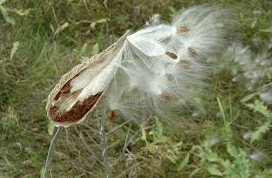
All of the following are examples of seed dispersal except:
a)
wind
b)
volcanic eruptions
c)
physical movement (rolling)
d)
animals droppings
7.
This occurs directly AFTER a tube grows down from the pollen grain through the style to the ovary.
a)
pollination
b)
germination
c)
fertilisation
d)
seed dispersal
8.
Seed dispersal does not reduce competition between the seedlings and the parent plant for
a)
light
b)
oxygen
c)
water
d)
space
9.
Small leaf-like structures forming an outer circle at the base of a flower.
a)
petals
b)
sepal
c)
anthers
d)
dicots
10.
The part of the flower on which the pollen grains land.
a)
anther
b)
stamen
c)
style
d)
stigma
11.
The part of a flower that produces the male reproductive cells.
a)
anther
b)
style
c)
stigma
d)
filament
12.
Which part produces pollen?
a)
A
b)
B
c)
C
d)
E
13.
Pollination can occur between flowers of the same plant. 
a)
True 
b)
False 
14.
What is the function of nectar?
a)
To provide food for the flower
b)
To attract pollinators
c)
To attract animals to disperse the fruits
d)
To produce perfumes for Man
15.
Wind-pollinated flowers usually have ______ and ________ petals. 
a)
big ... bright 
b)
small ... bright 
c)
big ... dull 
d)
small ... dull
16.
Insect dispersed pollen is usually sticky and spiky so that it can _______________. 
a)
attach to the pollinators' body without falling off easily 
b)
prevent pollinators from eating them
c)
stay attached to the anther so that it doesn't attach to a pollinator
d)
be used as glue
17.
When we see growth, or when a seed sprouts it shows _______.
a)
pollination
b)
sun
c)
germination
d)
reproduction
18.
What are 3 requirements for germination?
a)
Air, water, and warmth.
b)
Air, roots, seeds.
c)
Air, seeds, sun.
d)
Sun, soil, air.
19.
Seeds are only able to sprout or___________ under the right conditions
a)
photosynthesise
b)
germinate
c)
multiply
d)
spread
20.
Pollination is the process by which pollen
a)
causes people to sneeze
b)
is formed inside a plant
c)
moves from stamen to stigma
d)
moves from stigma to stamen
21.
Other animals besides bees can pollinate flowers.  These animals include:
a)
dogs, cats, birds, and bunnies
b)
bats, hummingbirds, butterflies, and flies
c)
horses, cows, pugs, and sheep
d)
elephants, giraffes, lions, and tigers
22.
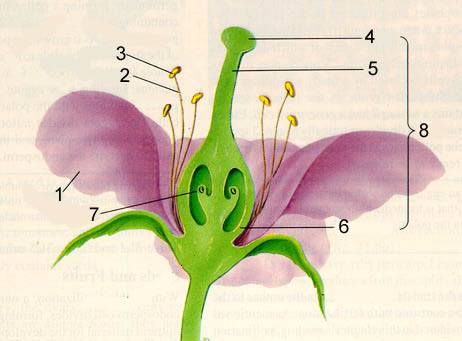
What is #8 pointing to?
a)
petal
b)
stamen
c)
carpel
d)
ovary
23.
What is #2 pointing to?
a)
anther
b)
filament
c)
ovary
d)
style
24.
What is #5 pointing to?
a)
anther
b)
filament
c)
stigma
d)
style
25.
The ovary, style, and the stigma make up the female part of a plant called the ?
a)
stamen
b)
petals
c)
stem
d)
carpel (pistil)
26.

Pollen grains are produced by ?

a)

the anther

b)

the stigma

c)

the flowers

d)

the leaves

27.
The seeds of apple would probably be disbursed by?
a)
animals
b)
wind
c)
water
d)
fire
28.
Seeds can be disbursed by animals, water, and __________ ?
a)
wind
b)
earthquakes
c)
fire
d)
blizzards
29.

A coconut would probably be dispersed by ?

a)

animals

b)

wind

c)

water

d)

volcanos

30.
What is seed dispersal?
a)
plant reproduction
b)
ability of plants to make food
c)
moving seeds to a new location
d)
adaptation of plants to produce more seeds
31.
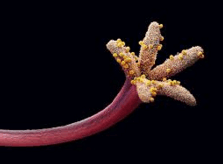
What is this a picture of?
a)
Pistil
b)
Stamen
c)
Stigma
d)
Ovule
32.
Small leaf-like structures forming an outer circle at the base of a flower.
a)
petals
b)
sepal
c)
stigma
d)
pistil
33.

The stalk that supports or holds up the anther is the

a)

style

b)

filament

c)

ovary

d)

pistil

34.

What is the name of flower part #10 ?

a)

sepal

b)

pollen tube

c)

filament

d)

stigma

35.

This is when a pollen grain combines with an egg in the plant's ovary.

a)

Fertilization

b)

Pollenation

c)

Reproduction

d)

Germination

36.

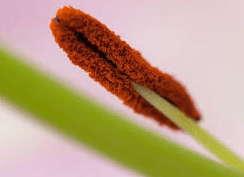
What part of a flower is this?

a)

Stamen

b)

Pistil

c)

Sepal

d)

Stomata

37.

Seeds that are forcefully ejected from their fruits are using __________.

a)

Animal Dispersal

b)

Fire Dispersal

c)

Mechanical Dispersal

d)

Water Dispersal

38.

What type of seed dispersal carries lightweight seeds with feathery or wing-like structures?

a)

Wind

b)

Water

c)

Fire

d)

Self-Dispersal

39.

Why is it important for seeds to be able to scatter?

*CHOOSE ALL THAT ARE CORRECT!*

a)

so they can grow in a new area that may better sunlight

b)

so they can grow in a new area that may have more water

c)

so they can grow in a new area with more nutrients

d)

so that animals and insects can eat them

40.

The purpose of seed dispersal is for the seeds to __________.

a)

germinate at the same time

b)

move to the same place and grow

c)

move further away from the parent plant

d)

compete with one another for minerals in the soil

41.

The purpose of seed dispersal is for the seeds to __________.

a)

germinate at the same time

b)

move to the same place and grow

c)

move further away from the parent plant

d)

compete with one another for minerals in the soil

42.

Why are bur seeds able to be dispersed by animals?

a)

It is light and has wing-like structure

b)

It has hooks to hook onto the fur of animals

c)

It has a fibrous husk that makes it float

d)

It has dry pods that split open

43.

What might happen if seeds aren't dispersed far enough?

a)

there is competition with the parent plant for light

b)

there is competition with the parent plant for carbon dioxide

c)

the parent plant and the new plant both have plenty of nutrients

d)

there is not competition between the plants for air

44.

What might happen if seeds aren't dispersed far enough?

a)

there is competition with the parent plant for space

b)

there is competition with the parent plant for carbon dioxide

c)

the parent plant and the new plant both have plenty of nutrients

d)

there is not competition between the plants for air

45.

What might happen if seeds aren't dispersed far enough?

a)

there is competition with the parent plant for nutrients in the soil

b)

there is competition with the parent plant for carbon dioxide

c)

the parent plant and the new plant both have plenty of nutrients

d)

there is not competition between the plants for air

46.

Germination is _________________________________.

a)

when a seed starts to grow

b)

when an egg and pollen join together

c)

when pollen moves stamen to stigma

d)

when a plant makes its own food.

47.

A seed needs __________, __________ and a __________ to germinate.

a)

soil, water, air

b)

suitable temperature, water, sunlight

c)

air, water, suitable temperature

d)

water, air, sunlight

48.

Which condition is NOT needed for germination?

a)

Water

b)

Oxygen

c)

Light

d)

Suitable temperature

49.

List three external conditions required for seed germination

a)

soil, water, air

b)

suitable temperature, water, sunlight

c)

oxygen, water, suitable temperature

50.

Why are some flowers scented?

a)

To attract insects for pollination

b)

To attract wind for pollination

c)

To attract humans for pollination

d)

So we grow more