
NEW
Font size
 Worksheets
Early Republic to Westward Expansion STAAR REVIEW
Total questions: 60
Worksheet time: 2hrs 26mins

Which of the following was a defining characteristic of the Era of Good Feelings?
The United States ceded territory to Great Britain in an attempt to avoid war.
There was a renewed sense of nationalism.
Evangelical revivalists challenged religious traditionalists.
Many states called for a restructuring of the federal government.

Which of the following was the most direct result of the environmental modifications listed below?
Federal regulations were adopted to ensure safety and ease of travel on the road.
State governments cooperated closely to maintain road quality.
Improved transportation to western states expanded trade and settlement.
Road construction became a major industry in the United States.

Which action completes this diagram below?
oversee state government agencies.
regulate the creation of new businesses.
establish a national bank.
eliminate protective tariffs.

This list below provides examples of?
topics discussed during the Second Constitutional Convention.
domestic issues faced by the leaders of the new republic.
weaknesses of the government under the Articles of Confederation.
issues leading to the ratification of the first constitutional amendments.

According to Alexander Hamilton, which action was necessary to ensure the stability of the nation’s economy?
The passage of a trade embargo against Great Britain.
The abolition of consumption taxes.
The creation of a trade alliance with France.
The establishment of a national bank.

The first political parties in the United States formed mainly in response to disagreements over?
taxation without representation.
the doctrine of judicial review.
territorial expansion to the west.
the extent of federal power.

Disagreements between these two cabinet members led to?
the creation of reservations for American Indians.
a struggle to ratify the Bill of Rights.
the establishment of the first U.S. political parties.
a compromise over slavery in western territories.

The Federalists and the Democratic-Republicans emerged as separate political parties partly as a result of disagreement over?
how the nation should develop economically.
whether to enforce the Monroe Doctrine.
how the nation should admit new states.
whether to approve the Declaration of Independence.

The first political parties in the United States were established in the 1790s largely because of political differences between?
John Adams and Benjamin Franklin
Alexander Hamilton and Thomas Paine
George Washington and James Madison
Thomas Jefferson and Alexander Hamilton

Which of the following best completes the diagram below?
Boston Tea Party
War of 1812
American Revolution
Civil War

Which phrase completes this excerpt below?
colonial Settlements
protective Tariffs
permanent Alliances
territorial Disputes

The U.S. foreign policy illustrated in this cartoon below was intended to?
prevent further European colonization in the Western Hemisphere.
deter Spain from inciting revolution in former U.S. colonies.
encourage European powers to invest in Latin America.
keep the war between France and Spain from spreading to Latin America.

Which of these best summarizes the Monroe Doctrine?
The immigration of Europeans to the United States must be discouraged.
International peace can be maintained without complicated alliances.
The power to nullify federal laws is necessary to preserve sovereignty.
Further colonization of the Americas by European countries is prohibited.

The Northwest Ordinance established guidelines for the orderly expansion of the United States by instituting a?
method to purchase territory from foreign powers.
procedure for military takeovers of existing countries.
process through which states could be added to the Union.
compromise line that prohibited slavery in the West.

The Northwest Ordinance is considered a historical milestone because it?
more than doubled the size of the United States.
established a method for admitting new states to the Union.
encouraged state legislatures to ratify the Constitution.
proposed treaties with American Indians to allow the peaceful settlement of new territories.

After the end of the Revolutionary War, states were eager to expand into newly available territory. The states of New York, Connecticut, Massachusetts, and Virginia argued over competing claims to land west of the Appalachian Mountains. This conflict was addressed by the?
Missouri Compromise
Wilmot Proviso
Northwest Ordinance
Kansas-Nebraska Act

How did the War of 1812 most affect the U.S. economy?
Disruption in trade contributed to domestic industrial growth.
Small farmers benefited from higher export prices for grain crops.
The sale of treasury bonds to international companies was prohibited.
New trade alliances resulted in increased foreign investment.
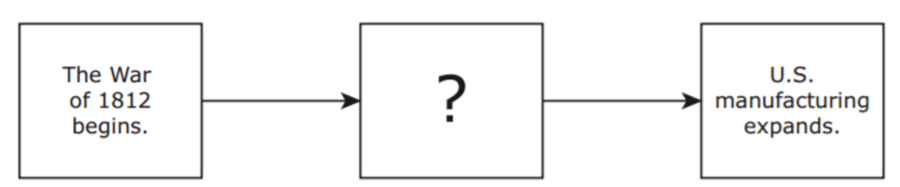
Which sentence best completes the diagram below?
The supply of British goods decreases.
Congress ends the European embargo.
Exports to Great Britain increase.
Congress reduces tariffs.

How did the War of 1812 affect the U.S. economy?
The use of federal paper currency increased.
Agricultural imports increased.
Imports of raw materials increased.
Manufacturing increased.

In Marbury v. Madison, the Supreme Court established a principle that would eventually be used by all courts to?
strike down any law that the court deems unconstitutional.
decide the outcome of contested election results.
overturn any impeachment that the court deems unsupported by evidence.
mediate disputes related to commerce between states.

The decision in Marbury v. Madison was significant in U.S. history because it?
reinforced federal authority over American Indian affairs.
confirmed the power of Congress to regulate interstate commerce.
established the practice of judicial review by the Supreme Court.
upheld the power of the Electoral College to choose the vice president.

Which precedent was established by the Supreme Court ruling in Marbury v. Madison?
The federal government has the power to regulate trade among the states.
State governments lack the authority to regulate federal bureaus.
Federal courts determine the constitutionality of a law.
State courts lack the authority to hear cases challenging federal law.

Which action should be added to this list below?
Upheld the doctrine of states’ rights.
Supported the popular election of Supreme Court justices.
Allowed slavery to extend into western territories.
Wrote the Supreme Court decision that established the principle of judicial review.

The Whiskey Rebellion challenged the idea that?
The federal government had the power to pass and enforce tax laws.
A national military was needed for dealing with foreign threats.
The federal government could raise tariffs to protect industries.
A national court system was needed for resolving disputes between states.

The organization of the first U.S. political parties resulted in large part from disagreements over which issue?
The purchase of the Louisiana Territory from France.
The election of George Washington to a second term as president.
The establishment of the First Bank of the United States.
The attack on the Port of Tripoli in North Africa.


The economies of the western states were very different from those of the northeastern states in the mid-1800’s. One major difference was that western states?
Relied on subsistence farming.
Used natural harbors for shipping.
Focused on mining and agriculture.
Traded freely with other nations.

Which phrase correctly completes the excerpt above?
We joined the local congregation.
We agreed to leave.
We asked the federal government for aid.
We sued our tormentors.

The names on this map best reflect which of the following?
Family names of early pioneers in the West.
The impact of American Indian culture on the southwestern states.
The influence of Spanish colonial heritage on the Unites States.
Religious beliefs brought by immigrants to the United States.

Which reason did the United States give for declaring war against Mexico in 1846?
To overturn a corrupt Mexican government.
To defend U.S. territory from Mexico aggression.
To end a Mexican slave rebellion.
To respond to attacks on U.S. merchant ships by Mexican pirates.

Which numbered area did the United States acquire in 1846 after negotiations with Great Britain?
A
B
C
D


What was the primary question surrounding the 1832 Nullification Crisis?
Can the federal government regulate interstate commerce.
Can a state regulate a federal agency.
Can a state overturn a federal law.
Can the federal government levy taxes on states.

