
 Worksheets
Science TCAP Review!
Total questions: 84
Worksheet time: 59mins
Name
Class
Date
1.

a)
budding
b)
sporulation
c)
vegetative propagation
d)
binary fission
2.
How many parent(s)are needed for asexual?
a)
4
b)
1
c)
9
d)
100
3.
When a starfish grows a new body off a broken arm, what kind of reproduction is this?
a)
Sexual
b)
Differentiation
c)
Asexual
d)
Specialization
4.
This produces 2 identical cells.
a)
mitosis
b)
meiosis
5.
What parts of the chromosomes code for traits?
a)
Genes
b)
Deoxyribonucleic Acid
c)
Chromosomes
d)
Nucleus
6.
Where is all the genetic material inside a cell?
a)
nucleus
b)
vacuole
c)
cell membrane
d)
ribosome
7.
Asexual reproduction in plants in known as
a)
regeneration
b)
vegetative propagation
c)
binary fission
d)
sporulation
8.
Asexual reproduction that involves the regrowth of a lost body part is known as
a)
regeneration
b)
vegetative propagation
c)
binary fission
d)
sporulation
9.
How many daughter cells are created from Mitosis?
a)
1
b)
2
c)
3
d)
4
10.
Which type of cell division produces gametes?
a)
Mitosis
b)
Meiosis
c)
Regeneration
d)
Vegetative Propagation
11.
How many daughter cells are produced from Meiosis?
a)
1
b)
2
c)
3
d)
4
12.
Reproduction that combines genetic material of two organisms
a)
Sexual Reproduction
b)
Asexual Reproduction
c)
Fertilization
d)
Budding
13.
A general name for a sex cell (egg or sperm) is a:
a)
zygote
b)
gene
c)
offspring
d)
gamete
14.
The way a surface reflects light.
a)
color
b)
luster
c)
streak
d)
density
15.
Refers to a mineral's resistance to being scratched.
a)
color
b)
cleavage
c)
hardness
d)
breakage
16.
Color of a mineral in powdered form.
a)
hardness
b)
streak
c)
breakage
d)
density
17.
__________________ is the tendency of a mineral to break along curved or irregular surfaces.
a)
Cleavage
b)
Fracture
18.
________________ is the hardest mineral.
a)
Talc
b)
Diamond
19.

Which mineral property is being tested in the diagram below?
a)
Streak
b)
Cleavage
c)
Breakage
d)
Luster
20.
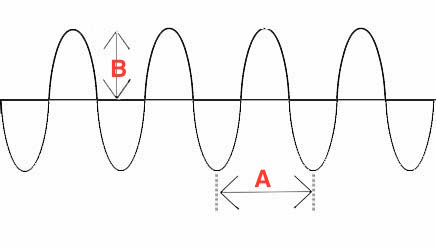
What property of this wave is represented by the letter "A"
a)
amplitude
b)
crest
c)
trough
d)
wavelength
21.
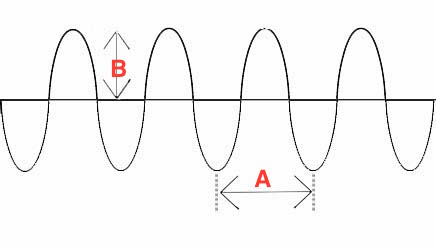
What property of the wave is represented by the letter "B"?
a)
amplitude
b)
crest
c)
trough
d)
wavelength
22.
The highest point on a wave is:
a)
the crest
b)
the trough
c)
the top
d)
the coast
23.
The lowest point on a wave is the:
a)
Amplitude
b)
Crest
c)
Trough
d)
Wavelength
24.
The number of wavelengths that pass a point each per second is:
a)
frequency
b)
period
c)
longitudinal
d)
transverse wave
25.
The type of waves that require medium to pass:
a)
Mechanical Waves
b)
Electromagnetic Waves
26.
When the frequency of a wave increases, what happens to the wavelength?
a)
The wavelength is not directly affected by the frequency of a wave.
b)
The wavelength increases.
c)
The wavelength decreases.
d)
More specific information is needed to form a conclusion about the wavelength.
27.

Which vocabulary term is used to identify the distance between points C & G?
a)
Amplitude
b)
Crest
c)
Frequency
d)
Wavelength
28.
A mechanical wave cannot travel through...
a)
a vacuum(empty space).
b)
water.
c)
air.
d)
glass.
29.
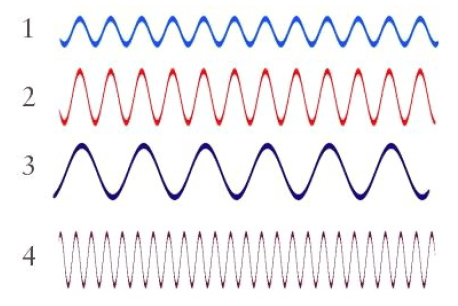
Which wave in the diagram has the greatest frequency?
a)
1
b)
2
c)
3
d)
4
30.
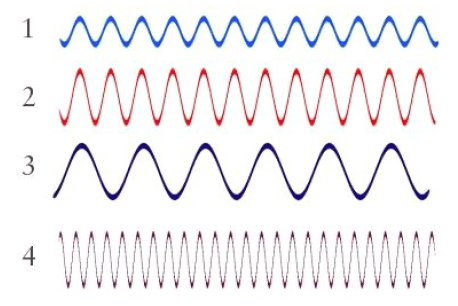
Which wave in the diagram has the greatest wavelength?
a)
1
b)
2
c)
3
d)
4
31.
which material does sound travel the fastest?
a)
solid
b)
liquid
c)
gases
32.
The main purpose of the ____________ system is to break food particles into pieces that can be used.
a)
circulatory
b)
respiratory
c)
digestive
d)
skeletal
33.
___________ are the building blocks of life.
a)
cells
b)
legos
c)
blocks
d)
blood
34.
When tissues come together, they form ___________.
a)
cells
b)
atoms
c)
organs
d)
systems
35.
Which of the following body systems work together for support, protection, and movement?
a)
respiratory and cardiovascular
b)
skeletal and muscular
c)
skeletal and integumentary
d)
digestive and respiratory
36.
This system helps the body respond to signals and information from both inside and outside the body.
a)
Nervous System
b)
Muscular System
c)
Skeletal System
37.
This system includes the spinal cord, brain and nerves
a)
Nervous System
b)
Digestive System
c)
Circulatory System
38.

What body system removes the waste from your body?
a)
Circulatory
b)
Excretory
c)
Digestive
d)
Respiratory
39.
Which body system transports oxygen and nutrients through out the body?
a)
Muscular System
b)
Nervous System
c)
Digestive System
d)
Circulatory System
40.
What system breaks food down into energy for the body?
a)
Stomach
b)
Digestive System
c)
Respiratory system
d)
Lungs
41.
The main purpose of the ________ system is to produce hormones for the body.
a)
excretory
b)
digestive
c)
reproductive
d)
endocrine
42.
What system is the body's way of fighting off pathogens that would make it sick?
a)
Excretory
b)
Immune
c)
Digestive
d)
Endocrine
43.
Which structures are found in every living cell?
a)
cell membrane and cytoplasm
b)
chloroplasts and mitochondria
c)
a cell wall and nucleus
d)
chloroplasts and cell wall
44.
What is the function of the cell nucleus found in both plant and animal cells?
a)
to produce energy
b)
to control cell activity
c)
to remove waste products
d)
to allow molecules to enter the cell
45.
Cell organelles that are responsible for digesting food, worn out organelles and other cellular wastes are called ___________________.
a)
Mitochondria
b)
Vacuoles
c)
Lysosomes
d)
Chlororplasts
46.
What is one basic function of the vacuoles?
a)
circulating oxygen
b)
producing food
c)
controlling cell processes
d)
storing water
47.
All cells need energy to function. Which cell organelle is responsible for producing energy in the cell?
a)
chloroplasts
b)
mitochondria
c)
nucleus
d)
vacuoles
48.
What is the function of a cell wall?
a)
to protect and support the cell
b)
to perform different functions in each cell
c)
to prevent water from passing through it
d)
to prevent oxygen from entering the cell
49.
In what part of the plant cell does the process of photosynthesis take place?
a)
nucleus
b)
mitochondria
c)
chloroplasts
d)
vacuoles
50.

Label #3
a)
Nucleus
b)
Mitochondria
c)
Vacuole
d)
Golgi Body
51.

Label #5
a)
Nucleus
b)
Nucleolus
c)
Endoplasmic Reticulum
d)
Mitochondria
52.

Label #7
a)
Lysosomes
b)
Golgi Bodies
c)
Nucleus
d)
Cytoplasm
53.
Type of cell????
a)
Plant and Animal
b)
Neither plant or animal
c)
Animal
d)
Plant
54.

Label #8
a)
Vacuoles
b)
Lysosomes
c)
Cytoplasm
d)
Endoplasmic Reticulum
55.

Label #10
a)
Endoplasmic Reticulum
b)
Golgi Bodies
c)
Ribosomes
d)
Nucleolus
56.

Label #11
a)
Cell membrane
b)
Cytoplasm
c)
Mitochondria
d)
Ribosomes
57.

Label A
a)
Cell wall
b)
Cell membrane
c)
Cytoplasm
d)
Chloroplast
58.

Label B
a)
Cell membrane
b)
Cytoplasm
c)
Chloroplasts
d)
Cell wall
59.

Label C
a)
Mitochondria
b)
Vacuole
c)
Nucleus
d)
Cytoplasm
60.

Label D
a)
Cytoplasm
b)
Chloroplast
c)
Vacuole
d)
Mitochondria
61.

Label E
a)
Lysosomes
b)
Ribosomes
c)
Cytoplasm
d)
Nucleus
62.

Label F
a)
Cell membrane
b)
Vacuole
c)
Chloroplast
d)
Chromatin
63.

Type of cell?
a)
Animal
b)
Plant
c)
Both
d)
Neither
64.

"For every action, there is an equal and opposite reaction."
a)
Newton's 1st Law
b)
Newton's 2nd Law
c)
Newton's 3rd Law
d)
Newton's 4th Law
65.

Force = Mass x Acceleration
a)
Newton's 1st Law
b)
Newton's 2nd Law
c)
Newton's 3rd Law
d)
Newton's 4th Law
66.

"An object in motion (or at rest) will to stay in motion (or at rest) until an outside force acts upon it."
a)
Newton's 1st Law
b)
Newton's 2nd Law
c)
Newton's 3rd Law
d)
Newton's 4th Law
67.

The tendency of an object to resist changes in its motion is...
a)
inertia
b)
force
c)
acceleration
d)
velocity
68.

Any push or pull on an object.
a)
force
b)
velocity
c)
inertia
d)
momentum
69.

The force that opposes motion between two surfaces in contact with each other.
a)
inertia
b)
friction
c)
momentum
d)
gravity
70.

The force of attraction between all matter.
a)
inertia
b)
friction
c)
net force
d)
gravity
71.
A Newton is a unit of...
a)
force
b)
inertia
c)
acceleration
d)
velocity
72.

An archer pulls the bowstring back, then releases the string and the arrow flies forward. The arrow flying forward is the...
a)
action force
b)
reaction force
c)
net force
d)
inertia
73.
The type of plate boundary where two plates come together is a .....
a)
Convergent Boundary
b)
Divergent Boundary
c)
Transform Boundary
d)
Plate Boundary
74.
Which of the following causes Earth's tectonic plates to move?
a)
Energy from the Sun
b)
Magnetic Pole Reversal
c)
Convection currents in the mantle
d)
Faults in Mountain Ranges
75.
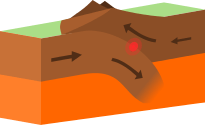
What type of plate boundary is this?
a)
Plate
b)
Divergent
c)
Convergent
d)
Transform
76.

What type of event will occur at this boundary?
a)
Earthquake
b)
Volcano Eruption
c)
Tornado
d)
Mountain Building
77.
A divergent boundary occurs when plates ....
a)
Pull apart
b)
Come together
c)
Slide past each other
d)
subducting
78.
Which of the following is NOT evidence to support the theory of plate tectonics?
a)
Fossils
b)
Mountains
c)
Glaciers
d)
Sand Erosion
79.
Oceanic Trenches are formed by _______ plate boundaries
a)
Convergent
b)
Transform
c)
Plate
d)
Divergent
80.
A fault is formed by the movement of a __________ plate boundary
a)
Transform
b)
Convergent
c)
Divergent
81.
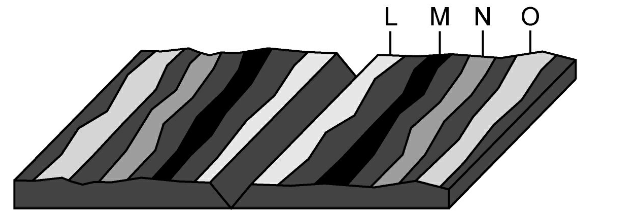
Where would the oldest rock be found?
a)
L
b)
M
c)
N
d)
O
82.
Mountains are created when....
a)
Two continental plates collide
b)
Two oceanic plates pull apart
c)
An Oceanic plate subducts under a Continental Plate
d)
Two continental plates pull apart
83.
This layer of Earth is the thickest part
a)
crust
b)
outer core
c)
mantle
d)
inner core
84.
This layer of Earth is solid Iron and Nickel
a)
Outer Core
b)
Mantle
c)
Inner Core
d)
Crust
100 %

