
NEW
Font size
S
M
L
XL
 Worksheets
Cheney 6th Grade Science Bowl (Test #2)
Total questions: 35
Worksheet time: 48mins
Name
Class
Date
1.
A controlled experiment is an experiment that ______.
a)
uses tools to take measurements
b)
includes a data table and a graph
c)
allows only one variable to be changed at a time
d)
is repeated several times
2.

Look at the diagram. Which force or forces are acting at Position A?
a)
Gravity only
b)
force applied by the string
c)
gravity and force applied by the string
d)
centrifugal force
3.
Anything you can change in an experiment that might affect the outcome
a)
variable
b)
independent variable
c)
dependent variable
d)
controlled variable
4.

What is the relationship between the length of the string and the number of swings a pendulum makes in 15 seconds?
a)
The longer the string, the fewer times the pendulum swings.
b)
The shorter the string, the less force it takes to swing.
c)
The longer the string, the less time it takes to swing.
d)
The shorter the string, the slower the pendulum moves.
5.

A large ball is going to be rolled down a ramp. What release position will require the largest force to bring the ball to a stop after it rolls down the ramp?
a)
1
b)
2
c)
3
d)
4
6.

A bowling ball starts at Position 1, rolls down a ramp, across the floor, and stops at Position 4. At which position does the bowling ball have the most potential energy?
a)
1
b)
2
c)
3
d)
4
7.
The energy of motion.
a)
energy
b)
potential energy
c)
kinetic energy
d)
momentum
8.

A snowboarder starts at Position 1 on a hill and stops at Position 4. At what position will she have the most potential energy?
a)
1
b)
2
c)
3
d)
4
9.
What is Newton's First Law known as? The Law of
a)
Newton's Toy Box #2 (Act.5-8)Friction
b)
Mass
c)
Inertia
d)
Gravity
10.
What is the name for a push or pull?
a)
A movement
b)
A force
c)
Speed
d)
Density
11.

What is the net force of this object?
a)
10 N, no direction
b)
10 N left
c)
5 N right
d)
0 N no direction
12.

The force that pulls things toward earth.
a)
Speed
b)
Gravity
13.
What is the unit of measurement for force?
a)
AMP
b)
Seconds
c)
Newtons
d)
Miles
14.
Who was the scientist who gave us the Laws of Motion?
a)
Sir Isaac Newton
b)
Albert Einstein
c)
Galileo Galilei
d)
Aristotle
15.
Name the 2 factors that affect acceleration of an object
a)
velocity and time
b)
distance and time
c)
mass and force
d)
mass and time
16.
Jenny and Johnny each have a mass of 55.0 Kg. If both are on roller skates, and Jenny pushes Johnny, who experiences the greatest force?
a)
Jenny
b)
Johnny
c)
The forces are the same.
17.

Which best explains why we are able to accelerate forward when starting to run?
a)
As one leg moves backward, it provides an equal and opposite force for the other foot to move forward.
b)
No acceleration takes place. Runners are always at a fixed velocity.
c)
The striking foot pushes backward against the ground. The friction with the ground provides an equal and opposite force forward.
d)
The runner's upper body quickly leans forward, causing the entire body to begin accelerating forward
18.

In this scenario, which law does this represent?
a)
Law of Inertia
b)
Law of Force and Acceleration
c)
Law of Action-Reaction
19.
The amount of matter in an object
a)
weight
b)
force
c)
gravity
d)
mass
20.
What was Mendeleyev able to do after he organized the periodic table?
a)
He found the atomic weight of each element
b)
He counted the protons in elements
c)
He moved from Russia
d)
He predicted the discovery of new elements
21.
Vertical columns on the periodic table are called?
a)
groups
b)
rows
c)
periods
22.
How is the atomic mass determined?
a)
Adding protons and electrons
b)
Adding protons and neutrons
c)
Adding neutrons and electrons
d)
Weighing it
23.
Is the following a physical or chemical change? Milk souring
a)
Physical
b)
Chemical
24.
What element is among the five most abundant elements in the Sun, Earth, ocean, atmosphere, and organisms
a)
Nitrogen
b)
Magnesium
c)
Carbon
d)
Oxygen
25.
What is the common name for sodium chloride?
a)
Road Salt
b)
Table Salt
c)
Epsom Salt
d)
Baking Soda
26.
a fundamental substance that cannot be broken into simpler substances by chemical or physical processes
a)
Atom
b)
Nucleus
c)
Element
d)
Substance
27.
When a liquid changes its phase and turns into a solid it is known as
a)
condensation.
b)
melting.
c)
vaporization.
d)
freezing or solidification.
28.
Adding HEAT to matter causes its particles to:
a)
move faster and farther apart
b)
Move slower and farther apart
c)
Move faster and closer together
d)
Move slower and closer together
29.
When an inflated balloon is exposed to cold air,
a)
the volume of the balloon decreases
b)
the volume of the balloon increases
30.
A plastic bottle filled with warm air is placed into cold water. The temperature of the air ________.
a)
doesn't change
b)
gets colder
c)
gets warmer
31.
True or False: Energy flows from hot chocolate when cold milk is poured into it.
a)
True
b)
False
32.
A closed container of water is kept at a constant temperature. Which of the following statements about the water particles is true?
a)
the average KE of the water particles stays the same
b)
the average KE of the water particles increases a little bit
c)
the average KE of the water particles dereases a little bit
d)
the water particles stop moving
33.
What type of heat transfer is most common with warming liquids, like a hot tub?
a)
Convection
b)
Radiation
c)
Conduction
34.
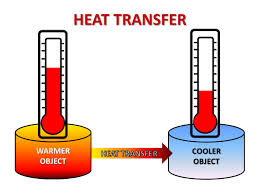
Heat transfers from an area of ____temperature to an area of ___ temperature.
a)
high to low
b)
low to high
c)
high to high
d)
It can travel high to low and low to high.
35.
To separate a mixture of salt and water what separation tool/method is used?
a)
Filter
b)
Screen
c)
Magnet
d)
Evaporation
Reset

