wayground logo

Free Printable Worksheets

NEW

Font size

S
M
L
XL
Worksheets

Quiz - Seasons and Weather

Total questions: 60

Worksheet time: 55mins

Name
Class
Date
1.

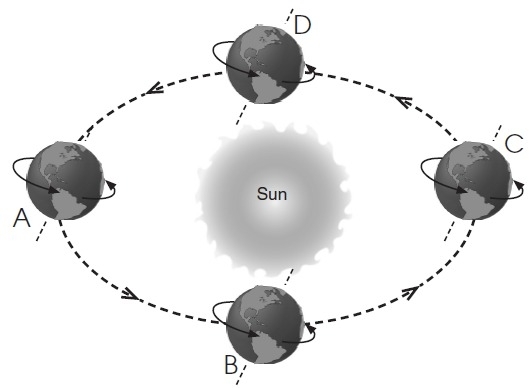
Which change in seasons occurs in the Northern Hemisphere as the Earth moves from position D to position A?

a)

Winter is ending and spring is beginning.

b)

Spring is ending and summer is beginning.

c)

Summer is ending and fall is beginning.

d)

Fall is ending and winter is beginning.

2.

During the course of the day, which location had the greatest intensity of insolation at solar noon?

a)

A

b)

B

c)

C

d)

D

3.
Based on the Sun’s apparent path, where is location D?
a)
equator
b)
Tropic of Cancer
c)
Tropic of Capricorn
d)
North Pole
4.
As the angle of the Sun’s rays striking Earth’s surface at noon changes from 90° to 43°, the length of a shadow cast by an object will
a)
Decrease
b)
Increase
c)
Decrease, then increase
d)
Increase, then decrease
5.

The diagram below indicates regions of daylight and darkness on Earth on the first day of summer in the Northern Hemisphere. Which location will have the most hours of sunlight in the summer?

a)

A

b)

B

c)

C

d)

D

6.

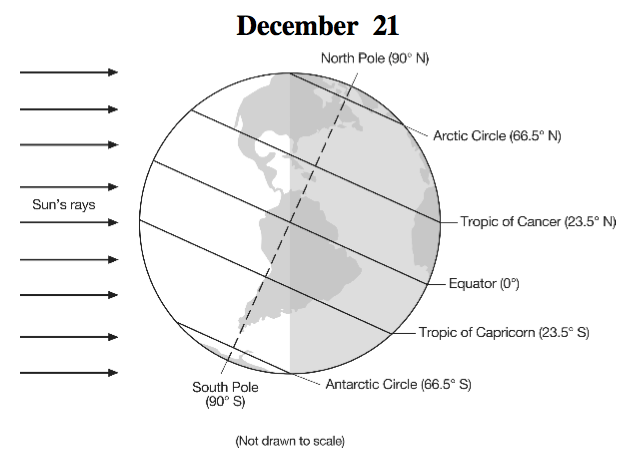
What day of the year is represented by the image shown?

a)

Dec 21

b)

Mar 21

c)

Jun 21

d)

Sept 21

7.
What day of the year is represented by the image shown?
a)
Dec 21
b)
Mar 21
c)
Jun 21
d)
Sept 21
8.

Which location is likely to have the highest angle of insolation at the position shown in the diagram?

a)

Canada

b)

Maryland

c)

Equator

d)

Brazil

9.
What day of the year is represented by the image shown?
a)
Dec 21
b)
Mar 21
c)
Jun 21
d)
Sept 21
10.

What line of latitude gets a direct angle of insolation on the date shown?

a)

Arctic Circle (66.5°N)

b)

Tropic of Cancer (23.5°N)

c)

Equator (0°)

d)

Tropic of Capricorn (23.5°S)

11.
Very cold climates occur at Earth’s North and South Poles because the polar regions
a)
are usually farthest from the Sun
b)
absorb the greatest amount of insolation
c)
receive the most hours of daylight
d)
receive low-angle insolation
12.

On which day of the year would the angle of insolation at Hagerstown, MD, most likely be greatest?

a)

March 21

b)

June 21

c)

September 21

d)

December 21

13.
What is the primary reason the United States is warmer in July than in February?
a)
The Earth is traveling faster in its orbit in February.
b)
The altitude of the noon Sun is greater in February.
c)
The insolation in the United States is greater in July.
d)
The Earth is closer to the Sun in July.
14.
In New York State, the risk of sunburn is greatest between 11 a.m. and 3 p.m. on summer days because
a)
The air temperature is hot
b)
The angle of insolation is high
c)
Earth's surface reflects most of the sunlight
d)
The Sun is closest to the Earth
15.
What factor has the greatest influence on the number of daylight hours a particular location receives?
a)
latitude
b)
longitude
c)
diameter of the Sun
d)
distance from the Sun
16.

What is season is it in the southern hemisphere?

a)

summer

b)

fall

c)

winter

d)

spring

17.

What is season is it in the southern hemisphere?

a)

summer

b)

fall

c)

winter

d)

spring

18.

What season would be have at position B?

a)

Spring

b)

Summer

c)

Fall

d)

Winter

19.

Where is the angle of insolation highest on December 1st?

a)

Equator

b)

Above the Equator

c)

Below the Equator

d)

At the North Pole

20.

Earth's axis is tilted at -

a)

23.5 degrees

b)

45 degrees

c)

75 degrees

d)

90 degrees

21.
The Earth's _______ is an imaginary line that goes from the North Pole to the South Pole.
a)
vernal equinox
b)
axis
c)
solar eclipse
d)
solar flare
22.

Which season is taking place in the Northern Hemisphere in Position 2?

a)

Spring

b)

Summer

c)

Fall

d)

Winter

23.

Summer is when the Earth is closest to the Sun.

a)

TRUE

b)

FALSE

24.

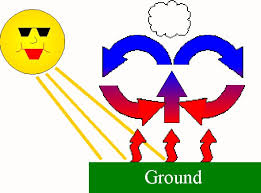
The process in which warm air rises and the cool air sinks.

a)

conduction

b)

convection

c)

radiation

25.

Winters in Maine are cold and snowy.

a)

Climate

b)

Weather

26.
Changes from minute-to-minute, hour-to-hour, day-to-day
a)
Climate
b)
Weather
27.
A tornado warning was issued for Kansas City this morning.
a)
Climate
b)
Weather
28.
Texas has long, hot summers.
a)
Climate
b)
Weather
29.
What is climate?
a)
 What's going on with the atmosphere at any particular time
b)
The type of weather that occurs during a particular season
c)
An area's pattern of weather over a long period of time
d)
How much sunshine an area gets 
30.
Which weather tool measures temperature?
a)
thermometer
b)
barometer
c)
psychrometer
d)
anememeter
31.
This weather tool measures wind speed and direction
a)
thermometer
b)
barometer
c)
anemometer
d)
psychrometer
32.
The amount of moisture (water vapor) in the air
a)
Barometer
b)
Humidity
c)
Rain gauge
d)
Evaporation
33.
The conditions of the atmosphere at a certain time and place. 
a)
weather
b)
climate
c)
precipitation
d)
atmosphere
34.
An instrument that measures air pressure
a)
thermometer
b)
barometer
c)
rain guage
d)
wind sock
35.
The layer of the atmosphere where weather occurs is the _.
a)
thermosphere
b)
stratosphere
c)
mesosphere
d)
troposphere
36.
An anemometer is used to measure...
a)
air pressure
b)
humidity
c)
precipitation
d)
wind speed
37.
What does the picture show?
a)
climate
b)
weather 
38.
What does the picture show?
a)
climate
b)
weather 
39.
What is the name of this tool?
a)
Barometer
b)
Hygrometer
c)
Rain Gauge
d)
Thermometer
40.
A high pressure system means we might have this weather.
a)
Snow blizzard
b)
Sunny and dry
c)
Rain storm
d)
Tornado
41.
A low pressure system means we might have this weather.
a)
Sunny 
b)
A clear sky
c)
Dry day
d)
Stormy or wet
42.
Which is not a factor that affects climate?
a)
altitude
b)
latitude
c)
lakes and oceans
d)
living organisms
43.

Which provides clues to the climate of the distant past

a)

rocks along ocean coastlines

b)

air in caves and deep holes

c)

water samples from the ocean holes

d)

air pockets in ice cores

44.
Because Earth's axis is _________________, the hemispheres receive different amounts of solar energy at different times.
a)
straight
b)
titled
c)
bent
d)
not there
45.
Scientists observe the thickness of a tree's _________ to learn about past climate conditions.
a)
rings
b)
branches
c)
roots
d)
bark
46.
Which BEST describes why latitudes closest to the equator have warmer climates?
a)
they are at lower elevations
b)
they receive more solar energy
c)
they are nearer to ocean currents
d)
they get more winds that carry energy in the form of heat
47.
___________is the result of the weight of a column of air pushing on an area.
a)
air pressure
b)
density
c)
volume
d)
none of the above
48.
As you climb up a mountain what happens to the air pressure?
a)
decreases
b)
increases
c)
stays the same
49.
Winds are caused by differences in
a)
precipitation
b)
humidity
c)
air pressure
d)
turbulence
50.
The ________ the difference in pressure, the __________ the wind speed.
a)
greater, slower
b)
less, faster
c)
greater, faster
51.
At the equator the air is usually ________.
a)
rising
b)
sinking
52.
At the poles, air is usually ________.
a)
rising
b)
sinking
53.
If you wanted to visit an area with very little wind, where might you go? 
a)
The doldrums around the equator
b)
the jet streams in the northern and southern hemisphere 
c)
the North or South Pole 
d)
the area around the Mediterranean Sea 
54.
Areas with low pressure generally have...
a)
 Sunny weather
b)
Precipitation
c)
Dry weather
d)
Cold Weather
55.
Which most likely produces clear, cool weather?
a)
zero air pressure
b)
stable air pressure
c)
a low pressure system
d)
a high pressure system
56.
Why does warm air rise?
a)
Warm air is more dense than cooler air.
b)
Warm air has more pressure than cooler air.
c)
Warm air is less dense than cooler air.
d)
Warm air has a higher dew point than cooler air.
57.
Meteorologist look at differences in air pressure when they are trying to predict the weather.  Why do these differences occur?
a)
The sun heats different places at different rates
b)
Volcanoes add different amounts of heat & gas to the air in different places
c)
Earth's rotation makes different places move at different speeds
d)
Moon's gravity has a different strength at different places
58.

Why do we experience the changing of the season on the earth?

a)

distance from the sun

b)

rotation of the earth

c)

change in solar output

d)

tilt of the earth's axis

59.
Which season is taking place in the Northern Hemisphere in Position 3?
a)
Winter
b)
Spring
c)
Summer
d)
Fall
60.

At the equator, air is warmer. This causes the air to ____ and the pressure to be ____.

a)

Sink, Low

b)

Sink, High

c)

Rise, Low

d)

Rise, High