
 Worksheets
ESS - U2L5 - Earth's Changing Surface
Total questions: 15
Worksheet time: 17mins


What type of rock do fossils form in?
Igneous
Metamorphic
Sedimentary

What is the FIRST step of forming fossils?
Organism dies
Sediment covers organism & soft parts decay
Sediment turns to sedimentary rock preserving parts of organism

What is the SECOND step of forming fossils?
Organism dies
Sediment covers organism & soft parts decay
Sediment turns to sedimentary rock preserving parts of organism

What is the THIRD step of forming fossils?
Organism dies
Sediment covers organism & soft parts decay
Sediment turns to sedimentary rock preserving organism's imprint and/or remnant

Which kind of plate movement is shown in the image?
uplift
subduction
diveregent
lateral slipping

Which geological feature(s) is observed in the image?
fault
rock strata
dike
sill

Magma that forces itself across rock layers and hardens is called a _________.
volcanic neck
sill
dike
batholith

Magma that squeezes between horizontal rock layers and hardens is called a ______.
volcanic neck
dike
sill
lava plateau

Fossils help scientists date rocks.
True
False
Younger sedimentary rock layers can be found beneath older rock layers.
True
False

The Precambrian period is also referred to as the cryptozoic period because so few fossils have been found so the organisms living at that time are mostly unknown.
True
False
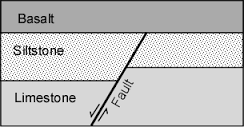
What are the relative ages of the features in order from oldest to youngest?
Limestone, Basalt, Fault, Siltstone
Siltstone, Fault, Basalt, Limestone
Limestone, Fault, Basalt, Siltstone
Limestone, Siltstone, Fault, Basalt

Of the answer choices provided, which is the oldest?
Layer L
Intrusion D
Intrusion H
Layer E


