
 Worksheets
The Water Cycle and Watershed
Total questions: 26
Worksheet time: 25mins
Name
Class
Date
1.
What is the energy source for the water cycle?
a)
the sun
b)
the earth
c)
water
d)
the moon
2.

What is the water cycle?
a)
the 3 forms of water
b)
the movement of water on, above, or below the surface of the Earth
c)
when water melts
d)
when clouds form
3.
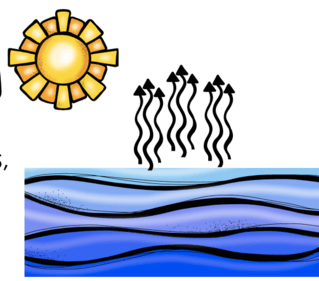
What part of the water cycle does this picture show?
a)
condensation
b)
precipitation
c)
evaporation
4.
What is evaporation?
a)
The part of the water cycle when the sun heats up water, turning it from a liquid into water vapor or steam. It rises from the ground into the air.
b)
The part of the water cycle when the water vapor in the air gets cold. The water turns back into a liquid and forms clouds.
c)
The part of the water cycle when clouds get heavy and can no longer hold the liquid water. This causes the water to fall from the sky to the earth as rain, snow, sleet, or hail.
5.
What is condensation?
a)
The part of the water cycle when the sun heats up water, turning it from a liquid into water vapor or steam. It rises from the ground into the air.
b)
The part of the water cycle when the water vapor in the air gets cold. The water turns back into a liquid and forms clouds.
c)
The part of the water cycle when clouds get heavy and can no longer hold the liquid water. This causes the water to fall from the sky to the earth as rain, snow, sleet, or hail.
6.

When water condenses, the water vapor in the air gets ___________ and changes back into liquid.
a)
cold
b)
hot
c)
warm
d)
solid
7.
Which best explains why runoff is important?
a)
It returns water to other locations on Earth
b)
It increases the chance of flooding
c)
It makes evaporation occur faster
d)
It increases condensation
8.

What is it called when plants give off water vapor as a waste product?
a)
condensation
b)
evaporation
c)
sublimation
d)
transpiration
9.
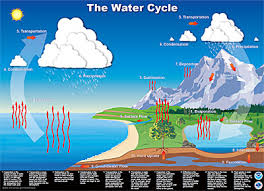
During which stage do clouds form?
a)
condensation
b)
evaporation
c)
precipitation
10.
What is the process during which water cools and turns from a gas to a liquid?
a)
Codensation
b)
Runoff
c)
Precipitation
d)
Evaporation
11.
The first step in the water cycle
a)
evaporation
b)
condensation
c)
precipitation
d)
there is no first step
12.

After the rain falls down onto Earth's surface, what most likely happens?
What is it called?
What is it called?
a)
1. The remains of the water is soaked into the ground.
2.Groundwater
2.Groundwater
b)
1. Groundwater
2. The remains of the water is soaked into the ground.
2. The remains of the water is soaked into the ground.
c)
1. Groundwater
2. Transpiration happens to the plants.
2. Transpiration happens to the plants.
d)
1. The liquid turns into a gas or water vapor
2. Evaporation
2. Evaporation
13.

The health of an ecosystem is directly related to the:
a)
Air quality
b)
Amount of animals in the area
c)
Water quality
d)
Amount of food in the area
14.

What is all the water that runs off the surface of the land and washes into rivers, streams, and other waterways called?
a)
Runoff
b)
Storm Drain
c)
Surface Water
d)
Tributary
15.
What is a stream or river that feeds into a larger body of water?
a)
Tributary
b)
Estuary
c)
Bay
d)
Watershed
16.
The use of pesticides and fertilizers must be carefully monitored
because of the effect they can have on the environment.
Which of the following is a possible negative effect of the use
of these chemicals on the environment?
because of the effect they can have on the environment.
Which of the following is a possible negative effect of the use
of these chemicals on the environment?
a)
Runoff carries these chemicals into lakes and streams.
b)
Theses chemicals cannot be purchased in large bulk.
c)
These chemicals are expensive to produce.
These chemicals are expensive to produce.
d)
Storage space for these chemicals is limited.
17.

What is a river?
a)
A large body of freshwater
b)
A saltwater inlet of the ocean
c)
A natural large stream of flowing freshwater
d)
An underground waterway
18.
An area of permeable layer of rock or soil that holds a large amount of water in the saturated zone is called what?
a)
Aquifer
b)
Spring
c)
Well
d)
Reservoir
19.
The water that fills lakes and rivers
a)
groundwater
b)
surface water
c)
water table
d)
saturated zone
20.
Water stored in cracks and pores below the Earth's surface is called:
a)
Groundwater
b)
Bogs
c)
Water in the ground
d)
surface water
21.
Pollution has ___________
a)
a negative human impact
b)
positive human impact
c)
humans have no impact
22.
Your parent(s) made you wash his/her car. As you rinsed the soap off of the surface of the car, you watched as it streamed off onto the ground like a river. Of what part of the water cycle could this be an example?
a)
Condensation
b)
Percolation
c)
Infiltration
d)
Run-off
23.

If gasoline or oil or trash goes into a storm drain in the street, it goes directly...
a)
to the sewage treatment plant
b)
into the stream
c)
to groundwater
d)
none of the above
24.

The illustration provided shows a river and four cities on that river. When the water from the river was sampled at location X, it was determined to be polluted with various chemicals. What would be the most likely source for this pollution?
a)
City 1 and City 2
b)
City 2 and City 3
c)
City 3 and City 4
d)
City 1 and City 4
25.
Overflow during a heavy rainstorm from a wastewater treatment plant would result in -
a)
over-treated drinking water.
over-treated drinking water.
b)
flooding in the local aquifer.
flooding in the local aquifer.
c)
polluted runoff into nearby ponds.
d)
weakened housing foundations.
26.
Why is gravity a factor in watersheds?
a)
it causes the water to flow away from a watershed
b)
it causes the water to flow towards a watershed
100 %

