
NEW
Font size
S
M
L
XL
 Worksheets
8th grade science AIR review
Total questions: 55
Worksheet time: 2hrs 7mins
Name
Class
Date
1.

Which layer of Earth is located above the outer core?
a)
crust
b)
inner core
c)
mantle
d)
lithosphere
2.
Which best describes the asthenosphere?
a)
molten metal
b)
dense, solid metal ball
c)
solid that flows
d)
dry land and ocean floor
3.
Pressure ______________________ as you go deeper into the Earth
a)
increases
b)
decreases
c)
goes up or down depending on the layer
d)
stays the same
4.
What is the rigid layer of the Earth's surface made up of the crust and upper mantle called?
a)
asthenosphere
b)
lithosphere
c)
mesosphere
d)
continental crust
5.
Heat transfer within a fluid takes place by...
a)
convection currents
b)
radiation
c)
conduction
d)
density
6.
When the heat source is removed from a fluid, convection currents in the fluid will
a)
speed up.
b)
change direction.
c)
eventually stop.
d)
continue at the same rate forever.
7.
What are the two kinds of crust?
a)
lithospheric and asthenospheric
b)
silicon based and iron based
c)
continental and oceanic
d)
outer and inner
8.
The type of plate boundary where two plates come together is a .....
a)
Convergent Boundary
b)
Divergent Boundary
c)
Transform Boundary
d)
Plate Boundary
9.
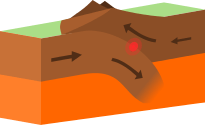
What type of plate boundary is this?
a)
Plate
b)
Divergent
c)
Convergent
d)
Transform
10.

What type of event will occur at this boundary?
a)
Earthquake
b)
Volcano Eruption
c)
Tornado
d)
Mountain Building
11.
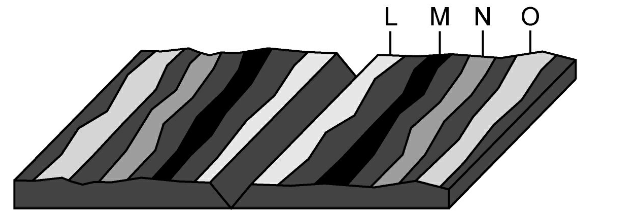
Where would the oldest rock be found?
a)
L
b)
M
c)
N
d)
O
12.
How is it possible for new crust to be formed without increasing the surface area of the Earth?
a)
Crust is destroyed at the same time it is created
b)
New crust is underwater where it sinks
c)
New crust breaks more easily than old crust
13.
The Great Rift Valley in Africa and the Mid-Ocean Ridge were all created by this boundary
a)
Divergent
b)
Convergent
c)
Reform
d)
Transform
14.
The Himalayas in Asia are an example of what type of plate boundary?
a)
divergent
b)
continent-to-continent convergent
c)
ocean-to-continent convergent
d)
transform
15.
Continental crust is more dense than oceanic crust.
a)
True
b)
False
16.
A fossil's location in the Earth's strata can help us know if it is older or younger than other fossils found in the strata.
a)
True
b)
False
17.

The presence of the same ________ on several continents supports the idea of continental drift.
a)
rocks
b)
fossils
c)
both fossils and rocks
d)
neither fossils nor rocks
18.

Matching ________ on different continents are evidence for continental drift.
a)
weather systems
b)
river systems
c)
rock structures
d)
wind systems
19.

Many scientists think hot plastic-like rock in the mantle is forced upward toward the surface, cools, and sinks. This process is called a(n) _________.
a)
earthquake
b)
convergent boundary
c)
volcano
d)
convection current
20.
What is the process that picks up and moves weathered rocks?
a)
deposition
b)
landslide
c)
weathering
d)
erosion
21.
Sarah does the investigation described below using a model to study how rivers erode earth materials.
· She pours 600 mL of sand onto a plate.
· She pours 150 mL of water onto the pile of sand.
· She measures how much of the sand washes off the edge of the plate.
· She notices that less sand washes off the plate when she pours water slowly than when she pours it faster.
How is the model similar to real rivers eroding earth materials?
· She pours 600 mL of sand onto a plate.
· She pours 150 mL of water onto the pile of sand.
· She measures how much of the sand washes off the edge of the plate.
· She notices that less sand washes off the plate when she pours water slowly than when she pours it faster.
How is the model similar to real rivers eroding earth materials?
a)
The model shows that faster-moving
water makes sand stick to the bottom of a river.
b)
The model shows that slower-moving
water makes sand float to the top of a river.
c)
The model shows that slower-moving water
erodes less earth materials than faster-moving water.
d)
The model shows that faster-moving
water erodes less earth materials than slower-moving water.
22.
The Law of Superposition helps scientists to determine what?
a)
The absolute age of rock layers
b)
The age of fossils
c)
The relative age of rock layers
d)
the super powers of rocks
23.

The gradual change in species over time is...
a)
Evolution
b)
Nucleotide
c)
Adaptation
d)
Natural Selection
24.

Darwin wrote that organisms with traits that are best suited to the environment will ________________
a)
increase in number
b)
become extinct
25.
Darwin referred to this as survival of the fittest. Over time, it results in changes in the inherited characteristics of a population because organisms with adaptations that make them fit for their environment will survive and reproduce better than those without favorable traits.
a)
Natural Selection
b)
Genetic Variation
c)
Survival of the Fittest
26.

what did Charles Darwin observe in finch populations of the Galapagos Islands off the coast of South America?
a)
different species on different islands
b)
all species on one of the islands
c)
identical species on all the islands
d)
the same species as North America
27.
States that younger rocks lie above older rocks if the layers have not been disturbed
a)
Law of crosscutting
b)
Law of superposition
c)
Relative Dating
d)
Unconformity
28.
An ordered arrangement of rock layers that is based on the relative ages of the rocks
a)
Superposition
b)
Unconformity
c)
Layered
d)
Geologic Column
29.
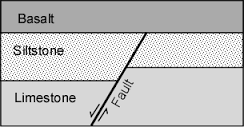
What are the relative ages of the features in order from oldest to youngest?
a)
Limestone, Basalt, Fault, Siltstone
b)
Siltstone, Fault, Basalt, Limestone
c)
Limestone, Fault, Basalt, Siltstone
d)
Limestone, Siltstone, Fault, Basalt
30.

According to the law of superposition, the oldest fossils are found
a)
At the top of the rock layers
b)
Near the bottom of the rock layers
c)
In the middle of the rock layers
d)
Somewhat near the surface
31.
The cells produced via meiosis are called:
a)
sex cells
b)
somatic cells
c)
body cells
d)
skin cells
32.
A human usually has xx amount of chromosomes.
a)
6
b)
22
c)
4
d)
46
33.
B=brown eyes
b= blue eyes
What is true about two brothers that have brown eyes?
One has genotype BB the other Bb.
b= blue eyes
What is true about two brothers that have brown eyes?
One has genotype BB the other Bb.
a)
they have same phenotype and genotype
b)
they have different genotypes and phenotypes
c)
they have same phenotype but different genotypes
d)
they have same genotype but different phenotypes
34.
A dog gives birth to 5 puppies. What percentage of the chromosomes does each puppy share with the mother?
a)
25%
b)
50%
c)
75%
d)
100%
35.
What does heterozygous mean?
a)
An organism that has the same genes for a trait (TT or tt)
b)
An organism that has different genes for a trait (Tt)
c)
When neither gene is fully dominant; offspring is a mixture of both
d)
the different forms of a trait (hair color--> brown, blonde, red
36.
If a heterozygous tall pea plant is crossed with a short pea plant, what are the possible genotypes of the future offspring?
a)
100% Tt
b)
50% Tt, 50% tt
c)
75%Tt, 25%tt
d)
25%TT, 50%Tt, 25%tt
37.

A heterozygous yellow pea plant's genotype would be:
a)
YY
b)
yy
c)
Yy
d)
Yg
38.
What is one advantage of sexual reproduction?
a)
offspring are identical to parents
b)
offspring are resistant to viruses
c)
offspring are born live, rather thna from eggs
d)
offspring inherit a wider variety of genetic information
39.
An organism's appearance is known as its
a)
heredity
b)
phenotype
c)
genotype
d)
pedigree
40.

Genotype refers to the ...
a)
physical expression of the genes
b)
the possible combination of alleles in a gene
c)
whether an allele is dominant or recessive
d)
how an organism will appear
41.
Which of the following is a phenotype?
a)
BB
b)
Bb
c)
bb
d)
Blue eyes
42.
In asexual reproduction, all of the offspring are:
a)
Physically Identical
b)
Genetically Identical
c)
Physically and Genetically Identical
d)
Not Identical
43.
the tendency of an object to resist a change in its motion
a)
acceleration
b)
inertia
c)
mass
d)
frame of reference
44.

How many generations are shown in this pedigree?
a)
1
b)
2
c)
3
d)
4
45.

In the second generation-how many people are carriers of the trait?
a)
2
b)
3
c)
5
d)
6
46.
In plants, tall (T) is dominant to short (t). Perform the following cross: Tt x Tt. What is the probability of producing a short plant?
a)
0%
b)
25%
c)
50%
d)
75%
47.
In a heterozygous genotype, the ___________ allele takes over in the phenotype.
a)
recessive
b)
dominant
c)
lower case letter
d)
both
48.
the passing of genetic traits from parent to offspring.
a)
heredity
b)
trait
c)
gene
d)
allele
49.

Balanced or unbalanced?
a)
balanced
b)
unbalanced
50.
A rightward force is applied to a dresser to accelerate it to the right across the bedroom floor.
a)
b)
c)
d)
51.

What is the net force
a)
10 N
b)
0 N
c)
25 N
d)
1 N
52.

What is the net force?
a)
40 N left
b)
0 N Balalnced
c)
400 N right
d)
40 N right
53.
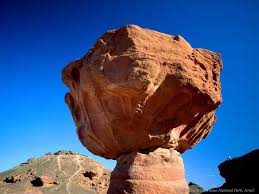
The process that breaks down rocks and other materials on Earth's surface is called
a)
Weathering
b)
Erosion
c)
Deposition
d)
Decomposition
54.
How would you expect the sizes of sediments deposited on a mountain to compare to those deposited downriver?
a)
Larger
b)
Smaller
c)
The same
d)
It is impossible to predict
55.
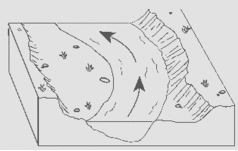
The diagram below shows a section of a meander in a stream. The arrow shows the direction of stream flow. The stream bank on the outside of this meander is steeper than than the stream bank on the inside of this meander because the water on the outside of the meander is moving
a)
Slower, causing deposition
b)
Faster, causing deposition
c)
Slower, causing erosion
d)
Faster, causing erosion
Reset

