
 Worksheets
8th grade review
Total questions: 178
Worksheet time: 5hrs 37mins
Name
Class
Date
1.
y + 6 = 20
a)
y = 22
b)
y = 13
c)
y = 14
d)
y = 16
2.
x - 10 = 12
a)
22
b)
-22
c)
2
d)
-2
3.
12 + z = 15
a)
-3
b)
3
c)
-27
d)
27
4.
2 + n =16
a)
18
b)
-18
c)
14
d)
-14
5.
a + 4 = 14
a)
-10
b)
10
c)
-18
d)
18
6.
m - 5 = -10
a)
-15
b)
15
c)
-5
d)
5
7.
4 + b = 30
a)
-34
b)
34
c)
-26
d)
26
8.
x - 60 = 20
a)
-80
b)
80
c)
-40
d)
40
9.
g - 16 = 4
a)
-12
b)
12
c)
-20
d)
20
10.
x - 15 = -20
a)
-5
b)
5
c)
-35
d)
35
11.
8v - 4(v + 8) = 8
a)
2
b)
10
c)
4
d)
-4
12.
2x - 3 + 4x = 27
a)
12
b)
4
c)
5
d)
15
13.
5x - 4 + 2x = 3
a)
1
b)
2
c)
3
d)
4
14.
3x + 2(4x - 4) = 3
a)
4
b)
3
c)
2
d)
1
15.
2x + 3(5x - 7) = 47
a)
1
b)
2
c)
3
d)
4
16.
-11 + 3(b + 5) = 7
a)
1
b)
-1
c)
3
d)
-3
17.
-(n - 8) = -2
a)
6
b)
10
c)
-10
d)
-6
18.
4x + 10 = -26
a)
4
b)
-4
c)
-9
d)
9
19.
5x - 4 + 2x = 3
a)
1
b)
2
c)
3
d)
4
20.
3x + 2(4x - 4) = 3
a)
4
b)
3
c)
2
d)
1
21.

a)
A
b)
B
c)
C
d)
D
22.
Solve.
(x/4) + 10 = 34
(x/4) + 10 = 34
a)
x = 4
b)
x = 6
c)
x = 96
d)
x = 144
23.

Solve.
(2x - 3) / 4 = 9
(2x - 3) / 4 = 9
a)
x = 24
b)
x = 12
c)
x = 17.5
d)
x = 19.5
24.
2x = x + 3
a)
6
b)
3
c)
2
d)
x
25.
7x = 3x + 24
a)
6
b)
10
c)
14
d)
4
26.
30 + 6t = 11t
a)
3
b)
5
c)
6
d)
30
27.
5 - 2t = 3t
a)
1
b)
5
c)
3
d)
2
28.
What letter represents the slope in the equation y = mx + b ?
a)
x
b)
y
c)
m
d)
b
29.
In the following equation, what is the y-intercept?
y = -3x + 7
y = -3x + 7
a)
-3
b)
7
c)
-3/7
d)
3
30.
What is the slope in the equation: y=4x+3
a)
3
b)
4x
c)
4
d)
x
31.
If m=3 and b=6, what is the correct slope intercept equation?
a)
y=3-6
b)
y=3x-6
c)
y=3x+6
d)
y=6x+3
32.
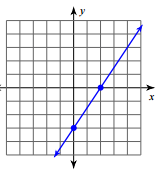
Find the slope.
a)
3/2
b)
-3/2
c)
(-0,-3)
d)
none of the above
33.

What type of slope does the following graph have?
a)
Postive
b)
Negative
c)
Zero Slope
d)
Undefined
34.
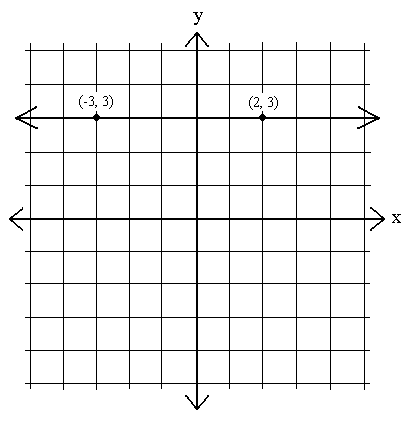
What type of slope does the graph have?
a)
Zero
b)
Undefined
c)
Negative
d)
Positive
35.
Find the slope of the line that passes through (10, -8) and (1, 12).
a)
20/9
b)
-20/9
c)
4/9
d)
9/4
36.
Find the slope of the line that passes through the points (2, 4) and (6, 12)
a)
1/2
b)
-1/2
c)
2
d)
-2
37.
Find the slope of the line that passes through the points (2, 4) and (6, 12)
a)
1/2
b)
-1/2
c)
2
d)
-2
38.
Write in slope intercept form
5x - 3y = -9
5x - 3y = -9
a)
y = (5/3)x - 3
b)
y = (5/3)x + 9
c)
y = (5/3)x + 3
d)
y = (3/5)x + 3
39.
Write in slope-intercept form:
-3x + 4y = 12
-3x + 4y = 12
a)
y = 3/4x + 3
b)
y = -3/4 x + 3
c)
y = -4x + 3
d)
y = 4x + 3
40.
Slope is know as rise/
a)
run
b)
fall
c)
none
d)
rise
41.

What type of slope does the graph have?
a)
Positive
b)
Negative
c)
Zero Slope
d)
Undefined
42.
What type of slope does the graph have?
a)
Zero
b)
Undefined
c)
Negative
d)
Positive
43.
In the equation y=mx+b, what does the m represent?
a)
slope
b)
y-intercept
c)
linear
d)
point-slope
44.
Find the slope of the line that passes through (10, -8) and (1, 12).
a)
20/9
b)
-20/9
c)
4/9
d)
9/4
45.
What is the slope in the equation y=2x + 3?
a)
2
b)
3
c)
5
d)
Cannot be Determined
46.
For the equation
y - 3 = 2(x + 4),
the line has a slope of 2 and contains what point?
y - 3 = 2(x + 4),
the line has a slope of 2 and contains what point?
a)
(-4, 3)
b)
(3, -4)
c)
(-3, -4)
d)
(-4, -3)
47.
For the equation
y + 1 = -3(x - 5),
the line contains the point (5, -1) and has a slope of?
y + 1 = -3(x - 5),
the line contains the point (5, -1) and has a slope of?
a)
-1
b)
1
c)
-3
d)
5
48.
Write the equation in point-slope form of the line that passes through the given point and has the given slope.
(4, -7); m = -1/4
(4, -7); m = -1/4
a)
y + 7 = -1/4(x - 4)
b)
y - 4 = -1/4(x + 7)
c)
y + 7 = 4(x - 4)
d)
y - 7 = -1/4(x - 4)
49.
Write the equation in point-slope form of the line that passes through the given point and has the given slope:
(-2, -1); m= -3
(-2, -1); m= -3
a)
y + 1 = -3(x - 2)
b)
y + 1 = -3(x + 2)
c)
y - 1 = 3(x - 1)
d)
y + 2 = -3(x + 1)
50.
Write the equation in point-slope form of the line that passes through the given point and has the given slope:
(-2, -1); m= -3
(-2, -1); m= -3
a)
y + 1 = -3(x - 2)
b)
y + 1 = -3(x + 2)
c)
y - 1 = 3(x - 1)
d)
y + 2 = -3(x + 1)
51.
-13t > 26
a)
t > -2
b)
t > 2
c)
t < 2
d)
t < -2
52.
8(m + 2)< 4(5 + 2m)
a)
no solution
b)
m < -2
c)
all real numbers
d)
m > 4
53.
6 - 2h > 30
a)
h < 24
b)
18 > h
c)
h > 12
d)
h < -12
54.
-7 + 10z > -27
a)
z < -2
b)
z > -34
c)
2 > z
d)
z > -2
55.
Solve:
6x+10>5x-12
6x+10>5x-12
a)
x>2
b)
x<2
c)
x<-22
d)
x>-22
56.

a)
A)
b)
B)
c)
C)
d)
D)
57.

a)
A)
b)
B)
c)
C)
d)
D)
58.

Which of the following inequalities matches the given graph?
a)
x ≥ -1
b)
x ≤ -1
c)
x > -1
d)
x < -1
59.
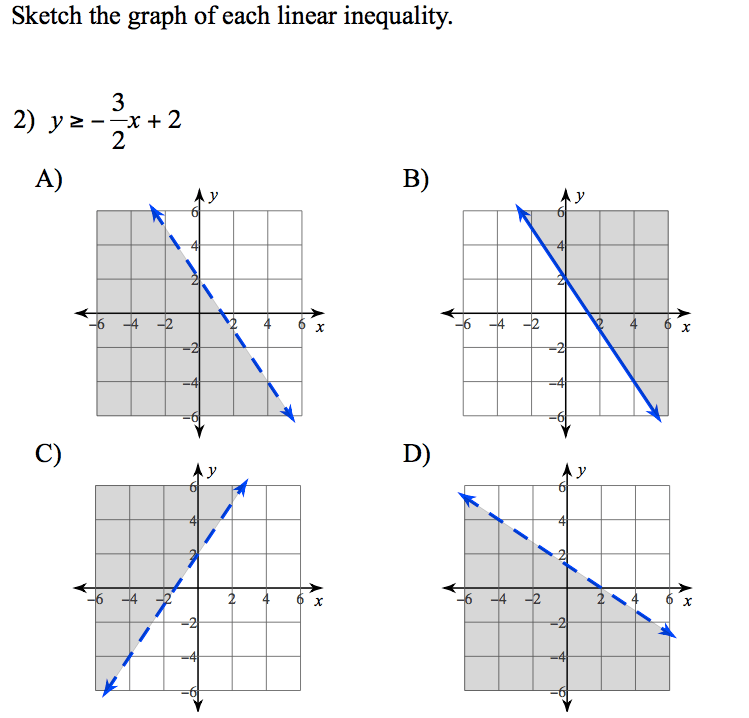
a)
A
b)
B
c)
C
d)
D
60.
Write the inequality in slope-intercept form:
-10x + 2y > 14
-10x + 2y > 14
a)
y < 10x + 12
b)
y > 10x + 7
c)
y < 5x + 7
d)
y > 5x + 7
61.
Write the inequality in slope-intercept form:
5x - y ≤ 16
5x - y ≤ 16
a)
y ≤ 5x + 16
b)
y ≤ 5x - 16
c)
y ≥ 5x + 16
d)
y ≥ 5x - 16
62.
Identify the quadrants included in the solution to:
y ≥ -3x + 4
y ≥ -3x + 4
a)
Quadrants I, II, and III
b)
Quadrants I, II, and IV
c)
Quadrants I and II
d)
Quadrants I and IV
63.
Identify the quadrants included in the solution to:
x - y ≤ 1
x - y ≤ 1
a)
Quadrants I, II, and III
b)
Quadrants I, III, and IV
c)
Quadrants I, II, III, and IV
d)
Quadrants I and II
64.
If a system of equations has no solution, what does the graph look like?
a)
intersecting lines
b)
parallel lines
c)
skew lines
d)
intersecting lines
65.
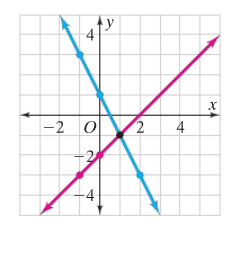
What is the solution?
a)
(1, -1)
b)
(-1, 1)
c)
(0, -2)
d)
(0, 1)
66.

How many solutions does this system of equations have?
a)
One Solution
b)
No solution
c)
Infinitely Many Solutions
d)
Two Solutions
67.
Solve for x and y
3x + 2y = 16
7x + y = 19
3x + 2y = 16
7x + y = 19
a)
(-2,5)
b)
(-2,-5)
c)
(2,-5)
d)
(2,5)
68.
If a system of linear equations has one solution, what does this mean about the two lines?
a)
Parallel lines
b)
the same line
c)
Intersecting lines
69.
Solve using substitution.
x - 2y = 2
3x + 4y = 3
x - 2y = 2
3x + 4y = 3
a)
(1.4, -0.3)
b)
(3.1, 5)
c)
(-2.5, 3.5)
d)
(6.9, 1.02)
70.

This system has _____ solutions
a)
0
b)
1
c)
2
d)
Infinitely many
71.
Find the solution to the system of equations:
3x + 2y = 16
y = -7x + 19
3x + 2y = 16
y = -7x + 19
a)
(-2,5)
b)
(-2,-5)
c)
(2,-5)
d)
(2,5)
72.
y = -6x + 5
-2x + y = 5
-2x + y = 5
a)
(-3, -6)
b)
(-6, 3)
c)
(0, 5)
d)
(-3, 5)
73.
A system of linear equations is...
a)
Math Magic
b)
One Equation
c)
Always more than 2 equations
d)
A set of 2 or more equations
74.
Determine if (4, 1) is a solution for the system of equations.
y = -x + 5
y = 2x - 7
y = -x + 5
y = 2x - 7
a)
yes
b)
no
75.
Solve the system of equations by elimination.
-x + y = -13
-8x - 4y = -8
-x + y = -13
-8x - 4y = -8
a)
(5, 8)
b)
(5, -8)
c)
(-5, -18)
d)
(-5, 8)
76.
Which of the following are ways to solve systems of equations?
a)
Graphing
b)
Substitution
c)
Elimination
d)
All of the above
77.
Solve the system by elimination.
−4x − 4y = 0
4x + 4y = 0
−4x − 4y = 0
4x + 4y = 0
a)
(−6, −4)
b)
Infinite number of solutions
c)
(−6, 10)
d)
(6, 4)
78.
Solve the system of equations by substitution.
y = -4x + 5
y = 3x - 16
y = -4x + 5
y = 3x - 16
a)
(-3, -25)
b)
(3,-7)
c)
(11, 17)
d)
(21, 47)
79.
Solve for x and y.
y = 2/3x - 2
y = -x + 3
y = 2/3x - 2
y = -x + 3
a)
(0,3)
b)
(0,-3)
c)
(3,0)
d)
(-3,0)
80.
What is the solution to the system?
8x + 4y = 12
y = -2x + 3
8x + 4y = 12
y = -2x + 3
a)
(0,3)
b)
(3,0)
c)
No solution(parallel lines)
d)
Infinitely many solutions
81.
Solve the system of equations.
y = 4x+1
3x + 2y = 13
y = 4x+1
3x + 2y = 13
a)
(1, 5)
b)
(5, 1)
c)
(0.25, 2)
d)
∅
82.
Which set of values is a function?
a)
(9,5) (10,5) (9,-5) (10,-5)
b)
(3,4) (4,-3) (7,4) (3, 8)
c)
(6,-5) (7, -3) (8, -1) (9, 1)
d)
(2, -2) (5, 9) (5, -7) (1, 4)
83.
What is the definition of function?
a)
Has inputs and outputs
b)
Every input has only ONE output
c)
Inputs have different outputs every time
d)
x-values and y-values
84.
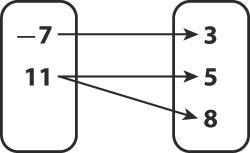
Is the relation a function? Why.
a)
Yes, because the x-value 11 has two y-values pair with it.
b)
Yes, because each x-value has only one y-value paired with it.
c)
No, because the x-value 11 has two y-values pair with it.
d)
No, because each x-value has only one y-value paired with it.
85.

a)
Function
b)
Not a Function
86.
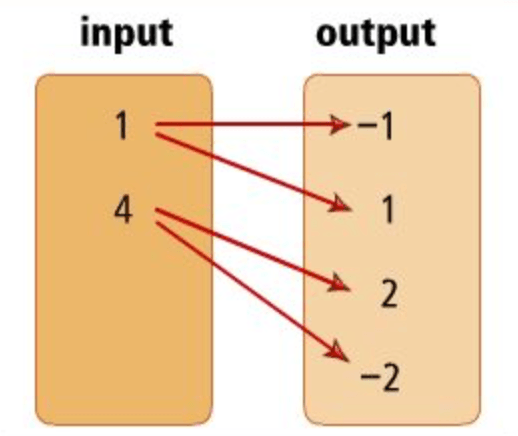
a)
Function
b)
Not a Function
87.
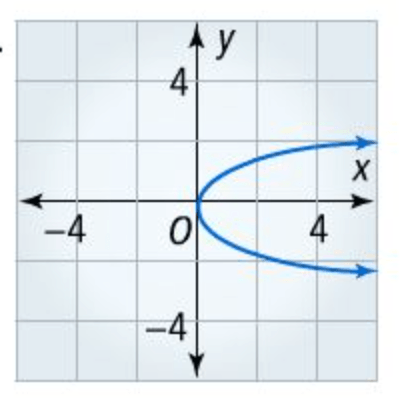
a)
Function
b)
Not a Function
88.
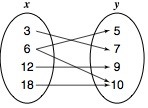
Is this mapping a function or not a function?
a)
Function
b)
Not a Function
89.
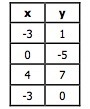
Is this table a function or not a function?
a)
Function
b)
Not a Function
90.

Is this table a function or not a function?
a)
Function
b)
Not a Function
91.

What is the domain of the graph?
a)
1≤ x ≤ 4
b)
1 < x < 4
c)
1≤ y ≤ 4
d)
1 < y < 4
92.
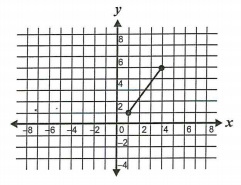
What is the range of the graph?
a)
1 ≤ x ≤ 5
b)
1 < x < 5
c)
1 ≤ y ≤ 5
d)
1 < y < 5
93.

Is this a function? Explain.
a)
Yes; it passes the horizontal line test.
b)
No; it is not a straight line.
c)
Yes; it passes the vertical line test.
d)
No; there is a line connecting the dots.
94.

a)
Function
b)
Not a Function
95.

a)
Function
b)
Not a Function
96.
If h(a) = 3 - 2a
Find h(-3).
Find h(-3).
a)
12
b)
-2
c)
-3
d)
9
97.
Given f(x) = -4x - 10 and f(x) = 10. Find x
a)
x = -5
b)
x = 5
c)
x = -50
d)
x = 30
98.
If f(x)=6x2-4,
what is f(0)?
what is f(0)?
a)
-4
b)
4
c)
0
d)
2
99.
If f(x)=6x2-4,
what is f(1)?
what is f(1)?
a)
13
b)
0
c)
12
d)
2
100.

What is x if
f(x) = -2?
f(x) = -2?
a)
4
b)
0
c)
3
d)
8
101.
The function h(t) represents the height in inches of a plant after t weeks. What does the notation h(4) = 5 mean?
a)
After 5 week the plant is 4 inches tall
b)
The plant grows at a rate of 5/4 inch per week
c)
After 4 weeks the plant is 5 inches tall
d)
The plant grows at a rate of 1 inch per week
102.
The function c(m) = 1.45m + 3.50 represents the cost of a taxi for m miles.
What does c(7) represent?
What does c(7) represent?
a)
A cost of $7 to ride the taxi
b)
The cost to ride 7 miles
c)
The minimum distance to ride a taxi
d)
The minimum cost of a taxi
103.

What is the domain of the graph?
a)
y≥1
b)
x ≥ 1
c)
All real numbers
d)
none of these
104.

What is the domain?
a)
x = 2
b)
−∞ < x < ∞
c)
y = 2
d)
none of these
105.

What is the range of the graph?
a)
y≥1
b)
x≥1
c)
All real numbers
d)
none of these
106.
√81
a)
9
b)
10
c)
8
d)
6
107.
√100
a)
15
b)
10
c)
11
d)
12
108.
√4
a)
3
b)
4
c)
2
d)
1
109.
√16
a)
4
b)
8
c)
2
d)
9
110.
√121
a)
12
b)
10
c)
11
d)
3
111.
√256
a)
14
b)
16
c)
13
d)
17
112.
√361
a)
18
b)
19
c)
16
d)
17
113.
52
a)
16
b)
25
c)
20
d)
10
114.
112
a)
132
b)
144
c)
121
d)
22
115.
(34)(37)
a)
328
b)
33
c)
3-3
d)
311
116.
(x8)(x-5)
a)
x-40
b)
x-13
c)
x13
d)
x3
117.
(58) / (53)
a)
55
b)
15
c)
511
d)
111
118.
(v-5) / (v-9)
a)
v-14
b)
v4
c)
1/v4
d)
1/v14
119.
(85)3
a)
88
b)
815
c)
82
d)
1/82
120.
(t-6)-5
a)
t-11
b)
t-30
c)
t30
d)
t11
121.
4-8
a)
18/4
b)
48/1
c)
4/18
d)
1/48
122.
x-42
a)
142/x
b)
x42/1
c)
x/142
d)
1/x42
123.
70
a)
71
b)
01
c)
1
d)
7
124.
(3x)0
a)
(3x)1
b)
01
c)
1
d)
3x
125.
Simplify
(3x3y5)4
(3x3y5)4
a)
3x12y20
b)
81x12y20
c)
12x12y20
d)
81x7y9
126.
Simplify
(2a2b4z)(6a3b2z5)
(2a2b4z)(6a3b2z5)
a)
8a5b6z6
b)
12a6b8z5
c)
12a5b6z6
d)
8a6b8z5
127.

a)
2a2b6
b)
1/2a2b6
c)
b6/2a2
d)
2b6/a2
128.
√28
a)
7√2
b)
7√4
c)
4√7
d)
2√7
129.
√24
a)
4√6
b)
2√6
c)
6√2
d)
2√12
130.
√96
a)
16√6
b)
2√6
c)
4√6
d)
√2
131.
√125
a)
5√5
b)
25√5
c)
5√25
d)
5√2
132.
In simplest radical form,
√75 is equivalent to
√75 is equivalent to
a)
25√3
b)
25√3
c)
5√3
d)
3√5
133.
Simplify the radical - 6√90
a)
10√8
b)
10√18
c)
18√10
d)
18√9
134.
Simplify the following radical: 2√24
a)
4√6
b)
2√6
c)
24√2
d)
4√4
135.
2√5 - √5 + 4√5 + √3
a)
6√5 + √3
b)
5√5 + √3
c)
6√5
d)
6√3
136.
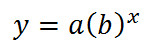
In an exponential function, what does the 'a' represent?
a)
SLOPE
b)
RATE OF CHANGE
c)
Y-INTERCEPT
d)
COMMON RATIO
137.
What is a, the starting term, for the function: f(x) = 300(1.16)x?
a)
300
b)
1.16
c)
.16
d)
x
138.
The value of a car is $15,000 and depreciates at a rate of 8% per year. What is the decay factor?
a)
.08
b)
1.08
c)
.92
d)
8
139.
Which of the following functions shows an initial amount of $15 and an increase of 35% each year?
a)
y = 15(35)x
b)
y = 15(1.35)x
c)
y = 15(0.35)x
d)
y = 35(1.15)x
140.
Classify the model as Exponential GROWTH or DECAY.
A=1200(.85)6
A=1200(.85)6
a)
Growth
b)
Decay
141.
Classify the model as Exponential GROWTH or DECAY.
A=10(1.01)3
A=10(1.01)3
a)
Growth
b)
Decay
142.

Is the pictured graph growth, decay, or linear or none?
a)
Exponential Growth
b)
Exponential Decay
c)
Linear
d)
None
143.
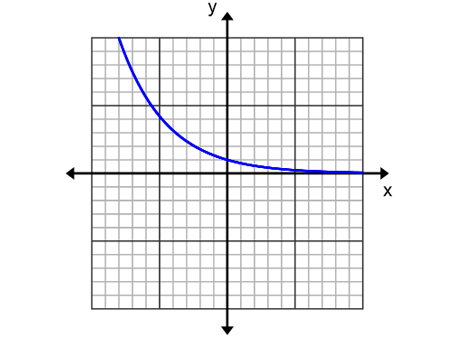
Is this exponential growth or decay?
a)
Growth
b)
Decay
144.

Determine whether the sequence is arithmetic, geometric, or neither.
a)
arithmetic
b)
geometric
c)
neither
145.

Determine whether the sequence is arithmetic, geometric, or neither.
a)
arithmetic
b)
geometric
c)
neither
146.

Determine whether the sequence is arithmetic, geometric, or neither.
a)
arithmetic
b)
geometric
c)
neither
147.
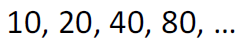
Find the common ratio for the geometric sequence.
a)
10
b)
1/2
c)
2
d)
4
148.
Write the explicit formula for the geometric sequence.
a)
an = 10(2)n-1
b)
an = 2(10)n-1
c)
an = 10(2)n
d)
an = 2(10)n
149.
Find the 22nd term of the following sequence:
5, 8, 11, ...
5, 8, 11, ...
a)
14
b)
68
c)
63
d)
71
150.
Create the explicit formula for the sequence:
2, 8, 14, ...
(Hint: Write your formula and then simplify it.)
2, 8, 14, ...
(Hint: Write your formula and then simplify it.)
a)
an=2+6n
b)
an=-6+6n
c)
an=6n-4
d)
an=4-6n
151.
Find the first term of the given sequence:
a14=68
d=3
a14=68
d=3
a)
14
b)
20
c)
26
d)
29
152.
Give the correct name for
3x
a)
Cubic Monomial
b)
Linear Binomial
c)
Linear Monomial
d)
Cubic Binomial
153.
(2x + 5y - z) + (-6x - 4y + 7z)
a)
-4x +6y + 6z
b)
4x + y + 6z
c)
-4x - y + 6z
d)
-4x + y + 6z
154.
(3x + 4y - 3z) - (2x - 6y + 7z)
a)
x + 10y - 10z
b)
-x +10y - 10z
c)
x -10y - 10z
d)
-x -10y - 10z
155.
(4x3-5x2+3x)+(-2x3-x2+6x)
a)
2x3-6x2-9x
b)
2x3+6x2+9x
c)
-2x3-6x2+9x
d)
2x3-6x2+9x
156.
(5x4 - 4x3 - 2x2 + x - 19) - (x4 + 5x3 + 8x2 + x + 5)
a)
4x4 - 9x3 - 10x2 - 24
b)
4x4 - 9x3 - 10x2 - 2x - 24
c)
4x4 - 9x3 - 10x2 + 2x - 24
d)
-4x4 - 9x3 - 10x2 - 24
157.
(2x + 1)(x - 3)
a)
-3x - 3
b)
2x2 + 5x - 3
c)
2x2 - 5x - 3
d)
2x2 - 5x +3
158.
(3x - 2)(6x + 1)
a)
21x2
b)
18x2 + 9x + 2
c)
9x2 - 9x - 2
d)
18x2 - 9x - 2
159.
(2x + 3)(x2 + 4x + 1)
a)
2x3 + 10x2 + 14x + 4
b)
2x3 + 11x2 + 14x + 3
c)
-2x3 - 11x2 + 14x + 5
d)
x3 - 11x2 + 14x + 3
160.
Find f(2) if f(x) = (x-4)(x-4)
a)
4
b)
-4
c)
0
d)
-3
161.
find f(-2) if f(x) = (x-3)2
a)
-25
b)
25
c)
1
d)
-1
162.

What are the values of x when y = 0?
a)
{ -3, 1 }
b)
{ -2 }
c)
{ -3, -1 }
d)
{ 1, 3 }
163.
Solve for the values of x:
(2x + 5)(5x - 2) = 0
(2x + 5)(5x - 2) = 0
a)
{ -5/2, -2/5 }
b)
{ -5/2, 2/5 }
c)
{ 5/2, 2/5 }
d)
{ 5/2, -2/5 }
164.
Solve for the values of x:
(2x - 1)(x + 4) = 0
(2x - 1)(x + 4) = 0
a)
{ 1/2, -4 }
b)
{ 1/2, 4 }
c)
{ 2, -4 }
d)
{ -2, 4 }
165.
Solve for the values of x:
(x - 5)(x - 1) = 0
(x - 5)(x - 1) = 0
a)
{ 5, 1 }
b)
{ 5, -1 }
c)
{ -5, 1 }
d)
{ -5, -1 }
166.
Solve for the values of x:
(x - 3)(x + 6) = 0
(x - 3)(x + 6) = 0
a)
{ -3, -6 }
b)
{ 3, -6 }
c)
{ -3, -6 }
d)
{ 3, 6 }
167.
Solve for the values of x:
(x + 2)(x - 3) = 0
(x + 2)(x - 3) = 0
a)
{ 2, 3 }
b)
{ -2, -3 }
c)
{ 2, 3 }
d)
{ -2, 3 }
168.
What is the first step in solving
(x + 2)(x - 3) = 0 ?
(x + 2)(x - 3) = 0 ?
a)
Plug in zero for x
b)
Solve for x
c)
FOIL
d)
Set each binomial factor equal to zero
169.
Factor x2-20x+51
a)
(x-17)(x+3)
b)
(x+17)(x+3)
c)
(x+17)(x-3)
d)
(x-17)(x-3)
170.
Factor x2-x-72
a)
(x-9)(x+8)
b)
(x+9)(x-8)
c)
(x+9)(x-8)
d)
(x-9)(x-8)
171.
Factor x2-11x-60
a)
(x-12)(x-5)
b)
(x-15)(x+4)
c)
(x-15)(x-4)
d)
(x+12)(x-5)
172.
Factor x2-14x+24
a)
(x-8)(x+3)
b)
(x+12)(x-2)
c)
(x+8)(x+3)
d)
(x-12)(x-2)
173.
Factor x2+12x+20
a)
(x-4)(x+5)
b)
(x+10)(x+2)
c)
(x-10)(x-2)
d)
(x+4)(x+5)
174.
Factor x2-6x+8
a)
(x-4)(x-2)
b)
(x+4)(x+2)
c)
(x-4)(x+2)
d)
(x+4)(x-2)
175.
Factor x2-2x-15
a)
(x+5)(x-3)
b)
(x-5)(x-3)
c)
(x-5)(x+3)
d)
(x+5)(x+3)
176.
Factor x2+4x-32
a)
(x+8)(x-4)
b)
(x-8)(x-4)
c)
(x-8)(x+4)
d)
(x+8)(x+4)
177.
x2-x-12
a)
(x+6)(x+2)
b)
(x-4)(x+3)
c)
(x+4)(x+3)
d)
(x-4)(x-3)
178.
Factor x2-8x+7
a)
(x+1)(x+8)
b)
(x+1)(x+7)
c)
(x-7)(x-1)
d)
(x+1)(x-7)
100 %

