
NEW
Font size
S
M
L
XL
 Worksheets
APES - "Cycles" review
Total questions: 49
Worksheet time: 38mins
Name
Class
Date
1.

What is it called when plants give off water vapor as a waste product?
a)
condensation
b)
evaporation
c)
sublimation
d)
transpiration
2.
What do we call water that flows over the ground surface rather than soaking in?
a)
runoff
b)
discharge
c)
recharge
d)
tributary
3.

Because they have large connected pores, materials such as sand and gravel allow water to pass through. This is known as
a)
Permeable
b)
Impermeable
4.

What is C?
a)
Evaporation
b)
Condensation
c)
Precipitation
d)
Runoff
5.

What is B?
a)
Evaporation
b)
Condensation
c)
Precipitation
d)
Runoff
6.

The arrows in the diagram below represent the movement of water in the water cycle.
Which arrow represents the process of transpiration?
Which arrow represents the process of transpiration?
a)
A
b)
B
c)
C
d)
D
7.
Most of the water on Earth is located in the oceans and has a salinity of about 3.5%. Which statement best explains why rain is fresh water and has a very low salinity?
a)
When water precipitates from oceans, most of the salt remains in the oceans.
b)
When water evaporates from oceans, most of the salt remains in the oceans.
c)
When water precipitates from clouds, most of the salt remains in the clouds.
d)
When water evaporates from clouds, most of the salt remains in the clouds,
8.
The amount of runoff will increase as the
a)
slope of the land decreases
b)
porosity of the soil increases
c)
evaporation rate exceeds the infiltration rate
d)
precipitation rate exceeds the infiltration rate
9.

What is D?
a)
Evaporation
b)
Condensation
c)
Precipitation
d)
Runoff
10.

How do plants get the nitrogen they need?
a)
from the air
b)
from the soil or water in which they live
c)
from the Sun
d)
from broken-down rocks
11.
Growing legumes such as alfalfa or soy beans increases
a)
denitrification
b)
nitrogen fixation
c)
ammonification
d)
ammonium oxidation
12.
After plants and animals contain nitrogen, what puts it back into atmosphere and soil?
a)
decomposition
b)
precipitation
c)
condensation
d)
bacteria
13.
How nitrogen is "fixed" into useable form for plants
a)
only through action of bacteria
b)
only through lightning
c)
through action of bacteria & lightning
d)
through photosynthesis
14.

Process where excess nutrients enter body of water causing overgrowth of aquatic plants and algae...
a)
Eutrophication
b)
Acid Precipitation
c)
Nitrogen Fixation
d)
Decomposition
15.

The step in the nitrogen cycle where plants take up nitrate and use it to make biological molecules is:
a)
nitrification
b)
ammonification
c)
nitrogen fixation
d)
assimilation
16.
The step in the nitrogen cycle where bacteria convert ammonia (NH3) to nitrate (NO3-) is:
a)
nitrification
b)
ammonification
c)
nitrogen fixation
d)
assimilation
17.
What part of the nitrogen cycle deals with the conversion of nitrogen in waste products or dead organisms into ammonia?
a)
nitrification
b)
ammonification
c)
denitrification
d)
nitrogen fixation
18.
What is the first step in the nitrogen cycle, in which gaseous nitrogen is converted into ammonia?
a)
nitrification
b)
ammonification
c)
denitrification
d)
nitrogen fixation
19.
Biogeochemical cycles:
a)
only include processes conducted by or within living organisms.
b)
describe the movement of water and other materials throughout the abiotic and biotic environment.
c)
only pertain to exchanges and interactions that occur within the atmosphere.
d)
are used to describe the attempts of humans to recycle various pollutants.
20.
Which of the following is a Nitrite?
a)
NO3-
b)
NO2-
c)
N2
d)
NH3
21.
Which of the following is a Nitrate?
a)
NO3-
b)
NO2-
c)
N2
d)
NH3
22.
Which of the following is a atmospheric nitrogen?
a)
NO3-
b)
NO2-
c)
N2
d)
NH3
23.

What process is shown at # 6?
a)
dentirification
b)
ammonification
c)
assimilation
d)
fixation
24.
When humans burn fossil fuels, most of the carbon quickly enters the as carbon dioxide.
a)
Water
b)
Atmosphere
c)
Sun
d)
Air
25.
Which one of these does not add CO2 to the atmosphere?
a)
cooking with gas
b)
planting trees
c)
burning wood
d)
riding in a bus
26.
Combustion is another word for _______________.
a)
a train
b)
a bus
c)
a dog
d)
burning
27.
What does not produce carbon dioxide?
a)
Photosynthesis
b)
Burning Fossil Fuels
c)
Animal respiration
d)
Plants decaying
28.
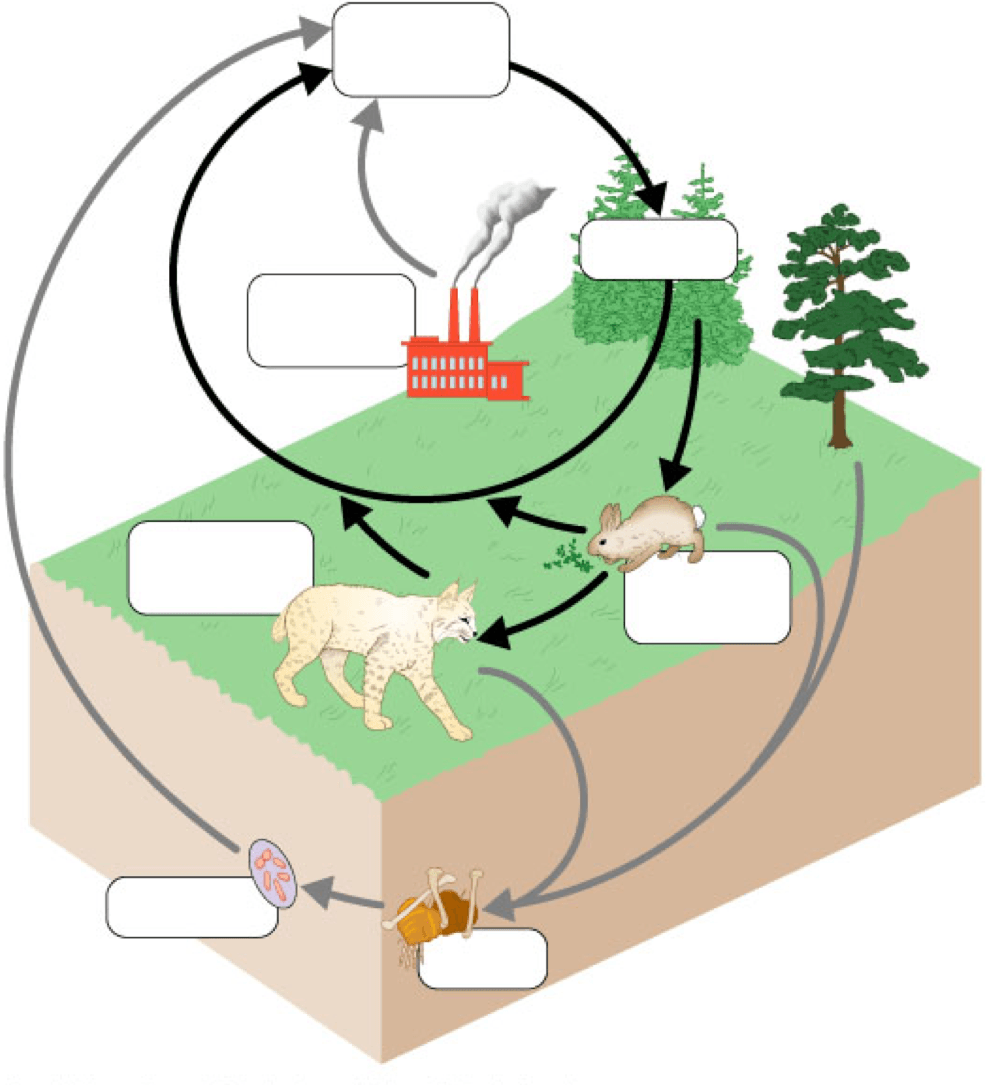
In what process is Carbon transformed into chemical energy?
a)
Photosynthesis
b)
Respiration
c)
Primary Production
d)
Secondary Production
29.
Why is the ocean important to the carbon cycle?
a)
It keeps sediment containing carbon underwater for millions of years
b)
The ocean gives out more carbon then it takes in (increases global warming)
c)
The ocean isn't important to the carbon cycle.
30.

This rock formed when bits of other rocks became pressed into a solid. What type of rock is it?
a)
Sedimentary Rock
b)
Metamorphic Rock
c)
Igneous Rock
31.

This rock was formed when magma cooled very slowly inside the Earth. What specific type of rock is it?
a)
Intrusive Igneous Rock
b)
Extrusive Igneous Rock
c)
Foliated Metamorphic Rock
d)
Clastic Sedimentary Rock
32.

This rock formed when lava cooled very quickly on Earth's surface. What specific type of rock is it?
a)
Extrusive Igneous Rock
b)
Intrusive Igneous Rock
c)
Non-Foliated Metamorphic Rock
d)
Biochemical Sedimentary Rock
33.
What are the 3 major types of rocks?
a)
Igneous, Metamorphic, Sedimentary
b)
Metamorphic, Igneous, Cementation
c)
Brown, Red, Gray
d)
Streak, Hardness, Breakage
34.
What process is used to form sedimentary rocks?
a)
Lava cools and hardens to form a rock.
b)
Weathering, Erosion, Deposition, Compaction, Cementation
c)
Extreme heat and pressure from inside the Earth turn rocks into new rocks.
d)
Magma trapped under the Earth's surface cools and solidifies.
35.

The process when rocks break into smaller pieces due to exposure to natural elements is called
a)
erosion
b)
weathering
c)
sediments
d)
deposition
36.
The movement of weathered material (sediment) is called?
a)
weathering
b)
erosion
c)
deposition
d)
cementation
37.
Which nutrient cycle does not have the troposphere in it's processes?
a)
Nitrogen
b)
Carbon
c)
Phosphorus
d)
Hyrdologic
38.
This process is responsible for most environmental problems of excess nitrogen and phosphorus entering streams, lakes and oceans.
a)
decomposition
b)
emissions from automobiles
c)
agriculture and house hold runoff
d)
photosynthesis
39.
Which of the following is known as the "sedimentary" cycle because its reservoir is sedimentary rock?
a)
Sulfur cycle
b)
Nitrogen cycle
c)
Phosphorus cycle
d)
Carbon cycle
40.
In terms of geological time, most fossil fuels were deposited during the _______ period.
a)
Precambrian
b)
Jurassic
c)
Carboniferous
d)
Triassic
41.
Phosphorous is needed in organisms for the production of
a)
ADP and ATP.
b)
Cellular membranes.
c)
Deoxyribonucleic and ribonucleic acids.
d)
All of the answers are correct
42.
In terms of availability, which of the following is the least available and is usually the most limiting factor for plants growth?
a)
Oxygen
b)
Carbon
c)
Nitrogen
d)
Phosphorus
43.
Which of the following statements is true of the phosphorus cycle?
a)
Phosphorus enters the atmosphere as phosphates.
b)
The phosphorus cycle utilizes the processes of erosion, and weathering.
c)
Phosphates are used in carbohydrate and glucose storage.
d)
The phosphorus cycle utilizes bacteria to breakdown phosphates and make them available for plants.
44.
This part of the nitrogen cycle can release nitrogen to the sediments of the ocean:
a)
Denitrification
b)
Nitrification
c)
Fixation
d)
Photosynthesis
45.
What role do decomposers play in the phosphorous cycle?
a)
absorb phosphorous
b)
release phosphorous into atmosphere
c)
return phosphorous into the soil
d)
combustion
46.

Identify the cycle pictured.
a)
The Water cycle
b)
The Carbon cycle
c)
The Nitrogen cycle
d)
The Phosphorus cycle
47.

Identify the cycle pictured.
a)
The Water cycle
b)
The Carbon cycle
c)
The Nitrogen cycle
d)
The Phosphorus cycle.
48.
Which nutrient is not cycled through the atmosphere and stays only on ground level?
a)
carbon
b)
nitrogen
c)
phosphorus
d)
water
49.
Cycle that is so slow that it "cycles" in geologic time
a)
Water
b)
nitrogen
c)
phosphorus
d)
carbon
Reset

