
 Worksheets
Milestones Review 1st Sem
Total questions: 40
Worksheet time: 36mins
Name
Class
Date
1.
Two objects at different temperatures are in contact. Which of the following happens to their thermal energy?
a)
Their thermal energies remain the same.
b)
Thermal energy passes from the cooler object to the warmer object
c)
Thermal energy passes from the warmer object to the cooler object.
d)
Thermal energy passes back and forth equally between the two objects.
2.
A large house being heated by heater warms a house when the air is circulating.
a)
Convection
b)
Conduction
c)
Radiation
d)
insulation.
3.
Friction is a force that acts in an ___________ direction of movement.
a)
similar
b)
opposite
c)
parallel
d)
west
4.
A type of friction that occurs when air pushes against a moving object causing it to decelerate.
a)
surface area
b)
air resistance
c)
velocity
d)
gravity
5.
Which of the following is an example of friction that is helpful?
a)
Brakes used on a bike
b)
Tires from a car on the road
c)
Tread on the bottom of your shoes
d)
All are examples that are helpful
6.
What does friction produce?
a)
light
b)
sound
c)
heat
d)
gravity
7.
The rougher the surface, the faster an object will travel over the surface.
a)
True
b)
False
8.

Why is the net force 0 in the image?
a)
Because the elephants are the same size
b)
Because they are both pulling the same amount of force in opposite directions
c)
Because they are elephants
d)
Because they are pulling away from each other.
9.
the tendency of an object to resist a change in its motion
a)
acceleration
b)
inertia
c)
mass
d)
frame of reference
10.
8 N to the left , and 4 N to the right. Find the net force. Is this balanced
a)
12 N Right No
b)
4 N Left No
c)
12 N Right Yes
d)
4 N Left Yes
11.
With unbalanced forces, the object will move in the direction of the _______ force.
a)
larger
b)
smaller
c)
equal
12.
If the net force is 0 the object is...
a)
in motion
b)
in the same place
13.
You and your dad are moving the couch from one side to another. Your dad pushes with a force of 35 N to the right and you push with a force of 25 N right. What is the net force on the couch?
a)
60 N right
b)
10 N left
c)
60 n right
d)
50 N left
14.

What type of energy is in this picture?
a)
Kinetic
b)
Potential
c)
Electromagnetic
15.

What kind of energy?
a)
Thermal (kinetic) energy
b)
Chemical (kinetic) energy
c)
Chemical (potential) energy
d)
Mechanical (kinetic) energy
16.
What kind of energy is associated with vibrations?
a)
mechanical energy
b)
electrical energy
c)
light energy
d)
sound energy
17.
What type of energy increases as molecules move faster?
a)
mechanical energy
b)
electrical energy
c)
thermal energy
d)
sound energy
18.
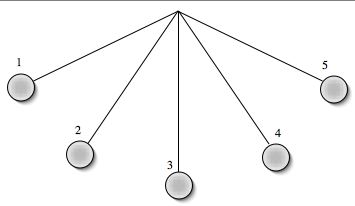
When a pendulum swings, at which point is kinetic energy highest?
a)
1
b)
2
c)
3
d)
4
19.

A battery converts what type of energy to another?
a)
sound to kinetic
b)
light to heat
c)
mechanical to electrical
d)
chemical to electrical
20.
What machine changes electrical energy into light and sound energy?
a)
battery
b)
lightbulb
c)
alarm clock
d)
apple
21.
What two factors effect the amount of energy a wave has?
a)
Frequency and wavelength
b)
Frequency and amplitude
c)
Amplitude and rest
d)
Wavelength and crest
22.
When the amplitude of a wave increases, what happens to the wavelength?
a)
The frequency increases.
b)
The wavelength increases.
c)
The wavelength decreases.
d)
Nothing happens, the two are not related.
23.
When the frequency of a wave increases, what happens to the wavelength?
a)
The wavelength and amplitude both increase.
b)
The wavelength increases.
c)
The wavelength decreases.
d)
Nothing happens, the two are not related.
24.
What kind of wave can travel through space?
a)
electromagnetic waves
b)
compressional waves
c)
transverse waves
d)
longitudinal waves
25.

If you replace the paper clip with a plastic spoon, what happens?
a)
The bulb doesn't light
b)
The bulb is dimmer
c)
The wires get hot
d)
There is no change
26.

What kind of circuit is this?
a)
series
b)
parallel
27.

What kind of circuit is this?
a)
Series
b)
Consecutive
c)
Parallel
d)
Training
28.
In a Series circuit the more lightbulbs you add the brighter they get
a)
False
b)
True
29.
If you increase the resistance of a circuit, what happens?
a)
Current decreases
b)
Current increases
c)
Electrons disappear
d)
Bulbs get brighter
30.

this circuit is .....?
a)
open
b)
parallel
c)
closed
d)
The cutest little circuit evah!
31.
A correct statement of Ohm’s Law is:
a)
I= V R
b)
V ∝ I
c)
V = IR
d)
both b and c
32.
What is an example of a RESISTOR?
a)
Light bulb
b)
Plastic
c)
Water
33.

Where should the fulcrum be placed in order for the student to use the least amount of effort possible?
a)
point A
b)
point B
c)
point C
d)
point D
34.

What is the mechanical advantage of the LAST inclined plane in the picture?
a)
1
b)
2
c)
3
d)
4
35.
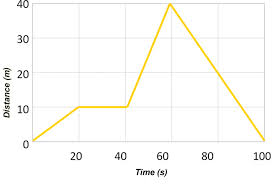
How long did it take this object to travel back to its reference/starting point?
a)
20 s
b)
30 s
c)
60 s
d)
100 s
36.

What is happening at C?
a)
Stationary
b)
Accelerating
c)
Fast steady speed; moving away from the starting position
d)
Slower steady speed; moving away from the starting position
37.

What is happening in this graph from point B to C?
a)
The object is going down a hill.
b)
The object is returning to its starting location.
c)
The object is slowing down.
d)
The object is staying still.
38.
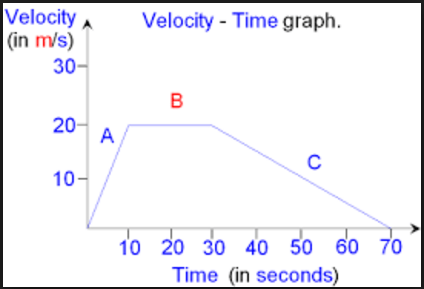
This is a velocity-time graph. What is the object doing in segment B?
a)
Positive acceleration
b)
Negative acceleration
c)
Constant Velocity
d)
Not moving
39.

What kind of acceleration is shown here?
a)
positive
b)
negative
c)
none
d)
varies
40.

This is a velocity-time graph. What is the acceleration for segment C?
a)
Positive acceleration
b)
Negative acceleration
c)
Constant Velocity
d)
Not moving
100 %

