
 Worksheets
Ohm's Law and Circuits Review
Total questions: 31
Worksheet time: 28mins

What is Resistance?
The flow of electrons
Electric potential difference
A battery
The ability to reduce the flow of electrons
Current times Resistance equals
Power
Voltage
Amperage
Ohm
Voltage divided by Resistance
Current
Power
Ohms
Watts
Voltage divided by Current
Current
Power
Resistance
Watts
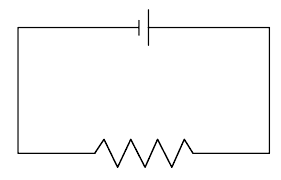
If the battery produced 12.6 Volts what would be the current flow for a 6 Ohm resistor?
2.1 Amps
2.4 Amps
1.71 Amps
15 Amps

The current in an appliance is 3 A and the voltage is 120 V. How much power is being supplied to the appliance?
40 V
360 V
40 W
360 W

If both resistors R1 and R2 are identical and have a resistance of 4 Ω, and the battery provides 12 V, then the total current coming from the battery is
6 A
1.5 A
24 A
3 A

If the voltage across the battery was 10 V, how much voltage does each bulb get?
10 V
5 V
20 V
0 V

For resistor 3, find
total resistance
total current
and the voltage
60 Ohms, 0.4 A, 8 V
60 Ohms, 2.5 A, 8 V
90 Ohms, 2.5 A, 24 V
60 Ohms, 0.4 A, 24 V
Which best describes a parallel circuit?
Electricity flows along one pathway.
The flow of electricity comes from one source.
Electricity flows along more than one pathway.
The flow of electricity comes from more than one source.
A series circuit has ____ path(s) that the electric current can take.
One
Two
Three
Four


Which circuit has the smallest equivalent resistance? All resistors have a resistance of 4 ohms.
A
B
C
Which parallel resistors have the greater equivalent resistance?


What is the total current in this circuit?
0.32 A
456 A
0.6 A
1.09 A
1.71 A

Which light bulb will be brighter, X or Y?
Y
X
They're both equally bright
Which current is greater, X or Y?
X because the total resistance is higher
X because the total resistance is smaller
Y because the total resistance is higher
Y because the total resistance is smaller
They're the same

Short circuits happen when there is too much current for an electrical appliance/device to handle. What can be possible reasons for having too much current in a circuit? Choose all that apply.
Not enough resistors
Broken path going around resistors instead of through then
Broken resistors
Not enough voltage
How is current electricity different from static electricity?
Static electricity is electrons in motion and current electricity is an imbalance of protons and electrons
Static electricity is an imbalance of protons and electrons and current electricity is electrons in motion
No difference. They're the same thing.
What is true about the total resistance in a parallel circuit?
It’s calculated using the formula RT=R1+R2 and increases as you add more resistors
It’s calculated using the formula RT=R1+R2 and decreases as you add more resistors
It’s calculated using the formula 1/RT=1/R1+1/R2 and increases as you add more resistors
It’s calculated using the formula 1/RT=1/R1+1/R2 and decreases as you add more resistors

