Wayground logo

Free Printable Worksheets

Font size

S
M
L
XL
Worksheets

Unit 13: The Cold War Review

Total questions: 51

Worksheet time: 42mins

Name
Class
Date
1.
What two nations were in competition with each other during the Cold War?
a)
Spain and Portugal
b)
England and France
c)
Germany and Italy
d)
United States and Soviet Union
2.

What was the term 'iron curtain' used to describe the division of?

a)

North and South Vietnam

b)

East and West Asia

c)

North and South Korea

d)

East and West Europe

3.
President Truman adopted a new foreign policy during the Cold War know as the Truman Doctrine. What was the main goal of the Truman Doctrine?
a)
To expand trade with Europe
b)
To limit the build up of nuclear weapons
c)
To stop the spread of communism
d)
to send financial aid to Europe
4.
The United States got involved in conflicts like Korea and Vietnam because they were afraid of the domino theory. What is the domino theory?
a)
If one country fell to democracy, others would follow
b)
If one country fell to communism, others would follow
5.
Why was the United States involved in the Berlin Airlift?
a)
to airlift food to the people of West Berlin
b)
to bomb East Berlin
c)
to demolish the Berlin Wall
d)
to transport people out of East Berlin
6.
Why did the United States become involved in the Korean War?
a)
to contain communism
b)
to colonize Korea
c)
to spread communism
d)
to Christianize Koreans
7.
In 1950, Korea fought a civil war over the spread of communism.  Communists from the north tried to take over the south.  What role did he US play in this war?
a)
The US and its allies went to Vietnam to fight Korean Communists.
b)
The US and its allies join the fight to keep communism from spreading.
c)
The US and its allies did not join the Korean War.
d)
The US and its allies fought to defend the North.
8.
In the 1950s, the United States became involved in the Vietnam War. Why did the United States become involved in this war?
a)
to prevent the collapse of the government of North Vietnam
b)
to stop Vietnam from taking over Hong Kong
c)
to stop the spread of communism to South Vietnam
d)
to prevent attacks against United States shipping
9.
How did the US respond to finding out that the Soviets had missiles in Cuba?
a)
They sent the Air Force to bomb Cuba
b)
They began placing missiles in the Soviet Union.
c)
They placed a naval blockade around Cuba.
d)
They invaded Cuba and the Soviet Union.
10.
Who were the two participants in the Space Race?
a)
The US and Cuba
b)
China and US
c)
The USSR and US
d)
US and North Vietnam
11.
What was the name of the first satellite in space launched by the Soviet Union?
a)
Gagarin
b)
Apollo 11
c)
Sputnik
d)
Apollo 13
12.
What did Khrushchev want when sending the missiles to Cuba?
a)
To increase the Soviet Union's nuclear capability
b)
Aid the Cuba
c)
Aid the US
d)
To increase the US nuclear capability
13.
What was the purpose of the US blockade of Cuba?
a)
Prevent missiles and military equipment from going in
b)
Prevent missiles and military equipment from going out
c)
Torture the Cubans into submission
d)
Torture the Cubans so that they will fight the Russians
14.
What conflict did the Cuban Missile Crisis occur in?
a)
WW2
b)
Cold War
c)
WW1
d)
Vietnam War
15.

What ended the Cuban Missile Crisis?

a)

The USSR removes missiles and the US leaves Cuba alone.

b)

The US uses all of their missiles and destroys Cuba

c)

Cuba forfiets

d)

JFK got tired of fighting and just made a treaty

16.

The Gulf of Tonkin resolution passed by Congress

a)

The Gulf of Tonkin resolution passed by Congress

b)

authorized President Johnson to take any measure needed to repel attacks on U. S. forces.

c)

called for both U. S. and North Vietnamese forces to withdraw from South Vietnam.

d)

condemned U. S. aggression against the people of Vietnam.

17.

The Tet offensive of 1968 during the Vietnam War demonstrated that

a)

the army of South Vietnam was in control of the South

b)

the Vietcong were loosing hope

c)

America was nowhere near winning the war

d)

a negotiated settlement was in the near future

18.

the leader of North Vietnam during the war

a)

Ho Chi Minh

b)

Ngo Dinh Diem

c)

William C. Westmoreland

19.
The ________ were communist rebels in South Vietnam.
a)
Japan
b)
Veitcong
c)
Soviet Union
d)
Germany
20.
The idea that if South Vietnam fell to communism, other nations would soon follow...
a)
Vietnamization 
b)
Communism
c)
Domino Theory
d)
Imperialism
21.
Shifting the burden of actual combat from American troops to S. Vietnamese forces.
a)
Vietminization
b)
Vietcong
c)
Internationalism
d)
Linkage
22.
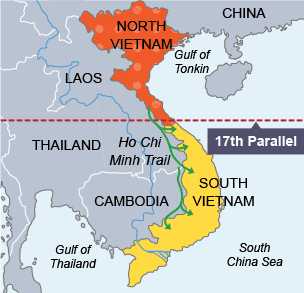
Networks of jungle paths used by N. Vietnam to transport supplies to the Vietcong?
a)
Saigon Route
b)
Bataan Death March
c)
Trail of Tears
d)
Ho Chi Minh Trail
23.
In Vietnam the fighters used a irregular warfare tactic that made it difficult for our soldiers to be successful...it was called?
a)
Vietnamese Warfare tactics
b)
Cheetah Warfare
c)
Hidden Warfare
d)
Guerrilla warfare
24.
What kind of government did Ho Chi Minh want?
a)
Communist
b)
Democratic
c)
Socialist
d)
Monarchy
25.
The U.S. got involved in Vietnam because of what foreign policy?
a)
containment
b)
Good Neighbor policy
c)
isolationism
d)
Roosevelt Corollary
26.
Who was elected president in 1968?
a)
Nixon
b)
Johnson
c)
Kennedy
d)
Eisenhower
27.
What was the chemical used to kill the vegetation in Vietnam?
a)
Agent Orange
b)
Agent Yellow
c)
Agent Napalm
d)
Agent Magenta
28.
What was a popular method of protesting the Vietnam War?
a)
Burning Clothing
b)
Burning Draft Cards
c)
Sit-Ins
d)
Burning Down Recruitment Centers
29.
What was the United States' bombing campaign of North Vietnam called?
a)
Operation Agent Orange
b)
Operation Napalm
c)
Operation Rolling Thunder
d)
Operation Hurricane
30.

The phrase "credibility gap" was coined to describe

a)

the public's frustration with the lack of media coverage in Vietnam

b)

the difference in Johnson’s and Nixon’s policies in Vietnam

c)

the difference between what the Johnson administration claimed and what the public believed was true

d)

the public’s frustration with the growing protest and counterculture movement

31.

What is the correct sequence of the following events?

1) Gulf of Tonkin Resolution

2)Geneva Accords

3)Vietnamization

4)Tet-Offensive

a)

1,2,4,3

b)

2,1,4,3

c)

4,1,3, 2

d)

1,4,2,3

32.
What resolution passed that gave Lyndon Johnson broad powers to defend South Vietnam from communism?
a)
Gulf of Tonkin Resolution
b)
Gulf of Maddox Resolution
c)
USS Tonkin Resolution
d)
Gulf of Vietnam Resolution
33.
What law limits the president's ability to send troops without a declaration of war?
a)
War Powers Act
b)
War Production Act
c)
Military Involvement Act
d)
War Involvement Act
34.
What country controlled Vietnam before Ho Chi Minh's communist revolution?
a)
France
b)
Germany
c)
United States
d)
Britain
35.

After World War II, the Soviet Union primarily took over

countries in which region?

a)

Western Europe

b)

Central Europe

c)

Eastern Europe

36.

The 38th parallel is an important dividing line between...

a)

China and Korea

b)

North and South China

c)

North and South Japan

d)

North and South Korea

37.

Why was the Yalta Conference of 1945 so significant?

a)

Germany was divided into four occupation zones at this conference

b)

A treaty signed at this conference ended the Cold War

c)

President Truman first articulated his “Truman Doctrine” at the conference

38.

What does the phrase “Iron Curtain” refer to, as used by Winston Churchill in 1946?

a)

Berlin Wall

b)

the ideological and political barrier between communism and capitalism/democracy

c)

the hostility between Truman and Stalin

39.

What was the outcome of the Vietnam War?

a)

North and South Vietnam merged under communist control

b)

The United States established a democratic government in Vietnam

c)

South Vietnam took control of North Vietnam

40.

All are effects of the Cold War EXCEPT

a)

USA takes minor role in United Nation

b)

USA emerged as the world's superpower

c)

Spread of Capitalism

d)

Large numbers of nuclear weapons amassed

41.

The Korean and Vietnam Wars both

reflected what American Cold War-policy?

a)

Containment

b)

Isolationism

c)

Appeasement

d)

Nuetrality

42.
Berlin is the capital of what European country?  
a)
France
b)
United Kingdom
c)
Denmark
d)
Germany
43.
Why did East Germany build the Berlin Wall?  
a)
To keep people from escaping to West Germany  
b)
To keep people from West Germany coming into East Germany 
c)
As a fortification to keep enemies out of the city 
d)
All of the above
44.
What country had control over the government of East Germany?      
a)
Soviet Union
b)
China 
c)
Poland 
d)
Hungary
45.
This was the time period where countries were building up their nuclear weapons supply out of fear
a)
Cold War
b)
World War I
c)
Heat Wave
d)
Great Depression
46.
This was an attempt to keep food and supplies from reaching West Berlin 
a)
Berlin Resistance
b)
Berlin Blockade
c)
Great Depression
d)
Cold War
47.
This was an operation carried out in order to deliver supplies to East Berlin
a)
West Berlin Aid
b)
Cold War
c)
East Berlin Aid
d)
Berlin Airlift
48.
In the 1950's, Senator Joseph McCarthy won national attention when he...
a)
Was convicted as a spy.
b)
Claimed hundreds of government employees were communists.
c)
Helped Eisenhower become president.
d)
Went to Korea and said atomic weapons should be used to break the stalemate.
49.
The House on Un-American Activities Committee (HUAC)
a)
Protested racial segregation in the armed forces.
b)
Investigated disloyalty and harmful foreign influences in the United States. 
c)
Investigated U.S. involvement in the Korean War and its lack of progress towards victory.
d)
Tried to deport all foreigners or Un-American peo
50.
The "Red Scare" means
a)
People were afraid of the color red.
b)
People thought Red's were friends. 
c)
People were afraid of Communists. 
d)
People were afraid of Democrats. 
51.
During the Cold War, why were people building bomb shelters near or under their houses?
a)
To hide atomic weapons
b)
America was the only nuclear super power
c)
Fear was heightened during the Cold War
d)
People distrusted the government