wayground logo

Free Printable Worksheets

NEW

Font size

S
M
L
XL
Worksheets

Social Studies 8 Final Exam Review

Total questions: 55

Worksheet time: 50mins

Name
Class
Date
1.
What amendment abolished slavery?
a)
13th
b)
14th
c)
15th
d)
16th
2.
The 14th Amendment of the United States Constitution...
a)
Gave African Americans citizenship
b)
Gave African Americans the right to vote
c)
Freed the slaves
d)
Gave landowners the right to sharecrop
3.
The 15th Amendment of the United States Constitution...
a)
Gave African Americans the right to own businesses
b)
Freed the Slaves
c)
Gave African Americans the right to vote
d)
Forced African Americans back into slavery
4.
Laws passed by southern states soon after the Compromise of 1877.  These laws legalized segregation whites and blacks to use separate facilities. 
a)
Jim Crow Laws
b)
Black Codes
c)
Freedman's Bureau
d)
Reconstruction
5.
The process of rebuilding the South after the Civil War. 
a)
Reconstruction
b)
Freedman's Bureau
c)
Black Codes
d)
Jim Crow Laws
6.

What famous phrase came out of the Plessy case?

a)

"Separate but equal"

b)

"Give me liberty or give me death."

c)

"By any means necessary"

7.

All of the following describe the results/effects of the Civil War EXCEPT

a)

More than 600,000 soldiers died.

b)

Billions of dollars in damage, mostly to the South.

c)

Union states did not free their slaves.

d)

Federal government strengthened power over states

8.
What is Manifest Destiny?
a)
The belief that it was America's destiny to control and civilize all of North America
b)
The belief that their destiny was to manifest
c)
A religious term used to explain how to be saved
9.
As Americans took over more and more land, what happened to Native Americans?
a)
They agreed to give up their land.
b)
They were given their choice of where to live.
c)
They were forced to live in reservations.
d)
They voluntarily moved to Canada and Mexico.
10.
The first railroad to cross the United States was the....
a)
Union Pacific Railroad
b)
Central Pacific Railroad
c)
Missouri Railroad
d)
Transcontinental Railroad
11.
Which of the following BEST explains how railroads stimulated the national economy in the late 1800s?
a)
They increased the number of railroad barons
b)
They allowed a large number of people to enter the United States
c)
They efficiently allowed products to be shipped across the country
d)
They diminished the power of monopolies in the railroad industry
12.

During the Gilded Age, there was an increase in ________________ and _________________ as people moved to U.S. cities looking for economic opportunities.

a)

Immigration / urbanization

b)

capitalism / imperialism

c)

communism / free enterprise

d)

reform movements / civil rights

13.

This type of economic system during the Gilded Age allowed for the growth of big business and monopolies.

a)

Communism

b)

Socialism

c)

Laissez-Faire

d)

Mercantilism

14.

A goal of Progressive Reform was to ____________.

a)

grow big business

b)

limit big business

c)

encourage expansion into the West

d)

give African Americans civil rights

15.

The ratification of this amendment granted suffrage to all genders.

a)

15th

b)

17th

c)

18th

d)

19th

16.

People like Jacob Riis were _____________ because they investigated and exposed abuse and corruption.

a)

supporters of political machines

b)

industrialists

c)

nativists

d)

muckrakers

17.

________________ was an advocate against child labor.

a)

Jane Addams

b)

Elizabeth Cady Stanton

c)

Susan B. Anthony

d)

Mother Jones

18.
Imperialism is __________.
a)
when a powerful nation uses its resources to help a weaker nation
b)
when a weaker nation invites a powerful nation to help it industrialize
c)
when a powerful nation takes control of the economy and government of a weaker nation
d)
when weak nations join together to fight a strong nation
19.
Economic motives for imperialism include _________.
a)
a desire to spread Christianity
b)
a need for military bases around the world
c)
a need for raw materials to be used in factories
d)
a desire to gain glory
20.

The Monroe Doctrine prevented Europe from taking over countries in __________________

a)

North America only

b)

South America only

c)

Asia

d)

North and South America

21.
What territories did the US gain as a result of its victory over Spain in the Spanish-American War?
a)
Philippines, Puerto Rico, Panama
b)
Philippines, Puerto Rico, Guam, Cuba
c)
Puerto Rico, Panama, Haiti
22.
Which of the following defines the Roosevelt Corollary?
a)
Europe was not allowed to imperialize the Americas
b)
America was the police force for the Western Hemisphere
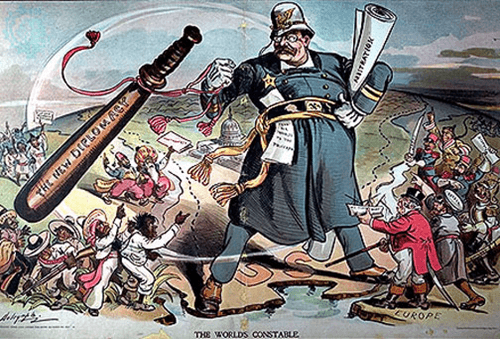
23.
Which aspect of Imperialism does this picture represent?
a)
Roosevelt Corollary
b)
Monroe Doctrine
c)
Influence of Naval Power Upon History
d)
Spanish American War
24.
What were the two sides called?
a)
Allied Powers and Central Powers
b)
Americans and Communists
c)
British and Russians
d)
Allied Powers and City Powers
25.

What was a MAIN cause of the U.S. entering WWI?

a)

US expansion into South America

b)

Russia dropping an atomic bomb

c)

Germans sinking of the US submarines

d)

Japan dropping an atomic bomb

26.
What was the name of the contract that ended WWI?
a)
Treaty of Versailles
b)
Treaty of France
c)
Treat of Paris
d)
Treaty of Milan
27.
What country was neutral at the beginning of the war?
a)
France
b)
United States
c)
Russia
d)
Germany
28.

Which statement is an opinion about the US in the 1920s?

a)

Economic boom because of laissez-faire expansion of stock market

b)

Industrial working conditions and wages improved

c)

Women increased their presence in the workforce

d)

The 1920s were the wildest times of the 1900s

29.

Henry Ford produced a more affordable car primarily because his company….

a)

Paid workers lower wages than his competitors.

b)

Used foreign-made parts.

c)

Developed a faster and less expensive method of production called the assembly line.

d)

Offered a variety of options to buyers

30.

The __________________________ ended prohibition and was passed in 1933.

a)

18th Amendment

b)

19th Amendment

c)

20th Amendment

d)

21st Amendment

31.

Young women in the 1920s who declared their independence from traditional values were known as __________________________.

a)

Fads

b)

Actresses

c)

Flappers

d)

Beyonce

32.

This event triggered the beginning of the Great Depression.

a)

The stock market crash of '29

b)

Prohibition ending

c)

People buying on credit during the 1920s

d)

the rise of the Jazz Age

33.
What is another name for the Stock Market Crash?
a)
Black Friday
b)
Taco Tuesday
c)
Black Tuesday
d)
Throwback Thursday
34.
Who was elected president because he had a plan to pull America out of the Great Depression?
a)
William McKinley
b)
Woodrow Wilson
c)
Theodore Roosevelt
d)
Franklin D. Roosevelt
35.
What was the name of FDR's plan to reconstruct America following the Great Depression?
a)
No Deal
b)
New Deal
c)
Reconstruction
d)
FDR's Plan
36.
During the Great Depression, there was a severe drought in the Great Plains. Strong prairie winds picked up the topsoil and spread dust everywhere. Many farm families packed everything up and moved west. What was this event called?
a)
Dust Bowl
b)
Salad Bowl
c)
Great Plains Panic
d)
Depressing Dust
37.

Because of high unemployment rates, people who could no longer afford their homes were forced to live in cardboard shacks that they built in public parks. What were these shacks called?

a)

Shantyshacks

b)

Town Homes

c)

Tenement Housing

d)

Hoovervilles

38.
Which of the following would MOST contribute to people living beyond their means?
a)
Credit
b)
Rich People
c)
Goverment
d)
The Stock Market
39.

What was the United States foreign policy before World War II?

a)

direct involvement

b)

aid to Axis Powers

c)

supported Japan

d)

isolationism

40.

What happened as a result of the event in the newspaper article?

a)

United States declared war on Japan

b)

United States remained neutral

c)

Japan captured and took control of Hawaii

d)

Germany declared war on Japan

41.

The systematic attempt to rid Europe of all Jews during World War II was called __________.

a)

the Progressive Movement

b)

Internment camps

c)

the Marshall Plan

d)

the Holocaust

42.

In the World War II poster, what did Rosie the Riveter

symbolize to Americans?

a)

American women who were placed in internment camps

b)

American women who fought for the right to vote

c)

American women who were opposed to the war

d)

American women who took jobs in defense plants

43.

What effect did World War II have on race relations in America?

a)

Many Japanese Americans were forced into internment camps

b)

Discrimination against African Americans came to an end

c)

German Americans were forced into concentration camps

d)

Japanese Americans were prohibited from serving in the military

44.
What is significant about D-Day?
a)
It was the Allied invasion of France, the largest land-sea-air operation in army history, and the turning point of the war.
b)
Thousands of Nazi soldiers froze or starved to death after they were trapped by the Soviets.
c)
The Allies discovered concentration camps where Jews and others had been murdered.
d)
The British stopped the German advance and were able to gain control of the Suez Canal.
45.

The president who decided to drop the atomic bombs on Hiroshima and Nagasaki to end the war was ______________

a)

Franklin Roosevelt

b)

Harry S. Truman

c)

Dwight Eisenhower

d)

Theodore Roosevelt

46.
The Big 3 agreed at the Yalta Conference to create what new international organization to prevent another world war?
a)
League of Nations
b)
United Nations
c)
NATO
d)
GATT
47.
What two nations were in competition with each other during the Cold War?
a)
Spain and Portugal
b)
England and France
c)
Germany and Italy
d)
United States and Soviet Union
48.
President Truman adopted a new foreign policy during the Cold War know as the Truman Doctrine. What was the main goal of the Truman Doctrine?
a)
To expand trade with Europe
b)
To limit the build up of nuclear weapons
c)
To stop the spread of communism
d)
to send financial aid to Europe
49.
The United States got involved in conflicts like Korea and Vietnam because they were afraid of the domino theory. What is the domino theory?
a)
If one country fell to democracy, others would follow
b)
If one country fell to communism, others would follow
50.
What was the result of the Brown v. Board of Education case?
a)
Segregation in public schools became illegal
b)
African-Americans began playing profession sports
c)
Rosa Parks refused to give up her seat on the bus
d)
MLK led a March on Washington
51.
What was the purpose of the Civil Rights Act of 1964?
a)
It made Jim Crow Laws illegal
b)
It allowed African-Americans to run for political office
c)
It ended segregation in school
d)
It made poll taxes illegal
52.
What was the purpose of the Voting Rights Act of 1965?
a)
It gave African-American women the right to vote
b)
It made literacy tests to vote illegal
c)
It made Jim Crow Laws illegal
d)
It allowed all African-Americans to vote
53.
The March on Washington is most famous for...
a)
causing race riots in Washington, D.C.
b)
200,000 people worked together to get the right to vote
c)
the KKK became an illegal organization
d)
MLK gave his famous "I Have a Dream" speech
54.
How was the Montgomery Bus Boycott effective?
a)
It gave free transportation to African Americans
b)
It segregated buses in America
c)
 It made Rosa Parks lots of money
d)
It helped de-segregate buses in America
55.

The Patriot Act gave government the right to detain people in order to stop _____________.

a)

communism

b)

socialism

c)

terrorism

d)

segregation