Wayground logo

Free Printable Worksheets

Font size

S
M
L
XL
Worksheets

Unit 7 Test Review: Formation of Europe

Total questions: 100

Worksheet time: 59mins

Name
Class
Date
1.
Who was the deeply religious German Monk who disagreed with the ways of the Catholic Church.
a)
John Calvin
b)
Thomas Hobbes
c)
Martin Luther
d)
Protestants
2.
What were the statements against the Catholic Church and posted to the door of the church called?
a)
88 Theses
b)
95 Theses
c)
99 Theses
d)
None of the above
3.
The 95 theses said it was wrong for the Roman Catholic Church to sell what?
a)
Indulgences
b)
Money
c)
Relics
d)
Mercedes
4.
The religious reform movement that divided the Western Church is called?
a)
Catholic Change
b)
Lutheran Shift
c)
Roman Reformation
d)
Protestant Reformation
5.
People wanted to reform the Roman Catholic Church because of corruption. ( Examples of Corruption : Popes were selling church positions, they were living sinful lives, selling indulgences)
a)
True
b)
False
6.
What group believed that people gained salvation by following Catholic rituals and doing good works?
a)
Catholics
b)
Protestants
c)
Both
d)
Neither
7.
Who believed that faith alone was key to salvation?
a)
Martin Luther
b)
Pope
8.
What can be defined as : God’s forgiveness for sin, and saving the soul for heaven
a)
Salvation
b)
Sin
c)
Hell
d)
All of the above
9.
Who broke with the Catholic Church for political reasons; he wanted to end papal control over the English church, and personal reasons: he wanted an annulment ( divorce ) from his wife.
a)
Henry VIII (8)
b)
Elizabeth I
c)
Mary Tutor
d)
None of the above
10.
Who was known as the most successful ruler of England. She was religiously tolerant and her people admired her.
a)
Mary
b)
Elizabeth I
c)
Henry VIII
d)
Charles V
11.

A reform movement within the Catholic Church was known as...

a)

Protestant Reformation

b)

Counter Reformation

c)

Reformation proclamation

d)

nothing

12.
The inquisition was a church court set up during the Middle Ages, They treated people fairly and put gave them a fair trial.
a)
True
b)
False
13.
Someone who wants to reform or change the church is called what?
a)
reformer
b)
heretic
c)
protestor
d)
calvinist
14.
Lutheran church differed from the Catholic Church by what?
a)
doing away with Catholic rituals
b)
held services in German
c)
Lutheran leaders were ministers not priests
d)
all of the above
15.
Some people believed buying indulgences was wrong because it was like buying your way into heaven.
a)
True
b)
False
16.
Most people in Western Europe belonged to the Roman Catholic Church during the middle ages. * before the start of the Protestant Reformation.
a)
True
b)
False
17.

What event is considered to be the starting point of the Protestant Reformation?

a)

invention of the printing press

b)

reopening of the Silk Road

c)

crucifixion of Jesus Christ

d)

nailing of the 95 Thesis

18.

The groups that met over a 20-year period that enacted reform on the Catholic Church was called?

a)

Council of England

b)

Council of Spain

c)

Council of Trent

d)

Council of Tribunes

19.

What was the "Peace of Augsburg?"

a)

it allowed Germanic kingdoms to determine their religious affiliations

b)

it brought peace between Henry VIII and Charles V

c)

it allowed people to decide which religion they wanted to follow

d)

it allowed peace between multiple religious groups

20.

Why did Medieval Christians fear excommunication?

a)

those cast out from their church had to leave their village

b)

those cast out from their church could not go to heaven

c)

those cast out from their church could not get work

d)

those cast out from their church could not rent property

21.

What are the major reforms enacted by Pope Paul III's Council of Trent? (ALL THAT APPLY)

a)

establishment of the Roman Catholic/Spanish Inquisition

b)

censorship of heretical texts that challenged the Catholic Church

c)

allowed women to become nuns

d)

creation of the Jesuits who lead missionary efforts & seminaries to train religion

22.

What was the Reconquista?

a)

religious ideas that opposed accepted church leadership and teaching

b)

an organization of priests that looked for and punished people in Spanish

c)

a reform movement started by Martin Luther against the Roman Catholic Church

d)

the effort of Christian kingdoms in northern Spain to push out Muslims

23.

What did Martin Luther teach?

a)

anyone could have a direct relationship with God

b)

people needed priests to help them communicate with God

c)

the church was corrupt

d)

God knew who would be saved before they were born

24.

Protestant reformers objected to the sale of indulgences by the church. What was an indulgence?

a)

a tax break given to church clergy

b)

a type of prayer

c)

a document that excused a person's sins

d)

a papal bull

25.
Which statement identifies an impact of the fall of Rome on Western Europe
a)
The Catholic Church was never able to recover its influence.
b)
The invaders carefully preserved Greco-Roman learning and adopted Roman technology.
c)
Western Europe divided into a number of separate barbarian kingdoms
d)
Western Europeans generally continued to speak a common language
26.
The Crusades were a series of 9 holy wars intended for:
a)
peasants to gain back their freedom from church rule.
b)
Christians to recapture the Holy Land of Jerusalem from Muslim rule.
c)
Knights to kill as many Muslims as possible.
d)
Muslims to kill as many Christian men as possible, allowing women & children to live.
27.
The _______ convinced many soldiers to fight in the Crusades by telling them that killing Muslims would get them to Heaven.
a)
king
b)
knights
c)
merchants
d)
pope
28.
One positive impact that the Crusades had on Medieval Europe was:
a)
an increase in trade of goods that were not previously common to Medieval Europe & improvement to old products that were used.
b)
an end to the over-population of crowded Middle Eastern cities.
c)
a cleansing of diseased livestock that plagued Medieval Europe.
d)
Christians & Muslims agreeing to a truce.
29.

_________, also known as "King of the Franks" united a large part of Europe and became the first Holy Roman Emperor.

a)

Carloman

b)

Chandragupta

c)

Charlemagne

d)

Caesar

30.
Why was the time immediately following the fall of Rome called the Dark Ages?
a)
Emperors kept tight control of the people.
b)
There was little formal education for the masses.
c)
Artwork from Greece, not Rome, survived.
d)
There was no building being done.
31.
The medieval Church was a unifying force in Europe after the fall of Rome because it offered:
a)
indulgences for sinners
b)
stability and security
c)
redistribution of wealth
d)
multiple sets of beliefs 
32.
 Which practice contributed to the spread of the Black Death in Europe?
a)
warfare, as knights carried the disease to Valencia
b)
religion, as pilgrims contracted the disease in Liege
c)
industry, as laborers spread the disease by the North  Sea
d)
trade, as merchants brought the disease to the  Mediterranean Sea
33.
_____________ is a political/social system and _____________ is an economic system.
a)
Middle Ages…feudalism
b)
manorialism…feudalism
c)
feudalism…manorialism
d)
Roman Empire…feudalism
34.
How did the emergence of medieval feudalism in Europe influence the Christian Church?
a)
The Church encouraged voyages of exploration.
b)
The Church published the Bible in the vernacular.
c)
The Church adopted Latin as the official language.
d)
The Church served as the unifying power in society.
35.
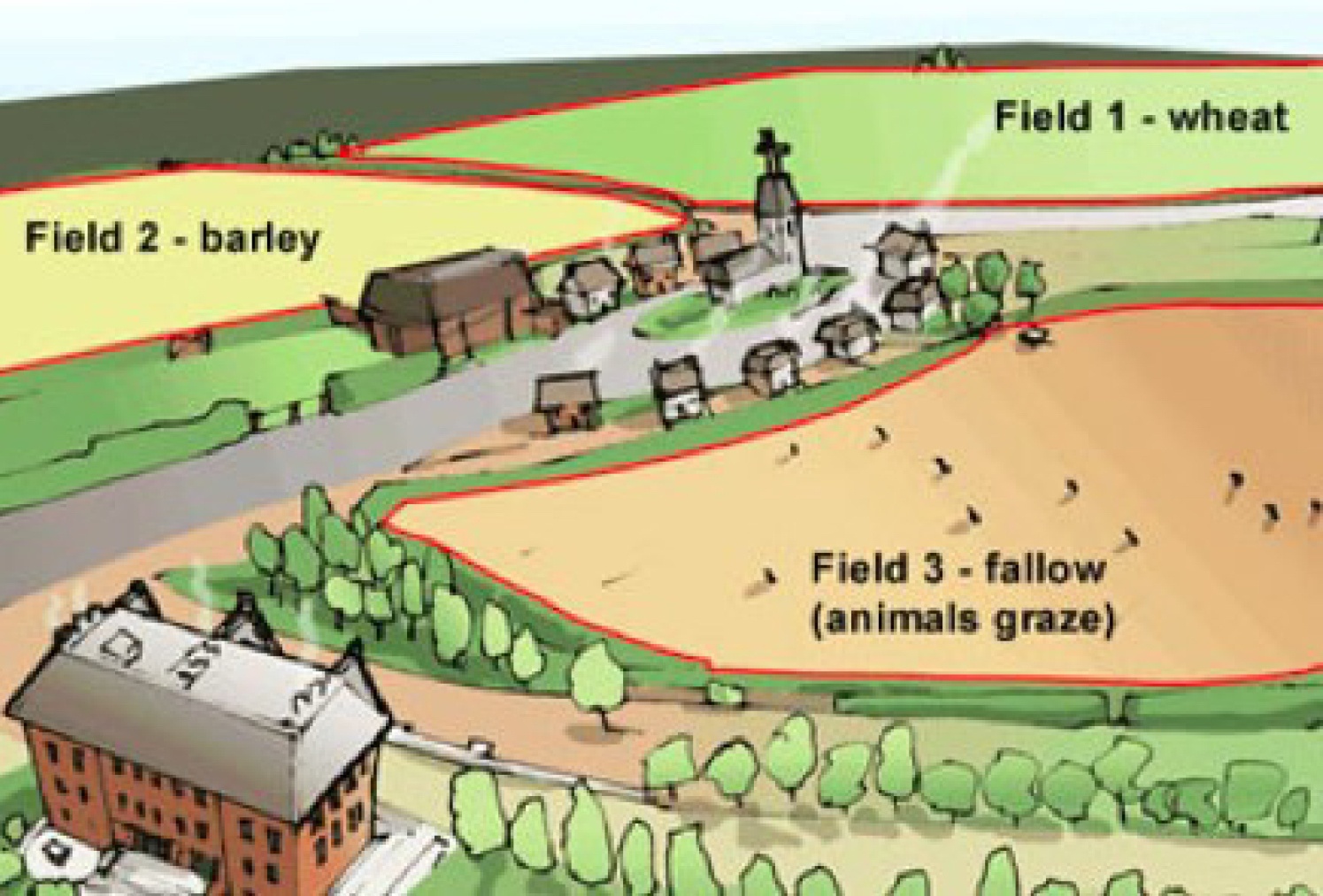
The picture above best describes which medieval farming technique?
a)
Three-field system
b)
Crop rotation
c)
Irrigation
d)
pig farming
36.
Which answer choice shows the order of Feudal Society from highest to lowest?
a)
peasants, knights, nobles, king
b)
king, nobles, knights, peasants
c)
knights, king, peasants, serfs
d)
merchants, knights, commoners, serfs
37.
What is the name for the system of promises between lords and vassals that governed Europe in the Middle Ages?
a)
Christianity
b)
Feudalism
c)
Shinto
d)
Chivalry
38.
How are knights and samurai similar?
a)
They are from Europe.
b)
They have metal armor.
c)
They are Christian.
d)
They follow codes of honor.
39.
Which of the following statements accurately describes feudalism?
a)
Under feudalism, kings gave land to nobles in exchange for their military service.
b)
Feudalism served to spread Christianity throughout Western Europe.
c)
Feudalism began as a way to protect those on pilgrimages to Jerusalem.
d)
The rise of feudalism marked the end of the Medieval Age.
40.
How did feudalism affect the lives of the nobility?
a)
Lords and knights were loyal to monarchs and provided protection.
b)
The monarchs established guilds to help serfs work the land.
c)
Monarchs were not allowed to build their own manor houses.
d)
The system elevated the serfs to a level equal to lords and knights.
41.
A form of government led by a king or queen where one leader passes down power to their offspring is called what?
a)
Mercenary
b)
Monarchy
c)
Missionary
d)
Momentum
42.
Which best describes the influence of the Church during the Middle Ages?
a)
A child from almost every family became a monk or nun in the Church
b)
The Church encouraged people of other religions to settle in Europe
c)
Church officials and kings worked separately to govern countries
d)
Daily life in villages and towns revolved around the Church
43.
Granted certain rights to the people and said that the king must obey the law.
a)
Constitution
b)
Magna Carta
c)
Declaration of Independence
44.
Castles were known for their.....
a)
Comfort
b)
Defense
c)
Vulnerability
45.
Member of the business guild in a feudal society
a)
Merchant
b)
Baron
c)
Nun
46.
A piece of land, given in exchange for loyalty and protection.
a)
Manor
b)
Fief
c)
Estate
47.
Knights were governed by a code of honor called....
a)
Chivalry
b)
Homage
c)
Vassalage
48.
How did new farming methods contribute to the growth of medieval European towns?
a)
People who lived in towns could start to raise their own food.
b)
Towns became less crowded as families moved to the country.
c)
Enough crops were grown to sell to people who lived in towns.
d)
Factories were set up in towns to make agricultural equipment
49.
In addition to new farming methods, another reason for the growth of towns was the
a)
fall of the Roman Empire.
b)
revival of long-distance trade.
c)
technology to build stone walls.
d)
discovery of better medicines.
50.
One of the biggest causes of disease in medieval towns was
a)
unsanitary conditions.
b)
poison in community wells
c)
 refusal to use herbal medicines.
d)
lack of care by family members.
51.

What caused the growth of feudalism in Europe during the Middle Ages?

a)

the rivalry between the ancient empires

b)

the unification of European rulers

c)

the decline of the Roman Catholic Church

d)

the collapse of a strong central government

52.

Which would be the most accurate description of a vassal?

a)

one who buys land from the government

b)

one who is at the lowest level of the social hierarchy

c)

one who is the leader of the manor and gives away land

d)

one who is obligated to another because of land received

53.

Choose the two roles that the Catholic Church acted as during the Middle Ages?

a)

source of stability

b)

universal health care provider

c)

sense of identity

d)

loan provider to developing countries

54.

How did the bubonic plague help to weaken feudalism? (Check ALL that apply)

a)

killed off work force (peasants)

b)

increased cost of labor

c)

people moved off of the manors and into cities

d)

numerous kings were killed

55.

Which actions by humans helped to spread the plague? (Check ALL that apply)

a)

mass trading of goods

b)

building canals to carry drinking water

c)

unrefined medical treatment

d)

unsanitary living conditions

56.

Which of the following is NOT a true statement about the Crusades?

a)

The feudal system was greatly weakened.

b)

The Crusaders conquered and maintained the Holy Land.

c)

Europeans kings gained more control of their kingdoms.

d)

Kings challenged the authority of the Church.

57.

Which of the following would be viewed as successes of the Crusades by Christians? (Check ALL that apply)

a)

Reconquista in Spain

b)

forever recapturing the Holy Land

c)

spreading of Christianity outside Europe

d)

slowing the spread of Islam into mainland Europe

58.

From the list below, choose the two initial goals of the Christians during the Crusades.

a)

recapture the Holy Land from Muslim

b)

control the Silk Road

c)

prevent the Turks from conquering the Byzantine Empire

d)

force Jews to convert to Christianity

59.

A large estate, with a castle, church, fields, and workers

a)

Fief

b)

Manor

c)

Deforestation

d)

Cathedral

60.
What was the Samurai's code called
a)
Buddhism
b)
Bushido
c)
Chivalry
d)
America
61.

What was the period of new interest in learning, science, art, and literature in Europe starting in the 14th Century?

a)

Humanism

b)

Reformation

c)

Renassiance

d)

Vernacular

62.

What are the belief values that everyone is good and problems can be solved using reason instead of religion?

a)

Vernacular

b)

Scientific Revolution

c)

Reformation

d)

Humanism

63.

A way of thinking or viewing something to gain understanding

a)

Patrons

b)

Scientific Revolution

c)

Perspective

d)

Vernacular

64.

Writing a work in the native language so ordinary people can understand it.

a)

Patrons

b)

Renaissance

c)

Perspective

d)

Vernancular

65.

A person who gives money to support artistic works.

a)

Patrons

b)

Indulgence

c)

Humanism

d)

Vernacular

66.

Buying and selling of goods over large distances and in large quantities

a)

commerce

b)

contrapposto

c)

chiaroscuro

d)

doctrine

67.

"Renaissance Man"- a sculptor, painter, inventor, architect, and inventor who painted the Mona Lisa

a)

Michelangelo

b)

Leonardo da Vinci

c)

Gutenberg

d)

Martin Luther

68.

The birthplace of the Renaissance

a)

Venice

b)

Rome

c)

Florence

d)

Paris

69.

Painter of the Sistine Chapel and sculptor of "David" and the "Pieta"

a)

Leonardo da Vinci

b)

Michelangelo

c)

Gutenberg

d)

John Calvin

70.

The Renaissance movement based on the values of the ancient Greeks and Romans that valued life and the subjects found within it, not just religion

a)

Humanism

b)

Secularism

c)

Vernacular

d)

Astronomer

71.

Belief that the church did not have to be the center of life, and you could study nonreligious topics

a)

humanism

b)

secularism

c)

vernacular

d)

reformation

72.
The refusal to accept one or more truths of Faith which are required by the Catholic belief.
a)
Heresy
b)
Heresay
c)
Hedonism
d)
Hellenism
73.
It was instrumental in spreading Luther's ideas.
a)
World of mouth
b)
The Printing Press
c)
Religious wars
d)
Translation of the Bible in German
74.
It made people question the authority of both Pope and clergy
a)
The translation and printing of the Bible
b)
The Printing Press
c)
The Preaching of Luther's Ideas
d)
Merchants spreading Luther's ideas
75.
In the 1500s. the peasants revolted against the nobles because
a)
They were sick and tired of work for no pay
b)
They believed in Luther's message of freedom
c)
They wanted to become Protestants
d)
They wanted to move to towns
76.
A new religious order that came about because of the Counter Reformation were:
a)
The Protestants
b)
The Peasants
c)
The Dominicans
d)
The Jesuits
77.
A court established to investigate people who wander from the faith.
a)
Trail at Worms
b)
The Inquisition
c)
The Council of Trent
d)
The Jesuits
78.
The belief that people are chosen by God to be saved even before they are born.
a)
Anglicanism
b)
Presdestination
c)
Solo Fida
d)
Eastern Orthodoxy
79.

How did the invention of the printing press help the Reformation?

a)

Bibles printed allowed more people to read them.

b)

People could read translations of the Bible in their language.

c)

It allowed reformers to spread their ideas.

d)

All of the Above

80.
This reformation leader believed in a hard work ethic and Predestination. 
a)
John Calvin
b)
Martin Luther
c)
Henry VIII
d)
Queen Elizabeth
81.
Church of England
a)
Anglican Church
b)
Lutheran Church
c)
Society of Jesus
d)
Catholic Church
82.
the buying or selling of ecclesiastical privileges specifically church offices
a)
Simony
b)
Indulgences
c)
Heretic
d)
Predestination
83.
Why does Machiavelli say that "it is much safer to be feared than loved, if one of the two has to be wanting"?
a)
Because when the people fear their leader, they grow a sense of patriotic duty to follow that leader which they do not develop through love.
b)
Because the feeling of fear is a more powerful obligation to follow and leaves no choice but to follow.
c)
Because fear is more universally understood than love, and so more people will react to fear than love.
d)
Because fear is the only way a leader can protect themselves from mutiny or assassination, whereas love leaves a leader vulnerable.
84.
In the following selection, what is the meaning of the phrase, "the end justifies the means"?
"Everybody sees what you appear to be, few feel what you are, and those few will not dare to oppose themselves to the many, who hav
e the majesty of the state to defend them; and in the actions of men, and especially of princes, from which there is no appeal, the end justifies the means."
a)
A leader is always morally right, so long as they achieve great results.
b)
The actions taken by a leader to get results do not matter to anyone.
c)
Most people will judge the actions of a leader only by their results.
d)
The angrier a leader is, the more effective they will be in achieving results.
85.
A government ruled by a religious leader (Ex: Pope and the Vatican City)
a)
monarchy
b)
oligarchy
c)
theocracy
d)
socialist
86.

The Hundred Years War was ...

a)

a constant battle with fierce fighting and no periods of peace

b)

a series of wars between the French and the English

c)

A battle that lasted 116 years

d)

100 years of war for the control of the Holy Land

87.

What method was used by Holy Roman Emperors to increase their power over the Pope?

a)

Challenged the appointment of bishops with lay investiture

b)

Exiled the Pope

c)

Competed for power and authority with the Church

d)

All were methods

88.
Who were considered heretics by the Spanish Inquisition?
a)
Muslims
b)
Baptists
c)
Anyone not Spanish
d)
Any non-Catholic
89.
What was the weapon that helped the English army win many important battles early on in the Hundred Years' War?
a)
Gun
b)
Cannon
c)
Bow and Arrow
d)
Longbow
90.

The split that divided the Catholic Church from 1378 to 1417 where multiple popes ruled at one time.

a)

Great Schism

b)

Reformation

c)

Ninety-Five Theses

d)

The Hundred Years War

91.
Why did churches become patrons to artists?
a)
To make beautiful art that would inspire people to join the church
b)
To get fancy decorations for their church
92.
What does the word "Renaissance" mean?
a)
Rebirth
b)
Stagnation
c)
Traditional
d)
A Latin term for art
93.
What is the artistic technique that is used to show depth and distance on a flat surface?
a)
realism
b)
perspective
c)
idealism
d)
distancism
94.
Which of the following is NOT a reason why the Renaissance began in Italy?
a)
Wealthy Italian patrons supported the arts
b)
Cultural diffusion encouraged curiosity and spread Arab and African ideas
c)
The Black Plague did not hit Italy as a result of the Alps 
d)
Renewed interest in the cultures of Ancient Greece and Rome
95.
The Medici Family...
a)
Were the first mafia family to live in Italy
b)
Were the most famous painters in Florence
c)
Were the family of Mona Lisa
d)
Were patrons of the arts in Florence
96.
Which of the following was NOT a pillar of the Renaissance?
a)
Individualism
b)
Humanism
c)
Mannerism
d)
Secularism
97.
Why does the Renaissance take longer to spread to the northern parts of Europe?
a)
It did not take longer
b)
Northern Europeans did not embrace the ideas of the Renaissance
c)
The Alps separated Italy from the rest of Europe, making it harder to spread ideas
d)
The Black Death started in Northern Europe
98.
Which of the following is a synonym best used to describe the word "secular"
a)
Worldly
b)
Religious
c)
Chivalry
d)
Rebirth
99.
Advantages of Johannes Gutenberg's printing press include all of the following EXCEPT:
a)
Cheaper book prices
b)
Increase in education/literacy
c)
Increase in church power
d)
Rapid spread of ideas
100.
While Gutenberg introduced the printing press in Europe, this country was the first to develop moveable type, which influenced his invention.
a)
Japan
b)
Korea
c)
England
d)
China