wayground logo

Free Printable Worksheets

NEW

Font size

S
M
L
XL
Worksheets

Astronomy

Total questions: 40

Worksheet time: 31mins

Name
Class
Date
1.

Most scientists believe the Big Bang Theory explains which of the following questions?

a)

How our planets and moons formed

b)

How our universe began

c)

How the sun turns hydrogen into helium

d)

How fast light travels through space

2.

Which elements are most

abundant in the visible

universe?

a)

Hydrogen and Carbon

b)

Carbon and Helium

c)

Hydrogen and Oxygen

d)

Hydrogen and Helium

3.
How old do scientists think the Universe is?
a)
13.8 billion years old
b)
4.5 billion years old
c)
24,000 years old
d)
5 years old
4.

Which word best describes a singularity?


a)

a. Large

b)

b. Cold

c)

c. Dense

d)

d. Flammable

5.

Where is the center of the universe located?

a)

There is no center of the universe.

b)

At the center of the Milky Way galaxy.

c)

14.5 billion light years away from Earth.

d)

In a large singularity near the Andromeda Galaxy.

6.

What do the initial moments after the Big Bang have in common with the universe as it exists now?

a)

a. All the stars, galaxies, and planets that exist today were formed just a few moments after the Big Bang.


b)

b. The universe back then could not sustain life, and it cannot sustain life now.

c)

c. The universe was extremely hot then, and it is still extremely hot now.

d)

d. The universe began expanding then, and it is still expanding today.

7.
How long does it take for the earth to make 1 rotation?
a)
One year
b)
One hour
c)
24 hours
d)
One minjute
8.
What causes seasons?
a)
The spinning of an eclipse
b)
A revolution
c)
A rotation
d)
One day
9.
What Model is where the sun is the center of the universe?
a)
Geocentric
b)
Heliocentric
c)
Earth's rotations
d)
Earth's planets
10.

Which person popularized the heliocentric model?

a)

Ptolemy

b)

Aristotle

c)

Copernicus

11.

Kepler's first law states that the orbits of the planets are in the shape of a/an...

a)

perfect circle

b)

ellipse

c)

spiral

12.
This person was the first to use a telescope to make observations in the sky -
a)
Aristotle
b)
Ptolemy
c)
Copernicus
d)
Galileo
13.
This person developed the heliocentric theory and was considered the founder of modern astronomy.
a)
Aristotle
b)
Copernicus
c)
Ptolemy
d)
Galileo
14.
What forces cause a planet to orbit?
a)
gravity and orbit
b)
gravity and inertia
c)
gravity and mass
d)
gravity and weight
15.
Gravity on the moon is about 1/6 the gravity felt on the earth. This is because
a)
the moon is much less massive than the earth
b)
the earth has a molten core and the moon doesn't
c)
the moon is so much further from the sun than the earth.
d)
the moon is so far away from the earth
16.
What would happen to the planets in the solar system if the sun’s gravitational force were to suddenly disappear?
a)
They will stop moving and become static.
b)
They will stop spinning.
c)
They will fly away in straight lines.
d)
They will start moving toward the Sun
17.
Which planet has the greatest attraction to the sun?
a)
Mercury
b)
Venus
c)
Earth
d)
Mars
18.

 
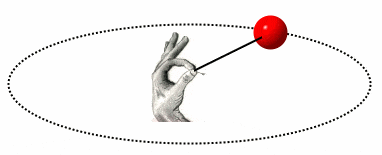
Which force in the Solar System is similar to the tension in the string?
a)
Friction
b)
Inertia
c)
Force
d)
Gravity
19.
On Mars, you would weigh
a)
more because Mars has more mass and weaker gravity
b)
more because mars has less mass and stronger gravity
c)
less because Mars has less mass and stronger gravity
d)
less because Mars has less mass and weaker gravity
20.
When riding your bike and you brake suddenly, you keep going forward because of
a)
inertia
b)
gravity
c)
friction
d)
speed
21.
Because of inertia, a resting object will remain at ________.
a)
rest
b)
a constant speed
c)
school
d)
inertia 
22.
Which of the following is the largest?
a)
The Milky Way Galaxy
b)
A red giant star
c)
The moon
d)
Jupiter
23.
Our galaxy is a ________ galaxy.
a)
Irregular
b)
Elliptical
c)
Spiral
d)
Twirl
24.
At the center of most, if not all, galaxies is a _________. 
a)
Giant Sun
b)
Black Hole
c)
Big Bang
d)
White Dwarf
25.
What type of galaxy is this?
a)
Spiral
b)
Elliptical
c)
Irregular 
d)
Irrational
26.
Is the universe a galaxy?
a)
Yes
b)
No
27.
When a meteor hits Earth, what is it called?
a)
meteorite
b)
meteroid
c)
meteor
28.
I am a rock entering a planet's atmosphere.
a)
meteor
b)
meteorite
c)
asteroid
d)
comet
29.
Objects made of ice, gas and dust and orbit our sun are called:
a)
Asteroids
b)
Comets
c)
Meteroids
d)
Meteors
30.
Asteroids "hang out" in our solar system in a place called:
a)
The Kupier Belt
b)
The Oort Cloud
c)
The Planetary Rings
d)
The Asteroid Belt
31.
Huge chunks of rock and metal (some measuring miles wide) and are believed to be left-over pieces of planets and moons are called:
a)
Comets
b)
Meteors
c)
Asteroids
d)
Meteroids
32.
These objects that orbit the sun are nicknamed, "dirty snowballs."
a)
Comets
b)
Asteroids
c)
Meteors
d)
Meteroids
33.
What is a meteor called when it's in space?
a)
meteroid
b)
meteor
c)
meteorite
34.
Where do comets originate from?
a)
our imagination
b)
the sun
c)
The Oort Cloud and Kuiper belt 
d)
unicorn landia  
35.
Which is the largest object in our solar system?
a)
Sun
b)
Jupiter
c)
Earth
d)
Pluto
36.
Earth and the other planets closest to the Sun are made mostly of _______
a)
gas
b)
metal
c)
water
d)
rock
37.
One of the main differences between the outer and inner planets is __________.
a)
The inner planets all have water
b)
the inner planets are much bigger than the outer planets
c)
the outer planets are gas planets
d)
the outer planets have rings, and the inner planets don't
38.
Which planet has the smallest pull of gravity?
a)
Saturn
b)
Jupiter
c)
Neptune
d)
Mercury
39.
The planet with the shortest year is
a)
Earth
b)
Neptune
c)
Pluto
d)
Mercury
40.
The farther from the sun the _____________ the revolution (year)
a)
shorter
b)
longer