wayground logo

Free Printable Worksheets

Font size

S
M
L
XL
Worksheets

Population Ecology

Total questions: 31

Worksheet time: 23mins

Name
Class
Date
1.

A ________ is a group of organisms of one species that interbreed and live in the same place at the same time.

a)

community

b)

ecosystem

c)

population

d)

biome

2.

Which contributes to a positive population growth?

a)

immigration

b)

net positive birth rate

c)

emigration

d)

net positive death rate

3.

What type of factor has an increasing impact as the population size increases?

a)

density-independent

b)

density-dependent

c)

cohort effect

d)

survivorship factor

4.

Which of the following are density dependent factors?

a)

competition for resources

b)

predation

c)

disease

d)

natural disasters

5.

Which of the following are examples of a density independent factors?

a)

forest fire

b)

seasonal cycles

c)

storms

d)

disease

6.

Factors like predation can have a positive benefit to the population of prey organisms because predators tend to keep prey populations below their ___________.

a)

carrying capacity

b)

sustainibility number

c)

exponential growth point

d)

competition level

7.

As a population of a species increases within a territory, which of the following most likely also increases?

a)

Immigration

b)

Food supply

c)

Carrying capacity

d)

Competition

8.

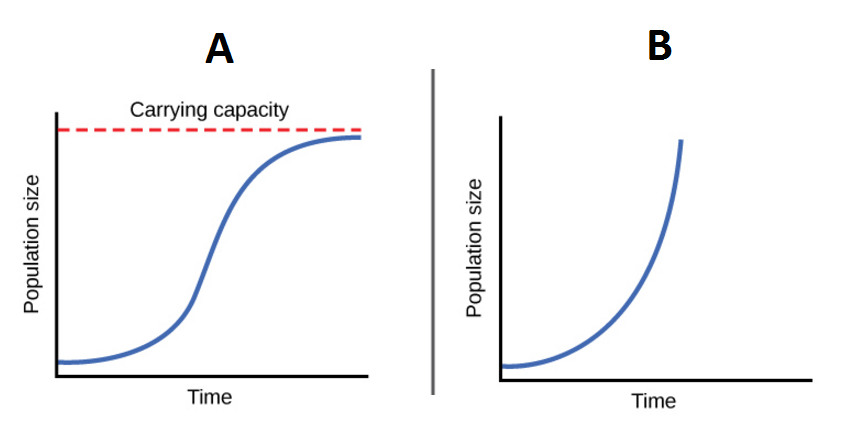
What type of growth model is shown in image A?

a)

Exponential

b)

Logistic

9.

What type of growth model is shown in image B?

a)

Exponential

b)

Logistic

10.

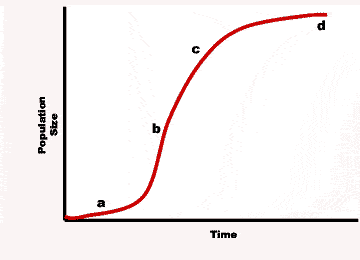
What point on the graph represents carrying capacity?

a)

a

b)

b

c)

c

d)

d

11.

At carrying capacity, a population __________.

a)

increases rapidly

b)

increases slowly

c)

decreases slowly

d)

is in dynamic equilibrium

12.

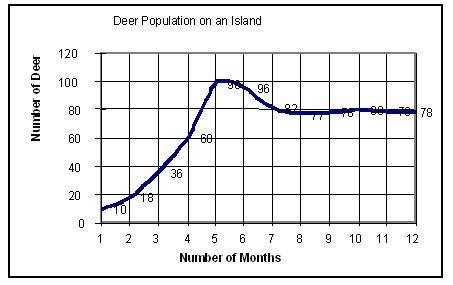
Which choice most closely approximates is the deer population's carrying capacity on the island based on the graph below?

a)

100

b)

80

c)

60

d)

10

13.

Which mathematical model most closely describes the population growth curve shown in deer population graph from the previous question?

a)

logistic growth

b)

exponential growth

14.

Which population growth model most closely describes the human population in the modern age?

a)

logistic growth

b)

exponential growth

c)

upward growth

d)

tumor growth

15.
What factor describes when populations decrease because animals are moving out of a population?
a)
Emigration
b)
Limiting Factors
c)
Immigration
d)
Exponential Growth
16.
Which limiting factor would increase due to the number of individuals in a population?
a)
Unusual weather
b)
Natural disaster
c)
Births
d)
Disease
17.
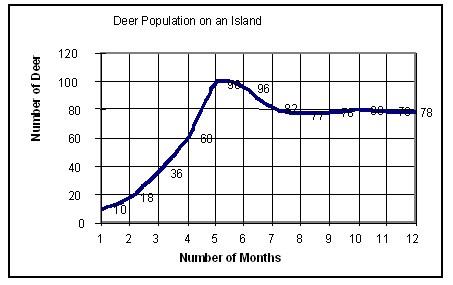
What does the graph represent?
a)
Emigration
b)
Exponential growth
c)
Immigration
d)
Logistic Growth
18.
What does the graph represent?
a)
Emigration
b)
Exponential growth
c)
Immigration
d)
Logistic Growth
19.
Which limiting factor is independent of the number of individuals in a population?
a)
competition
b)
parasitism/disease
c)
stress
d)
natural disasters
20.
Logistic growth has 3 phases. In Phase 1, the population grows rapidly. In Phase 2, population grows slowly. In Phase 3, growth stops. What causes growth to stop in the 3rd phase of logistic growth?
a)
Emigration
b)
Immigration
c)
Exponential Growth
d)
Carrying Capacity
21.
A population is...
a)
A group of one species in one area
b)
Multiple species that live in one area
c)
All of the living and nonliving things in an area
d)
None of these
22.
What is the carrying capacity of the following graph?
a)
1000
b)
8000
c)
800
d)
600
23.
Which factor is a density-dependent limiting factor on the population of a species?
a)
seasonal variation
b)
natural disasters
c)
unusual weather
d)
predation
24.
Any abiotic or biotic factor in an ecosystem that causes a population’s size to slow or decrease is a ____________ factor.
a)
growth
b)
limiting
c)
carrying
d)
density dependent
25.
What point on the graph represents the carrying capacity?
a)
A
b)
B
c)
C
d)
D
26.
The graph of logistic growth can be described as...
a)
S-shaped
b)
J-shaped
c)
W-shaped
d)
U-shaped
27.
When a population has reached carrying capacity
a)
Growth & Immigration are equal to Death & emigration
b)
Growth & Immigration are less than Death & emigration
c)
Growth & Immigration are greater than Death & emigration
d)
Growth is exponential
28.
Organisms move away from an area
a)
Competition
b)
Predation
c)
Emigration
d)
Immigration
29.
largest number of individuals of a population that the environment can support  
a)
carrying capacity
b)
primary succession 
c)
denitrification
d)
mutualism
30.
An environmental factor such as storms and extreme heat or cold that affects population regardless of their density
a)
density- dependent factor
b)
population density
c)
dispersion
d)
density- independent factor
31.
An environmental factor such as predation, disease, and competition that depends on the number of members in a population per unit
a)
dispersion
b)
density- independent factor
c)
density- dependent factor
d)
population growth rate