wayground logo

Free Printable Worksheets

Font size

S
M
L
XL
Worksheets

Impacts to Populations

Total questions: 26

Worksheet time: 26mins

Name
Class
Date
1.

Biotic or Abiotic factor that restricts the growth of the population

a)

carrying capacity

b)

limiting factor

c)

abiotic factor

d)

biotic factor

2.

In the graph to the right, what is the population of deer at the carrying capacity of the environment?

a)

3

b)

7

c)

70

d)

40

3.
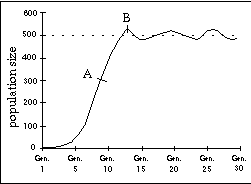
What is the carrying capacity of the graph?
a)

around 500

b)

around 600

c)

around 15

d)

around 30

4.
What is the carrying capacity of the following graph?
a)
1000
b)
8000
c)
800
d)
600
5.

What will happen if all of the frogs in a population die?

a)

The frogs' predators will decrease and the frogs' prey will increase

b)

The frogs' predators will increase and the frogs' prey will decrease

c)

Nothing. Frogs are producers and there are plenty of producers in the ecosystem.
6.
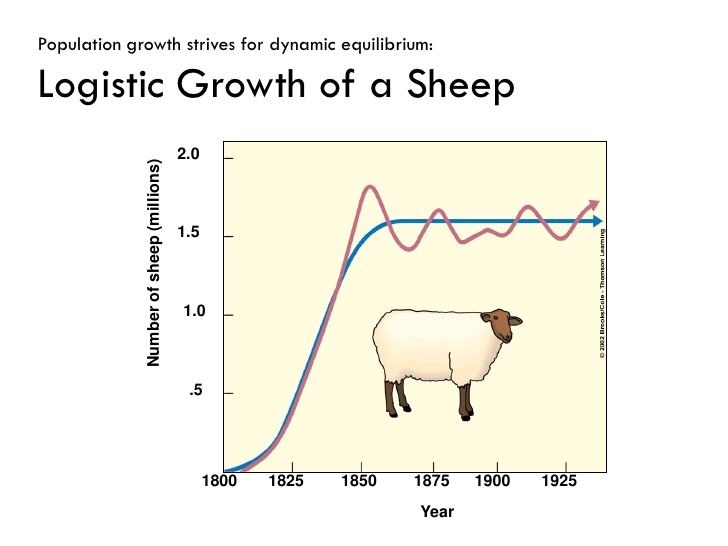
What is the carrying capacity for this sheep population?
a)
1.8 million
b)
1.25 million
c)
1.6 million
d)
1.o million
7.
What point on the graph represents the carrying capacity?
a)
A
b)
B
c)
C
d)
D
8.

When resources are not available a population will _____________ in size.

a)

Increase

b)

Decrease

c)

Stay the same

9.

Parasites and diseases will ______________ the size of a population, so the are examples of limiting factors.

a)

Increase

b)

Decrease

c)

Stay the same

10.

In many desert ecosystems, days are hot and nights are cold. Water is scarce, so animals seek water wherever possible. The spines of a cactus are actually leaves adapted to conserve water. The cactus plants have also adapted to live in thin, sandy soil. Which of the following is a biotic component of a desert ecosystem?

a)

the thin, sandy soil

b)

the wide temperature range

c)

the scarcity of water

d)

the spiny cactus leaves

11.

What happens if a population grows past its carrying capacity?

a)

The population keeps growing

b)

The population starts to die off

c)

The entire species will go extinct

d)

The carrying capacity just increases

12.
If a disease destroying barley plants in a field swept through an ecosystem, what would happen to the barley eating bird population in the the field ?
a)
The bird population would stay the same
b)
The bird population would infinitely increase
c)
The bird population would decrease
13.
Nonliving things found in an ecosystem.
a)
factories
b)
factor trees
c)
biotic factors
d)
abiotic factors
14.
Is a weather an abiotic or biotic factor? 
a)
abiotic
b)
biotic
15.
2 factors which increase population size
a)
Birth Rate, Immigration
b)
Death Rate, Immigration
c)
Birth Rate, Emigration
d)
Death Rate, Emigration
16.
When organisms move into and join a new population
a)
Immigration
b)
Birth Rate
c)
Death Rate
d)
Emigration
17.
When organisms leave a population and move away
a)
Emigration
b)
Immigration
c)
Birth Rate
d)
Death Rate
18.
2 factors which decrease population size
a)
Birth Rate, Immigration
b)
Death Rate, Immigration
c)
Birth Rate, Emigration
d)
Death Rate, Emigration
19.
From 1901-1981 how would you describe the Raven Population
a)
Below Carrying Capacity
b)
Above Carrying Capacity
c)
At Carrying Capacity
d)
Bird-Like
20.
Birth Rate 20, Death Rate 50
How will the population change
a)
Increase
b)
Decrease
c)
Stay the same
21.
Beginning Population 100, Birth Rate 20, Death Rate 40, Immigration 5, Emigration 10.
Final Population Size?
a)
75
b)
65
c)
120
d)
This question is dumb... There is no relationship between Math and Science
22.
Immigration >Emigration
Population will...
a)
Increase
b)
Decrease
c)
Stay the same
23.
The lion is the natural predator of the zebra. If the zebra population drops, the lion population will most likely
a)
drop
b)
thrive
c)
be unaffected
d)
decrease, then increase exponentially
24.

An animal that hunts other animals for food is a ___________

a)

herbivore

b)

predator

c)

prey

d)

producer

25.
If the grasshopper were to be removed completely from the food web, what organism would be most effected?
a)
The squirrel
b)
The shrew
c)
The deer
d)
The rabbit
26.
What may happen if the snowshoe hare was removed from the food web pictured?
a)
The insects in the habitat would increase.
b)
The shrew population would decrease due to being only hawk food source.
c)
The willow tree population would decrease.
d)
Foxes would dies due to no food source.