
 Worksheets
6 Weeks Review -River Valley civilizations
Total questions: 54
Worksheet time: 37mins
Name
Class
Date
1.
Building dams, channels, canals, and ditches to bring water to crops
a)
irrigation
b)
nomads
c)
ziggurat
d)
scribes
2.
Where did the first civilizations arise because of farming conditions?
a)
in the mountains
b)
near the sea
c)
in river valleys
d)
n the desert
3.

More food than as needed by a person.
a)
Trade
b)
Domestication
c)
Surplus
d)
Irrigation
4.
The type of arrangement in which each worker specializes in a particular task or job
a)
Division of Labor (Specialization)
b)
Polytheism
c)
Work Force
d)
Domestication of Labor
5.
Rule by one person, a king or queen
a)
Dictatorship
b)
Theorcracy
c)
Monarchy
d)
Oligarchy
6.
What is a dynasty?
a)
a collection of queens
b)
a collection of kingdoms
c)
series of rulers from different families
d)
series of rulers from the same family
7.
Where did the Indian culture develop over 4000 years ago?
a)
Africa
b)
Indian subcontinent
c)
Middle East
8.
What river did these people in the ancient India settle along?
a)
Tigris
b)
Nile
c)
Indus
9.
What were two things that these ancient people developed in the Indus River Valley?
a)
sewer system, grid - like streets
b)
written language, temples
c)
roads, irrigation
10.
Like other ancient civilizations, ancient India was divided into four__________ ___________,also called __________, based on occupation.
a)
ultimate religions, leaders
b)
social classes, castes
c)
government classes, dictators
11.
What prevented ancient India from being in contact with other civilizations?
a)
Religion
b)
Himalayas
c)
No language
d)
Trade
12.
Along what river did China's earliest civilizations develop?
a)
Huang He (Yellow)
b)
Indus
c)
Yangtze
d)
Nile
13.
The right of a Chinese Dynasty to rule with the blessings of the Gods is called...?
a)
The Mandate of Heaven
b)
The Dynastic Cycle
c)
The Heavenly Commandments
d)
The Oracle Bones
14.
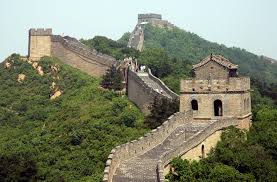
What is the purpose of the structure pictured here?
a)
It is a temple
b)
To protect China's northern border
c)
To protect China's Southern border
d)
To protect China from India
15.
What is the name for the system of rise and fall of Chinese ruling families?
a)
Dynastic Cycle
b)
Mandate of Heaven
c)
Dynastic Change
d)
Mandate of Dynasties
16.
Confucius believed respect for parents, or _____, was very important to the relationships.
a)
civil service system
b)
mandate of heaven
c)
filial piety
d)
dynastic cycle
17.
A civilization is
a)
a group of farmers and workers dividing jobs
b)
an advanced society with common elements like laws, trade and art
c)
a large group of settlements that trade with each other
d)
b and c
18.
When civilization gets too large and surplus food is available
a)
art becomes important
b)
religion becomes important
c)
specialized jobs become important
d)
a and c
19.
The major reason that writing developed was so that early people could...
a)
Record information
b)
Communicate
c)
Tell stories
d)
Write term papers
20.
All major early civilizations began around a source of...
a)
Flint
b)
Tin
c)
Water
d)
Copper
21.
Interaction between early civilizations were a result of...
a)
Exploration
b)
Happenstance
c)
Trade and War
d)
Nomadic Lifestyles
22.
This is the turning point in history when farming and domestication began.
a)
Paleolithic Era
b)
Neolithic Era
23.
What religion did Asoka believe?
a)
Islam
b)
Buddhism
c)
Christianity
d)
Judaism
24.
Who was Asoka?
a)
King of Egypt
b)
King of Mesopotamia
c)
King of India
25.

How was Chinese civilization affected by mountains and deserts?
a)
They became wealthy.
b)
They were isolated from other civilizations.
c)
They made it easier to travel.
d)
They made China easy to be attacked.
26.
Main belief of Hinduism
a)
Reincarnation - people live their lives over and over to reach spiritual perfection
b)
Becoming one with Brahman
c)
follow the caste system
d)
Cows are holy
27.
Founder of Hinduism
a)
Cows are holy
b)
Siddhartha Gautama
c)
Abraham
d)
No single person (Aryans and local traditions)
28.
Religious Book for Hinduism
a)
Eightfold Path
b)
Torah
c)
Vedas
d)
Wheel of Law
29.
Religious Practices/Rules for Hinduism
a)
follow the 10 Commandments
b)
Follow the Caste System
c)
Four Noble Truths
d)
worship in synagogue
30.
Ultimate Goal for Hinduism
a)
Reach Nirvana
b)
Reach spiritual perfection (becoming one with Brahman)
c)
Reach Canaan, the Promise Land
d)
Have a lighter heart than the feather
31.
Gods and Goddesses for Hinduism
a)
Brahman, Vishnu, Shiva
b)
Allah
c)
God
d)
Osiris and Isis
32.
Miscellaneous Detail for Hinduism
a)
Don't eat pork
b)
Rabbi means teacher
c)
Cows are holy
d)
Meditation clears your mind
33.
Main belief of Buddhism
a)
You can end suffering by not being greedy.
b)
A messiah will come to bring world peace.
c)
Reincarnation
d)
Enlightenment
34.
Founder of Buddhism
a)
Moses
b)
Siddhartha Gautama
c)
Aryans
d)
Abraham
35.

Which religion is represented by the symbol above?
a)
Christianity
b)
Islam
c)
Buddhism
d)
Hinduism
36.
Religious Practices/Rules for Buddhism
a)
Follow the 10 Commandments
b)
Follow the caste system
c)
Follow the Four Noble Truths and the Eightfold Path
d)
Follow the king's laws
37.
Ultimate Goal for Buddhism
a)
Reach Brahman
b)
Reach the afterlife
c)
Reach Nirvana (Enlightenment)
d)
Reach Canaan
38.
Gods and Goddesses for Buddhism
a)
God
b)
Brahman
c)
Buddha
d)
None
39.
Miscellaneous Detail for Buddhism
a)
Meditation is a way to clear your mind.
b)
Buddhism is the largest followed religion in the world today.
c)
Rabbi means teacher.
d)
Moses received the 10 Commandments.
40.
Which symbol represents Hinduism?
a)
b)
c)
d)
41.

Which is the most important fact that makes the Silk Road significant to history ?
a)
It brought Silk to Europe.
b)
Marco Polo used the Silk Road.
c)
It was one on the first times Europe and Asia were connected and products and cultures were exchanged.
d)
It was so long ago.
42.

Which cultural idea was exchanged on the Silk Road?
a)
language
b)
religion
c)
skills
d)
All of the listed answers
43.

The Silk Road was what?
a)
One road that was the color of silk.
b)
A network of roads used for trading.
c)
A road that only silk was traded on.
d)
The name of the first road in Asia.
44.

Persian Empire was located in what modern Country.
a)
Iran
b)
Saudi Arabia
c)
America
d)
Europe
45.
A satrap in the Persia empire was what?
a)
Governor
b)
Tax collector
c)
Judge
d)
Preist
46.
The Persian Empire was connected by what road system?
a)
Broad road
b)
Blue Road
c)
Great road
d)
Royal Road
47.
The Persian empire was built on what princpal?
a)
Destruction
b)
Economic
c)
Tolerance
d)
Military
48.
The Persians learned other languages because they were tolerant.
a)
True
b)
False
49.
What religion first used Monotheism?
a)
Hinduism
b)
Judaism
c)
Animism
d)
Buddhism
50.
Which one didn't the Gupta Empire NOT invent
a)
Astronomy
b)
The Alphabet
c)
Arabic Numerals
d)
The idea of zero
51.
What flourished under the Guptas?
a)
Wealth
b)
Armies
c)
Learning
d)
Swag
52.
Vast network of trade routes for Chinese goods stretching as far west as Greece and Rome.
a)
Silk Road
b)
Highway to Heaven
c)
Golden Road
d)
Route 66
53.
The most important Chinese export
a)
cotton
b)
jade
c)
terra cotta
d)
silk
54.
Which invention from the Han dynasty helped people to navigate?
a)
silk
b)
paper
c)
compass
d)
printing press
100 %

