
 Worksheets
6th 6 Weeks Review
Total questions: 35
Worksheet time: 57mins
Name
Class
Date
1.
Silver spoon tarnishing (getting dull and changing colors) is a...
a)
physical change
b)
chemical change
2.
Water separating into hydrogen and oxygen is a physical change
a)
true
b)
false
3.
Leaves changing colors in the fall is a chemical change
a)
true
b)
false
4.
A change where one or more new substances are created.
a)
Physical Change
b)
Chemical Change
5.

a)
Element
b)
Compound
6.

a)
Element
b)
Compound
7.
H2
a)
Element
b)
Compound
8.
What is the speed of a car that travels 400 m in 20 minutes?
a)
20 miles/hr
b)
20 m/min
c)
800 m/min
d)
200 miles/hr
9.
Mr. Rudman speed walked 2 miles in 10 minutes, what is his speed?
a)
0.2 miles/min
b)
2 miles/min
c)
20 miles/min
d)
40 miles/min
10.
What does autotrophic mean?
a)
Has a nucleus
b)
No nucleus
c)
Makes its own food
d)
Gets its food from others
11.
What does unicellular mean?
a)
1 parent
b)
2 parents
c)
1 cell
d)
More than 1 cell
12.
What does asexual reproduction mean?
a)
1 parent
b)
2 parents
c)
1 cell
d)
More than 1 cell
13.
What does eukaryotic mean?
a)
Has a nucelus
b)
No nucleus
c)
Makes own food
d)
Gets its food from others
14.
What makes the domain Eukarya unique?
a)
All organisms in this domain are multicellular
b)
All organisms in this domain reproduce sexually
c)
It's the only domain that has a nucleus
d)
It's the only domain that is lacking a nucelus
15.
What do the domains Bacteria and Archaea have in common?
a)
They both have a nucelus
b)
They are both lacking a nucleus
c)
They are both made of many cells
d)
They are both dead
16.
Based on the following characteristics, what kingdom would you classify the organism below?
Eukaryotic
Autotrophic
Unicellular
Asexual Reproduction
Eukaryotic
Autotrophic
Unicellular
Asexual Reproduction
a)
Eukarya
b)
Plantae
c)
Protista
d)
Fungi
17.
Based on the following characteristics, what domain would you classify the organism below?
Prokaryotic
Autotrophic
Unicellular
Asexual Reproduction
Salty enviroment
Prokaryotic
Autotrophic
Unicellular
Asexual Reproduction
Salty enviroment
a)
Eukarya
b)
Bacteria
c)
Archaea
18.
Based on the following characteristics, what kingdom would you classify the organism below?
Eukaryotic
Autotrophic
Multicellular
Asexual or Sexual Reproduction
Eukaryotic
Autotrophic
Multicellular
Asexual or Sexual Reproduction
a)
Protista
b)
Plantae
c)
Fungi
d)
Animalia
19.
Based on the following characteristics, what kingdom would you classify the organism below?
Prokaryotic
Autotrophic
Unicellular
Asexual Reproduction
Normal Environment
Prokaryotic
Autotrophic
Unicellular
Asexual Reproduction
Normal Environment
a)
Protista
b)
Eubacteria
c)
Archaebacteria
d)
Fungi
20.
Based on the following characteristics, what domain would you classify the organism below?
Eukaryotic
Autotrophic
Unicellular
Asexual Reproduction
Eukaryotic
Autotrophic
Unicellular
Asexual Reproduction
a)
Eukarya
b)
Bacteria
c)
Archaea
d)
Protista
21.

Which kingdom would this organism belong to?
a)
Protista
b)
Plantae
c)
Animalia
d)
Fungi
22.

What kingdom would an organism belong to if it lived in this volcano?
a)
Archaebacteria
b)
Eurbacteria
c)
Protista
d)
Extremophile
23.
What do protists, plants, fungi, and animals have in common?
a)
Multicellular
b)
Eukaryotic
c)
Prokaryotic
d)
Consumers
24.
What are the three domains?
a)
Archaea, Bacteria, and Eubacteria
b)
Archaea, Protists, and Eubacteria
c)
Archaea, Bacteria, and Eukarya
d)
Archaea, Fungi, Animalia
25.
I am made of many cells. My cells have an organized nucleus. I have two parents and eat food.
a)
Protista
b)
Fungi
c)
Bacteria
d)
Animalia
26.
I am made of many cells. My cells have an organized nucleus. I mostly have two parents, but sometimes one. I make my own food.
a)
Fungi
b)
Bacteria
c)
Plantae
d)
Animalia
27.
I am only made of one cell. My cell does not have an organized nucleus. I only have one parent. Sometimes I make my own food, but other times, I eat food. I like to live in volcano vents, salt water of deep oceans, or the freezing cold Arctic.
a)
Protista
b)
Archaea
c)
Animalia
d)
Fungi
28.

Nonliving things found in an ecosystem.
a)
factories
b)
factor trees
c)
biotic factors
d)
abiotic factors
29.

A group of the same type of organisms living in the same place at the same time.
a)
threatened species
b)
populations
c)
community
d)
limiting factor
30.
A __________ includes all living and non-living things in an environment.
a)
population
b)
niche
c)
abitotic
d)
ecosystem
31.
Temperature, light, air, water, and soil are all _____ parts of the environment
a)
alive
b)
biotic
c)
abiotic
d)
living
32.
Which of the following is not an abiotic factor?
a)
sun
b)
temperature
c)
soil
d)
grass
33.
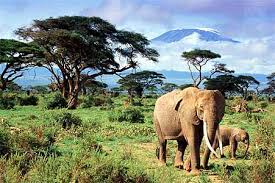
What are the biotic factors in this image?
a)
sunlight, elephants, and grasses
b)
sunlight, water, and air
c)
elephants, plants, trees
34.
Which of these is an example of one living thing depending on another living thing?
a)
Cat walking on the sand
b)
Bird building a nest in a tree
c)
Dog warming in the sunlight
d)
Squirrel drinking water
35.
Which is an example of a living thing interacting with a nonliving thing?
a)
A sea turtle burying its eggs in the sand
b)
A killer whale eating harbor seals
c)
Dolphins communicating with other dolphins
d)
A jellyfish stinging a smaller fish
100 %

