
 Worksheets
Force and Motion
Total questions: 39
Worksheet time: 2hrs 39mins
Name
Class
Date
1.

During which interval is the object not moving?
a)
B to C
b)
C to D
c)
D to E
d)
only at point A
2.

During which interval is the object traveling at a constant velocity?
a)
B to C
b)
D to E
c)
F to G
d)
it traveling at a constant velocity during all of the intervals shown.
3.

During which interval is the object speeding up?
a)
A to B
b)
B to C
c)
D to E
d)
E to F
4.

During which interval is the object slowing down?
a)
A to B
b)
D to E
c)
E to F
d)
G to H
5.
Acceleration occurs when an object changes its speed or ______.
a)
direction
b)
force
c)
inertia
d)
mass
6.

Which runner stopped for a rest?
a)
Albert
b)
Bob
c)
Charlie
7.

Which runner won the race?
a)
Albert
b)
Bob
c)
Charlie
8.

How long did one of the runner's rest?
a)
8 seconds
b)
13 seconds
c)
5 seconds
d)
50 seconds
9.
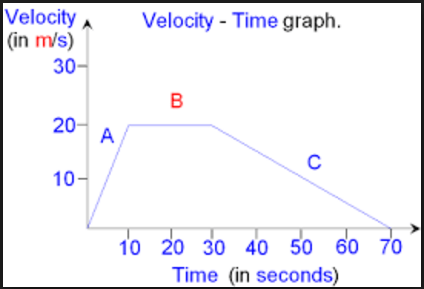
This is a velocity-time graph. What is the object doing in segment A?
a)
Positive acceleration
b)
Negative acceleration
c)
Constant Velocity
d)
Not moving
10.

This is a velocity-time graph. What is the object doing in segment B?
a)
Positive acceleration
b)
Negative acceleration
c)
Constant Velocity
d)
Not moving
11.
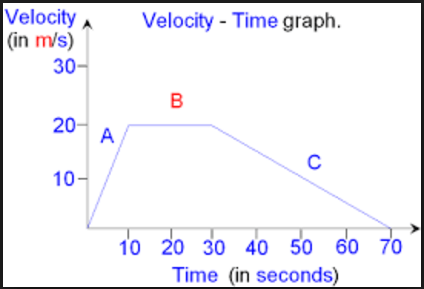
This is a velocity-time graph. What is the object doing in segment C?
a)
Positive acceleration
b)
Negative acceleration
c)
Constant Velocity
d)
Not moving
12.

Calculate the acceleration for segment A.
a)
2 m/s2
b)
20 m/s2
c)
-2 m/s2
d)
0 m/s2
13.
A car driving at 50 miles per hour drives for 2 hours. What distance did it cover?
a)
50 miles
b)
25 miles
c)
100 miles
d)
75 miles
14.
A truck driving at 60 miles per hour travels 150 miles. How long is it driving for?
a)
9000 hours
b)
0.4 hours
c)
210 hours
d)
2.5 hours
15.
Velocity is
a)
speed and acceleration
b)
constant speed
c)
a frame of reference
d)
speed in a given direction
16.
Acceleration is
a)
increasing speed
b)
decreasing speed
c)
changing direction
d)
all of the above
17.

When a heavy football player and a light one run into each other, who exerts more force?
a)
The heavy one
b)
The light one
c)
They are equal
d)
there is no such thing as force
18.
What is Newton's First Law
a)
F=ma
b)
Every action has an equal and opposite reaction
c)
An object at rest stays at rest, an object in motion stays in motion.
d)
Friction
19.
What is Newton's First Law
a)
F=ma
b)
Every action has an equal and opposite reaction
c)
An object at rest stays at rest, an object in motion stays in motion.
d)
Friction
20.
What is Newton's First Law
a)
F=ma
b)
Every action has an equal and opposite reaction
c)
An object at rest stays at rest, an object in motion stays in motion.
d)
Friction
21.
If a ball of cheese is fired into frictionless space, the amount of force needed to keep it going equals
a)
twice the force with which it was fired
b)
the same amount of force with which it was fired
c)
1/2 the force with which it was fired
d)
zero, since no force is requires to keep it moving.
22.
What pulls a ball back to earth?
a)
Gas
b)
Gravity
c)
Friction
d)
Molecules
23.
What is the speed of an object that travels 20 meters in 4 seconds?
a)
80 m/s
b)
0.2 m/s
c)
5 m/s
d)
24 m/s
24.
If a 10 kilogram object accelerates suddenly at 15 m/s2, how much force was applied to the object?
a)
150 Newtons
b)
15 Newtons
c)
150 kilograms
d)
100 kilograms
25.
A(n) __________ is a push or pull.
a)
newton
b)
acceleration
c)
force
d)
momentum
26.
Which of Newton's laws includes the formula: Force = mass x acceleration?
a)
Newton's 1st Law
b)
Newton's 2nd Law
c)
Newton's 3rd Law
27.

Which of Newton's Laws deals with Action/Reaction pairs?
a)
Newton's 1st Law
b)
Newton's 2nd Law
c)
Newton's 3rd Law
28.
Which law is also known as the Law of Inertia?
a)
Newton's 1st Law
b)
Newton's 2nd Law
c)
Newton's 3rd Law
29.

The greater the mass, the greater the amount of force needed for a given acceleration, which law is represented here?
a)
Newton's 1st Law
b)
Newton's 2nd Law
c)
Newton's 3rd Law
30.

An object at rest will stay at rest unless acted upon by a force.
a)
Newton's 1st Law
b)
Newton's 2nd Law
c)
Newton's 3rd Law
31.

The rocket pushes gases downward. The gases push the rock upward.
a)
Newton's 1st Law
b)
Newton's 2nd Law
c)
Newton's 3rd Law
32.

It requires MORE force to push a car than a lawn mower.
a)
Newton's 1st Law
b)
Newton's 2nd Law
c)
Newton's 3rd Law
33.

When a horse suddenly stops, the rider flies over the horses head.
a)
Newton's 1st Law
b)
Newton's 2nd Law
c)
Newton's 3rd Law
34.

When you paddle BACKWARDS on a canoe, the canoe goes FORWARD.
a)
Newton's 1st Law
b)
Newton's 2nd Law
c)
Newton's 3rd Law
35.

A push or a pull is known as:
a)
Acceleration
b)
Mass
c)
Force
36.
What is Inertia?
a)
An unbalanced for will stay as an unbalanced for unless acted upon by a movement of force
b)
A point of unbalanced forces will move while a object at rest will stay at rest until smashed into by an unstoppable force
c)
Inertia is when moose stay at place and dont move... ever
d)
An object at rest will stay at rest and a object in motion will stay in motion unless acted upon by an unbalanced force
37.

What Law is this?
a)
F= m x a
b)
Action and Reaction
c)
Inertia
d)
Sir Isaac Mooseton
38.
What is Newton's first law called?
a)
Action and Recation
b)
Moose = m x m
c)
Law of inertia
d)
Force = Mass x Acceleration
39.
Person 1 is moving right with 50N while person 2 is moving left with 62N of force. What is the Net Force?
a)
112 N
b)
12 N
c)
45 N
d)
663,637,432 N
100 %

