wayground logo

Free Printable Worksheets

Font size

S
M
L
XL
Worksheets

Plate Tectonics, Earthquakes, & Virginia Provinces

Total questions: 86

Worksheet time: 15hrs 7mins

Name
Class
Date
1.
The part of the earth that includes the crust and the upper mantle and is split into tectonic plates is the
a)
lithosphere
b)
 crust
c)
asthenosphere
d)
mantle
2.
This layer is completely liquid
a)
crust
b)
inner core
c)
mantle
d)
outer core
3.
Supporting Evidence: subduction, earthquakes, volcanoes, Mid-Atlantic Ridge, older theories
a)
Continental Drift
b)
Seafloor Spreading
c)
Plate Tectonics
4.
Supporting Evidence: discovery of Mid-Atlantic Ridge, core rock samples showing older rocks the farther that you get from the mid ocean ridge
a)
Continental Drift
b)
Seafloor Spreading
c)
Plate Tectonics
5.

The name for the actual lithospheric plates

a)

Tectonic Plates

b)

Plate Tectonics

c)

Pangaea

d)

Continental Drift

6.

Alfred Wegener's theory stating the continents were once joined in a large mass that broke apart is ___________.

a)

Continental Drift

b)

Seafloor Spreading

c)

Plate Tectonics

d)

Pangaea

7.
The process for new oceanic lithosphere forming at mid ocean ridges
a)
Continental Drift
b)
Seafloor Spreading
c)
Plate Tectonics
d)
Pangaea
8.
The circular pattern of heating, rising, cooling, sinking of magma in the mantle causing tectonic plates to move.
a)
Plate Tectonics
b)
Convection Currents
c)
Pangaea
d)
Subduction
9.

The Mid-Atlantic Ridge is formed at this type of boundary.

a)

Divergent

b)

Convergent

c)

Normal

d)

Transform

10.
Faults can occur at plate boundaries, near boundaries, and at other weakened areas of crust.
a)
True
b)
False
11.
Continental crust is more dense than oceanic crust.
a)
True
b)
False
12.
Hot spots are volcanically active areas that are not near tectonic plate boundaries.
a)
True
b)
False
13.
The youngest material of the ocean floor is found at mid-ocean _________.
a)
ridges
b)
trenches
c)
basins
d)
rifts
14.

The presence of the same ________ on several continents supports the idea of continental drift.

a)

rocks

b)

fossils

c)

fossils and rocks

d)

neither fossils nor rocks

15.
A lack of evidence for continental drift prevented many scientists from believing a single supercontinent called _________ existed.
a)
Glossopteris
b)
Pangaea
c)
Gondwanaland
d)
Mesosaurus
16.

The theory of _______ states that Earth’s crust and upper mantle are broken into pieces (or plates) that are in constant, slow motion.

a)

plate tectonics

b)

continental drift

c)

seafloor spreading

d)

divergent boundaries

17.

Matching ________ on different continents are evidence for continental drift.

a)

weather systems

b)

river systems

c)

mountain systems

d)

wind systems

18.
Many scientists think hot plastic-like rock in the mantle is forced upward toward the surface, cools, and sinks.  This process is called a(n) _________.
a)
earthquake
b)
convergent boundary
c)
volcano
d)
convection current
19.
The _________ is the thinnest layer of Earth.
a)
outer core
b)
inner core
c)
mantle
d)
crust
20.
_______ are formed when two continental plates collide.
a)
Mountain ranges
b)
Transform faults
c)
Rift valleys
d)
Volcanoes
21.
The theory of continental drift was first proposed by __________.
a)
Thomas Edison
b)
Alfred Wegener
c)
Benjamin Franklin
d)
Harry Hess
22.
What is the correct order (starting from the surface) of Earth’s layers?
a)
mantle, outer core, inner core, crust
b)
crust, mantle, outer core, inner core
c)
outer core, inner core, crust, mantle
d)
crust, outer core, inner core, mantle
23.
The layer of caramel-like consistency that flows and moves the plates of the Earth is called the ________.
a)
mantle
b)
lithosphere
c)
crust
d)
asthenosphere
24.
The _______ is the thickest layer of the Earth at 1800 miles thick.  This layer contains most of the mass of the Earth.
a)
crust
b)
mantle
c)
outer core
d)
inner core
25.
The _________ is so hot that the metals in it are all in the liquid state.
a)
crust
b)
mantle
c)
outer core
d)
inner core
26.
_________ currents carry heat from the hot inner core to the cooler outer mantle and back again.
a)
River
b)
Radiation
c)
Convection
d)
Conduction
27.
Plates move apart at _________ boundaries.
a)
volcanic
b)
divergent
c)
convergent
d)
transform
28.
The San Andreas Fault in California is an example of a ________.
a)
divergent boundary
b)
convergent boundary
c)
transform fault
d)
subduction zone
29.
Which type of plate boundary occurs at B?
a)
convergent
b)
divergent
c)
transform
d)
country
30.
The feature labeled C represents some of the deepest spots on the ocean floor. These areas are called ___.
a)
mid-ocean ridge
b)
trenches
c)
deep-sea vent
d)
abyssal plain
31.
The feature labeled D is part of the continuous underwater mountain range that circles Earth. It is called ___.
a)
mid-ocean ridge
b)
trenches
c)
deep-sea vent
d)
abyssal plain
32.
Which type of plate boundary is shown at A?
a)
transform boundary
b)
convergent boundary
c)
divergent boundary
d)
fractured boundary
33.
When plates slide past one another, _________ occur.
a)
divergent boundaries
b)
convection currents
c)
subduction zones
d)
transform faults
34.
What technology did scientists use in the mid-1900s to map the mid-ocean ridge?
a)
sonar
b)
submarines
c)
satellites
d)
deep-sea diving
35.

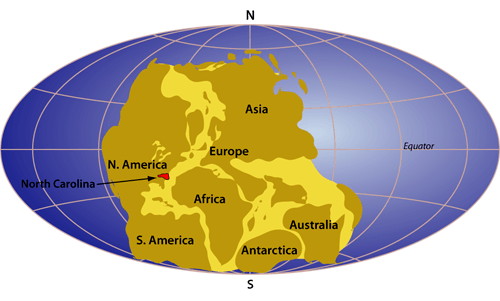
What is this a picture of?

a)

plate tectonics

b)

continental drift

c)

Pangaea

d)

glacier scaring

36.
What does the theory of continental drift state?
a)
The continents were once joined in a super-continent and have moved over time
b)
Continents are stationary and do not move
c)
The Earth is broken into lithospheric plates that move due to convection currents
d)
none of the above
37.
What two specific continents fit together most noticeably?
a)
Africa and North America
b)
South America and Europe
c)
South America and Africa
d)
Antartica and Africa
38.
The OLDEST seafloor is located? 
a)
Closest to the mid-ocean ridge
b)
Farthest from the mid-ocean ridge
39.

What happens when subduction occurs?

a)

Parts of the crust fall into the mantle

b)

Parts of the crust fall into the core

c)

Parts of the crust fall into space

d)

None of the Above

40.
Which type of crust is more dense and thinner?
a)
Continental
b)
Asthenosphere
c)
Oceanic
d)
Byers
41.

Which of the following supports the theory of seafloor spreading?

a)

Fossils

b)

Crustal Age

c)

Magnetic Reversal

d)

Continuous Mountain Chains

42.
What causes the crust to move?
a)
convection
b)
conduction
c)
tension
d)
radiation
43.

What geologic feature/event would you most likely to find at a divergent boundary between two pieces of continental crust?

a)

Mid-Ocean Ridge

b)

Mountain

c)

Rift Valley

d)

Island Arc

44.
Which of these events can ONLY happen at a CONVERGENT BOUNDARY?
a)
Rift Valley
b)
A Tree
c)
Volcano
d)
Orcacane
 (Orca Hurricane)
45.

The stress that occurs when two plates pull apart

a)

Tension

b)

Shearing

c)

Compression

d)

Ring of Fire

46.

The stress that occurs when two plates slip past each other

a)

Compression

b)

Shearing

c)

Tension

47.

A stress force that occurs when two plates come together

a)

Tension

b)

Shearing

c)

Compression

48.
What type of event will occur at this boundary?
a)
Earthquake
b)
Volcano Eruption
c)
Tornado
d)
Mountain Building
49.
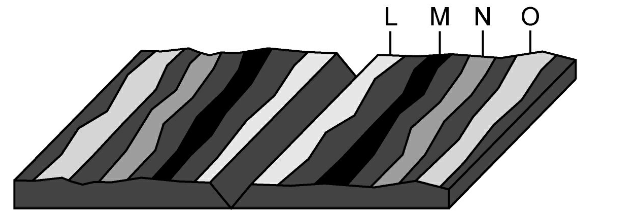
Where would the oldest rock be found?
a)
L
b)
M
c)
N
d)
O
50.
How is it possible for new crust to be formed without increasing the surface area of the Earth?
a)
Crust is destroyed at the same time it is created
b)
New crust is underwater where it sinks
c)
New crust breaks more easily than old crust
51.
Mountains are created when....
a)
Two continental plates collide
b)
Two oceanic plates pull apart
c)
An Oceanic plate subducts under a Continental Plate
d)
Two continental plates pull apart
52.

Why are convection currents able to move through Earth's mantle?

a)

Solid materials conduct heat best.

b)

It's warm deep inside the Earth.

c)

The mantle is not solid. Its state is between a solid and a liquid.

d)

The inner core is liquid iron and nickel.

53.

The Atlantic Ocean is slowly getting wider because new crust is being formed at the Mid-Atlantic Ridge.

a)

True

b)

False

54.

The area around the Pacific plate where boundaries form is called...

a)

death ring

b)

fire zone

c)

ring of fire

d)

zone of fire

55.
Which of the following is where one plate slides under another plate and old crust is recycled?
a)
submarine zone
b)
divergence zone
c)
subduction zone
d)
lower zone
56.
This area contains over 70 percent of volcanoes and 90 percent of earthquakes in the world.
a)
North American plate
b)
ring of fire
c)
fiery rings 
d)
African plate
57.
Which of the following is associated with transform boundary?
a)
volcanoes
b)
mountains
c)
trenches
d)
earthquakes and fault line
58.
Which is subducted in an ocean-continental convergent boundary?
a)
continental plate
b)
oceanic plate
59.

Which of the following did NOT support the Continental Drift Theory?

a)

Magnetic striping in the ocean floor

b)

identical fossils found in different continents

c)

Mountains that extend over continents

d)

Coastlines of continents such as South America and Africa fit like a puzzle

60.

What type of event is most likely to happen at a TRANSFORM fault boundary, such as the San Andreas Fault in California?

a)

earthquake

b)

hot spot

c)

mountain building

d)

volcano

61.
The epicenter of an earthquake is
a)
The point below the surface where rock begins to break and the first motion occurs
b)
The seismic station closest to the earthquake
c)
The place where the greatest damage occurs
d)
The point on the surface directly above the focus
62.
This famous transform fault is located in the western United States creates significant earthquake activity for California
a)
New Madrid
b)
Denali Fault
c)
Ramapo Seismic Zone
d)
San Andreas
63.
The Richter scale measures:
a)
the amount of radon gas released
b)
the movement of plates
c)
the strength of an earthquake
d)
the weight of tectonic plates
64.
Which travels fastest, always being the first detected by seismic stations?
a)
P waves
b)
S waves
65.
The Modified Mercalli scale rates the amount of damage from an earthquake
a)
true
b)
false
66.
What do S (secondary) waves do during an earthquake?
a)
Shake the ground
b)
Cause eruptions
c)
Open cracks in the earth's surface
d)
Create loud noises
67.

Vocabulary Question: Liquefaction is when...

a)

the soil behaves like liquid

b)

the ground becomes liquid

c)

magma rises to the surface

d)

buildings are damaged, crumbling like liquid

68.

________ are created by all 3 types of plate boundaries.

a)

Earthquakes

b)

Mountains

c)

Subduction Zones

d)

Volcanoes

69.

Vocabulary Question: What is the measure of the amount of ground shaking during an earthquake?

a)

Intensity

b)

Epicenter

c)

Magnitude

d)

Seismogram

70.

Which scale rates earthquakes based on the amount of damage done?

a)

Mercalli Intensity Scale

b)

Richter Magnitude Scale

c)

Seismogram Shakey Scale

d)

Bernoulli Scale

71.

All of the following are reasons some buildings are damaged more than others during an earthquake EXCEPT....

a)

The strength of the building materials.

b)

How close the building was to the earthquake's epicenter.

c)

What type of soil the building is on.

d)

The people living inside of the building.

e)

The design of the building.

72.

How does the Richter Magnitude Scale calculate its measurements?

a)

Eyewitnesses

b)

Amount of damage caused

c)

The amount of time the earthquake lasted

d)

The strength of the seismic waves recorded by a seismograph machine.

73.

The most destructive type of wave is a

a)

P-wave (or Primary wave)

b)

S-wave (Secondary wave)

c)

Surface wave (L or Longitudinal wave)

d)

transverse wave

74.

What is the correct order (starting from the surface) of Earth’s layers?

a)

mantle, outer core, inner core, crust

b)

crust, mantle, outer core, inner core

c)

outer core, inner core, crust, mantle

d)

crust, outer core, inner core, mantle

75.

Select the three mineral resources below that are mined in, and make the largest contributions to Virginia's economy

a)

Petroleum

b)

Sand

c)

Talc

d)

Coal

e)

LImestone

76.

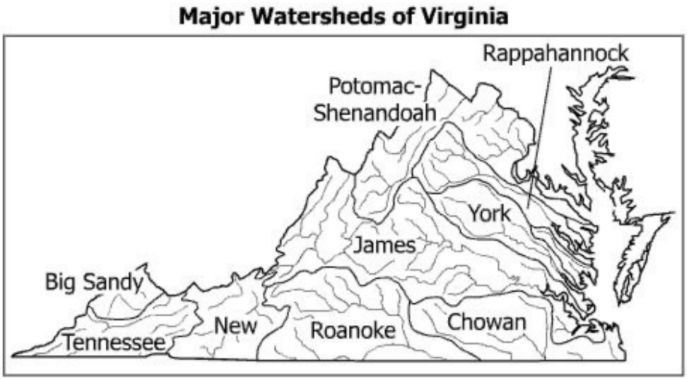
Which Virginia Watershed has the greatest impact in the state due to its size?

a)

Tennessee River Watershed

b)

James River Watershed

c)

Chowan River Watershed

d)

Rappahannock River Watershed

77.

What is the best evidence that many different geologic periods are represented in Virginia?

a)

The presence of fossils of different ages

b)

The location of the Piedmont

c)

The amount of chemical weathering

d)

The length of its rivers

78.

The Chesapeake Bay is not only affected by Virginia, there are many states that affect it. Which of the following actions would negatively affect the Chesapeake Bay?

a)

Using less renewable resources for energy.

b)

Stocking ponds in Virginia with more fish.

c)

Planting trees along the James River in order to prevent erosion.

d)

Runoff of sediment from construction going into the James River.

79.

Trilobites,are fossils of an ocean dwelling animal related to the modern day horse shoe crab. These animals lived throughout Earth's oceans hundreds of millions of years ago. Fossils of these animals can be found in sedimentary rock layers in the mountains of Virginia. This indicates that-

a)

the mountains of Virginia were formed by massive volcanoes

b)

the mountains of Virginia were once covered by swamps

c)

the mountains of Virginia has never been covered by water

d)

the mountains of Virginia were once a marine environment

80.

Sand is a valuable resource that is mined in Virginia, and is exported all over the country. Sand can be used to make glass, and is one of the ingredients of concrete. Which province of Virginia is sand predominantly mined in?

a)

Coastal Plain

b)

Piedmont

c)

Blue Ridge

d)

Valley and Ridge

81.

All of the following Virginia River watersheds empty into the Chesapeake Bay Except

a)

Rappahannock River

b)

New River

c)

Potomac River

d)

York River

82.

Select the three processes that contribute the to the formation of streams and rivers.

a)

Erosion

b)

Weathering

c)

Metamorphism

d)

Deposition

e)

Subduction

83.

Karst topography is found primarily in which of Virginia's physiographic provinces?

a)

Coastal Plain

b)

Blue Ridge

c)

Piedmont

d)

Valley and Ridge

84.

Due to the weathering and erosion of the mountains of Virginia, which province has the youngest rock layers due to the deposition of sediment along its almost flat topography.

a)

Piedmont

b)

Ridge and Valley

c)

Blue Ridge

d)

Coastal Plain

85.

Colliding tectonic plates caused sedimentary rock layers in

which province of Virginia to become folded and faulted?

a)

Coastal Plain

b)

Ridge and Valley

c)

Blue Ridge

d)

Piedmont

86.

Virginia has gone through many geologic changes throughout the last 200 million years. When Pangaea ripped apart into the current continents on Earth today, Virginia was at the center of the breakup. What feature most likely formed along Virginia when Pangaea ripped apart?

a)

Island Arc

b)

Rift Valley

c)

Transform Plate Movement

d)

Convergent Plate movement